William Soper Hammer Gun
William Soper - Gunmaker
Stories from the Scrap pile – four
One of two 12 bore Hammer guns, that created no interest when offered for sale. The two guns being in storage for some considerable time, fortunately found their way into the hands of a shooting family wanting the best for the guns. Taking time in trying to find the guns a new home, with the best intentions, patients and a lot of effort. There were no buyers ! The only interest being from a third party, wanting them for deactivation and decorating a country pub. This was not ideal, and far from satisfactory, but this is the way so many of these wonderful vintage guns are ending up. fortunately the two guns were being transferred to their final destination through a British gun enthusiast. The two guns were checked throughout, measurements taken, and briefly researched. The transfer for deactivation was halted at this point.
The first gun being made by William Soper, well known for his “Soper Rifle”, William was without doubt a talented Victorian Gunmaker, his ability in producing quality guns is often overlooked. William Soper is less well known for his shotguns.

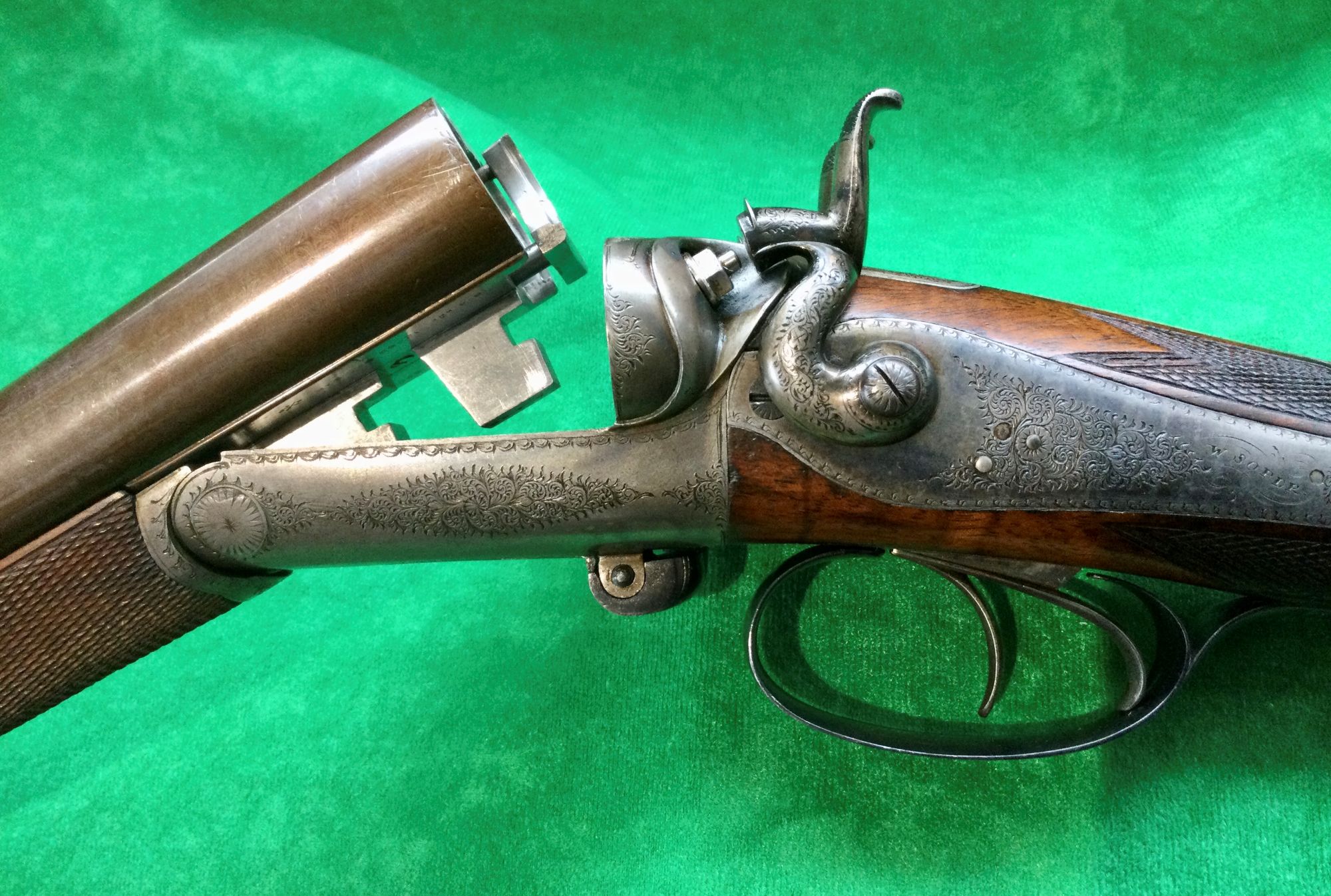
Well made William Soper Hammer-gun, with side lever opening
The Soper family were a long established family of Gunmakers - William Soper born 1836 had a flourishing Gun making business in Reading, and, as we know produced a weapon famous enough to be called the “Soper Rifle”. William Sopers’ father, Richard Soper (1794-1863) had taken over the business from William Sopers’ elder brother, John (1793-1830) who had committed suicide at the age of 37.
Richard Soper (Williams Father) and his wife Sarah, née Paterson, and four of their children are recorded in the 1841 census, as residing in Market Place, Basingstoke. Richard is a gunsmith in Basingstoke at this time, at Winchester Street from 1829-1834 and in London Street from 1843-1848.
The Soper business appears to be established in Reading by John Soper, and recorded at Fisher Row from 1823 to 1830, John Soper appears to have died between 1831 and 1842. In 1843 Elizabeth Soper was recorded at 22 Broad Street as a gunsmith and whitesmith, she ran the business until 1850 when Richard Soper took over and moved the business to 138 Friar Street. In 1862 the firm became R & W Soper (Richard and William - Father & Son).
In 1865 William Soper patented an underlever falling block rifle mechanism (No. 2151) which was examined at the War Office Breech-Loading Trials in 1867, it was rejected as too complicated, but commercially it was moderately successful. In 1868 it appears Richard retired or died, and from 1868 the firm was known as William Soper.
On 30 November 1868 William Soper patented a side-lever version (No. 3637) of his falling block rifle mechanism. The firm moved between 1868 and 1877 to 22 Friar Street and between 1878 and 1895 to 23 Friar Street. The firm appears to have closed prior to 1900. (R B Rodda of Calcutta & Birmingham may have been granted a licence to make guns under Soper's patent No. 3637 and the gun supplied to Prince Koonur Singh may have been one of them).
The Soper family of Gunmakers produced a good number of quality guns, that ensured costumers were loyal, in turn, supporting the business to flourish, expanded, and developed to the point of the famous “Soper Rifle”. The Soper Rifle, has in effect been a distraction, taking away focus on other guns produced by the Soper gunmaking family, including; Rifles, Revolvers, and Shotguns.

The side-lever operates Purdey bolts, ensuring strong lock-up
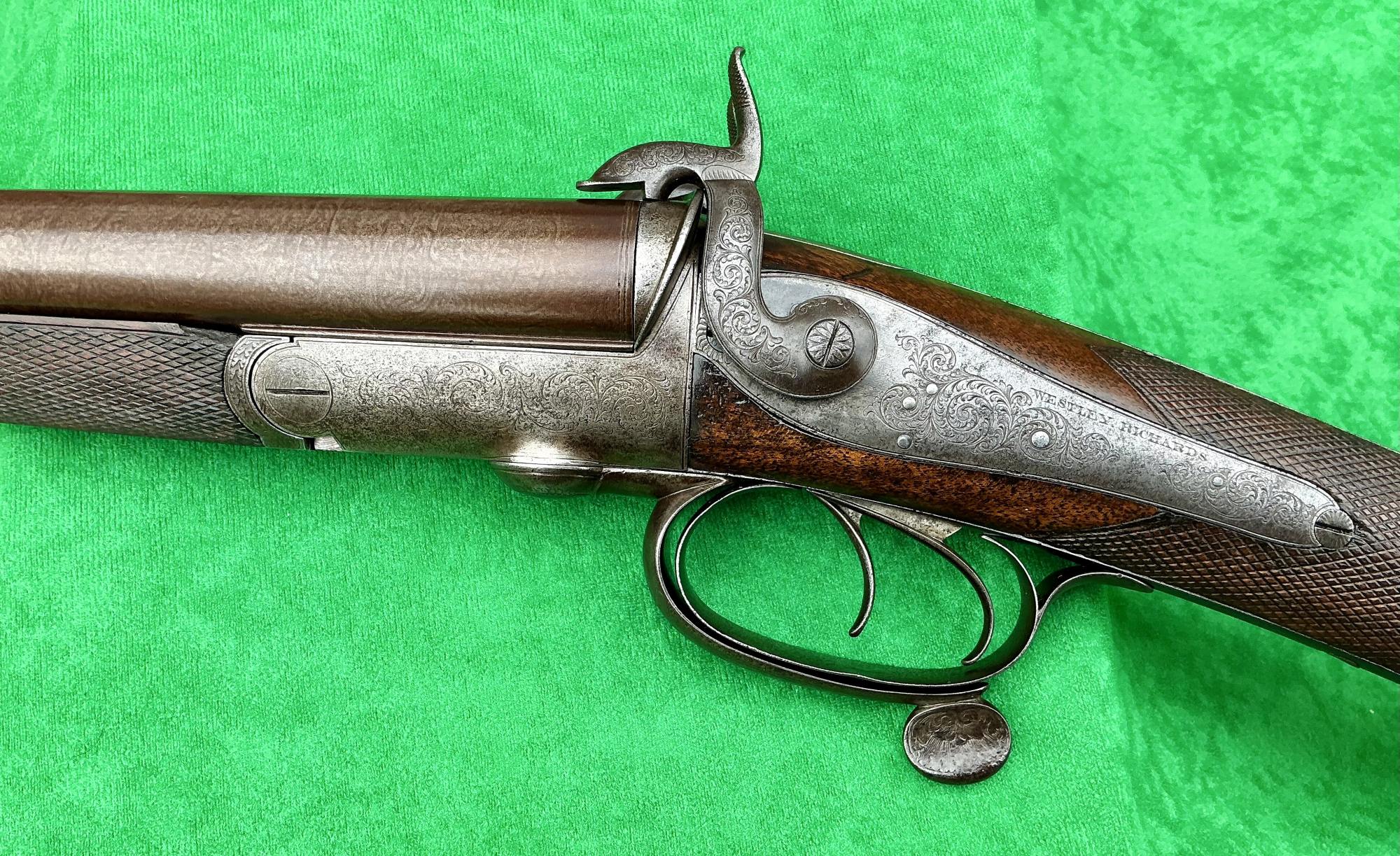
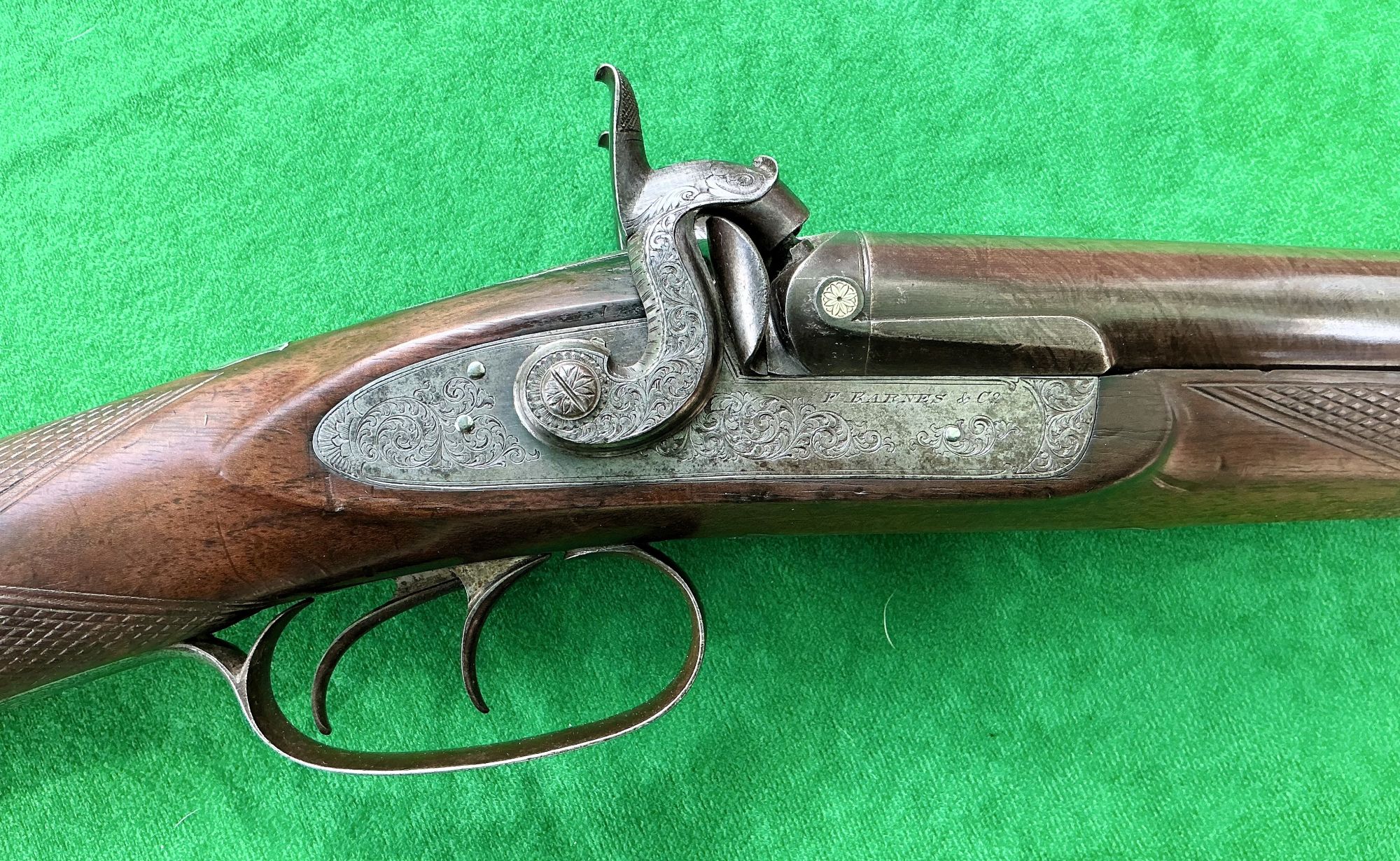
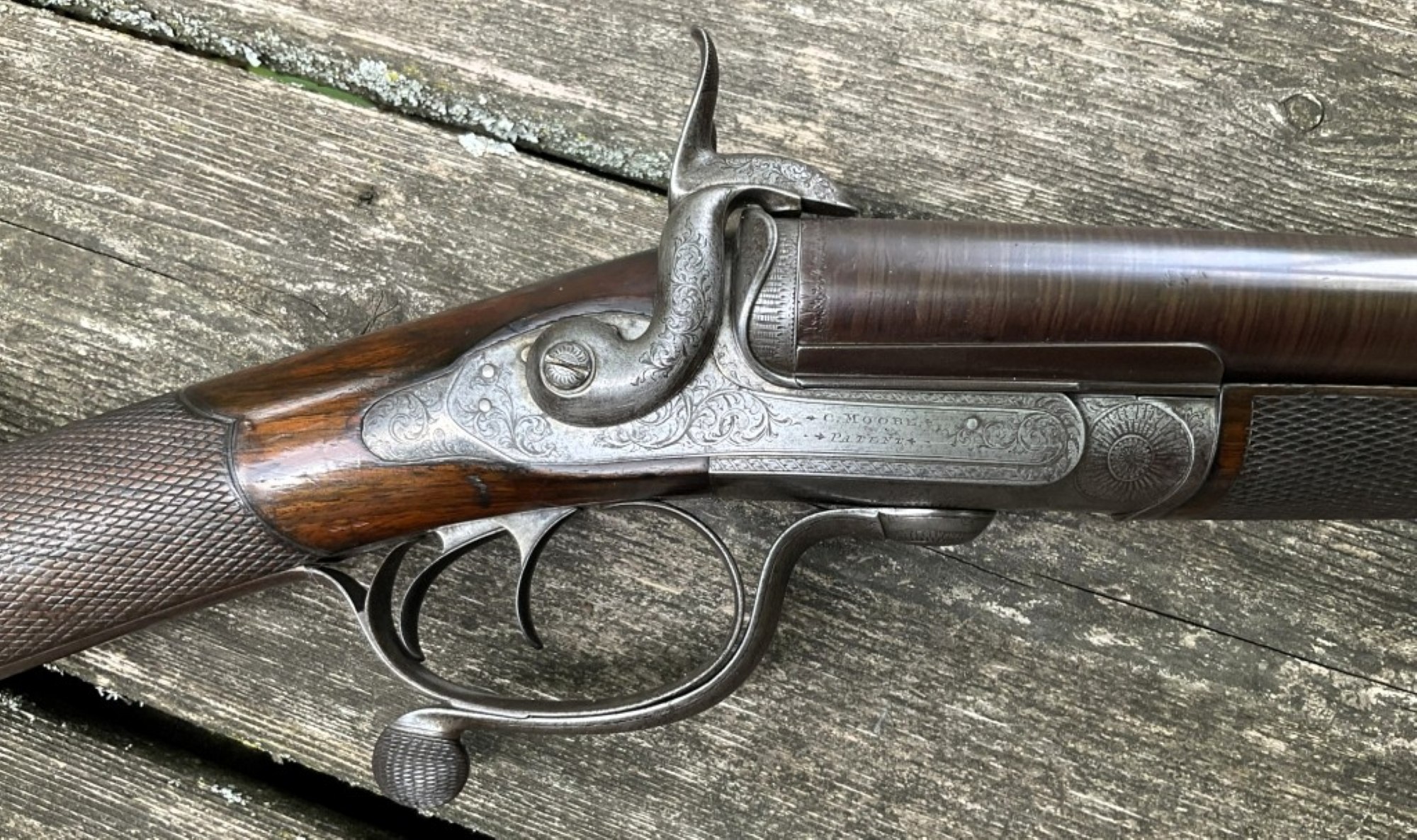
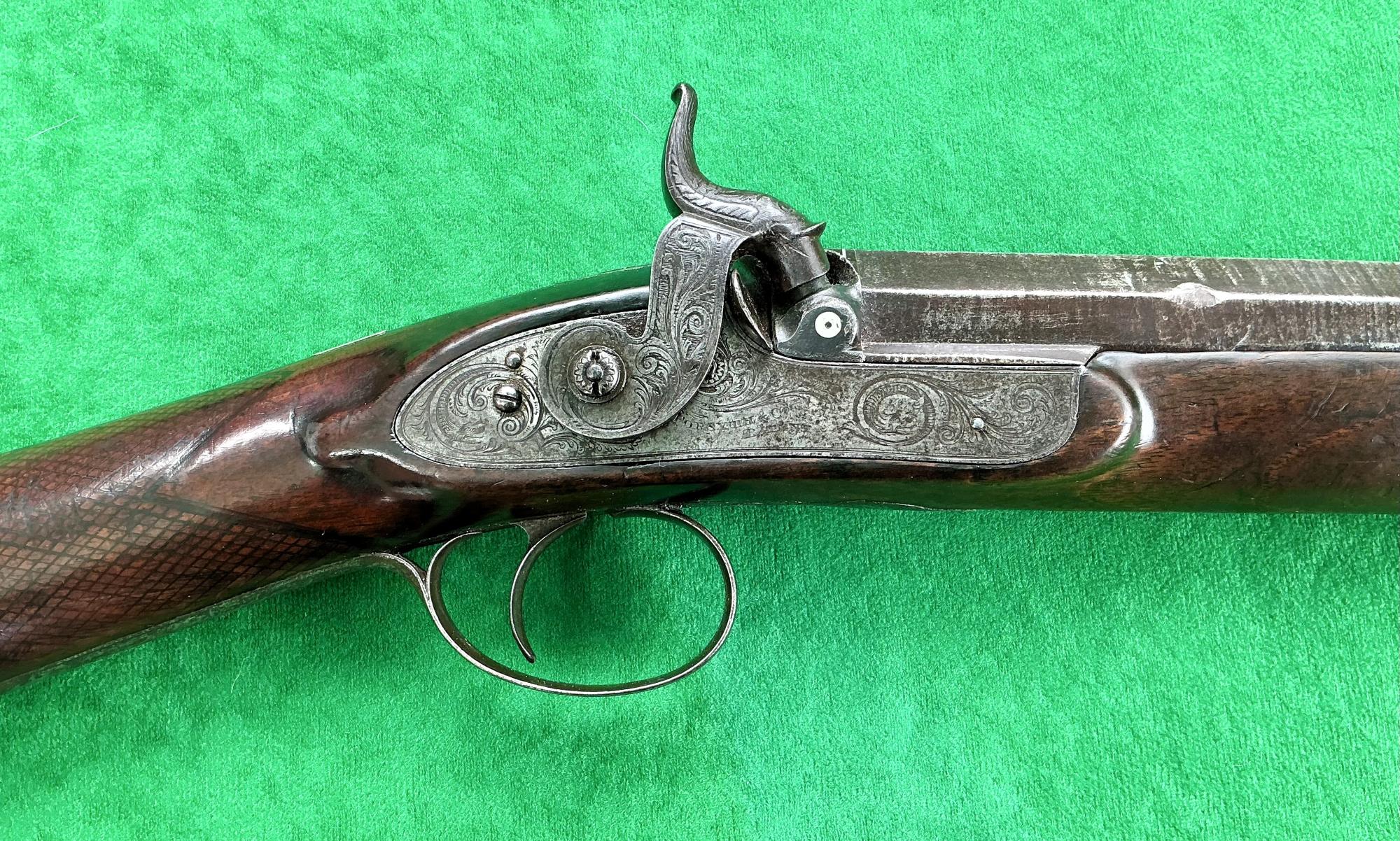
This article focuses on a 12 bore Shotgun, that was sold from his Reading premises at 22 Friar Street, and would be typical of what was on offer from William Soper to his Victorian clients. This William Soper Hammergun made circa 1870, and interestingly, at the same time his second patent Soper Rifle was in production. This Hammer gun being of good quality throughout, with the finish close to that of a best gun. The gun has a number of early breech loading traits, these span the period as progression and developments of breech loaders were made, some of the design’s linking back to the muzzle loader era, with others bringing it up to date and beyond.
The gun has engraved heel and toe plates to the butt, percussion fences, hare ear hammer tips, cross pin Forend fastening, wide top rib, and heavy Damascus barrels. The gun also incorporates period up to date innovations like, the Purdey double bolted lockup, and gun opening via a Side-lever. The was gun originally Black Powder Proofed between 1868 and 1875. This gun took a second trip to Birmingham for Nitro Proof 120 years later in 1990. The gunmaker responsible for the most recent updating work, has ensured this gun would be fit for purpose during the 1990's period and beyond, taking time when boring the original un-choked barrels to leave 3 thousandths of an inch in both tubes, in turn forming a little choke, allowing patterns to be tightened. This being achieved using the guns’ original barrel boring to formulate the restriction. The gun has maintained an enviable barrel wall thickness considering the amount of work that has taken place, of 26 thousandths of an inch in both barrels. The gun being Nitro Proofed post 1954, having generous barrel wall thickness, being lightly choked, and an excellent internal barrel condition, would allow the gun to be considered for use with modern standard steel cartridges.

The images show, there is so much more to William Soper than just the “Soper Rifle” he is famously known for.
This Hammer gun is a classic, good quality British shotgun, of a type that is being lost to the scrap pile on a regular basis. The gun was made, and fitted with best quality Stanton & Co. locks, these having been consecutively numbered, they are also stamped “Joint Patents”. The first, patent No. 49 of 8 January 1867, received only provisional protection and used an external spring to lift the hammer to half-cock. Very shortly after this Stanton secured a second patent, No. 367 of 9 February 1867, in which the hammer is returned to half-cock by the mainspring. This was achieved by lengthening one limb of the mainspring on the top in a bar-action lock, and the bottom in a back-action lock, off which the tumbler bounces. And was this design that was widely adopted, appearing in both new guns and as conversions to existing locks. The locks stamped “Joint patents” refers to the previous and latest patents being jointly used, and are regularly seen on early Hammer-guns as the move to using re-bounding locks takes place, and during the time the first patent remained in force.
The elegant use of a side lever open, operated by Patent No. 1104, of 2 May 1863 – Double Bite Snap-Action (“Purdey Bolts”) ensures a smooth and positive lockup. The patent achieves this, as when closing the gun, the bolts are pushed back by the front lump, and being nearer to the cross-pin, it has greater leverage than that of single-bite actions, which are locked on the rear lump alone. The Purdey bolts patent allows the bites to operate sooner, smoother and more positively as the barrels are closed and locked onto the action.


Both sides of the right handed stock with good figure
At the time, both this shotgun and the Soper Rifle were being made, two principal gun makers were working for William Soper; John Warrick, and an apprentice called Joseph Elliot, who are both listed as residing at Soper’s residence in 1861 according to the census of that year. John Warrick was a very fine engineer and was able to reduce the moving parts of the original Soper Rifle patent action, from 39 parts to 22. This is what made the weapon so devastatingly quick to operate and fire.
We cannot leave the Soper Hammer Gun article without mentioning the “Soper Rifle” It is one of the most interesting and controversial British firearms of the 19th Century. Patented by William Soper of Reading (patent number 3637). The first being an underlever dropping block action, of the design submitted for evaluation to the Special Committee on Breechloading Rifles in 1868. According to Soper, his rifle was rejected because it arrived one day late. The rifle is operated by a lever fixed to the right side of the action adjacent to the trigger so it can be thumb operated with minimal disturbance to the shooter's position. When depressed the lever acts via a connecting rod to raise the breech block which is hinged to the right side of the body. The hammer is cocked by an internal tumbler rotated by the axis pin of the operating lever simultaneously with the opening of the breech. Further pressure on the operating lever actuates a sliding bar extractor. The breech is closed by lifting up the lever so dropping the block into a formed channel in the body. The breech block houses the firing pin and a transverse locking bar which enters a groove in the left body wall when fully closed. The hammer has a half-cock safety position, and when fully cocked can only be opened by first pressing a spring catch to the right of the trigger. It was with a rifle of this model that Sgt. John Warrick of the Berkshire Volunteers (and Soper's assistant) achieved 60 shots in 60 seconds at the Basingstoke Exhibition of 1870.