Westley Richards – 1860 Breech-Loader
Westley Richards – Gunmakers
1860 Breech-Loader
The first Westley Richards Sporting Game breech-loading guns emerged in 1858, and were of Pin-fire form. The majority of early breech-loaders from Westley Richards encountered today are of Top-Lever patented designs.

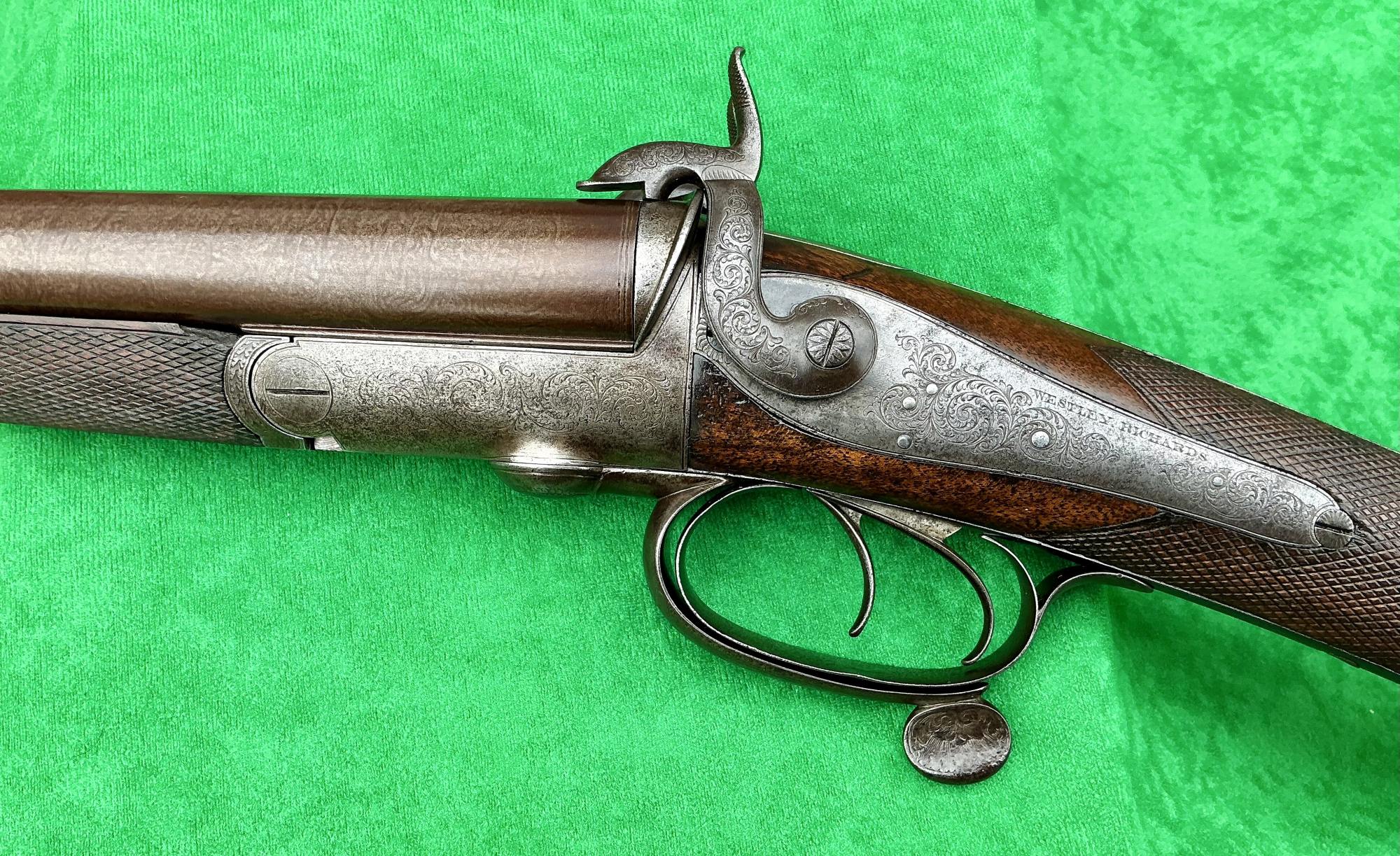
Westley Richards Pinfire - Under-Lever, serial number 9519, completed on the 17th of August 1860
The very earliest guns built with doll’s head rib extensions had a simple, long turning Top Lever, which blocked the path of the doll’s head when closed. The early designs use a simple locking system, by which the barrels are opened and held shut. This dates back to patent 2149 of September 24th 1858. It is described as ‘Improvements in Firearms and Cartridges’. The records show the invention has a registration date of 24th September 1858 and was sealed with the patents office on 25th November 1859.
The first Westley Richards Pinfire gun with this design was made in 1862, with serial number 9448. The gun being built as a 16-bore pin-fire. The gun fortunately remains in the Westley Richards collection. The butt-plate of the gun has the engraved inscription:
“This gun was built for John Amphlett of Clent for £45 in 1862.
He used no other.
This was the first gun the firm sold with a top-lever action.”
The second patent Top Lever was registered in 1862, when Westley Richards patented their Doll's head and "Crab-Joint" gun. The first of these used a "Pull Back" top lever, this patent was further improved. The design changes in the patent design, improving the Top Lever operation by having a laterally-pivoting Top lever, which did the same work, but with less effort than the Pull back Top lever. This pivoting top-lever action was given the patent No. 2623 in October 1864. The patent design worked well, and supported the bridge between Pinfire and Centre-fire guns’.

This early Westley Richards 'Pin-Fire' - Pre-dating the Top-Lever. Completed 17th of August 1860

'Starburst' engraved Pinfire barrel holes, engraved top rib breech-end
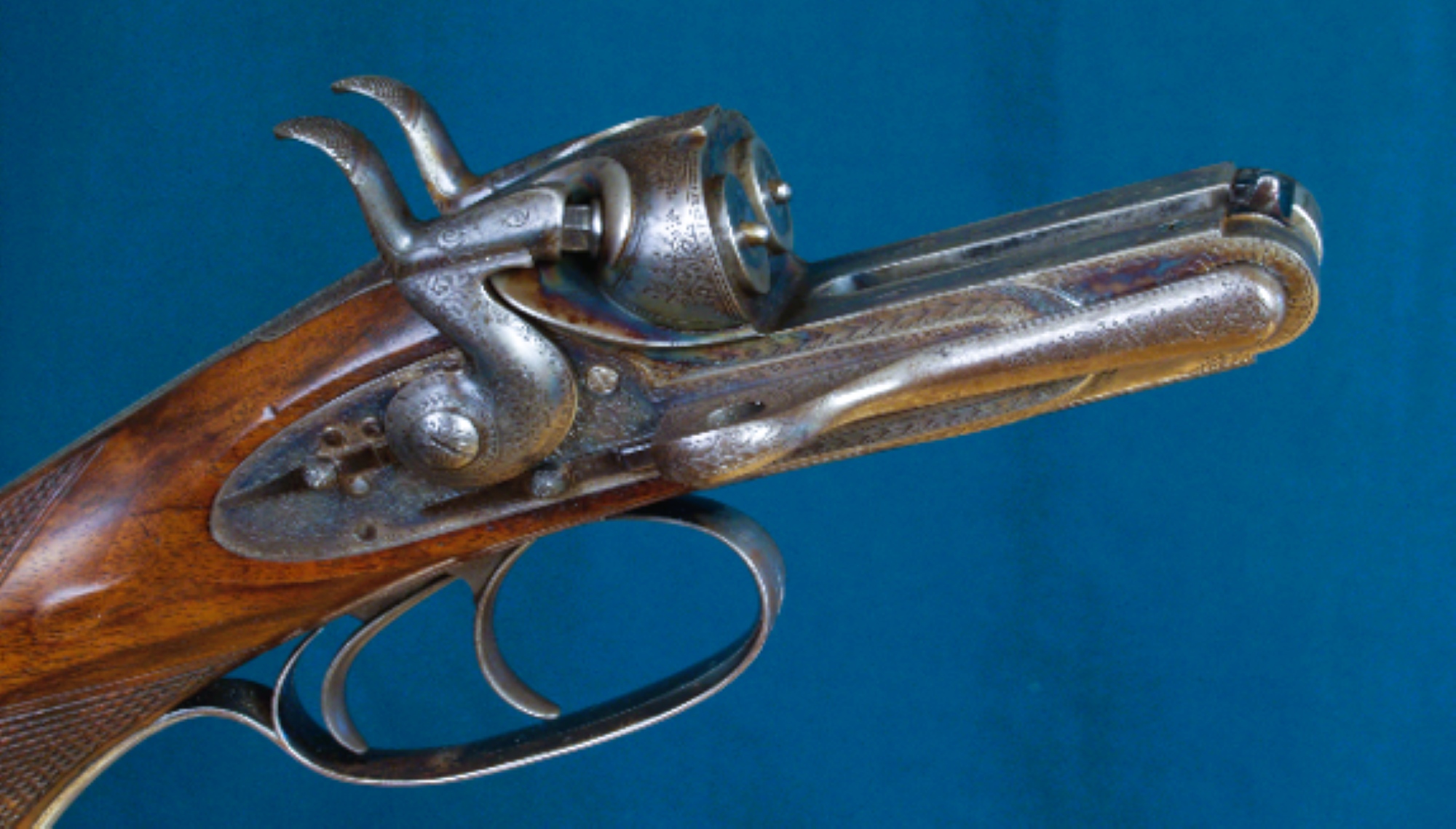
The Westley Richards Sporting Pin-fire game gun in this article pre-dates the previously mentioned Top-Lever patents, and represents an early, and rarely seen Westley Richards 'Pinfire' single bite under-lever design.
The serial number was given to Steve Harrindence of Westley Richards Ltd., who kindly checked the ledgers and hand written records, these showed the gun with serial number 9519, as being made as a Double Breech Loading 13g, completed on the 17th of August 1860, and sold to the Hon. F. Villiers via William Bishop on the 17th of September 1860 from the prestigious, 170 New Bond Street London address.
This gun is an early example of Breech-loader from Westley Richards, made within the first eighteen months of breech-loading Sporting guns from Westley Richards. There appears to be very few pre 1862 Pinfire Sporting guns made with an under-lever from the Westley Richards gun making business being encountered today.
The under-lever design on this gun pre dates the double screw grip under-lever from Henry Jones (Patent No. 2040 of 1859)

The use of an Under-Lever is rare sight on an Westley Richards Pin-fire !
The gun uses a rear facing single bite, under-lever / over guard. The lever-over-guard found its way into British Gun-making from France, and links its arrival with the Great Exhibition of 1851 and Casimer Lefaucheux, however, Beatus Beringer is likely to have been the first to use a rear facing under-lever on a Pin-fire / Breech-loading gun circa. 1838/40. The first British Sporting Game gun with the lever-over-guard is credited to Charles Lancaster, although based on another French patent circa. 1856.
The name Beatus Beringer keeps coming up when researching early British breech-loading Pinfires, the information shows Beatus Beringer designs had more in common with Joseph Lang’s first Pinfire Sporting Game gun than those of Casimer Lefaucheux. Two of Beatus Beringer characteristics are present, of which are more than a consequence in Joseph Lang’s first breech-loader, are (1) a single-bite barrel lug attachment, and (2) a stud rising from the action bar to assist with the opening and closing of the barrels.

The Action and Locks are likely to have been supplied by Thomas Brazier - Single bite Under-Lever lock-up
The under-lever design used on this gun, as previously mentioned pre dates the Jones Double-bite of 1859. This particular under-lever design is of a single bite design, being a design modified from Edwin Hodges’s take on Lefaucheux and Beringer Pin-fire guns, and after Hodges design improvements for Joseph Lang’s first breech-loaders of 1853/54.
As we look closer at this early Westley Richards Under-Lever Pinfire, the gun uses the Beatus Beringer close fitting under-lever that follows the close contours of the trigger bow, and the rear facing single bite lug, however there is no rising stud from the action bar, or any sign of 'Hodges' lightening slots. This action body design could be a direct design from Westley Richards, or more likely from Thomas Brazier, we are aware the Brazier family were supplying early breech-loading pinfire action bodies to the Gun-trade from the late 1850’s. The business relationship between Westley Richards and Thomas Brazier, and the Brazier family of Wolverhampton was on a strong footing, supplying component parts, and the majority of locks used in Westley Richards best guns.

Single Bite barrel lug, No rising stud, No lightening slots - Action confirmed not to be by Edwin Hodges.
The forend is an early design, incorporating a stop for the barrels against the action body on opening. The cross pin fastening escutcheons are again early, using white metal (silver) with no fixing screws.
The locks are a design which supports the new pinfire concept being taken forward by Westley Richards, the locks are “Best Locks” and very well made, stamped TB for Thomas Brazier, the bridles at this point come in to focus, not only being finely made, the bridles include additional sculptured peaks to the top and bottom edges of the bridles.

Best Quality Thomas Brazier locks (TB) - the bridles with additional tails (top and bottom)
The barrels are best laminated steel, the top rib is engraved in bold capitals – 170 NEW BOND ST LONDON. The top rib also has a notable taper of 12 mm at the breech to 8 mm at the muzzle. The bottom barrel rib is parallel as expected.
The barrels are 13 bore, with proof marks for 1855 to 1868, the barrels remain in proof under the rules of proof of the day. The barrel wall thickness are a minimum of 22 and 23 thousandth of an inch in both barrels. The barrel length being 28 inches and retaining a wide top rib from the muzzle loading era at the breech-end, however, as previously mentioned the Top rib has a tapering rib design. The guns' use of a 'Tapering Top Rib' is a rarely seen applied to 'Pinfire' sporting game guns.
The stock and forend are of walnut and have good figure, with strong grain running through the hand, the stock butt retains a steel plate and extending butt plate tang onto the comb.
The rarity of this early breech-loader from Westley Richards cannot be understated. The firm were relatively late to build breech-loaders, for context Joseph Lang were selling breech-loaders from 1853/54, with John Blanch and E. M. Reilly following suit during 1855/56. Westley Richards are said to have built their first breech-loader in 1858. The WR firm patented a Top-lever and “Crab-Joint” gun in 1858, however the first of these did not emerge until 1862 and remains in the WR collection.

The flat area in front of the Under-Lever - Action body, Barrel lump, Forend iron, and Forend wood.
The consensus of opinion from Historians, Collectors, and researchers, is that prior to the Westley Richards patented actions, the number of breech-loading Pinfires made with single bite underlevers by Westley Richards would have been extremely low, possibly only just in to double figures.
The lack of engraving on the hinge pin would confirm a period replacement. This was one of the criticisms of the day for early breech-loaders, in that early breech-loaders would “Wear at the hinge,” the response from breech-loading owners being, that “Changing the hinge pin every few years was a small amount of time and money to rectify and resolve the problem”. The following statement was published from a correspondent subscriber in the “28th February 1857 issue of The Field:” ...in seven to ten years they may require a new pin in the joint, which costs half a crown; whereas a pair of nipples a year at 5’s. a pair with your ordinary gun would cost you 50’s., thus saving 47s. 6d."
This was repeated in the 8th August 1863 issue of the Field, by none other than Joseph Lang: "By having a new joint-screw about every seven or ten years (which costs half-a-crown only), a first-rate breech-loader will last for forty years. I can give any gentleman references to many sportsmen who have used from fifty to eighty thousand cartridges in the last ten years, and their guns are as sound and as good as when first made."

The hinge pin is unengraved, a likely replacement, and in-line with the guns' extensive use.
This is an interesting statement of an identified issue with the early breech-loader, and how easily the issue can be resolved for less money than maintaining a muzzle-loader. Interestingly, as the breech-loader and lock-up designs were developed the issues with sporting guns requiring regular hinge pins replacement reduced.
The owner of this particular sporting gun, might give some indication to the quality of the gun in this article when first made. The guns’ appearance when found, was that of a bargain basement auction find, and that of a well-used sporting gun, showing heavy age related wear, and getting closer to the scrap pile.
The guns’ general condition could be the contributing factor for the gun being overlooked until now. This gun has fortunately survived for 166 years, and been obsolete for almost 150 years. Thankfully the gun has been kept from “Madame Guillotine”, and remains intact. The question asked, is How and Why has this gun survived ?

Brazier Action body, Barrel single bite lug - Large barrel flats and no extractors.
The owner of this early breech-loading, under-lever, pinfire has been confirmed as the Hon. Francis Robert Child‑Villiers (1819–1862) Parliamentarian, and the younger son of the 5th Earl of Jersey.
Francis Robert Child‑Villiers was a mid‑Victorian Conservative politician whose life stood at the intersection of aristocratic lineage and a financial super power.
Being the son of the 5th Earl of Jersey and his mother, the heiress of the Child banking fortune, Francis belonged to one of the most influential families in Britain. His brief parliamentary career, combined with his position within the Child‑Villiers dynasty, reflects the political and social networks that shaped the United Kingdom during the 1850’s.
Born on 11 October 1819, Francis was raised within the dual heritage of the Villiers political dynasty and the Child banking house, whose wealth underpinned the family’s estates at Osterley Park and Middleton Park. Francis Villers upbringing has styled the Honorable Francis from birth, he received the education and social formation typically of a younger son of the peerage.

All steel butt plate with three stage top tang extending onto the comb
Francis Child‑Villiers served as Member of Parliament for Rochester from 1852 to 1855, representing the Conservative Party of Rochester, a naval dockyard constituency, was traditionally aligned with establishment interests, and his election reflected the Villiers family’s longstanding parliamentary influence. He resigned his seat in 1855 by accepting the Stewardship of the Chiltern Hundreds, the formal mechanism for leaving the House of Commons.
Francis was the son of: George Child Villiers, 5th Earl of Jersey, a senior Tory peer and court official, and Sarah Sophia Child‑Villiers, Countess of Jersey, one of the wealthiest women in Britain and principal heiress of Child & Co.
Francis siblings included prominent political and diplomatic figures, notably - George Child Villiers, 6th Earl of Jersey, the Hon. Frederick William Child‑Villiers MP, the Hon. Augustus Child‑Villiers MP, and Lady Clementina Villiers, wife of the 6th Earl of Clarendon, Foreign Secretary.
In 1848 Francis married Lady Elizabeth Maria van Reede, daughter of the 7th Earl of Athlone. The couple had no surviving children, and as a consequence his line did not continue.
Francis Child‑Villiers died on 8 May 1862, aged 42. He was interred at Middleton Stoney, within the family vault, the traditional burial place of the Jersey family. His death without heirs contributed, and resulted in the consolidation of family estates under his elder brother, the 6th Earl.
Though his parliamentary tenure was brief, Francis Child‑Villiers represents the characteristic role of younger aristocratic sons in Victorian public life; ensuring family influence, occupying strategic parliamentary seats, and reinforcing the social and political networks that shaped mid‑19th‑century Britain. His position within the Child‑Villiers lineage places him within a key junction of aristocratic politics, banking wealth, and Victorian governance.

Bold engraved Top Rib - Westley Richards 170 New Bond Street London
Osterley Park Estate - The origins of Osterley Park trace back to the medieval manor of Isleworth in Middlesex, where lands known as Osterley were held by local tenants as early as the 13th century. In 1300, John of Osterley possessed two carucates (approximately 240 acres) of land spanning Isleworth and neighboring Heston, primarily used for arable farming and meadow grazing within the broader boundaries of Isleworth manor.
In 1713, Sir Francis Child, a prominent London banker and founder of Child & Co., acquired Osterley Park and its estate through a defaulted mortgage. The previous owner, property speculator Nicholas Barbon had died in considerable debt in 1698. The purchase of Osterley Park Estate was made shortly before Sir Francis Child's death during the same year, this reflected the growing influence of England's 'financial revolution' and the Child family's rising wealth from goldsmith-banking on Fleet Street, which later contributed to the establishment of the Bank of England. Although Sir Francis never resided there, the estate passed to his sons, who maintained it as a family holding without significant alterations in the immediate aftermath.
The Child family's major transformation of Osterley began in the mid-18th century under the direction of Sir Francis Child's grandson, also named Francis Child (1735–1763), who inherited the estate in 1753 and sought to modernize the aging Tudor mansion into a suitable venue for entertaining banking clients and elite society. In 1761, Francis commissioned the renowned Scottish architect Robert Adam to undertake a comprehensive neoclassical redesign, a project funded by the family's burgeoning fortune from stock market investments and their banking operations. Robert Adam's work, which spanned from 1761 to 1778 and was completed under the oversight of Francis's brother Robert Child after the commissioner's untimely death in 1763, preserved much of the original ground plan while enveloping the structure in an elegant Portland stone facade to create a palatial villa.
Central to Robert Adam's vision were luxurious interiors tailored for opulent entertaining, including an octagonal entrance hall with coffered ceilings and scagliola columns evoking ancient grandeur, a library lined with mahogany bookcases for intellectual gatherings, and state bedrooms adorned with silk damask and classical motifs to impress distinguished guests. The innovative Etruscan dressing room, inspired by ancient Greek vase paintings and featuring Wedgwood cameos set into walls, exemplified Robert Adam's fusion of classical archaeology with contemporary luxury, positioning Osterley as a 'palace of palaces' for the Childs' social and business ambitions. This overhaul not only elevated the estate's status but also showcased the Child banking dynasty's wealth and cultural sophistication during the Georgian era.
Sarah Sophia Fane born in 1785 inherited Osterley Park Estate from her grandfather Robert Child in 1782. Sarah Sophia Frane inherited through a trust established in her grandfather’s Will to safeguard the estate from disposal upon her potential marriage and to keep it out of the hands of her father's family, the Franes.

Barrel breech-end construction - Barrel lug with single bite - Forend loop towards the muzzle
In 1804, Sarah Sophia married George Bussy Villiers, Viscount Villiers and heir to the 5th Earl of Jersey, who adopted the additional surname Child in 1812 to comply with the terms of the inheritance, thereby transferring the estate to the Child-Villiers family. This union secured the property's continuity under the Earls of Jersey, with Sarah Sophia assuming control upon reaching her majority in 1806 and managing it alongside her banking interests at Child & Co.
Throughout the 19th century, Osterley Park served primarily as a private family residence for the Earls of Jersey and their descendants, including Sarah Sophia's son George Child Villiers, the 6th Earl, who maintained it as a seat of aristocratic life. The estate saw limited structural alterations to the main house, preserving much of Robert Adam's 18th-century design, though minor Victorian-era updates were made to service areas, such as the conversion of the large walled kitchen garden for leasing to a local tenant farmer by the late 1800’s, where it was planted with fruit trees. Additional landscape modifications included extensive tree planting in fenced groups and along boundaries, enhancing the parkland's informal character established earlier in the century.

Splinter Forend - Silver cross-pin latch guides - historic tip repair
Throughout the Industrial Revolution, Osterley remained a secluded symbol of inherited wealth and social prestige for the Child-Villiers family, with access strictly limited to private guests and estate workers. However, the estate faced increasing suburban pressures from London's rapid expansion, exemplified by the arrival of the railway in 1883, which prompted the creation of the South Avenue to screen the property from the new line and mitigate encroaching urbanization.
Middleton Park Estate - The Jersey family’s association with Middleton Park began when William Villiers, the 3rd Earl of Jersey, bought the estate in 1737. Purchases of additional farms and lands over the next 30 years, that resulted in the Jerseys owning almost the whole of the Middleton Stoney parish.
The family was closely involved in the life of the village, and was responsible for improvements, particularly in the nineteenth century, with the building of new cottages for their tenants, and the provision of a school, shop and reading room, among other charitable works.

Birmingham Proof marks for 1855 to 1868 - Serial number to both barrels 9519 (1860)
The family also acquired other estates in neighbouring parishes: for example, George, the 5th Earl of Jersey, purchased the Manor of Chesterton from the Duke of Marlborough in 1808, the Manor of Somerton from William Fermor in 1820, and properties in Upper & Lower Heyford between 1808 and 1856.
Middleton Park remained the seat of the Jersey family until it was sold in 1946.