Forsyth's Scent-Bottle Lock
Forsyth’s Scent‑Bottle Lock
The Chemical Breakthrough - Ending the age of Flint
The Reverend Alexander John Forsyth, at the time of his invention, was neither a gunsmith or gunmaker by trade, yet his focussed frustration as a keen Scottish wildfowler led to one of the most consequential inventions in firearms history.
John Forsyth was instrumental in the production of some of the finest quality guns in resolving his frustrations. These guns being made by some of the best London Gunmakers working for Forsyth at this time.

Forsyth Scent Bottle lock gun Cira. 1820 - Converted to percussion circa. 1825
The Flintlock in Forsyth’s mind betrayed the shooter twice. The first with the bright flash in the pan, and the second with the predictable delay between the spark and ignition. Forsyth’s insight to resolving this issue, was chemical rather than mechanical. Forsyth recognised that mercury fulminate, a shock‑sensitive explosive compound, could be detonated by impact alone, creating no spark, using no exposed priming powder, and resulting in no pan flash.

This gun was made with a raised rib in 1820, this is both unusual and scarce.
During 1807, Forsyth patented a mechanism that embodied his principle. The Forsyth invention being ‘The Scent‑bottle Lock’. This elegant and unusual lock system design, was named due to the ‘rotating priming magazine’ being shaped like a small perfume bottle.
This article has been inspired after acquiring an interesting Sporting gun made during 1820, and the gun being made by the gun-making business of Forsyth and Co., even more inspiring, the gun was made originally as a roller primer 'scent-bottle' gun. Interestingly the gun was then converted to Forsyth's latest design of percussion, only a short time after being originally made.

The image showing the scarce raised rib, and its precise fitting to the raised breech plug, and action.
The gun gives an insight to the exacting standards and quality of a Forsyth & Co. ‘Scent Bottle’ gun. The conversion would have removed the Scent Bottle, replacing the original system through the fitting of a nipple / anvil and flash channel, a platinum breech plug, and new hammer. However, it is important to remember, that other than the conversion to percussion, this gun throughout is that of an original ‘Scent Bottle’ gun made by Forsyth & Co.

The Scent-Bottle Lock, Invented by Reverend John Forsyth, made by Forsyth & Co. London
The original ‘Scent Bottle’ mechanism carefully measured the correct amount of fulminate. This all happening as the shooter pulled back the hammer, and ensuring the lock was cocked, the magazine could be rotated at this point, in turn this action dispensed a precise amount of the fulminate charge into either, a vent, or nipple. The gun being fired, the falling hammer immediately crushed the fulminate, this produced a violent jet of flame that passed directly into the breech.

The complicated workings of the Scent-Bottle Lock
The advantages were revolutionary, with instantaneous ignition, creating no pan‑flash, the system giving a weatherproof operation, unaffected by wind or rain. The sealed ignition path, reducing both misfires and hang-fires.
The invention was ingenious, removing a number of issues for the sportsman. However, Forsyth’s invention had limitations, the rotating magazine was intricate and expensive to manufacture, the Fulminate Powder was dangerously unstable, and prone to accidental detonation if contaminated or mishandled.

Eight sided barrel to Sixteen sided, with cross pin fastener and silver escutcheon.
Although Forsyth’s invention had secured the bridge between Flint and Chemical ignition, and achieved a new milestone in firearms development, allowing reliable and immediate firearm ignition. The resistance from Forsyth, and his refusal to license his patent for other gun-makers to use, created a decade‑long bottleneck for the firearms industry, and further development. Forsyth’s practice of resistance in safeguarding his patent would have been seen as a very savvy business move for Forsyth personally at the time.

The rare Scent-Bottle Lock exhibited on a 'Highly Prized' double barrel, by Forsyth & Co.
The London gun trade were well aware of the Forsyth invention, all of which recognising the ‘percussion ignition system’ as being the future, however, Forsyth stifled and delayed inventors and innovators through controlling the chemistry within his wide ranging patent detail.
Reverend John Forsyth had importantly set out good foundations in securing much of the essential work needed for the future. Forsyth had proved that chemical percussion ignition was not only viable, but superior. Forsyth also provided the intellectual and mechanical foundation upon which the next generation would refine and simplify the percussion ignition system.

An original Forsyth & Co. case label, proudly displaying the benefits of the Scent-Bottle Lock.
The descriptive text at the base of the Trade label reads;
“This Lock is entirely different from the common Gun lock. It produces inflammation by means of percussion, and supersedes the use of flints. Its principal advantages are the following. The rapid and complete inflammation of the whole charge of Gun powder in the chamber of the barrel - The prevention of the loss of force through the touch hole. Perfect securely against rain or damp in the priming - No flash from the pan - And loss risk of an accidental discharge of the piece than when the common lock is used. This being new and different from the lock in general use, very particular printed instructions are sent with each gun, to prevent any chance of mismanagement"
The simplification of the percussion system was achieved through the invention of the Copper Cap, this provided, not only the necessary standardisation of the system, it also provided and supported the birth of modern day Ignition.
Forsyth’s patent expired in 1821, this opened opportunities for gunmakers and inventors across Britain and Europe to distil Forsyth’s principle into a system form that was inexpensive, safe, and mechanically elegant. The percussion cap had now been universally accepted.

Sixteen sided barrel to molded band before barrel becoming round, ram rod pipe and silver forend tip.

Bottom rib with ram rod tube guide and securing notch acting as a ram rod lock.
The small but perfectly formed copper cup, contained only a drop of fulminate mixture. Placed over a hollow iron or steel nipple, requiring no rotating magazine, no sliding primer, and no complex lock-work. Therefore when struck by the hammer, the cap detonated and sent flame through the flash channel via the nipple directly to the main charge chamber.
The Forsyth invention of the ‘percussion lock’ supports all the ignition systems being developed, and allowed the retrofitting to existing flintlocks for use with the latest percussion copper cap.

The raised top rib engraved - Forsyth & Co. No. 8 Leicester Street, Leicester Square London.
There became a strong trade in converting flintlocks, this had been recognised by the likes of Joseph Manton and several prominent gunmakers during the 1820’s. The Gun-making trade were carrying out flintlocks to percussion conversions for clients who owned best quality, and favourite sporting guns.
The invention and introduction of the percussion cap did not only improve firearms, the system allowed a standardisation of ignition. The system created a universal interface, being, the nipple, and a universal consumable, the copper cap. This standardisation made mass production possible, paving the way for the next leap toward; the self‑contained metallic cartridge.

The stock figuring becomes straighter and stronger through the hand and grip.

Stock with flat top checkering, the walnut figuring stronger towards the butt.
This particular Forsyth & Co. muzzle loader carries another early and interesting adornment, the use of a ‘Raised Rib’ – The first raised ribs were found on guns made by Joseph Manton, who had taken out several patents between 1792 and 1825, that included designs like; an improved hammer and breeching; a spring to prevent the rattling of the trigger; cartridges; a perforated hammer to allow air to escape when the charge is being rammed down; the 'elevated rib,' by which the barrels of double guns are connected together; the 'gravitating stop' to prevent accidental discharge, and the 'musical sear,' by which a musical sound was produced on the cocking of the gun.

Steel Butt plate boarder engraved and checkered.
The Manton ‘Elevated Rib’ was designed primarily for the ‘Double Barrel Sporting gun’, however, in this case Forsyth & Co. have fitted a full length ‘Raised Rib’ to this best quality single barrel sporting gun, to which the Action ‘Top Tang’ and breech end has also been raised when made, ensuring the action and top rib meet seamlessly. The raised rib on this gun is concaved and runs the full length of the barrel, the rib towards the action is engraved and signed, 'Forsyth & Co. 8 LEICESTER Street, Leicester Square London'. The sight of a raised Rib on a single barrel sporting gun was short lived, and remains scarce, and something of a rarity.

Elongated butt plate extending on to the comb - engraved with feathers, scroll, and the mask of a Lion.
The details for this ‘Best Quality’ 13 bore, Single-barrel Sporting gun, serial number 2334 made by Forsyth and Co. London, are as follows. The serial number 2334 records the gun as being made in 1820. The gun was originally made as a roller primer ‘Scent-Bottle’, the gun was converted to percussion shortly after being made.

The converted 'Scent Bottle Lock'
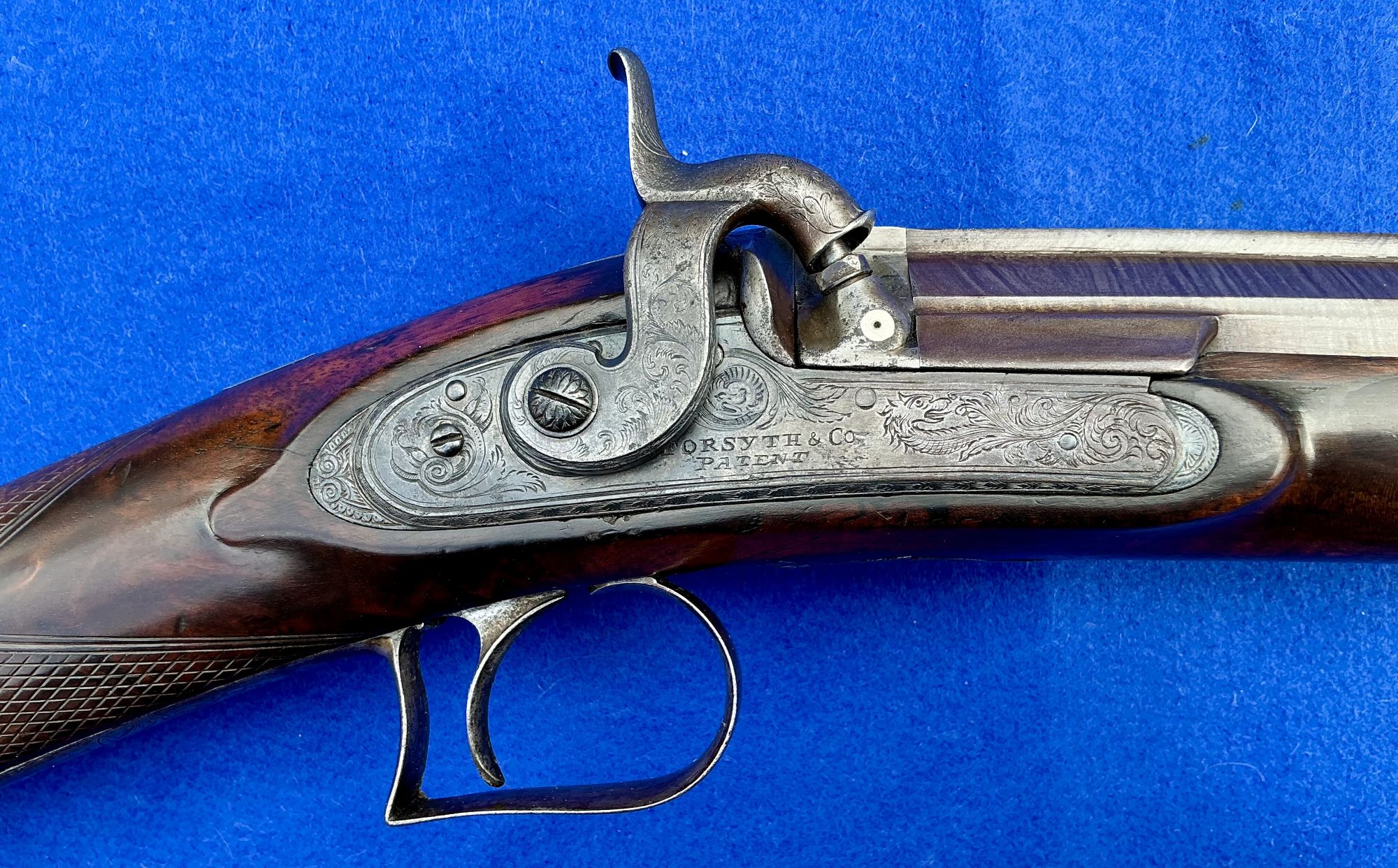
The screw above the main spring, now used to blank off the Scent Bottle lock. The Scent Bottle lock was located on the front of the lock bar, linked to the Scent Bottle, and restricted the full rotation of the system. The screw is also a focal point, where the action bar can been seen as being reduced, this has removed part of the serial number as can be seen in the above image.

The converted Scent Bottle action, has a replacement hammer, and re profiled bar and blanking stud.
The converted lock plate engraved 'FORSYTH & Co. PATENT' with game birds emerging from scroll work on the left behind the hammer, and a feathered serpent to the front of the reduced action bar. The Scent Bottle locking system retaining screw now used as a blanking piece, this is located at the top of the serpents head.
The gun has an expertly re-browned barrel which measures 30 inches, the bore is bright and clean, and remains in proof, with the gun being 13 bore (.710), the barrel now measures .715, the barrel wall thickness has minimum measurements of 55 thousandths of an inch. The barrel is initially octagonal, worked up to sixteen sided, then with a moulded band at the intersection where the barrel becomes round towards the muzzle. The barrel made with an unusual raised concave rib, and as previously stated the raised rib is signed ‘Forsyth and Co’. 8 Leicester Street, Leicester Square London. The barrel has a bead fore-sight, and a platinum vent to the nipple-bolster. The lock is engraved with border-line and scroll engraving, the lock also inhabited with engraved with a feathered serpent, and just behind the hammer there is engraving of two partridges in part emerging from scroll engraving. there is an inlet blanking off the area where the original ‘Scent-Bottle’ locking mechanism resided. The half-stock is of walnut, having iron furniture except for the white metal (Silver) barrel-key escutcheon, and the fore-end tip. The heel-plate is checkered and has an elongated strap extending onto the comb, at this point there is an engraved Lion's mask. The gun has a vacant rectangular escutcheon to the wrist behind the top tang. The gun is completed with a brass mounted and ebony ramrod with capped steel worm.
This elegant Forsyth Sporting gun is ready for a morning in the field in the persuit of game, the gun handles like a wand, comes quickly and easily to the shoulder, with its raised rib and only weighing 5 pounds 14 ounces.

This gun is an impressive 206 years old this year.
Another article – ‘Reverend Alexander John Forsyth, Inventor of the Percussion Lock’ is also available on this website, sharing more in-depth information and overview about Forsyth and Co. for those interested.