Richard Burnand - Gunmaker
Richard Burnand – Gunmaker
Newcastle-on-Tyne
1837-1886
Richard Burnand, a talented Gunmaker from the North of England, Burnand produced quality guns of various types, including; Dueling Pistols, Rifles and Sporting game guns, all within the Victorian Period. Burnand is given credit by a number of gun-making historians and collectors, even though many of us are unfamiliar with Richard Burnand's work.
Richard Burnand’s attention to detail has ensured his Sporting guns were made to an excellent standard, and with the majority of his work seen primarily as ‘Best Quality’. This was achieved through using the best materials, along with a strong foundation of gun-making skills instilled during Richard Burnand’s apprenticeship with John Gardner.

Good Quality Pin-fire from a North of England provincial Gun-maker - Richard Burnand.
The Newcastle gun-making tradition during the 19th century was shaped by its geography and economy. The city of Newcastle sits at the gateway to Northumberland and County Durham, these regions contain vast shooting estates, wealthy landowners, with a strong and well established culture of Sporting game shooting. This created a steady demand for quality sporting guns, pistols, and rifles, although numbers made were relatively low. The numbers made were nowhere near the scale seen from Birmingham or London gunmakers.

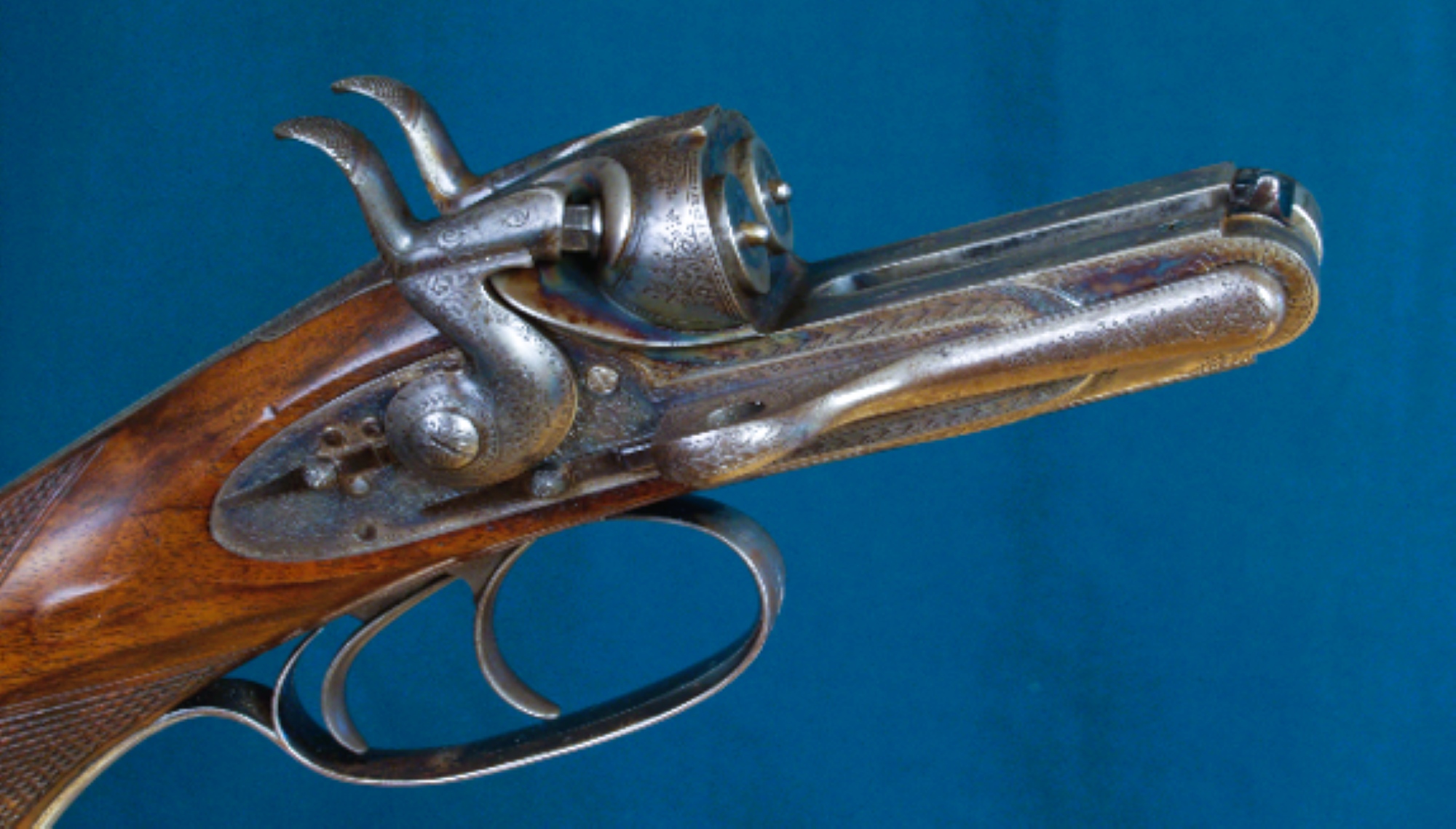
The gun uses the LOG system (Lever-Over-Guard)
As a result, Newcastle and North of England gunmakers operated as provincial specialists, with several Northern gun-makers using a similar business model. This included, the use of smaller workshops rather than large factories, the use of locally apprenticed and highly skilled gunmakers, using staff who were specializing in all areas of the gun-making process, including Stocking, finishing, and engraving.

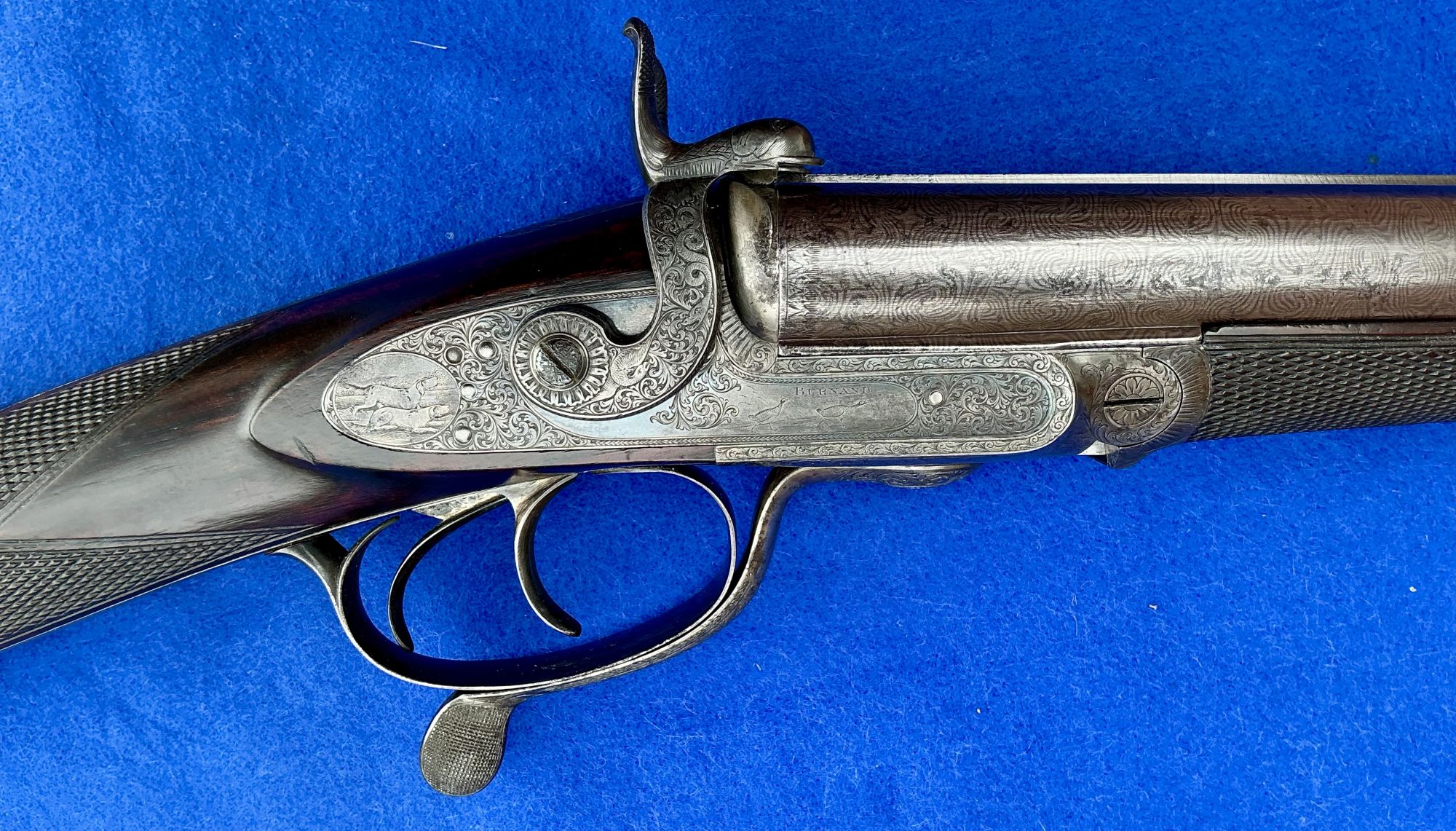
The gun is built with elegant lines and well finished throughout.

The Dolphin headed Hammers with engraved scaled bodies.
The business model shows a reliance on Trade suppliers, and trade hubs from the heart of the British gun-making industry, also, the all-important close relationships with Estate and Land Owners, Shoot Managers, Game-Keepers, and local dedicated Sporting Game shooters.
The provincial gun-making craft in Newcastle was a combination of strong local traditions, supported by well-established national gun-making and gun-trade networks.
The incorporation of the Birmingham and Wolverhampton’s gun-trades, and their components suppliers, would allow the Newcastle gun-makers in achieving a level of mechanical excellence, placing their guns alongside the ‘Best’ from Birmingham and London.

The elongated top action tang supports the lines of this Quality made gun.
There have been a number of 'North of England' gunmakers who have been celebrated for their work, some even being used in conversation as ‘Purdey of the North’ in years gone by. It is not difficult in understanding, with statements like this these, that these celebrated makers naturally become elevated and well-known within game shooting syndicates, shooting parties and their own enthusiastic client base.
Richard Burnand, as a gunmaker, has been overlooked by both collectors and enthusiasts in the past. This article will hopefully evidence the quality regularly found in Sporting Game guns made by provincial gunmakers, and the likes of Richard Burnand.

Richard Burnand - Gun case 'Trade Label' - Straight forward provincial label.
The Burnand gun that inspired this article, is a Thirteen bore, Double barreled, Pin-fire, Sporting Game gun. The number of best Sporting game guns built in Pinfire form by Richard Burnand would have been low, as the Burnand business operated as makers of best quality guns, and not that of a high volume maker.
This gun demonstrates the developments of the day, and latest features, including fine and well-balanced lines, all of which place the guns’ date of manufacture circa. 1864.
The gun has been built with 30-inch barrels, are of best quality Damascus and bead sighted at the muzzle. The top rib engraved ‘Burnand, Pilgrim St, Newcastle on Tyne’. The barrel condition is excellent, with London proof marks for 1855 to 1868 (Black Powder), the barrels made as 13 bore (.710) and covered under the rules of proof for pre 1868 would put the gun out of proof at 12 bore (.729), both barrels now measure .717 (In Proof). The barrels remain bright and clean, with barrel wall thickness of twenty-seven thousandths in both.

The locks and hammers are fully engraved including Dogs, Serpents, and Birds, along with scroll engraving.
The gun is scallop engraved at the breech, with full border and scroll engraved throughout, the border and scroll engraved locks are signed Burnand, finely decorated with hounds and game birds, the locks are internally signed Joseph Brazier ‘Ashes’, the internal quality of the lock-work and finely pierced bridles are of ‘Best Quality’.

'Best Quality' Joseph Brazier 'Ashes' lock-work including pierced bridles.
The border and scroll engraving continue to dolphin headed hammers, with the hammer sides including engraved serpents. The gun uses a rotary double bite under lever action made and signed by Joseph Brazier ‘Ashes,’ on the action table. The action and barrel opening are by way of an under-lever, this was made after the under-lever by Jones. Henry Jones allowed his under-lever patent number 2040 of 1859 to lapse in 1862; this allowed the patent design to be used and modified from late 1862 without challenge.

Best Quality Damascus barrels - Engraved; Burnand, Pilgrim St. Newcastle-on- Tyne
The barrels are stamped by their maker, with HM for Henry Mills of Walsall. Henry Mills would have been supplying Joseph Brazier with Barrels and best quality steel for gun-making.
Henry Mills was a ‘Master Iron Maker’ who worked with John Marshall, of the ‘Monway Iron and Steel Works’ at Leabrook, Wednesbury; The business producing quality iron for gun barrels since the 1840’s – The ‘Monway Iron and Steel Works’ was run by ‘Marshall & Mills’ until 1865, becoming part of ‘Patent Shaft and Axletree Company’ at that point.
Marshall & Mills, were ‘Master Iron Makers’ producing in the mind of many gunmakers the best gun barrel iron in the world. Their customers included many Birmingham gun makers, this expanded to both the British and American governments. By 1844 their iron sold for £44 a ton.
John Marshall and Henry Mills were in business with each other, but also ran parts of their business themselves, with John Marshall at the Monway Iron Works, Wednesbury, and Henry Mills at the Victoria Iron Works at Pleck, Walsall. Interestingly the distance between the ‘Victoria Iron Works’ ran by Henry Mills (HM) and Joseph Brazier’s factory at the ‘Ashes’ was less than eight miles.

The Gun was made in Newcastle-on-Tyne, however the Barrels and Action were Proofed in London.
Colt's president, Elisha Root, testified before the ‘Commission on Ordnance’ on March 26th, 1862: "We have engaged 54,000 skelps of Marshall iron; have on hand 19,000; also have engaged 25,000 barrels of steel, solid, to be bored, and by us; we have also 20,000 barrels made in England, rough bored and first smooth bored. They have turned breech pins fitted." Skelp, sometimes spelled scalp, is wrought iron or steel that is rolled or forged into narrow strips and ready to be made into pipe or tubing by being bent into a cylindrical shape, or mandrel and hammer welded.
It was reported in the London Gazette on the July 4th 1865. That the partnership of John Marshall and Henry Mills as ‘Iron-Masters’ carrying on business as ‘Iron-Masters’ at the Monway Iron Works, Wednesbury and the Victoria Iron Works at Pleck, Walsall was dissolved by mutual agreement. With each of the partners continuing their business, but separately, and on their own private account, with John Marshall at the ‘Monway Iron Works’ and Henry Mills at the ‘Victoria Iron Works’. This agreement will be in place by the 30th June 1865.

Barrels Proofed for Black Powder, with 1855 to 1868 proof stamps for London, and remain in Proof.
The action body, at the start of the top tang and between the hammers has a vignette containing the engraving of a female ‘Black Grouse’, this is a scarce subject engraved on any pinfire sporting game gun, this would have been amongst the customer’s personal request when initially ordering this handmade gun. The Grouse engraving fits well with Richard Burnand’s customer base. The location of the business is close to the nucleus of grouse shooting within the UK during the 1860’s. The primary areas of Grouse at this time being on the hills of central and eastern Scotland, the Pennines, parts of Northumbria, North Wales, and the North York Moors.

Vignette containing an engraving of a female ‘Black Grouse’
The gun is stocked with good strong straight grained walnut, giving added strength through the hand and grip, which is checkered. The under-side of the stock, just behind the trigger tang we find a Gold oval escutcheon neatly inlet, with finely engraved initials ‘J M’, with a further set of initials stamp directly into the stock of ‘G J.’

Strong straight grained figuring for the stock, giving strength through the hand and grip - using a steel butt plate.

Gold oval, with the initials ‘J M’, a second set of initials of 'G. J.' stamp directly into the stock.
The fore-end has matching walnut and also checkered, the forend fastening using a cross-pin latch to secure the fore-end to the barrels and the gun. The gun has steel mounts, including an engraved butt plate and elongated butt plate tang, with the tang / top strap extending on to the rear of the comb, all of which is border and scroll engraved, which includes a running Hare. The gun has been made for a right-handed shooter, with a length of pull at 14 ¼ inches, and overall length of the gun being forty-six inches. The gun has an overall weight is 7 lbs. 5 oz, with the barrels weighing 3 lbs. 8 oz, and as expected the gun has a balancing point directly over the hinge pin. The gun on closing retains a firm and secure lock-up. Interestingly, the gun retains its original hinge-pin. This supports the thoughts of the gun having been lightly used.

The elongated butt plate extending to the stock comb - boarder and scroll engraved.

A swift running 'Hare' engraved within the boarder scroll of the elongated butt plate.
This particular gun has been built at an interesting time, allowing the relationship between Richard Burnand and Joseph Brazier to be researched and considered. The development and introduction of the breech-loader at this time would have been demanding prospect for the provincial gun-maker in providing their customers. The supply of the latest and best developments of the breech-loader becomes even more difficult for makers, if only making very small numbers. The process of building a gun of this quality is likely to have been supported by Joseph Brazier. What we already know is this gun has best quality locks with pierced bridles signed by Brazier, the gun also has a best quality action body signed by Brazier. Additional information has allowed the depth of Brazier’s developments in supporting the ‘Gun Trade’ to be looked at and evidenced.
An advertisement dated 1864 has surfaced, interestingly during the build period of this particular gun. The advertisement gives rise to thoughts of how much involvement the Brazier business had with the build of the Richard Burnand Pinfire gun, and other makers, both provincial and national. The advert states;
"JOSEPH BRAZIER manufacturer of BEST BREECH LOADER ACTIONS AND BARRELS, BEST GUN LOCKS, REVOLVING PISTOLS, BULLET MOULDS, PATCH CUTTERS ETC. Also all kinds of forged work used in the trade, Gun Implements, Nipples, Rifle Sights, & c. Gun Furniture, Wadding Punches, Rifle Traps, Etc. The Ashes, Wolverhampton."

'Joseph Brazier' advertisement circa. 1864 - Best Breech Loader Actions and Locks.
This information would allow consideration to the possibility, in that, the gun could have been supplied to Richard Burnand in ‘The White’ a term used for the supply of an unfinished gun from a ‘Trade Supplier’, whereby, the receiving gunmaker would complete the gun to the customers’ requirements.
We are aware from the Joseph Brazier stamps to the inside of the locks, and further Brazier stamps on the action table, that Joseph Brazier supplied a considerable amount of this gun. The barrels are of best quality Damascus, and are highly likely to have been supplied by Brazier as a 'Barrel and Action'. The question being how much of this gun was supplied, if not the whole gun via Joseph Brazier ? However, exactly how much remains speculative.

Locks with Vignettes containing Dogs in wait for dispatched game.

Engraving on the second lock plate with a Dog after retrieving a fallen Duck.

The engraving covers a large amount of this gun, and well executed.
Another Joseph Brazier advertisements from 1866, stated the firm were making and supplying barrels. However, we suspect from the gun in this article, the practice of Brazier supplying 'Barrelled Actions' was taking place long before the sight of the adverts in local Wolverhampton newspapers and The Field magazine.
Richard Burnand was apprenticed to the Gunmaker John Gardner, who established his business in 1797 at Bigg Market, Newcastle-upon-Tyne. The Gardener business then moved to Collingwood Street between 1811 and 1815, during the period 1815 to 1823 the John Gardener Gun-making business moved to 130 Pilgrim Street.
This quality gunmaker trained two apprentices of note - Richard Burnand and William Greener, both of which were guided throughout their apprenticeships by John Gardener, the apprenticeships resulted in establishing two excellent Gunmakers. While Richard Burnand remained with John Gardener, William Greener went to work for Joseph Manton in London during 1822.

Only a close up image of the Hammer's gives us an idea of how much work has gone into building this gun.
After working with Joseph Manton for seven years, William Greener returned to Newcastle-Upon-Tyne, setting up his own gun-making business during 1829. Unfortunately for William Greener, there were regular issues, too, which became problematic. The primary issue being in obtaining the necessary and consistent supply of materials for the William Greener Gun making business. These difficulties lead to another move during 1844, whereby William Greener and the Greener business moved to Birmingham. The business has remained in Birmingham ever since, and remains in operation today, producing truly exceptional sporting guns.
Richard Burnand was born in Yorkshire during 1806, as previously stated was apprenticed to John Gardener in 1820. After Richard’s apprenticeship had concluded, during 1828 Richard married, his wife Jane was 4 years his senior.

Joseph Brazier made a large proportion of this gun including the Locks and Action body.
Richard remained working for John Gardner until about 1840, the records show sometime between 1837 and 1843 Richard Burnand purchased the business from John Gardener. The business now under Richard Burnand’s name, moved from 130, Pilgrim Street to 111, Pilgrim Street, Newcastle-On-Tyne
By the time of the 1841 census Richard and Jane were living at Croft Court, near Croft Street, together with their daughters, Ann (aged 12) and Mary (aged 10)
The census information would ensure the move to 111 Pilgrim Street took place after 1841. There are no sons recorded or mentioned for Richard in any of the censuses, but in the 1841 census, a Mary Burnand (aged 65 and possibly Richard's mother) lived at Croft Court as did another Mary aged 30 (possibly Richard's sister) - and Robert Burnand aged 20, recorded as a tailor.
In the 1851 census Richard and Jane were living at 111 Pilgrim Street, neither of the daughters were with them on the night of the census. At that time, Richard employed 3 men and 2 apprentices.
In the 1861 census, Richard and Jane were recorded at 28 Pilgrim Street. At the time of the census the firm employed four men and 2 boys (apprentices).
By the time of the 1881 census Jane had died and Richard, now 75 years old, was living at 195 Portland Road with Mary, his sister, who was seventy-two.
Between 1883 and 1886 the firm moved to 29 Pilgrim Street.
Two former employees a Mr. Small and a Mr. Johnson “Small & Johnson”, appear to have bought the business from Richard Burnand during 1885/6. The business was moved it back to 28 Pilgrim Street. The reason for this is likely that Richard and / or his sister were still living and remained at 29 Pilgrim Street.
The Birmingham and Wolverhampton gun-making precision hub, and the skills of Northumbrian gun-making craftsmanship, has ensured that the sporting firearms that remain today, are historically significant, aesthetically distinctive, and highly collectible.