Frederick Barnes & Co.
Frederick Barnes & Co.
Gunmaker, London - 1825 to 1865
The established business of Frederick Barnes is not well known for its contribution to the Victorian Sporting game gun. However, there have been a number of surviving guns bearing the Barnes name, including Shotguns, Muskets, Rifles, and Pistols. The period of gun-making and manufacturing from Barnes took place between 1825 and 1865.

Frederick Barnes & Co. London - 13 bore, Sporting Game Gun. Circa. 1855-56
Frederick Barnes started out as a sword cutler, wholesale gun maker, percussion cap and shooting requisites maker at 109 Fenchurch Street in 1825. The research into Frederick Barnes & Co. has revealed the business was far bigger than first anticipated, with business addresses at, 103 & 109 Fenchurch Street, London. The business also had premises in Birmingham and Sheffield. The business operated under the name Frederick Barnes from 1825 to 1851.
The business continued to expand, including sales to; Africa, India, and America. The demands for products continued to increase, which lead, in 1831 to Frederick Barnes opening a factory in Birmingham at 182 Livery Street. Then in 1839, the firm then opened a factory in Sheffield. The premises at 3 Union Row, Tower Hill, London opened in 1847.

Good example of a Birmingham made gun, marked and sold through a London retail outlet.
In 1851, the name of the firm changed to Frederick Barnes & Co, and the business opened further premises at 67 Minories, London.
In 1856, the Government started to make military arms at their new Enfield factory in London, this allowed the Government to be less reliant on support from the Gun-Trade, as a result the Frederick Barnes business outlets and workshop’s at Union Row and Minories premises in London were closed. In 1861 the Birmingham factory moved to 57 Livery Street Birmingham.

Strong straight grained Walnut woodwork, with minimal figuring.

Both sides of the stock and woodwork, being free from damage, only age related marks present.
Thomas Barnes, of 15 Lionel Street Birmingham was trading as a Gun, Rifle & Pistol Maker, between 1863 and 1865, the Thomas Barnes business was relatively short lived, as the business was amalgamated with Frederick Barnes & Co. in 1865. Frederick and Thomas are likely to have been brothers.
Frederick and Thomas Barnes were probably related to William Barnes, who was in business in 1870 in Oliver Street, Birmingham.

Steel Butt Plate, with an extending and engraved Butt Plate tang running onto the Stock comb.
George Barnes of Queenstown, South Africa, was a Gunsmith, Gun Importer and Gun Dealer between 1877 to 1894, It is likely George would have business links, and related to Frederick Barnes.
The markets for ‘British’ military and sporting guns at this time was extremely high. The Frederick Barnes business model was gaining momentum, this is clear from the numerous factories and premises operated by the Frederick Barnes business, interestingly the business manufactured all types of guns for the trade.
As previously stated, the business during 1851 became ‘Frederick Barnes & Co.’ The business also exhibited at the ‘Great Exhibition of 1851’ However, not as a Gunmakers !

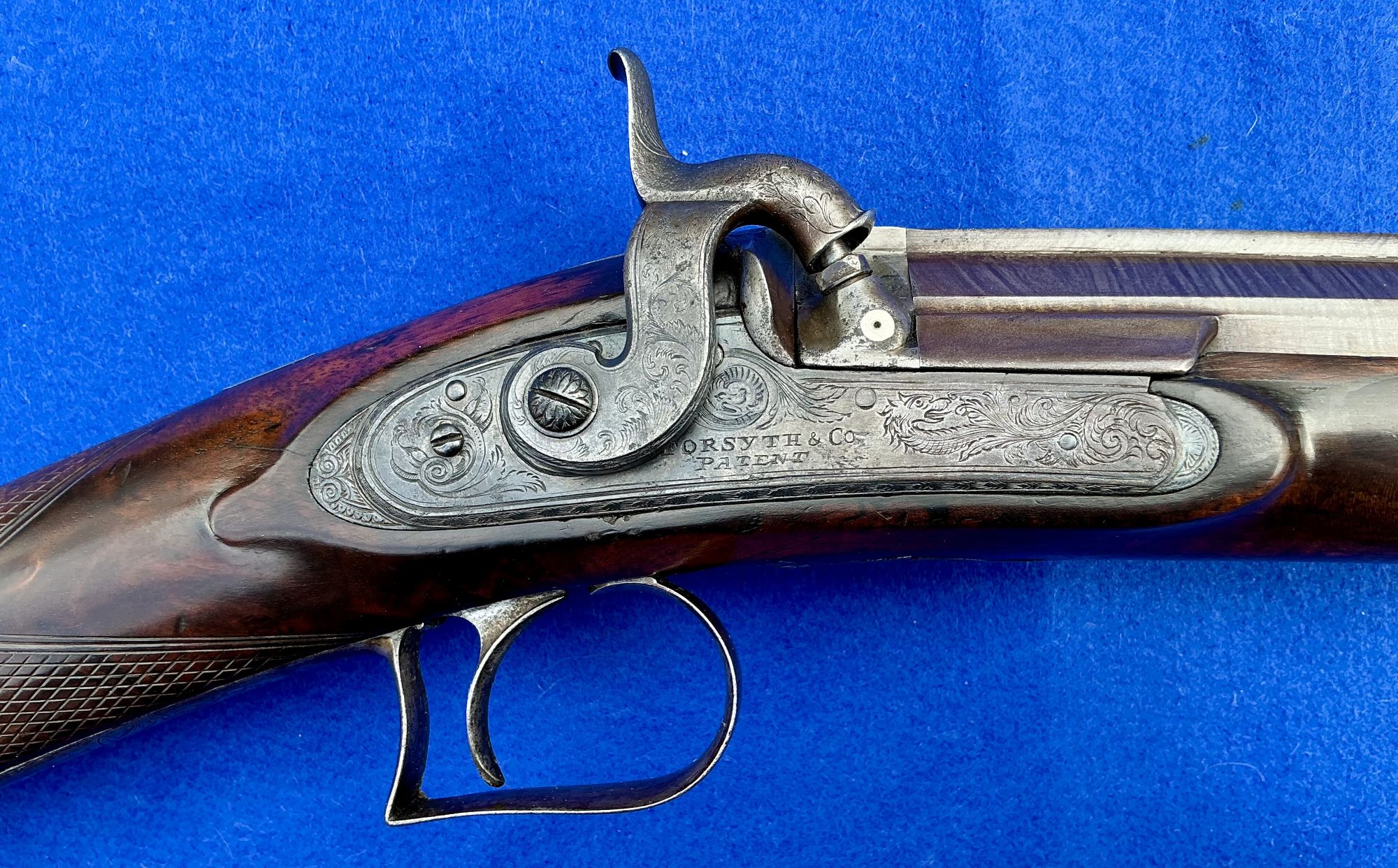
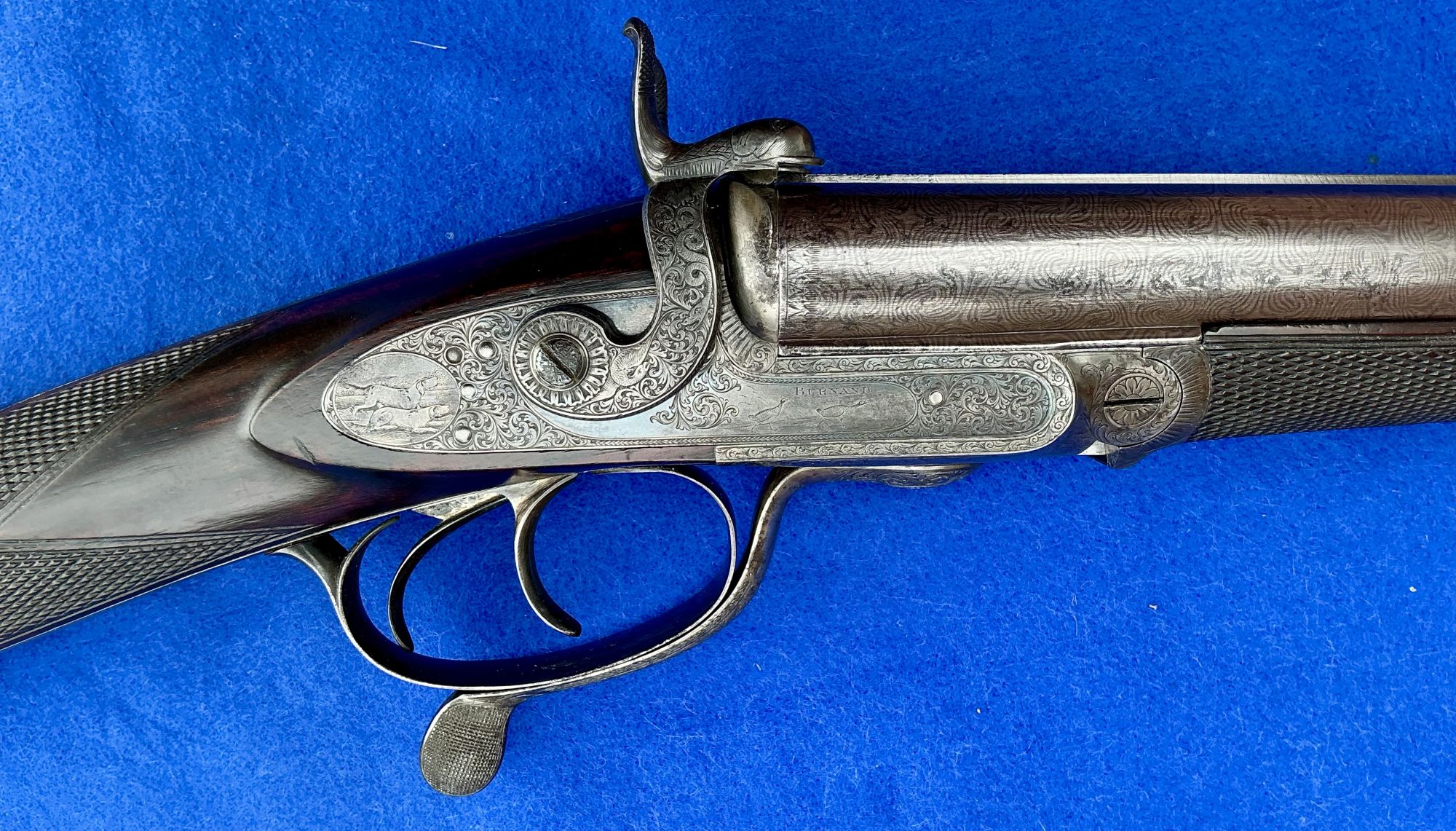
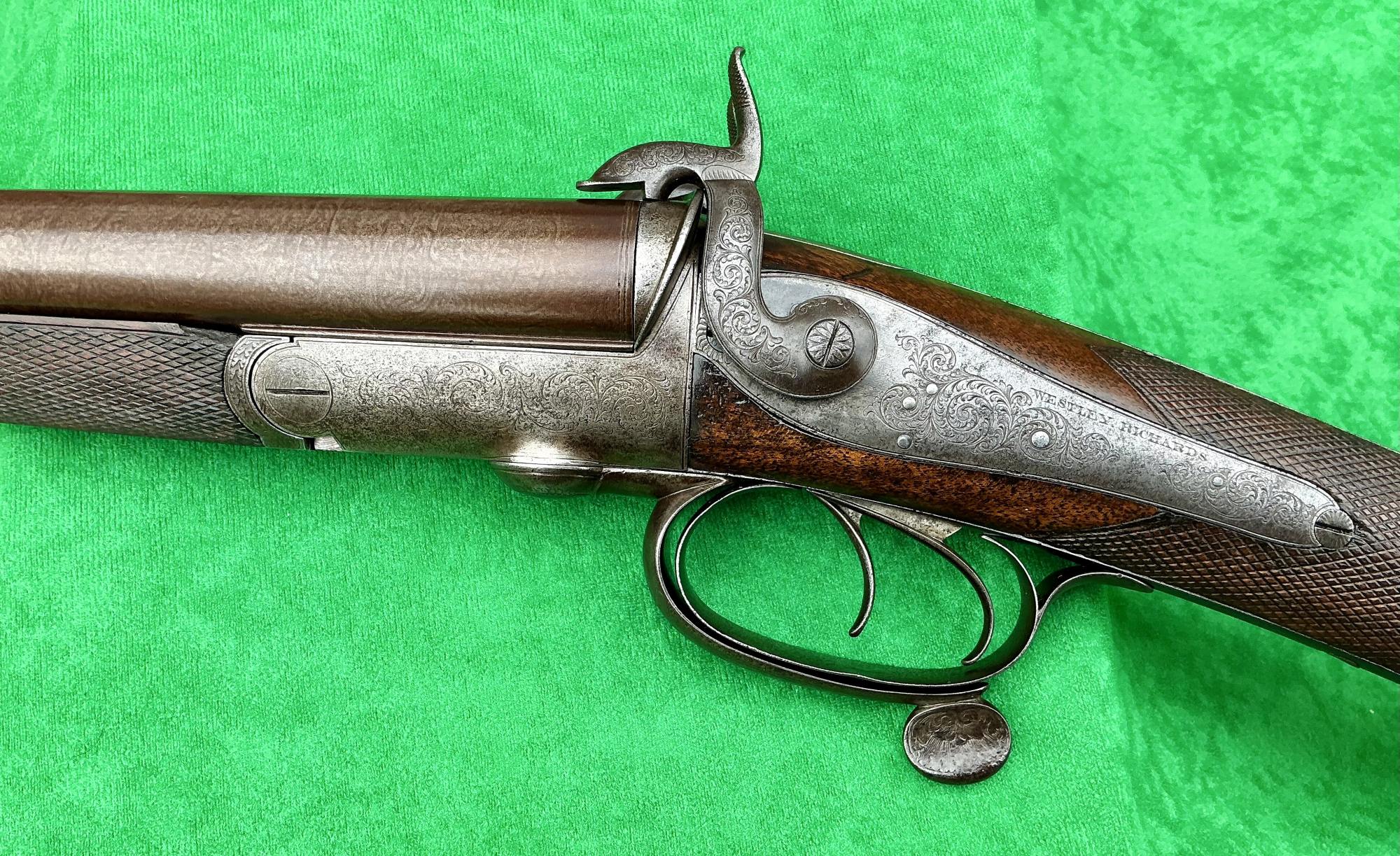
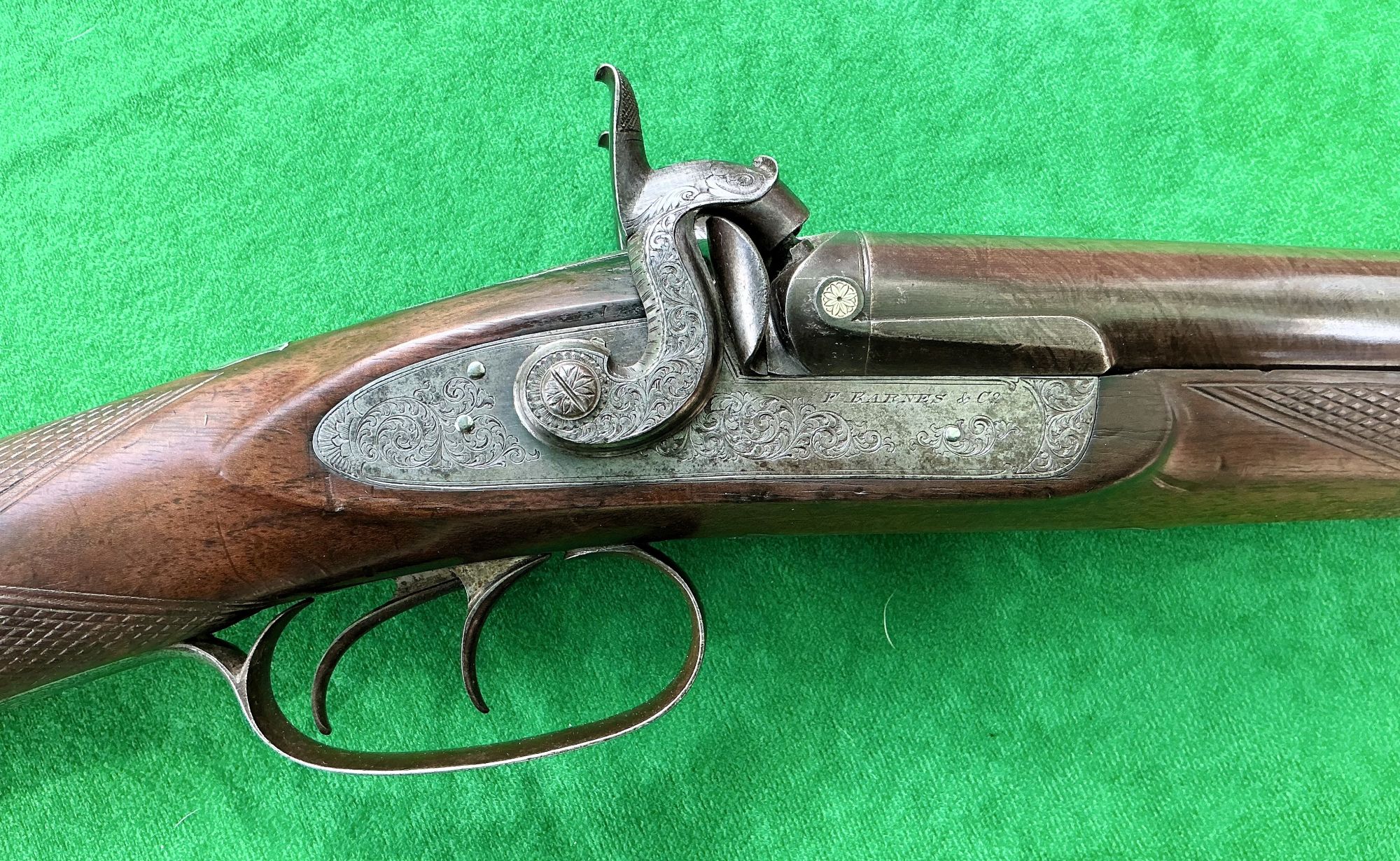
Well made 'Lock Plates' - Good coverage of engraving, with fully engraved Dolphin Headed hammers.
The ‘Heal Collection’ (Heal, 85.13) holds a Trade Card that advertises – “Frederick Barnes, Ship's Ironmonger. Iron and Tin Plate Worker, Brazier. Gun & Pistol Manufacture, Sword Cutler. Ships Hearths, Cabin Stoves, Bells Scuttles, Deck Lights & Ventilators, Iron and Copper Nails. Emigrants Tools, Agricultural Implements, Barrows, Mills, Carts. A Large Assortment of Fine Single & Double Fowling Pieces, Rifles, Revolving-Pistols, Swords, Bowie Knives. Always On Hand”.
Returning to the Great Exhibition of 1851, this gives us more information about Frederick Barnes & Co. and allows a broader amount of information to be gathered surrounding his involvement with the Victorian Sporting gun trade.

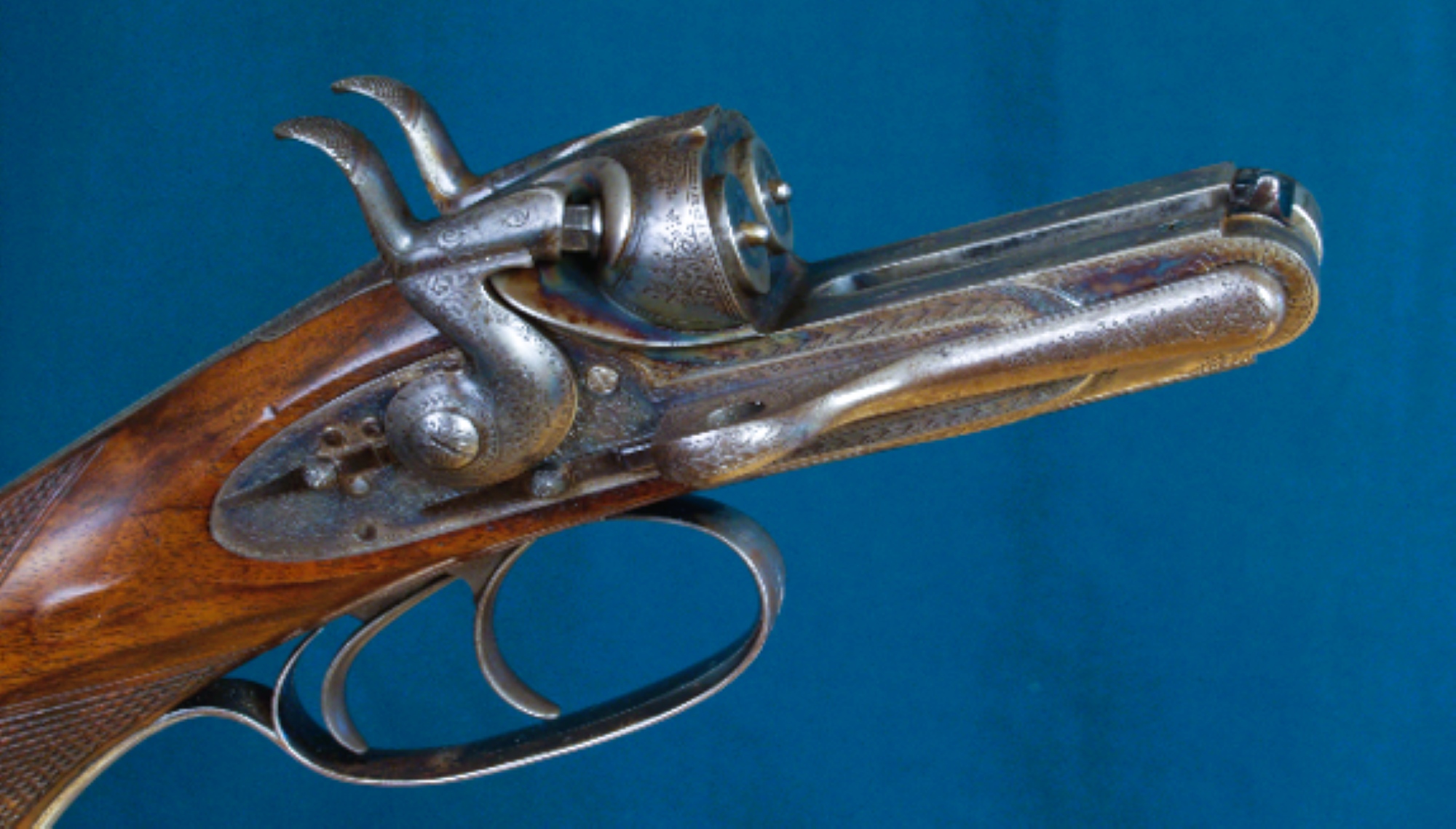
Well made 'Trade Locks' - Colour hardening still present on internal lock-plates.
The Great Exhibition official catalogue entries for ‘Gunmakers’ follow a strict formula, this would be - Name — Address — Articles Exhibited, this was not the entry submitted or Exhibited under by Frederick Barnes & Co.
The Great Exhibition entry for Frederick Barnes & Co., reads: ‘Barnes, Frederick & Co., 103 and 109 Fenchurch Street, London; Union Row; Tower Hill; with works in Birmingham and Sheffield — Swords, cutlery, firearms, and military accoutrements’. This entry aligns with the Exhibition’s Class XXVIII remit, and not that of an entry for a Gunmaker.

Iron Twist Damascus, demonstrating consistently patterned tubes - Top Rib engraved, F Barnes & Co. London
From the Great Exhibition entry, we understand Frederick Barnes & Co. was not a high-end London Gunmaker, but a Wholesale Gunmaker, Military supplier, Ship’s Chandeliers, Cuttler’s and Iron mongers. The business included the supply of wholesale trade guns, both home and abroad, including; Africa, India, the Colonies, and America.
The manufacturing of firearms, shotguns and pistols, including that of military muskets and related parts and accessories would have been conducted from within the Barnes & Co. factory premises of London, Birmingham and Sheffield. However, the quality displayed in Frederick Barnes & Co. Sporting Guns, Sporting Rifles, would point toward some guns being made in part by well-established Birmingham Gunmakers who regularly supplied the ‘Trade’, or the possible use of, outworking engravers and finishers.

Proof Marks for 1855 to 1868 Birmingham - The gun was retailed by F. Barnes & Co. in London.
The Frederick Barnes & Co. gun in this article, is without doubt a well-made Sporting Game gun. The attention to detail, quality of materials, including the level of engraving and overall finish, is enough to place this gun in a higher quality category than that of a basic sporting gun.
Frederick Barnes & Co. have the footprint of a large-scale Victorian arms supplier and cutlery manufacturer, not that of a boutique, or specialized Gun shop. The details of the 1851 Exhibition entry confirms, that Barnes was positioning himself among the major British suppliers of military hardware for use at home, the Colonies and across the British Empire.

Substantial ebony and brass ram rod - Well formed and detailed ram rod guides.

Ram rod retaining clip bridges barrels and bottom rib - The clip is effective and secures the ram rod in place.
The Sporting Victorian game gun in this article has survived for over 170 years, being made after the 1851 Great Exhibition and prior to Frederick Barnes death in 1856. The proof marks on this gun are for 1855 to 1868, and proofed at Birmingham. Confusingly the gun is engraved on the top rib F. Barnes & Co. London, possibly as a result from the gun being made in Birmingham, then retailed in London.
The barrels are 29 inches in length, with good bores and barrel wall thickness at a minimum of 30 thousandth of an inch in both, the Iron twist Damascus barrels have well-formed patterning, the bottom barrel rib carries the ram rod locating tubes, and a ram rod retaining clip at the muzzle end. The ram rod locating tubes have shaped ends, the ram rod itself is substantial with a brass capped steel worm. The gun is engraved throughout, as per the images. The wood-work is of walnut, and of strong straight grain with figuring towards the butt end, the butt plate is steel and extends on-to the comb. The gun has good lines, and handles well, moving in a lively manner. The locks are well made ‘Trade’ locks, no internal lock-makers name, the internal lock plates retain a high amount of colour, with the locks working faultlessly, and in excellent condition. The lock plates externally are engraved, signed F. Barnes & Co. , the hammers are well engraved and the hammer noses depicting Dolphin heads. The gun has an overall length of 45 inches and weighs 6 pound 15 ounces, the gun balances directly over the center point of the gun. The platinum breech plugs on this gun are also engraved. This gun would have been a good advertisement for the Frederick Barnes & Co. when used on driven game days in the right company.

Engraved forend finial, Cross-pin forearm securing catch.
Frederick John Barnes was born in Hendon, Middlesex, on 4 April 1800, the son of Edmund and Hannah Barnes. In 1828, he married Sophia Susannah Kerslake Baker (1802-1888) and is recorded before the birth of their first daughter (Fanny) in 1829, as an ironmonger in Fenchurch Buildings, London. Until 1832, Frederick Barnes was in partnership with Thomas Kerslake Baker (c.1800-1879), who was his brother-in-law. Frederick Barnes & Co. was eventually formed at 109 Fenchurch Street, near Tower Hill, London and listed as a gun, rifle, and pistol manufacturer. Barnes, though, was a merchant, who also sold ironmongery, including cutlery. This was sourced from Sheffield, where by 1839 he had an office in Howard Street. Joseph Clarke was the agent at Sheffield in the 1840’s and early 1850’s (by which time Carver Street was the office address). Barnes also had a sales outlet in, Livery Street, Birmingham, which was managed by John Marrian (who had been born in Bobbington, Staffordshire, in 1807).

Well finished 'Sporting Game Gun' from Frederick Barnes & Co.
Frederick Barnes apparently prospered, though he had financial problems in 1847 caused by overseas business and the Indian trade. He lived in Sydenham village, Kent. He died on 26 March 1856, aged 55, and was buried in Norwood Cemetery. When his widow, Sophia, died in 1888 she left £27,073. They had three daughters, but no sons, and after Barnes died his business passed to John Marrian. The latter continued to operate in London, Birmingham, and Sheffield, where Frederic Barnes & Co’s address after about 1860 was Cornhill Works, Solly Street.

Made in Birmingham by Frederick Barnes, Sold in London by Frederick Barnes & Co.
The Frederick Barnes & Co. business during the 1860’s had started to move away from supplying Firearms, and Sporting guns, the emphasis shifted from firearms, table cutlery and Bowie knives, towards files and other tools.