J. D. Dougall - Percussion / Cartridge Conversion Guns
J. D. Dougall – Gunmaker
J. D. Dougall - Percussion / Cartridge Conversion Guns
This article covers the mindset of the Victorian Gunmaker and Inventor J. D. Dougall. This unusual dual firing system, allowing the sporting Victorian game shooter to use the latest established design concept of the Centre-Fire Breech-Loader, but also in adverse or difficult conditions, allowing the gun to be used in reverse, and return to days gone by, through the gun being used as a Muzzle-Loader.
The Dougall dual fire system design is a rare and unusual concept, so the opportunity to learn about two guns by J. D. Dougall, both using the Lock-Fast design, and both having their ‘Conversion Systems’ present today after 152 years is a real bonus for collectors, enthusiast and historians of the British Sport Game Gun and the Dougall brand.
This Article has been written and images supplied by the guns’ safe-guarding custodian Mr. R. Kirk Lubbes, an avid J. D. Dougall researcher, enthusiast and collector.
J. D. Dougall - Percussion / Cartridge Conversion Guns
By R. Kirk Lubbes
Lockfast Conversion Shotguns
This article shall investigate two unusual shotguns produced by Dougall. Both guns, designed so that they could be either used as either percussion or cartridge guns with the ability to transition back and forth, shall be discussed in the order in which they were built.
J. D. Dougall was an innovative Scottish gunmaker working from around 1841 to about 1890.
James Dalziel (J. D.) Dougall, Sr. was born in 1819. His gun-making business has its roots in his father’s fishing tackle business. While J. D. Dougall used the 1760 establishment date in his advertising, Boothroyd 1 states that John Dougall (J. D.’s father) started his business in 1808 as a fishing and fowling maker, who later specialized in needles and fishing hooks.
During 1841, the company’s name was changed to James D. Dougall, Fishing-Tackle Manufacturer and Gunmaker. During early 1845, Dougall announced he had “engaged a first-rate Gunmaker and is prepared to execute all orders in that department…” (Glasgow Herald, 24 March 1845).
This time period saw the transitioning from percussion to pinfire cartridge guns. The improved Lefaucheux action, introduced in 1854, was the first breechloading action capable of handling the pressures of a pinfire cartridge. However, the action was basically weak and tended to loosen. Two inventors attacked this problem: Henry Jones of Birmingham England (1859) and J. D. Dougall (1860). The Jones design, known as the Jones Underlever, had a trigger guard that could be rotated, allowing a dovetail to engage the locking lug on the barrel. This was a very strong action and was very popular; however, it was slow to operate. Dougall used an entirely different approach as described below.
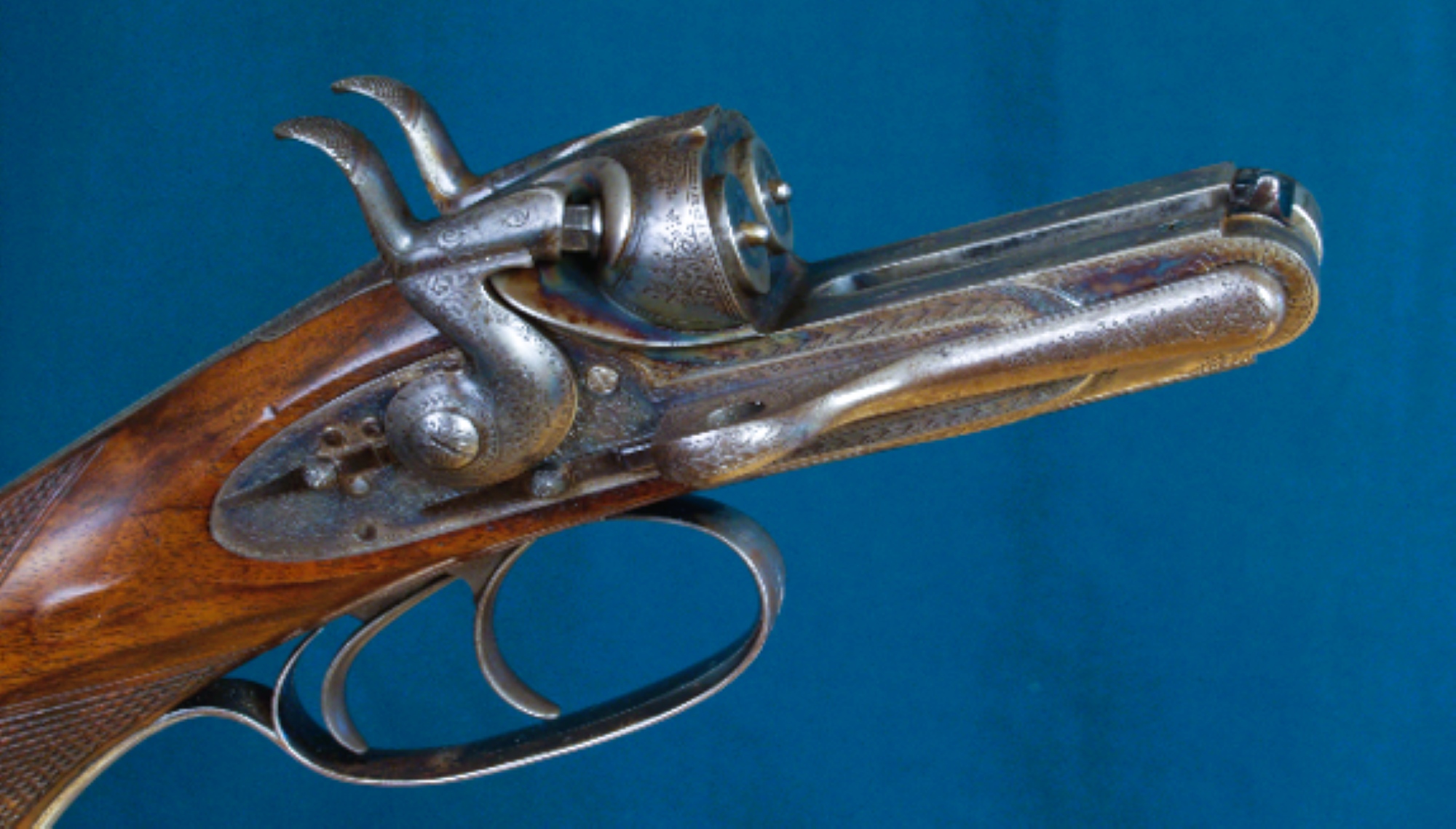
The Lockfast Action - For those unfamiliar with the Lockfast action, the following is a quick tutorial. Dougall designed a slide and drop action in which a sidelever slides the barrels forward on a concentric cam (Figure 1) and allows them to drop, rotating on the hinge pin. The locking mechanism consists of a boss (a steel disk) attached to the standing breech and aligned with each barrel (Figure 2) and a barrel under-lug. The barrels’ breech end slides over the bosses and the barrel lug engages the action. The action closes by pulling the lever back, which forces the barrels over the two round bosses pushing the cartridges into the chamber and sealing it. The action completely encases the cartridge in steel, eliminating the weakness at the interface between the barrels and the standing breech. In addition to being an extremely strong action design, Dougall Lockfasts were also faster to reload than the Jones Underlever.

Figure One

Figure Two
Lockfasts were built in at least the following five gauges: 4, 8, 12, 16 and 20 bores. The 4-bore was a single-barrel punt gun with an oarlock forend. The others were double guns. Dougall also built Lockfast double rifles in a wide number of calibers, including gauge rifles, as well as Lockfast howdah pistols.
Based upon surviving examples, most Dougall Lockfasts were high-quality guns. I have only seen two field-grade guns in my 18 years of gun collecting. Lockfasts were expensive guns. A Dougall advertisement in an 1875 Australian newspaper lists the Highest grade 10 bore at £54 and the Highest grade 12 bore at £50. Cases were available for all grades. The Dougalls contained in my collection are marked as either Highest or Best.
Due to his guns being so expensive, Dougall’s customers were wealthy gentleman. During 1870, the average age for a London laborer was just under a British pound a week; thus, a Highest grade Dougall Lockfast would be about a year’s salary for the common man.
Gun #1 - The first gun we shall investigate is a 10-gauge, Lockfast shotgun (Serial #3007), built circa 1872. The shotgun is in its original case with its original tools required to convert it back and forth between percussion and cartridge configurations. Both the action and barrels are marked Highest, indicating the gun itself was the most expensive grade. This gun likely exceeded the quoted price of £54, as its case includes custom tools and associated components necessary to implement the conversion.
The original Damacus barrels for this gun predate chokes. They would have been cylinder bored. Greener 2 states he first became aware of choking in 1874. Sometime between 1887 and 1896 (based on the London proof marks on the current barrels), the gun was returned to the Dougall factory and a new set of choked barrels were installed on the gun. The Dougall factory used the original serial number on the new barrels.
The new barrels are interesting in that the Damascus barrel patterns do not match. The right barrel is fine stripe Belgian Damascus. The left barrel is a fine Damascus chain pattern. I have never seen this pattern on any vintage English shotgun. There are no maker’s marks on the barrels. Both barrels are marked choked and 29-¼” in length.
The lock has ¾ coverage in a tight scroll pattern with traces of the original case hardening. The hammers are of an unusual early style (Figure 3). They may be unique to Dougall. I have only seen them used on Dougall guns. They are engraved with full coverage. The locks are non-rebounding. The stock is beautifully patterned. Length of pull is 14”. Drop is 1-½” at the comb, 2-½” at the heel and balanced one inch in front of the hinge pin. The butt has engraved toe and heel plates to protect the stock during muzzle loading.

Figure Three
The original case and tools associated with this gun are important to the gun historian. It allows one to observe the changes J. D. made in outfitting the gun and its associated tools. This case contains the following:
1) Two special brass “cartridges” numbered to the gun and designated for the right and left barrels, similar to those for the 12-gauge gun discussed below (Figure 10). Each cartridge has a hole in its base through which charge can be ignited. The interior of these brass inserts is tapered from the ignition hole to funnel the percussion cap’s flame to the powder charge. Dougall patented a “conical tapered base for cartridge head to reduce powder space” (Patent #3746 of September 1876).
2) Four extra steel cartridge retractable firing pins and their associated threaded holders. It should be noted that retracting springs were not necessary. The Dougall barrels slid forward for extraction. The firing pins would be pushed back by the cartridges as the barrels slid backwards onto the new cartridges.
3) Two percussion “firing” tubes. These tubes appear to be identical to the cartridge firing pins and their associated threaded holders, except they are non-retractable and the “pins” are hollow tubes rather than being solid. The only other difference is that there are two opposing shots in the associated threaded holders. The tubes are interchangeable with the firing pins.
4) A hex nipple extraction tool with an offset-handle. This tool was designed to remove the cartridge firing pins.
5) A percussion “firing” tube extraction tool with an offset handle. This tool has two pins on its face to align with the slots in the “firing” tube associated threaded holder.
6) Replacement cam
7) Loading tools – brass capper/decapper and ebony tamper
8) Miscellaneous tools including a screwdriver, a Bartrum horn-handled chamber brush, two cleaning tool wallets containing a mop and oil bottle, three Turks-head brushes and three mops.
The interior of the original case was in rough condition. The exterior of the case was mechanically sound but has seen rough use. The partitions were loose and the interior cloth was badly stained. The original label and charge card were still in the case. I decided to reline the case in its original configuration (Figure 4) using the original partitions, label and charge card (Figure 6).

Figure Four

Figure Five

Figure Six
The charge card in figure five reads 4 ½ drams for 1-¼ or 1-½ oz of shot and 4 drams for 2 oz of shot.
It appears that only two tools (see #4 and #5 in the above list) were needed to change nipples to firing pins and vice versa (Figure 6). It is also interesting to note the changes Dougall made with the tool set included with the later gun.
The remaining tools in the case, possibly purchased at Dougall’s shop in London, were added to facilitate cartridge loading and cleaning.
Gun #2 - The second gun we shall investigate is a 12-gauge Lockfast shotgun (Serial #3175), probably built in 1874. This is the gun that sparked my interest in collecting Dougall guns. I discovered it at the Las Vegas gun show 14 years ago and was taken by the fact that it was designed to be used both as a muzzle loader and a cartridge gun, and its braggadocios charge card (Figure 7) stating “no charge can hurt the gun.” (I have always wondered what J.D.’s lawyer must have thought about this statement.)

Figure Seven
This gun has 31-inch cylinder-bored Damascus barrels. The barrels are stamped Best. Length-of-pull (LOP) is 14-½ inches. The gun weighs 7-¼ pounds and balances on the hinge pin. The locks are signed Stanton non-rebounding locks. The buttstock is well-marbled. Again, it retains heel and toe plates to protect the butt while it is being loaded as a percussion gun. Engraving coverage is about 75%. The forend is attached with a cross-pin, which is a late hold-over from earlier guns and unusual for a gun built this late.
In 1870, Dougall was appointed Gun and Rifle Maker to HRH Prince of Wales. Similar to this gun, the ribs on most Lockfasts subsequently manufactured are engraved “J. D. Dougall Gun and Rifle Manufacturer to HRH The Prince of Wales, 59 St. James St. London.” The top tang is also engraved with the three Prince-of-Wales feathers insignia.
The original gun case (Figure 8) contained tools to convert the gun from a cartridge gun to a percussion muzzle loader. These tools include:
1) Two special brass “cartridges” numbered to the gun and designated for the right and left barrels (Figure 9). Each cartridge has a hole in its base through which the charge can be ignited. The interior of these brass inserts is tapered from the ignition hole to funnel the percussion cap’s flame to the powder charge.
2) Two special nipples with tubes to vent the percussion cap ignition flame into the rear of the special cartridges (Figure 10).
3) A Bartram nipple wrench to remove the firing pins and replace them with the percussion nipples. The wrench also serves as a socket wrench for insertion of a turn screw bit (Figure 11).
4) Powder measure marked Dougall and Bartram. The powder measure is marked for a 12-bore dispensing 3- to 4-½ drams of powder. W. Bartram and J. D. Dougall patented this “variable powder and shot measure with funnel and cut off lever” (Patent #1984 of September 1869), as well as the shot measure indicated below.
5) Shot measure marked Dougall and Bartram. The shot measure is marked for a 20-bore dispensing 1- to 1-½ oz of shot. One can only imagine the amount of shot in the 12-bore measure.
6) Bartram nickel-plated capper/decapper tool
7) Bartram nickel-plated roll/crimper tool
8) Cleaning rod and various other small tools
The case therefore contains examples of all three Dougall patents, from the Lockfast gun to the tools. The gun was probably purchased with case and tools.

Figure Eight
To convert the gun from cartridge to percussion, the nipple wrench was used to remove the firing pins and replace them with the specially designed percussion nipples. The numbered brass “cartridges” were inserted into the breech and the action locked. The gun was then loaded like any muzzle-loading shotgun. The bosses on the standing breech sealed the chamber to prevent any potential gas leaks.

Figure Nine

Figure Ten

Figure Eleven
During my research for this article, I discovered that Dougall also had made an earlier conversion gun that “can be used as pin or central fire and extracts cartridges, 12 bore, 6 lbs, 13 oz weight” (Glasgow Herald, 19 July 1867). This gun was for sale by Dougall as a used gun. Note the gun has extractors, which would not have been necessary on a pinfire.
Conclusion - J. D. Dougall’s invention of the Lockfast was an important contribution to the evolution from muzzle-loading guns to cartridge guns. The Lockfast action was probably a case of over engineering at a time when early breech loaders were shooting loose. He invented an action that “no charge could hurt the gun.” The Lockfast proved a breech-loading action could be developed that was both reliable and safe. It remained for others to prove that a less robust and faster action gun could be developed which met those requirements. The Lockfast was so strong that it was used well into the 20th century for live pigeon competition shooting.
These conversion guns were probably designed to be marketed to the British officers going to India during the Raj or anywhere cartridges might be difficult to obtain. They are an interesting innovation. I have not come across any other maker who produced these guns.
J. D. Dougall, Sr. died on 28 February 1891. The firm of J. D. Dougall & Sons, Gun, Fishing Rod and Tackle Makers was officially dissolved on 21 February 1905, ending the Dougall family’s participation in J. D. Dougall and Sons. Charles Ingram Annan was to continue doing business under the same name and at the same address.
If anyone has any further information, contact me at [email protected].