Reverend Alexander John Forsyth
Reverend Alexander John Forsyth
Inventor of the Percussion Lock
Alexander John Forsyth (1768-1843) was the Presbyterian church minister of Belhelvie, Aberdeenshire, Scotland, from 1791 to 1843. The Reverend is highly regarded for his inquisitive mind, the invention of the percussion lock, and the high quality of his work.

In 'As found condition' - Forsyth & Co. built in 1827 - Percussion 'Sporting Gun'
Reverend Alexander Forsyth "The only man in the world to receive, in his honour, a salute fired every day of the year."
This was the tribute paid to the Reverend Alexander John Forsyth by the president of the National Rifle Association of Great Britain in 1930, the NRA President explaining that every time a sportsman or a soldier fired his gun, he unconsciously paid tribute to the modest Scottish minister who invented the percussion lock.
The gun that inspired this article is an Alexander Forsyth Sporting gun with serial number 3362, records show this gun was made during the early part of 1827, with the serial number range being 3351 to 3450, giving a total of 99 guns made during 1827.

Piccadilly from Hyde Park Circa. 1810
Forsyth & Co. Gun Makers operated from No. 10 Piccadilly in 1808
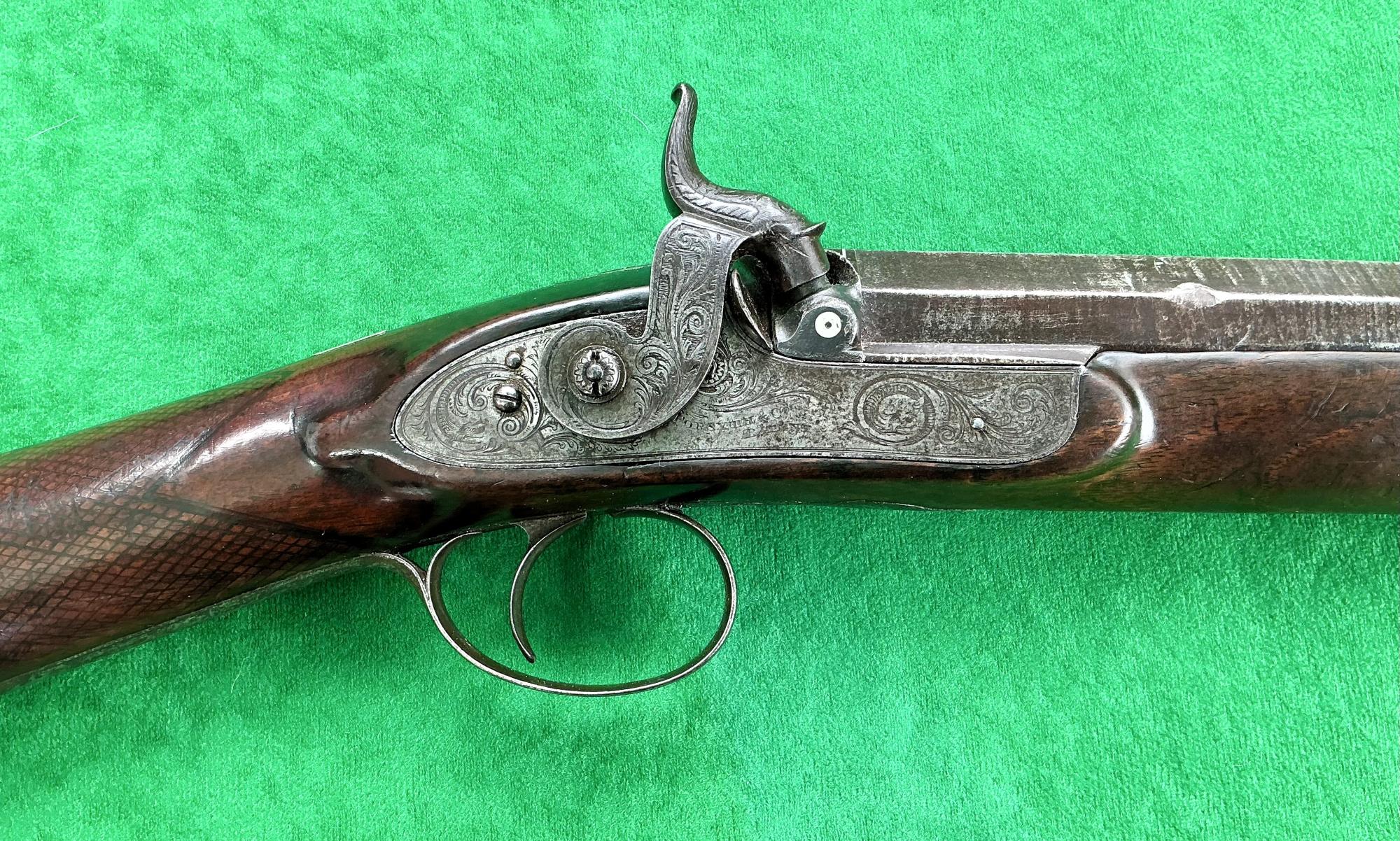
The gun is best described as a Gentleman’s Sporting single barrel gun, made as a 10 bore, the date of manufacture of this Forsyth gun ensures the gun to be of an early design, and capable of accepting the ‘Joyce’ style copper percussion cap. The barrel is of twist iron and 28 inches in length, the barrel being made of a three stage form, the barrel starts as octagonal, becomes hex-decagonal, then with a raised ring junction, the barrel transitions to round towards the muzzle.
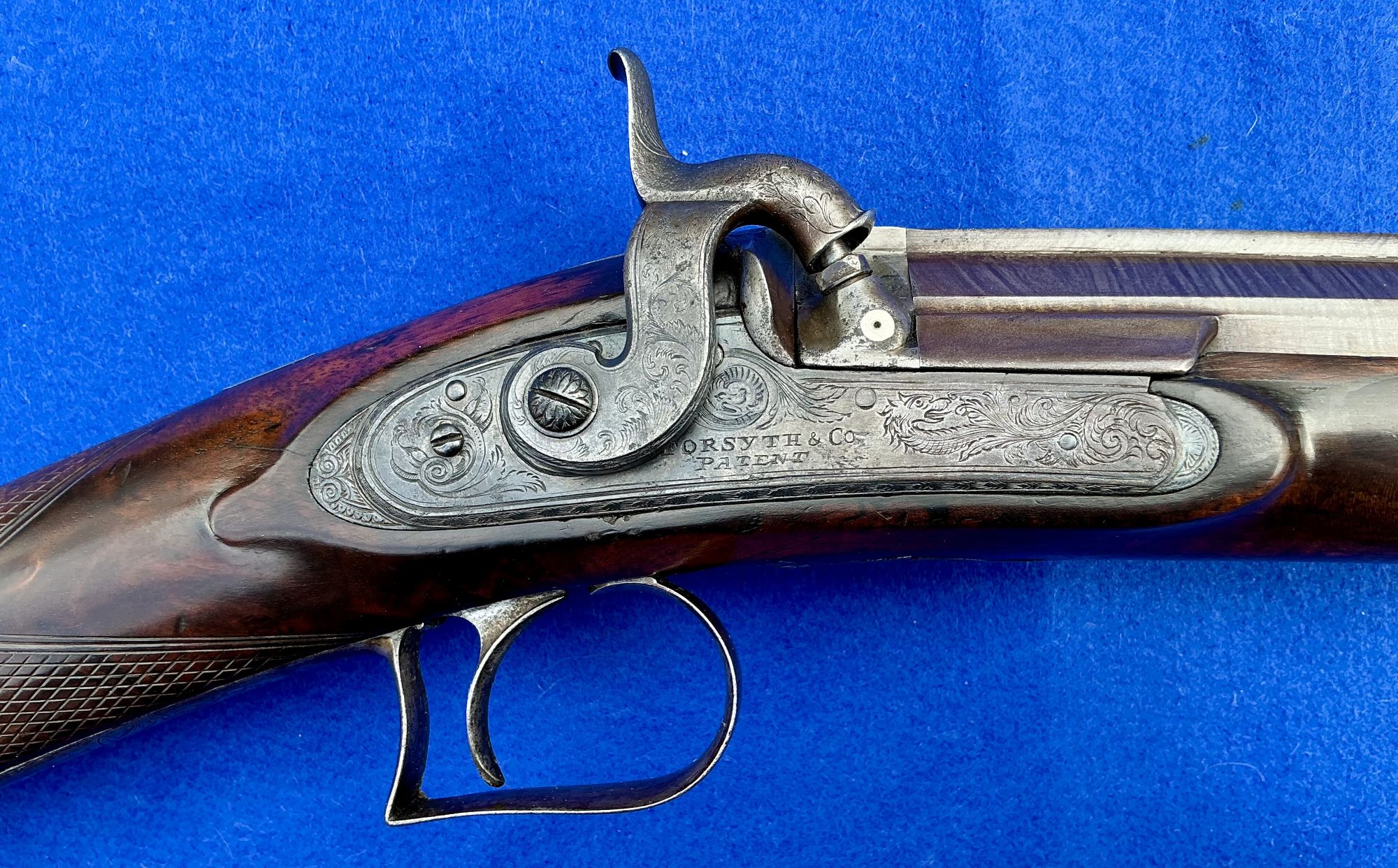
The barrel top signed 'FORSYTH & CO., PATENT GUN MAKERS, LONDON'. The gun is half stocked in straight grained walnut, with flat topped checkering to the hand (Worn Flat) and a cross-pin fastening catch, to attach the barrel to the front end of the woodwork. The butt plate is of steel with an elongated engraved butt plate tang running on to the stock comb. The lock plate is scroll engraved, having FORSYTH & Co. PATENT engraved just in front the lower part of the hammer. The lock being removed for cleaning and lubricating, allows us to view a lock made in Alexander Forsyth’s workshop almost 200 years ago, the lock is refined for the time it was made, however, today the lock would be considered as being over engineered, needless to say, the lock is of excellent quality and works today as if it had just been made. The lock is not marked by a maker, however, this should be of no surprise, as the lock would have been fitted and finished within Forsyth’s workshops.

Engraved lock plate, with flat sided fully engraved hammer - Signed 'Forsyth & Co. Patent
The gun is in “As found condition” therefore remains untouched, other than the removal of surface rust and dirt, and a little TLC by way of, gun oil, fine wax, and boiled linseed oil. The gun being almost 200 years old, would have been made at 8 Leicester Street, Leicester Square. London, during spring 1827. The gun has been cared for by many custodians over the past 200 years, and now supports an article about its maker and inventor of the percussion lock.

The Lock internals are well made - At almost 200 years old, the lock operates faultlessly
Many written notes, reports and papers describe the search for a replacement to gunpowder have been published, including those of Samuel Pepys, in his diary for 11th November 1663, Pepys noted that a grain of fulminate of gold "Will give a blow like a Musket." Then in the late 1700’s Claude Berthollet, a French chemist, experimented with fulminates of silver and potassium chlorate; and in England, Edward Howard extracted for the first time a working compound of fulminating mercury. These Chemists were trying to find a substitute for gunpowder, both Berthollet and Howard came to the conclusion that the fulminates were too unstable, aggressive and violent to be used in a gun.
The Reverend Alexander John Forsyth, having studied these papers, reports and notes of his fellow researchers and their discoveries, made the decision in beginning his own experiments. This would be in ascertaining if the new fulminating powders could be used, not as Gunpowder, but as an ignition agent for the charge of gunpowder. For this to be a practical proposition, Forsyth would have to devise a mechanism in which the fulminate could be stored safely, and to be detonated only when required.

Barrel engraved - Forsyth & Co. Patent. Gun Maker. London
In 1805, Reverend Alexander John Forsyth was 37 years old, Forsyth produced his first successful percussion lock, using a chemical compound which he had spent many hours experiment with. The following year 1806, Forsyth took his gunlock to London. Forsyth moved to London, where his cousin, Henry Brougham, later becoming Lord Chancellor, introduced him to Sir Joseph Banks, to which, Sir Joseph introduced him to Lord Moira who was “Master General of Ordnance”. Lord Moira was impressed with the Forsyth design, and arrangements were made to ensure the Reverend Forsyth could secure a leave of absence from his parish in Aberdeenshire.
The Reverend was given quarters in the Tower of London workshops, and proceeded with the task of perfecting his gunlock. Forsyth’s researchers and workers within the Tower were exceptionally inquisitive, and were seen as hampering Forsyth’s work, this resulted in the Reverend renting workshops outside the Tower, this also supported Forsyth’s concerns his work could copied or stolen.

Serial No. 3362 for 1827 - London Proof Marks for 1813 to 1855
Lord Moira was succeeded by the Earl of Chatham as Master-General of Ordnance. The Earl of Chatham was very much a ‘Champion of the Flintlock’, this resulted in the Earl of Chatham ordering the Reverend Forsyth to remove his "Rubbish" forthwith from the Tower of London.
Reverend Forsyth's dismissal from the Tower of London, was seemingly discourteous, however, this freedom from any official tie was to become a positive in regards to Forsyth's fortunes.

Barrel Breech-Plug, with a more recent percussion nipple - Acting as an Anvil & Flash Channel
During April, 1807, Alexander Forsyth was granted a very broad patent on his invention. Forsyth’s chief claims were; that closing the firing vent to dampen the reaction and the open air vent, in turn preventing the escape of explosive gas outward. This creating the ignition of powder with a fulminate rather than with loose powder and sparks from flint.
The containment of the fire (ignition), and sending the ignition directly to the main charge without waste into the air was an achievement. What this gives the shooter is, no longer limited to that of a burning wick as in the primitive Matchlock, or flying sparks as in the Wheel lock or Flintlock, what is now available to the shooter, is a reliable and instantaneous ignition response from the simple blow of a hammer by way of percussion.

Steel Butt Plate, with engraved butt tang onto the Stock comb
The Reverend Alexander John Forsyth obtained financial support from entering into a partnership with his cousin James Brougham (brother of Henry) to open premises, with an excellent group of workmen in the heart of London. The Forsyth workforce was overseen by the master gunmaker James Purdey, the Gun-making firm operated under the name ‘Forsyth Patent Gun Co.’ from 1808, at 10 Piccadilly. The business created a considerable amount of work, and in turn placed strain on Forsyth and Brougham in running the business, the decision was made in 1809 to bring in Charles Uther in to the business, as a Partner and Manager, with these changes came the change in business name to ‘Forsyth & Co.’ The business was sold to Charles Uther & Son in 1819, this supported James Brougham’s return to politics and the Reverend Forsyth's need to concentrate on ministering to his flock in Scotland.

Straight strong grained walnut woodwork, flat topped checkering worn flat
Recorded in the December 23, 1808, issue of London's "MORNING POST" in this manner:
"To Sportsmen, The Patent Gun- lock invented by Mr. Forsyth is to be had at No. 10 Piccadilly, near the Haymarket. Those who may be unacquainted with the excellence of this invention are informed that the inflammation is produced without the assistance of flint, and is much more rapid than in the common way. The Lock is so constructed as to render it completely impervious to water, or damp of any kind, and may in fact be fired under water.''
Several lock styles were produced on the Forsyth premises at 10 Piccadilly ( from 1808 ) and at 8 Leicester Street, Leicester Square ( from 1816 ). The arms built were of original Forsyth designs, of excellent quality and superb workmanship. The most notable of the Forsyth lock designs, being a rotating magazine of a Flask-like shape, which resembled a ‘Scent-bottle’. In turn the design became known as "The Forsyth Scent-bottle Lock." This is a glamorous mechanism design, and as time has passed, gained historic interest and value.

Dings & Dents, but no cracks or major damage - Testament to numerous careful custodians.
The simplest of the early percussion locks designs, was that of the tube lock. This design is a small copper tube containing fulminate, the tube was partly inserted into the touch-hole, the uncovered end was crushed by the hammer creating ignition. There was an issue with the tubes being dangerous to handle and the possibilities of being blown out of the touch-hole.
Alexander Forsyth protected his patent and designs with considerable passion, bringing successful legal action against Gunmakers and Gunsmiths whom Forsyth claimed had infringed his patent, Joseph Vicars, W A Beckwith, Jackson Mortimer and Joseph Manton had legal action taken against them by Forsyth. There is information stating Joseph Manton managed to continue in developing his work through and after the legal action. Manton patented a pellet lock in 1816, a tube lock in 1818, and in 1834 almost persuaded the Ordnance in adopting another lock using wooden plugs filled with detonating powder.

Three stage 'Iron Twist' barrel, White-metal forend tip, Cross-pin latch, and Ebony ram rod.
Baron Heurteloup, the distinguished French urologist, invented an ingenious lock, which employed a long strip of soft metal containing priming chemicals, this was fed automatically into position when the lock was cocked, when the hammer fell, a small piece was cut off and detonated.
The percussion device which was finally adopted in nearly every country was a copper cap in the shape of a hat, with a small portion of fulminate in its crown. This was placed on an iron nipple which was screwed into the breech and acted as both anvil and flash channel. There are many claimants to the invention of the percussion cap, and Joseph Egg went so far as to print trade labels which bore the words "Inventor of the Copper Cap." Nevertheless, his first percussion patent, dated 26th November 1822, related to a tubular magazine for percussion powder. A slightly earlier patent, No. 4648 of 12th February, 1822, by Sampson Davis, a combined percussion and flintlock, while incorporating a nipple, also does not mention a cap. The action depended on "a cavity under the jaw of the cock falling on the top of the nipple, which is primed with the percussion powder."

Engraved short action tang, Platinum barrel bands, Dolphin headed hammer.
The first British patent to mention a copper percussion cap was that of John Day of Barnstaple, North Devon, with patent No. 4861 dated 12th November 1823. The only safe conclusion that can be drawn is that sometime after 1815 experiments were made with percussion caps but that they did not immediately remove or replace other forms of priming. In fact, it is doubtful whether the copper cap achieved much popularity before 1824.
We have seen, that Howard first successfully produced fulminate of mercury in 1799 and that Forsyth invented a lock which would detonate any of the known fulminating powders. Forsyth seems to have favoured a mixture containing chlorate of potash, which had a strong corrosive action. The problem of properly applying fulminate of mercury, which did not have this effect on copper caps, does not seem to have been solved until 1823.

Case label - Stating; 'Inventors & Patentees' of 'Lock to Fire' without 'Flint'
On the 18th September 1823, E. Goode Wright of Hereford wrote a letter to the Editor of "THE PHILOSOPHICAL MAGAZINE" (Vol. LXII, p. 203) describing how he had successfully made copper caps with this type of priming, and coating the powder with gum benzoin.
The process of production and manufacturing in the UK was finally taken to the London chemist, Frederick Joyce. Mr. Joyce of 11, Old Compton Street, Soho, using a specification of a new 'Anti-corrosive percussion powder'." Joyce appears in the London Directories as an "Operative Chemist" from 1823-27, however, from 1828 becomes F. & E. Joyce, Percussion Powder Manufacturers. Later Joyce described himself as "Inventor and sole manufacturer of the anti-corrosive gun cap."
The percussion lock had become the go to ignition system by 1830 once all the hard work had be done by Alexander John Forsyth, and not forgetting the inventors and developers who eventually gave us a safe and reliable copper cap.
It was inevitable that Forsyth's ideas, would be, and were developed by others into the percussion cap. The cap invention of which was most notably claimed by both Joseph Manton and Joseph Egg, but also by Joshua Shaw, an Englishman who emigrated to America. Interestingly, Joshua Shaw was an artist but, because of the copper cap, called himself an inventor. He reportedly invented his cap in 1815 and patented it in the USA in 1822.
The importance of change in ignition from the Flintlock to the Percussion lock, cannot be overstated, with the invention of the Percussion Lock being a milestone, and the start of separated and controlled ignition between caps and primers, and their propellant powders.

An elegant Gentleman's Sporting gun from 1827 - built by 'Forsyth & Co. Patent, Gun Makers London
Forsyth’s invention was gradually appreciated for its contribution to the science of shooting, this resulted in Alexander John Forsyth being made ‘Hon. Doctor of Law’ at Kings College of Aberdeen in 1834.
During the late 1830’s, military powers across the globe began to consider the merits of the percussion system. The Austrian military adopting a fulminate tube lock system in 1838, the US officially adopted the percussion lock in 1841, the French in 1840, Prussians in 1839. The British began the transition in 1836, with the Brunswick Rifle becoming Britain’s first percussion musket in 1837. The full adoption of Forsyth’s Percussion system took place during 1839, with the ‘Brunswick Rifle’ being first rifle issued to the British military in 1840, in 1851 the Pattern 1851 Rifle Musket was adopted for all British troops.
The company traded for some years as Alexander Forsyth & Co, and exhibited in the Gunmakers Row section at the Great Exhibition of 1851; a safety gun, and patent locks. The company closed in 1852.
The contributions of the Reverend Alexander John Forsyth, the ‘Forsyth Patent Gun Co.’ – ‘Forsyth & Co.’ – and, ‘Alexander Forsyth & Co.’ were simply outstanding. Finally, his work in the creation of the percussion lock and percussion cap, their far reaching impact, their sheer importance of the invention were to be recognised. The Reverend Alexander John Forsyth gained a well-deserved place in firearms history, when on the 30th of January 1929 a memorial Tablet was unveiled at the Tower of London.
‘Continued development created the Centre-fire ammunition of today’