Thomas Wild - Birmingham
Thomas Wild – Gunmaker – Birmingham
Sidelock Non-Ejector Circa. 1908
Stories from the Scrap Pile
The number of vintage British shotguns being disregarded at this time is something of a concern! Unfortunately, the value of the historic British game gun is in freefall at present, except for those guns deemed ‘Best or Better Quality guns’.
There are a number of factors that are driving this issue, one of which is the legislation for the introduction of Steel Shot. This comes into Law in the UK on the 1st April 2029, and to all intense and purposed it will affect all shotgun users. This has resulted in shotgun owners across the UK, taking stock and make changes to what remains in the ‘Gun Cabinet’

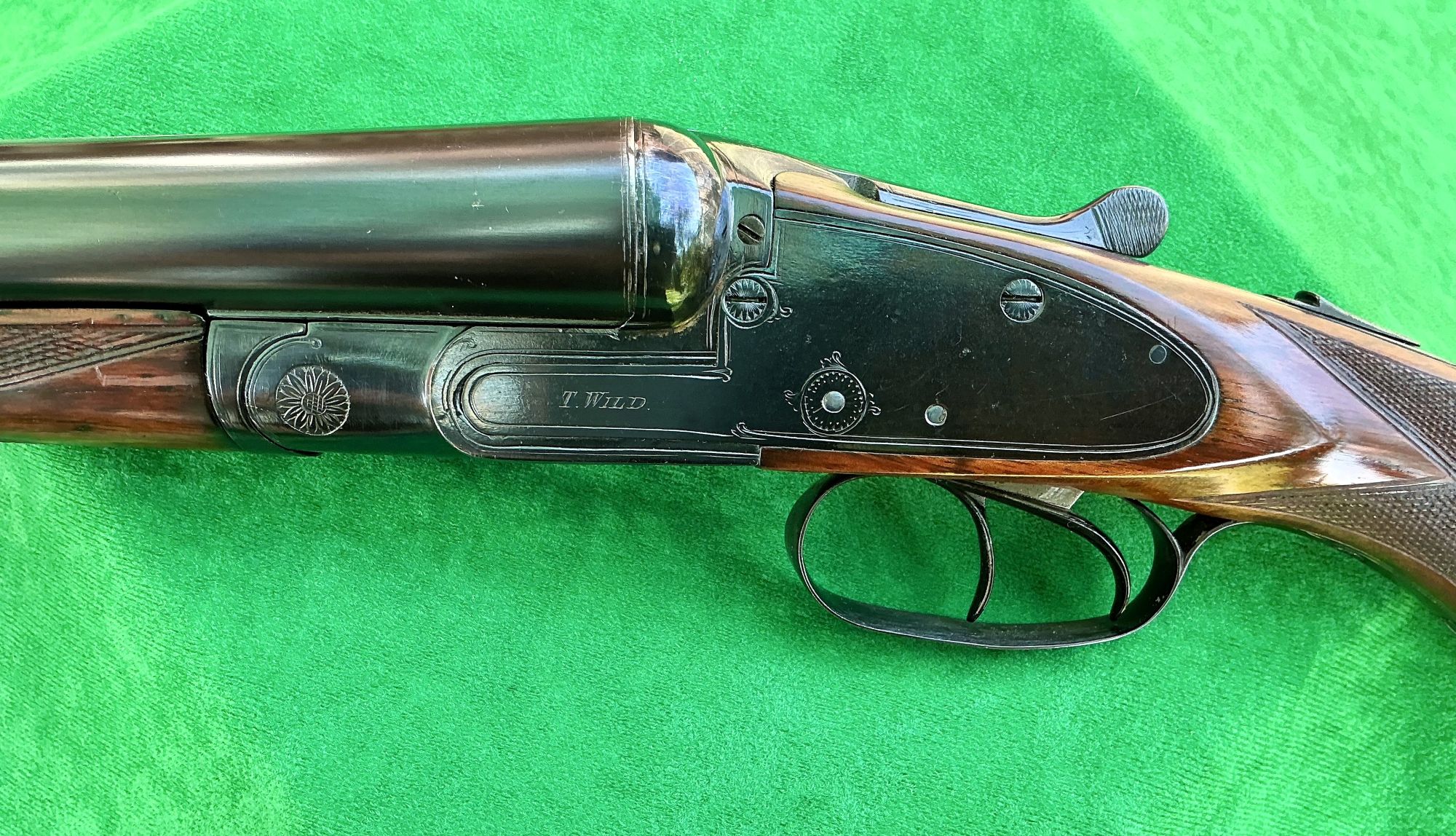
Thomas Wild - Birmingham - Made Circa. 1908, Using William Baker's Patent No. 2899 of 1902
The information on ‘Steel Shot’ is plentiful, however not always clear to understand. The range of available steel shotgun cartridges for those affected in using certain British game guns, are not fully developed, and neither are the full range of cost effective alternatives. This becomes more difficult to understand when there remains a number of British Game guns in regular use, and to which some of those guns are in excess of one hundred years old.
The introduction to this article, answers in part the question of – why has this gun been abandoned prematurely, even though the gun has decades of service left to offer. This gun still has a value, although not necessarily in monetary terms. Thankfully, the gun had the good fortune in being given a new home in exchange for; ‘a cup of tea and a bacon sandwich’

None ejector single extractor, and triple-locking including a 'Dolls Head Extension'
This gun in decades past has been extensively used, however, has been valued, ensuring the gun has been well maintained and cared for. There has been a reasonable amount of money spent, as the gun is in fully serviceable condition.
The gun has been totally renovated approximately 40 years ago, which has included being re-jointed as a part of the sleeving process, the barrels have been re-proofed at .732 in both barrels, however, both barrels measure .729 today, with barrel wall thickness at a minimum of 30 thousandth of an inch in both barrels and Chambered for 2 ¾ cartridges. The gun passing reproof, with the letters M C either side of crossed swords and the number 1 at the base of the crossed swords, giving us a date code for all the latest work on the gun of 1986, and being passed at the Proof House by a ‘First Class Inspector’. The sleeving work has been well done, with barrels identically bored, with good consistent barrel wall thickness throughout, the barrels ring true and are nicely balanced.
The previous proof marks have been struck over, initially making dating the gun more difficult, furthermore there appears to be a possibility of a third set of proof marks. The serial number from the earliest available ledger information gives serial number 6416 with a build date circa. 1892/3, however, the gun itself uses the William Baker patent 2899 lock of 1902, this helps with the interpretation of the older struck through proof marks, giving a strong indication the gun was originally proofed between 1904 and 1925, with a build date Circa. 1908

Old proof marks over stamped, with the earliest being 1904 to 1925 and for Black Powder
The gun being ‘Sleeved’ and proofed in 1986 for Nitro Powders, and having 2 ¾ inch chambers, would without question allow this gun to be safely used with ‘Standard Steel’ cartridges after some minor choke alteration.
The stock and forend are of a reasonable grade of walnut, with finer cut of checkering than expected to be found on this grade of gun, the gun uses the ‘Hackett’s forend fastener' ( patent no. 964 of 1878 ). Although the gun is a Sidelock, the gun is also a non-ejector, and has minimal engraving, this giving the gun a very plain and functional appearance. The best description for this gun would be a ‘Middle-of-the-range-Gun’ the research shows, that the majority of ‘Coil Spring Guns’ sold for approximately half-the-cost of a ‘Best Gun’

Walnut stock & forend with strong straight grain and little figuring.

Straight grained walnut, with well fitted Vulcanite heel pad
This Thomas Wild gun today remains in good working condition after over one hundred fifteen years, the barrels are 28 inches in length, the gun balances over the hinge pin, the gun weighs 6 pounds 12 ounces, has a length of pull of 14 ¼ inches, with an overall length of 45 inches. The balance, handling and pointability of this gun is surprisingly good.
The gun made and retailed by Thomas Wild of Birmingham, using the William Baker ‘Coil Spring Lock’ patent No. 2899 of 1902. The example of the patent No. 2899 in this particular gun is one of three variants of the patent, however, this is the only one that is regularly encountered.

William Bakers catalogue describes the patent No. 2931 of 1898 - predecessor to the patent No. 2899

The lock reduces the amount of wood needing to be removed for inletting

William Baker patent No. 2899 of 1902 - 'Coil Spring' Sidelock - W B initials just in front the Hammer
There is a full and concise entry on the William Baker patent’s using his ‘Spiral Spring’ design in; ‘The British Shotgun’ Volume Three – from pages 204 onwards, by I. M. Crudgington & D. J. Baker.
Thomas Edwin Wild was born in Leicester in 1825. Where Thomas was apprenticed is not exactly known, but he was recorded in 1849, probably as an 'outworking stock maker' at Court, 17 Steelhouse Lane Birmingham. At the time he was living as a lodger with Richard Johnson, a cordwainer (boot and shoe maker), at 42 Whittall Street.
Almost certainly, Thomas work for Benjamin Watson (Gunmaker), and at some time between 1851 and 1857 he married Benjamin Watson's daughter and moved to 29 Whittall Street. It has been widely reported that in 1857 Benjamin Watson handed the business over to Thomas Wild. These reports imply that Benjamin ceased to trade, but this is not correct, as close to the time of the marriage of his daughter to Thomas, Benjamin (aged 52) appears to have decided to concentrate on being a "percussioner" to the trade and, in order not to upset his trade customers, he left Thomas Wild to run the retail side of the Watson Gun-making business under the Wild name.
In the 1861 census Benjamin was recorded as a gun percussioner living at 14 Steelhouse Lane with his wife, Sarah, who was recorded as a burnisher. From 1861 to 1864 Benjamin Watson (III) was also shown in the street directories as trading at 73 Moland Street. At this time the firm was probably exporting arms to the USA for use in the civil war. The Moland Street premises had become Watson's principal place of business, but he still lived and worked at 14 Steelhouse Lane.
At the time of the 1861 census Thomas Wild and Sarah were living above the shop at 29 Whittall Street.

The 'Coil Spring' Sidelock plates lack the external pin tips of the usual 'V' spring Sidelock
The 1861 census records, the same Isaac Watson of Summer Lane (brother of Benjamin and noted in the 1841 census) as a gun percussioner aged 38 living at 23 Lower Loveday Street with his wife, Elizabeth (a provision dealer), and children; Isaac (b.1856), Rowland (b.1857), plus three daughters and another son.
Benjamin (III) died in 1870 aged 65. Between 1864 and 1870, it seems that Thomas Wild took over his business and the premises at 35 Moland Street. These premises did not become his principal address, the principal address remained at 29 Whittall Street until 1883/6.
The 1861 census showed Benjamin (IV), aged 29 and a gun maker, living at 37 Bagot Street as a lodger, with his wife, Eliza (a warehousewoman born 1837), and their son Benjamin (V) (b.1857). It is believed they married in 1857. The 1871 census recorded Benjamin (IV) as a gun percussioner living at 37 Bagot Street with his wife, Eliza, and Benjamin (V) who by then was an iron caster aged 14.
In the 1871 census Thomas Wild and Sarah were still living at 29 Whittall Street (no children were recorded), but between 1883 and 1886 the firm's principal place of business changed to 35 Whittall Street, which probably between 1886 and 1894 (just after Thomas Wild died) was named ‘Victoria Gun Works’ where they also traded as ‘The Arms and Ammunition Manufacturing Company’. The company claimed a head office at 143 Queen Victoria Street, London, and the City of ‘Liege’ in east Belgium.

Barrels engraved with; T. Wild. Whittall Street. Birmingham.
At the time that he died Thomas Wild was living in Aston. No other census entries for the Wild family have been found, but there may have been a son. A Benjamin Wild worked for BSA then for Midland Gun Co, but in the 1930s he established his own business, Benjamin Wild & Co which is trading today. There were a number of people named Wild in Birmingham at the time, so whether he was related to Thomas Wild or not is not known.
The 1891 census recorded Benjamin (IV), as a gun maker aged 59, and Eliza living at 2 Court, 2 Park Road, Aston Manor, but in 1893 a firm by the name of Rowland Watson was recorded at 17 Whittall Street, as was Thomas Wild & Co. It would appear that Benjamin (IV) retired in 1893 (he died in 1896) and that Rowland Watson (I) took over from him. There are reports that Rowland Watson was the son of Benjamin Watson (III), and was Thomas's nephew but, as mentioned above, he was in fact the son of Isaac Watson of 23 Lower Loveday Street and was therefore Sarah's cousin. Rowland Watson's trade label at this time claimed establishment in 1857 which was the date Thomas Wild started his business, but the trade label used from about 1900 stated the date of establishment of the original Benjamin Watson in 1723.
In the 1901 census, Rowland Watson was recorded as a gun maker aged 44 (b.1857) at 17 Whittall Street living with his wife, Catherine, and their son, Gilbert aged 19. He was recorded not as an employer but as a worker, working from home, and Gilbert's occupation was recorded as gunmaker's assistant, presumably to his father. The firm of Thomas Wild appears to have been operating from 19 Whittall Street, although from about 1901 Rowland Watson's address was also given as 17 Whittall Street.

Front lump shows through the Action base, the second lump within the Action body.
In 1933 the firms of Rowland Watson and Thomas Wild (& Co) occupied 17 and 18 Whittall Street.
In 1941 Rowland Watson (I) died and his brother Gilbert Watson took over. Gilbert appears to have retired or died in 1951 and his son, Roland H G Watson (Roland (II)) born on 19 May 1910, took over. He was a Guardian of the Birmingham Proof House. The firm remained at 17 and 18 Whittall Street until 1962 when they moved to 32 Lower Loveday Street.
Roland H G Watson retired from the management of both firms in 1987 and also as a Proof House Guardian. He died in 1988 in Solihull, and Barry A King, who had started work with the firm in 1951, bought the business. Barry King started as an errand boy, became a warehouseman, and eventually specialised as a stocker. The firm stocked guns for many Birmingham gunmakers such as Holloway & Naughton, Skimmin & Wood, Midland Gun Co, G E Lewis, William Ford and others.

Action with 'Purdey Bolt' patent no. 1104 of 1863 - & - Hackett’s forend fastener patent no. 964 of 1878.
Guns produced by the firms were marked Watson or Wild, but the same numbering sequence was used for all guns. Obviously, most Watson guns made for the trade were engraved with the name of the retailer rather than with the names of Watson or Wild. The early records of the firms seem to have been lost.