Edward Bond - London
Edward Bond – London
1865 Pin-fire
Gun maker 1762-1879
Edward Bond of London is best known from the era of the Muzzle-loader covering; pistols, sporting guns and military weapons made as both, Flint-lock and Percussion. The quality of work from this maker is well established including good quality ‘Duelling Pistols’
Edward Bond and the manufacture of Sporting Game guns in the form of Pin-fires are relatively low in number. The new breech-loading concept attracted the landed gentry, with the majority of best sporting game guns being made by premier makers of the day. Although Edward Bond was a good gun-maker, the business did not attract the same level of clients for the latest breech-loading sporting guns, this is not to say commissions for best breech-loading guns were not taken on by Edward Bond.

Edward Bond - 13 bore Pinfire - Serial No. 711 - Built Circa. 1865
The gun that inspired this article has survived for 160 years, and is a strongly made Pinfire sporting gun. However, the gun realistically has been built as a ‘Third Quality’ London Pin-fire sporting gun in respect to overall finish. The gun has been made using good quality materials and component throughout, ensuring the gun will provide good reliable service and longevity.
The stock is of a strong straight grained walnut, there is little in the way of figuring to either the stock or forend. The engraving throughout the gun is open, the barrels are of Damascus, with strong open patterning. The gun represents a good example of a third quality off the shelf early breech-loader, supplied by a well-established London maker.
However, not all that glitters is gold. This gun in fact represents a prime example of the ‘London and Birmingham’ gun trade working together. The Edward Bond business at this time was trading on a good reputation, the quality of Edward Bond’s products has never come into question, or raised any issues in respect to reliability or quality. The decision for the Bond business of buying in Trade made guns, is nothing new, and a common practice for many gunmakers. This practice is not an issue, especially if the Trade supplier is reliable, building good quality guns that provide reliability in line with the retailers expectations.

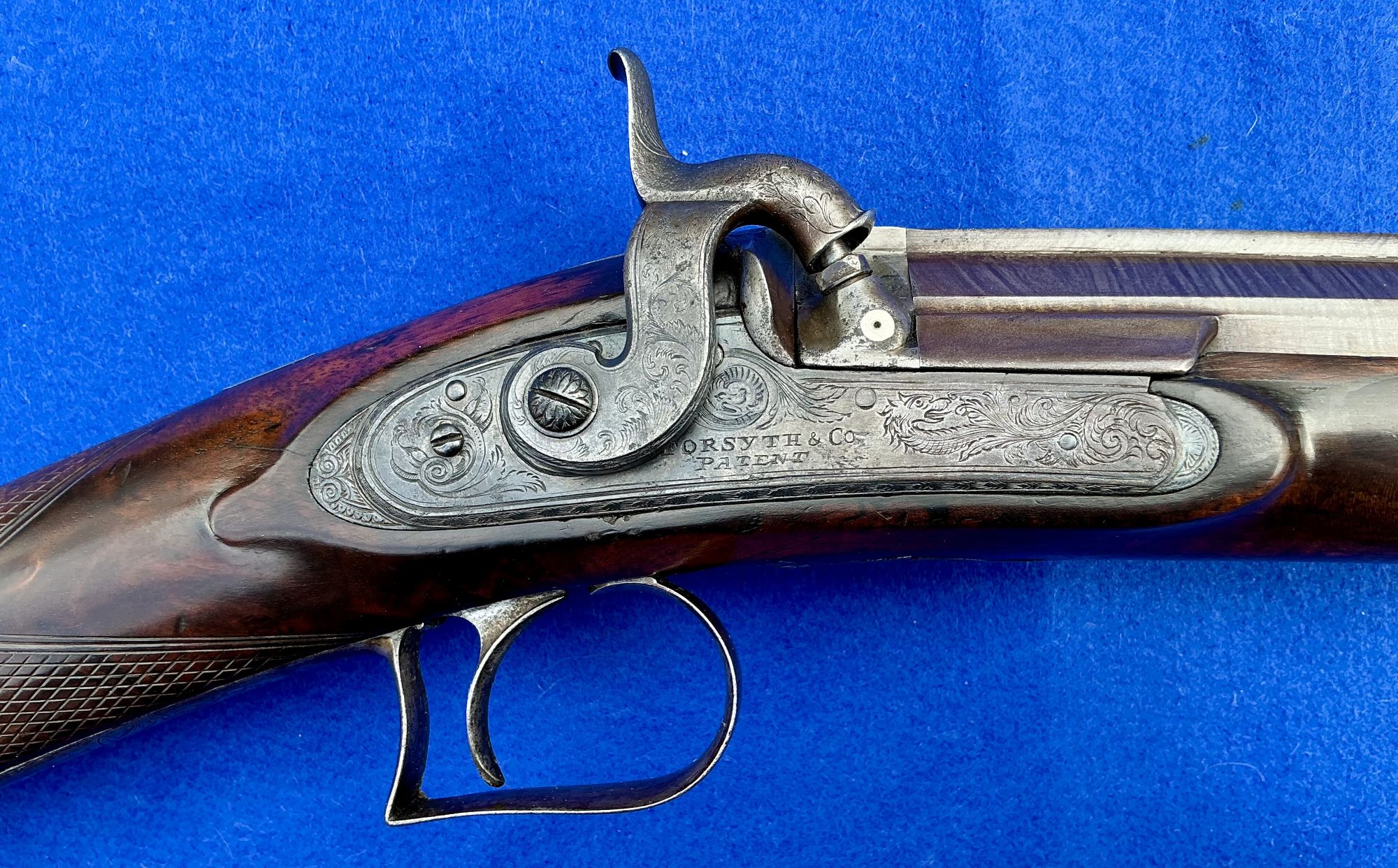
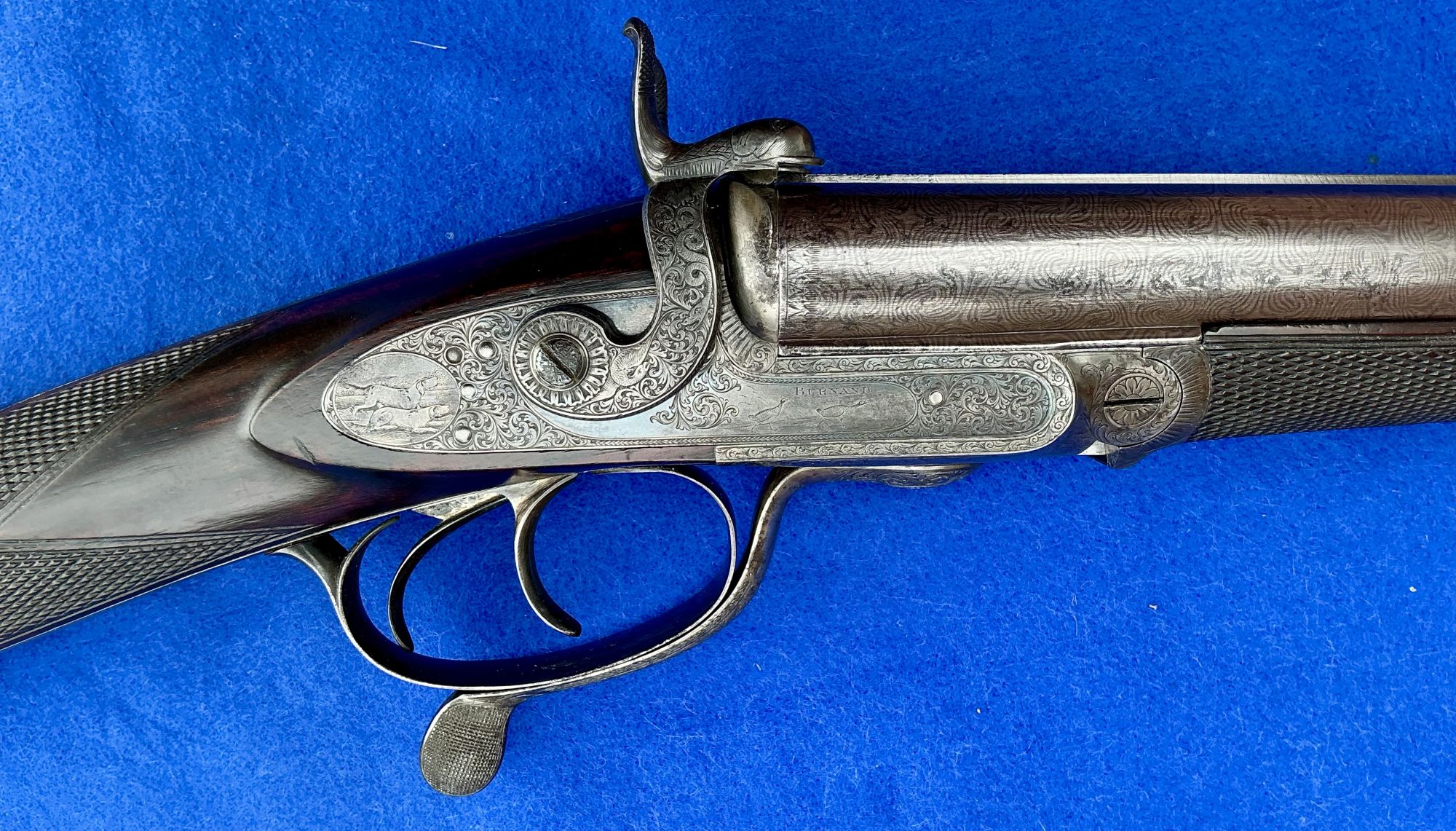
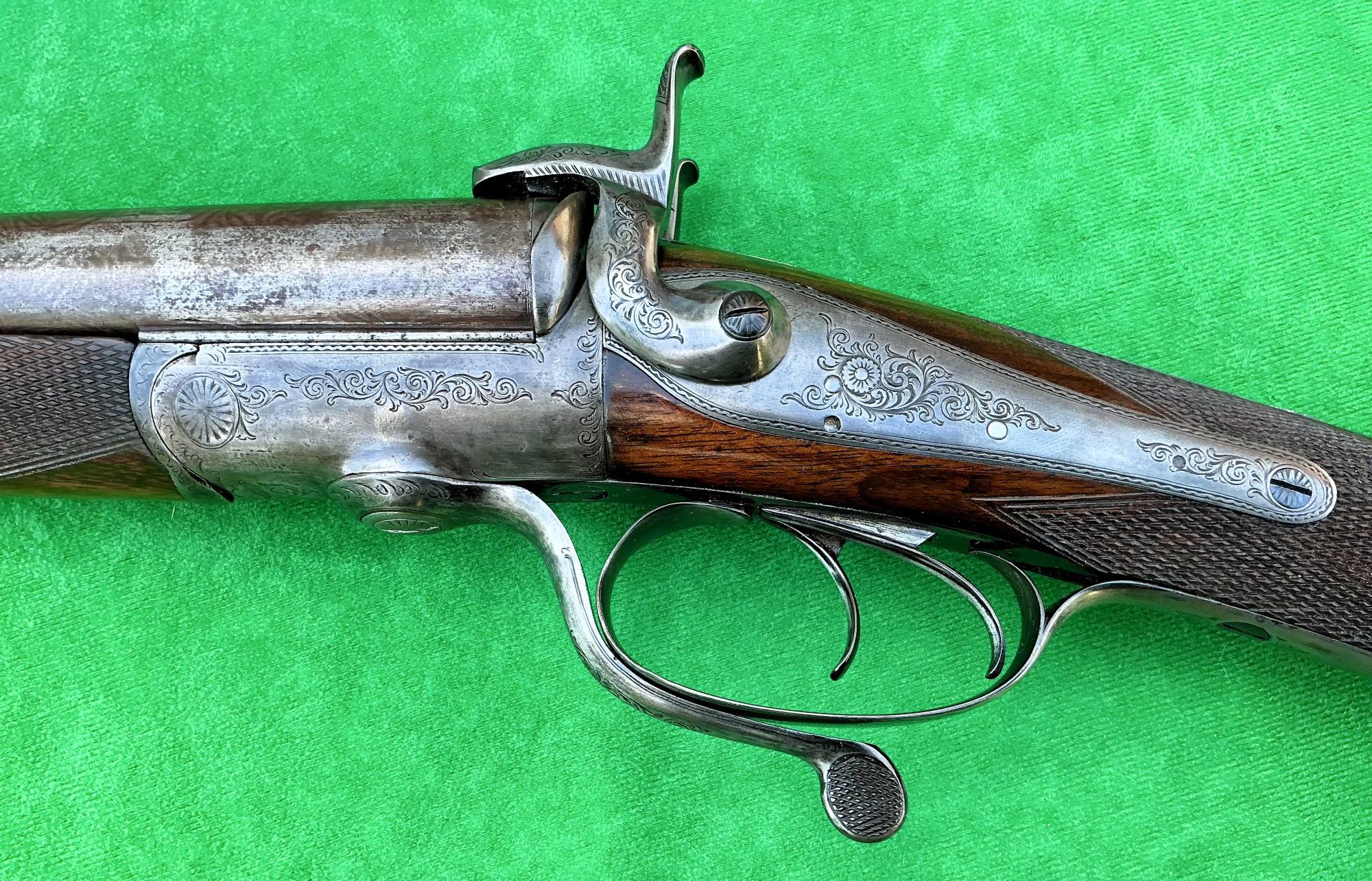
Jones style under-lever opening (Double Bite) - Minimal engraving - Locks Unnamed
This Edward Bond of London – Pinfire, serial number, No. 711, was in actual fact built in Birmingham. The gun carries Birmingham proof marks for 1855 to 1868, the gun uses a Jones style ‘Double Bite’ lever over guard locking system, the barrels are 30 inches in length, although pitted, they remain in proof at .722 and .727, with barrel walls at 25 and 28 thousandths of an inch. The locks are well made trade locks, lacking the internal refinement and finish of best locks, are un-named and unnumbered. The gun is engraved throughout using an open style of engraving, however, the gun is far better finished than an entry level gun.

The gun retains its original hinge pin - Strong open pattern Damascus
The retailer being Edward Bond, would not have wanted to advertise the gun as being made by another, so the top rib is finely engraved, and carries the name ‘E. Bond London’. The close examination of the gun reveals on the bottom rib, between the barrel flats and the forend loop a small makers stamp, and the initials R R. The only recognisable gunmaker and Trade supplier with the initials R R at this time, being that of Richard Redman of Birmingham. This aligns perfectly with Richard Redman’s known activity during this period. Richard Redman (of Pryse & Redman) was operating between 1842–1873, Redman was actively supplying gunmakers within the same period - 1855–1868, importantly, Pryse & Redman were major suppliers of sporting guns (finished, or in the White), barrels, actions, and component parts, all of which were being supplied to both Birmingham and London gun making outlets.

The gun is identified by the Top rib engraving - 'E. Bond. London.
The making and supplying of guns, and gun parts for provincial makers by other makers has taken place for some considerable time, if not for hundreds years. These services were usually supplied by gunmakers with capacity, and on occasion, through a collaboration of likewise gunmakers.

Birmingham Proof marks - 1855 to 1868 - The Makers stamp 'R R' for Robert Redman of Birmingham
An example of a collaboration of makers typical of supplying such a gun would be, The Abingdon Works, which was formed in 1867. This was a manufacturing partnership located in Shadwell Street, Birmingham, to supply the trade with ready-made guns and gun parts. The Abington Works partners were John Dent Goodman, Thomas Bentley, William Bourne, Charles Cooper, Charles Pryse, Richard Redman, Joseph Smith, Charles Playfair, Joseph Wilson, John Field Swinburn and Fred and Henry Woodward.
Many of the collaborated partners had been making guns and parts for the gun trade prior to the Abingdon Works partnership, as evidenced by the Edward Bond Pinfire sporting game gun being supplied by Richard Redman, or Pryse & Redman just a few years before the Abingdon Works came to fruition.

Lightly figured with a strong straight grain running the full length of the stock.

The stock carries a silver oval (unsigned) and a steel butt plate with short widows peak onto the comb.
This gun is a prime example of the mid‑Victorian two‑tier gun trade, whereby, Birmingham gunmakers manufacture the gun, and London gunmakers retail the gun under their own name. The practice might sound familiar, as modern manufacturing systems across thousands of products globally are used in businesses today.
The correct and careful choice of which Birmingham ‘Trade Supplying’ Gun-maker is important for the retailer, ensuring the products retailed through the likes of Edward Bond’s London outlet are of; good quality, reliable, provide good service, are affordable, and available for clients / customers when needed.

Made by Birmingham gunmakers - Retailed by the London Gun-trade, by Edward Bond of London.
The business of Edward Bond as a family of Gunmakers has an interesting and history - Edward Bond was apprenticed to Samuel Blanckley in 1746. He was turned over to Abraham Jones and free of the Gunmakers Company in 1754. In 1762 Edward Bond started his business at 108 Leadenhall Street.
In 1771 he moved to 59 Lombard Street ("The Golden Blunderbuss") and became Viewer to the Hudson's Bay Company, a post he held until 1789.
In 1775 he took over the business of John Bumford at 8 George Street, Minories, he probably used these premises as a factory but there is no record of this.
In 1776 he became Elected Assistant in the Gunmakers Company, and he took Livery in 1778. He was Master in 1780.
From 1780 to 1787 the firm had a factory at 31 Nicholas Lane.
In 1790 Edward Bond died but the firm was continued under his name by his wife Mary until in 1794 their elder son, Philip John Joseph Bond took over. He had been apprenticed to Thomas Tringham in 1774 and became free of the Goldsmiths Company in 1781.

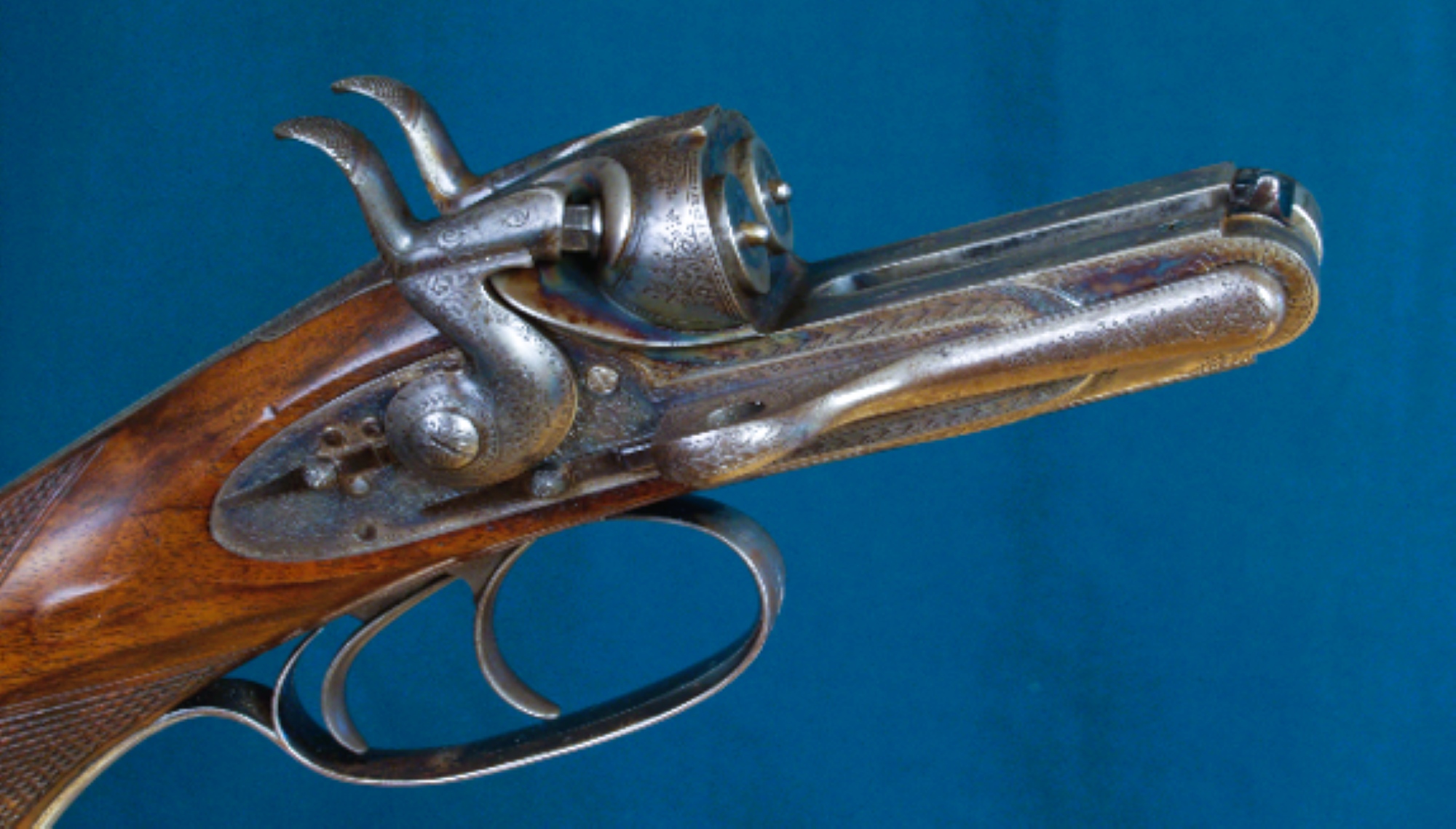
The Under-lever sits close to the trigger bow - Common name - 'LOG' - Lever-Over-Guard
The firm, still trading as Edward Bond, took on additional premises at that date, at 45 Cornhill, and described themselves as gun makers and sword cutlers. At some date, probably after his mother died (about 1810?), Philip Bond changed the name of the firm to his own.
From 1790 to 1815 Philip Bond was Viewer to the Hudson's Bay Company (he died in 1816).
In 1803 Edward and Mary's younger son, William Thomas Bond (William Thomas (I), had taken-over the 59 Lombard Street business from Philip Bond. He ran it under his own name until 1836, when he died, it was then run by his wife Elizabeth until 1845 (this must have been a second marriage because he was married on 8 February 1796 to Sarah Ashby). William Thomas (I) had been apprenticed to Richard Williams in 1786, was free of the Gunmakers Company by patrimony in 1799, took livery in 1819, became Elected Assistant in 1827 and Master in 1829. In 1803 he was appointed gunmaker to the Grocers Company, he was Gunmaker to Ordnance in 1835.
From 1816 to 1825, Philip's elder son Edward James Bond ran the 45 Cornhill business which again traded as Edward Bond. Edward James Bond had been apprenticed to Philip in 1804, was free of the Goldsmiths Company in 1811, and took Livery in 1816. He was Gunmaker to the Hudson's Bay Company 1821-1825, Gunmaker to the East India Company 1816-1834, and Viewer to the Hudson's Bay Company 1816-1823.
In 1825 William Thomas (II) (Philip Bond's younger son, was taken into partnership by his elder brother, Edward James, at 45 Cornhill. William Thomas (II) had been apprenticed to Edward James Bond in 1818, and free of the Goldsmiths company in 1825. They traded as Edward & William Bond, Gunmakers and Archery Warehouse and later, as E & W Bond, sword cutlers & gun makers but in apprenticeship papers he was also referred to as a goldsmith.
Edward died in 1834 and William Thomas (II) continued on his own until 1844. William Thomas (II) was Gunmaker to the East India Company from 1835 to 1844.

Good materials has help this gun survive from 1865
The 1841 census records Annie (b.1788) who was Edward James' widow, living in King Street Crescent (Dalston / Hackney) with Elizabeth Bond (b.1799 Annie's sister-in-law), and Annie's children, Edward Philip (b.1821 and Eyton (b.1826). Both Edward Philip and Eyton were described as gun makers.
In 1844 when William Thomas (II) died, Edward Philip Bond took over with William Thomas' widow, Ann, as his partner. The name of the business remained E & W Bond. Edward Philip was the son of Edward James and had been apprenticed to his uncle, William Thomas (II) in 1835 but was turned over to John Edward Barnett in 1836. He was free of the Gunmakers Company in 1842, Elected Assistant in 1843, and Master in 1847, 1859, 1864, 1875 and 1883). From 1844 to 1853 he was a Contractor to the East India Company, and in 1856 a Contractor to Ordnance.
In 1846 the firm acquired premises at Hooper Square, Goodmans Fields.
The 1851 census records Edward Philip as a 30 year old gun maker employing 30 to 50 men which made him one of London's largest gun makers. He was living at 1 Hereford Villas, Queens Road, Hackney with his wife Eliza Ann (b.1823) and their children, Edward James (b.1848) and Frances (b.1850) and a servant and a nurse. This census records Edward Philip's mother, Annie, as a widow and gun maker living at 19 Dalston Rise, Hackney, with Eyton and his wife Mary (nee Crowe b.1822) and Elizabeth Bond. Eyton was described as a ship broker so he had obviously given up gun making probably because with Edward Philip in control of the business he saw little future in it for himself. However, in 1856 he moved to Birmingham and established his own business as a gun maker, but he probably worked closely with Edward Philip by obtaining guns and gun parts for him.

'Edward Bond London' engraved on the Top Rib & Serial No. 711 on the Trigger tang.
In 1856 in London the firm's principal address changed from 45 Cornhill to 142 Leadenhall Street, but in 1859 these premises closed and the firm traded as Edward Philip Bond from Hooper Square only.
In the 1861 census Edward Philip and Eliza Ann were recorded living at 5 Pembury Road, Hackney. Edward described himself as a gun manufacturer employing 60 men and 20 boys. The children recorded were Catherine (b.1856), Eliza Ann (b.1857), Margaret Alice (b.1859) and Ellen Augusta (b.1860). The family employed two general servants and a nursemaid.
Eyton and Mary were recorded living in Heathfield Road, Handsworth, Birmingham (see Eyton Bond of Birmingham.
In 1866 the Snider breech loader was adopted by the British Government and conversion of the existing Enfield muzzle-loading rifles in service was split between BSA (156,000), The Royal Small Arms Factory (296,352), and the London Small Arms Company (85,200). The contract lasted until 1871. The London Small Arms Co. was established by Edward Philip Bond who was Managing Director, and probably others such as Charles Lancaster, in order to fulfil this and, hopefully, further contracts. To what extent it succeeded with further contracts is not known but The London Small Arms Co. traded until 1925.
In about 1868 Edward Philip Bond was appointed executor to Charles William Lancaster's Will, but when Charles died in 1878 he declined to act in that capacity.
In 1870 the Hooper Square factory was disposed of and the firm moved to 4 Northumberland Alley, Fenchurch Street, where they traded again as E & W Bond.

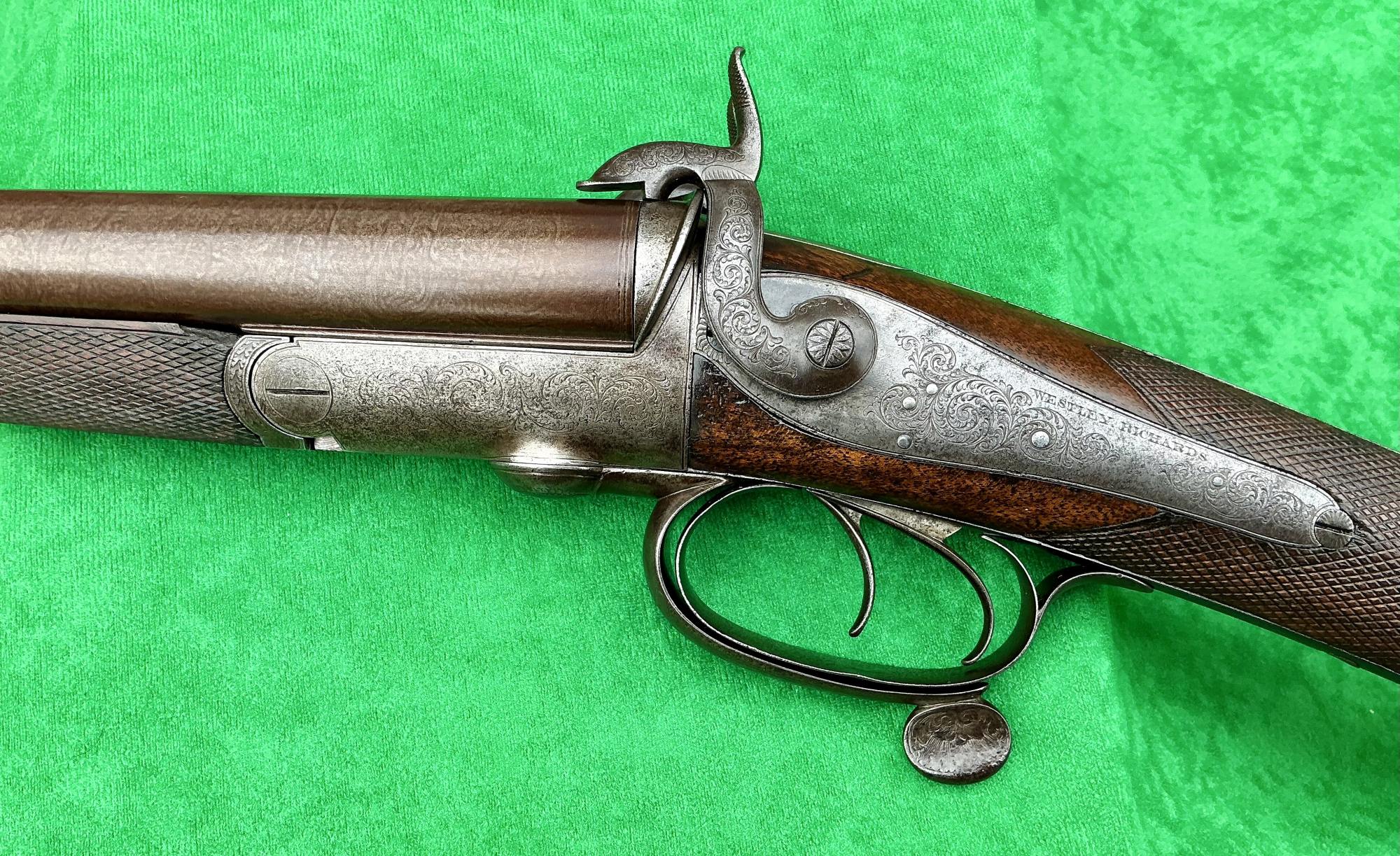
The Hammer noses hide the Pin holes and engraving representing 'Star-bursts'
There appears to be no record of Edward Philip Bond in the 1871 census, and after 1879 the firm was not recorded. However, Edward Philip Bond was recorded in the 1881 census living at 4 Fellows Road, Hampstead, with Eliza Ann, Frances, Catherine, Margaret Alice, Ellen Augusta and a previously unrecorded daughter, Florence (b.1862). In this census Edward Philip described himself as Managing Director of the London Small Arms Company.
Edward Philip Bond died on 29 September 1890 and, as Eyton Bond had died in 1889, there was nobody to succeed him.