Henry Watson Whaley - Gunmaker
Henry Watson Whaley
Strood, Kent
A Pinfire Single barrel, signed Whaley
An interesting article from Stephen Nash, after securing a Single barrel conversion - Muzzle-loader to Pin-fire, by a provincial gunmaker, who likes to doing things the hard way !
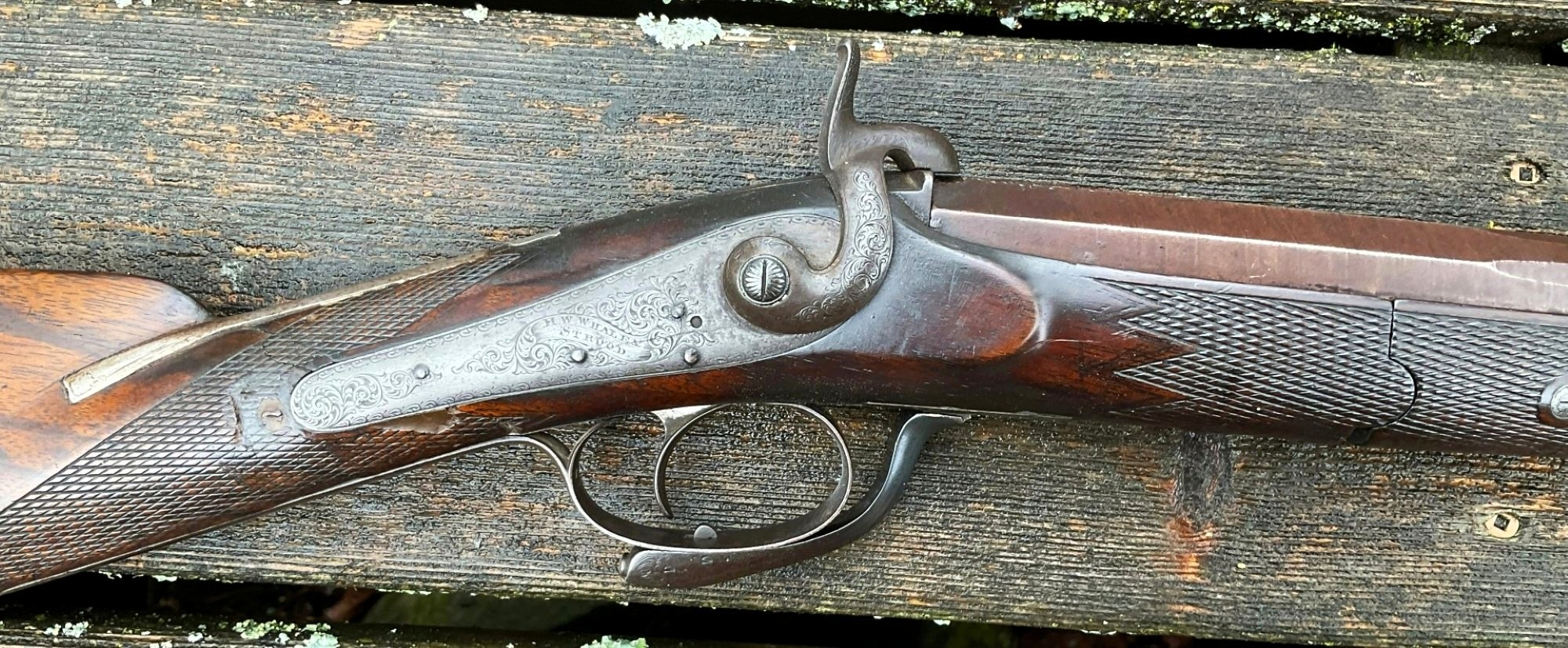
This single barrelled gun in the first instance would have been made by Henry Watson Whaley as a single barrel muzzle-loader. The conversion from muzzle-loader to breech-loader is not an easy task, however, the decision to conduct the conversion using an unmarked action of the Robert Adams No. 285 patent design of 1860 might have been a carefully considered and clever move ! - especially considering the gun had been made with an ‘Island Lock’ this would have simplify the fitting of the ‘Adams’ design under-lever, and further supported the remaking the gun with a Bar-in-Wood action and semi-crab joint forend ! – However, all this work, without having the gun re-proofed ? creates a mysterious tale -

Pin-fire by Henry Watson Whaley - using Robert Adams Patent 285 of 1860
Henry Watson Whaley – Gunmaker - Strood, Kent - On the surface, this single-barrelled pin-fire, signed ‘H. W. Whaley, Strood, Kent,’ is a fine-looking gun that has undergone period repairs and perhaps more recent (and less skilled) restorative work. The dimensions of the gun are for a person of typical stature (and not a small person, or boy’s gun), the level of decoration is in keeping with that of a second-quality London gun, or a first-quality gun of a provincial maker (Strood is a small town about 27 miles east of central London).
The action fitted during the conversion is the design of Robert Adams of London, conforming to his patent No. 285 of 3 February 1860, although it is unmarked and unattributed to Adams ! In a letter to the weekly sporting paper, ‘The Field’ dated 6 February 1864, Adams stated his guns were “my own patent, made on my own premises, and under my own supervision,” when challenged about the origins of his pieces, clearly establishing his 76 King William-street workshop as the builder and purveyor of his patented action. However, a number of provincial makers sold guns with Adams' actions, possibly under some arrangement with Adams.

Island Lock - Unsigned Robert Adams action - Bar-in Wood - Crab Joint removable forend.
I expected to find a patent mark or a patent-use number on the action, however surprised to find no markings of any kind on the action, not even provisional proofs. The story got darker, as no proof marks on the barrel were found, only a bore stamp (15). The 28 1/16-inch barrel is of twist construction and is half-16-sided to half-8-sided towards the breech, suggesting it might have been repurposed from a muzzle-loader; the chamber is bored for the 14-gauge pin-fire cartridge.
Whatever marks might have been on the original barrel were gone from the conversion work, and once rebuilt, the barrel and the action were never submitted for proof to either the London or Birmingham Proof House, an offence under the Gun Barrel Proof Act of 1855.
Mr. Adams, whose action design graces this gun, was well aware of the risks of avoiding the proof house; in February of 1860, he was fined £10 for having sold a rifle whose barrel lacked proofs, Mr Adams claiming in court he had sent the rifle out “by mistake.” He subsequently had to recall 20 rifles to avoid paying an additional £20 fine for each one of those rifles. One can assume he did not want to take on further risk to his finances and reputation, and ensured that all his guns were subsequently inspected and marked.

Slimline Action body - Under-lever Locking point in the Trigger Bow base.
In the event Mr. Adams had not made the action, it could have been built by the provincial gunmaker Whaley, or come from a Birmingham workbench. With no way to date the gun, it could have been made after the Adams patent lapsed, explaining the lack of markings on the action. However, by such time, there would have been far easier and more robust designs to copy than the Adams under-lever.
This action was popular in the early 1860’s; a correspondent to The Field in the 29 November 1862 issue, ‘Mountaineer,’ wrote about the Adams action, stating, “I have used one for the past two seasons made by Mr Adams, of King William-street, City; whose principle, for simplicity and strength, I consider the best out.” He further noted, “last season I fired from this gun 2000 shots, and over 1000 this season,” giving an idea of how pin-fire guns were used in the field. He described “another great advantage in Mr Adams's breech-loaders, which is, the absence of that mass of iron-work at the junction of the barrel and breech, which makes it as light and handy as any muzzle-loader.”

Slimline Action and Adams Under-lever, with fine Crab-Joint and Cross-pin forend latch.
Adams's guns under this patent were of the bar-in-wood type, hiding a narrow action bar and the hinge beneath the woodwork. Some of his guns had a permanently attached fore-end, though this particular one is removable. Making any bar-in-wood gun is not for the faint of heart, and this is the only bar-in-wood single-barrel pin-fire gun I've ever come across. It has an ‘island lock,’ and very little metalwork is apparent, giving it the look of a fine muzzle-loading gun.
The name and address on the gun, Henry Watson Whaley of Strood, Kent, offers another avenue to the investigation. Henry Watson Whaley was born in Lynn, Norfolk, around 1805. His father, John, was born in 1781 and was a gunmaker by trade, and Henry likely apprenticed under him. John Whaley & Son traded in High Street, Strood, starting in 1831. Henry married in 1834, but happiness was replaced with trouble in the business. In June 1839, the company was dissolved, and both the father and son were sued and ended up in the notorious Marshalsea debtors' prison that year.

Underside of Barrel - The barrel is void of any Proof Marks
Around 1844, Henry resumed the business under his name at 46 High Street. There must have been a severe falling-out between Henry and his father, as on 13 November 1849, he took out an advertisement in the South Eastern Gazette announcing, “that John Whaley, Sen., his father, has left him, and has no connection whatsoever with his business, and that the said John Whaley, Sen., is not authorised to receive any money or take orders on account of Henry Watson Whaley, from this date.” Nothing much is known about the business, but Henry was recorded as a master gun maker. He did not have any children to continue the business. In the 1851 census, he is recorded as having a 15-year-old apprentice, Henry Jackson, and in the 1861 census, another 15-year-old apprentice, George B. Richardson, is listed as living with him above the workshop. Henry died in 1881, and the business, as gun maker and cutler, was continued by his workman, Edward Palmer, until around 1894 (Palmer may have apprenticed under Whaley).
Unfortunately, there is no way of knowing if Robert Adams's workshop made any part of the action, or if it was made under licence (or not) by Whaley at the High Street address. From the possibly repurposed barrel, I presume it was fitted and the gun assembled by Whaley; the special-order nature of the single-barrelled conversion might help explain why the action and barrel were never proofed, being a one-off conversion, perhaps made under time pressure. In any case, it was originally fine work and aesthetically pleasing. The 14-gauge was popular then, and the single-barrel, bar-in-wood construction made for a light gun weighing 5 pounds 10 ounces.

A full size single barrel Pinfire - Muzzle loader barrel, with Adams patent No. 285 underlever
The silver stock escutcheon is unmarked, leaving no clue as to the original owner. The gun is unnumbered, which is not unusual for a gunmaker producing a small number of guns each year, and, in any case, no Whaley records have survived. The period repair, a pinned metal strap straddling the hand and comb, shows that someone wanted to keep the gun in the field despite a broken stock, perhaps sometime after the pin-fire system was out of fashion. Two other repairs, filler added around the lock and a possibly replaced fore-end tip of darkly-stained wood instead of horn, suggest later amateur repairs or restoration work of a lower quality, perhaps when the gun was relegated to wall-hanger status. Despite these minor blemishes, the gun is interesting, unusual, and storied. The stock is nicely figured, and the flat-top chequering is well executed. Exactly who made the converted gun cannot be determined, nor can the reason for its construction or why it escaped the proof house. Few Whaley arms of any type (by father or son) have surfaced, so it is impossible to know if it was typical in build, quality, or legality. Perhaps some information will turn up in the future that will help fill some of the blanks in this story.