Robert Adams - Gunmaker - Pinfire
Robert Adams - Pinfire
London - 1858-1866
Stories from the Scrap pile
Stood quietly in a corner of a provincial gun shop, dusty, rusty, and out of favour, this old gun was getting ever closer to ‘Madame Guillotine’. This quality made 1860’s London made Pinfire, in well worn condition had a ‘Tale to Tell’ - fortunately for the gun, after a lengthy conversation with the shop owner, the gun was purchased for the price of a good Pub lunch !

Robert Adams Pinfire - Patent No. 285 of 1860 - The 141 st Gun made using the patent.
Robert Adams' career was based around his ability to design and invent, Robert was involved within the Gun trade and industry as a designer, managing director and as a business owner. Robert worked with various Gun Industry designers, including John Deane, and his son John Deane Jr., Lieutenant (Royal Engineers) Frederick Edward Blackett Beaumont, James Kerr, and John Adams (Roberts’ cousin)
The designs of Robert Adams have stood the test of time, but the Robert Adams name has not, with only collectors and enthusiast knowing something about this talented gunmaker. The primary interest today surrounds and focuses on his ‘Revolvers’, however, Robert Adams ability in design concepts, were also used to excellent effect during the ‘Birth of the Breech-loading Game gun’

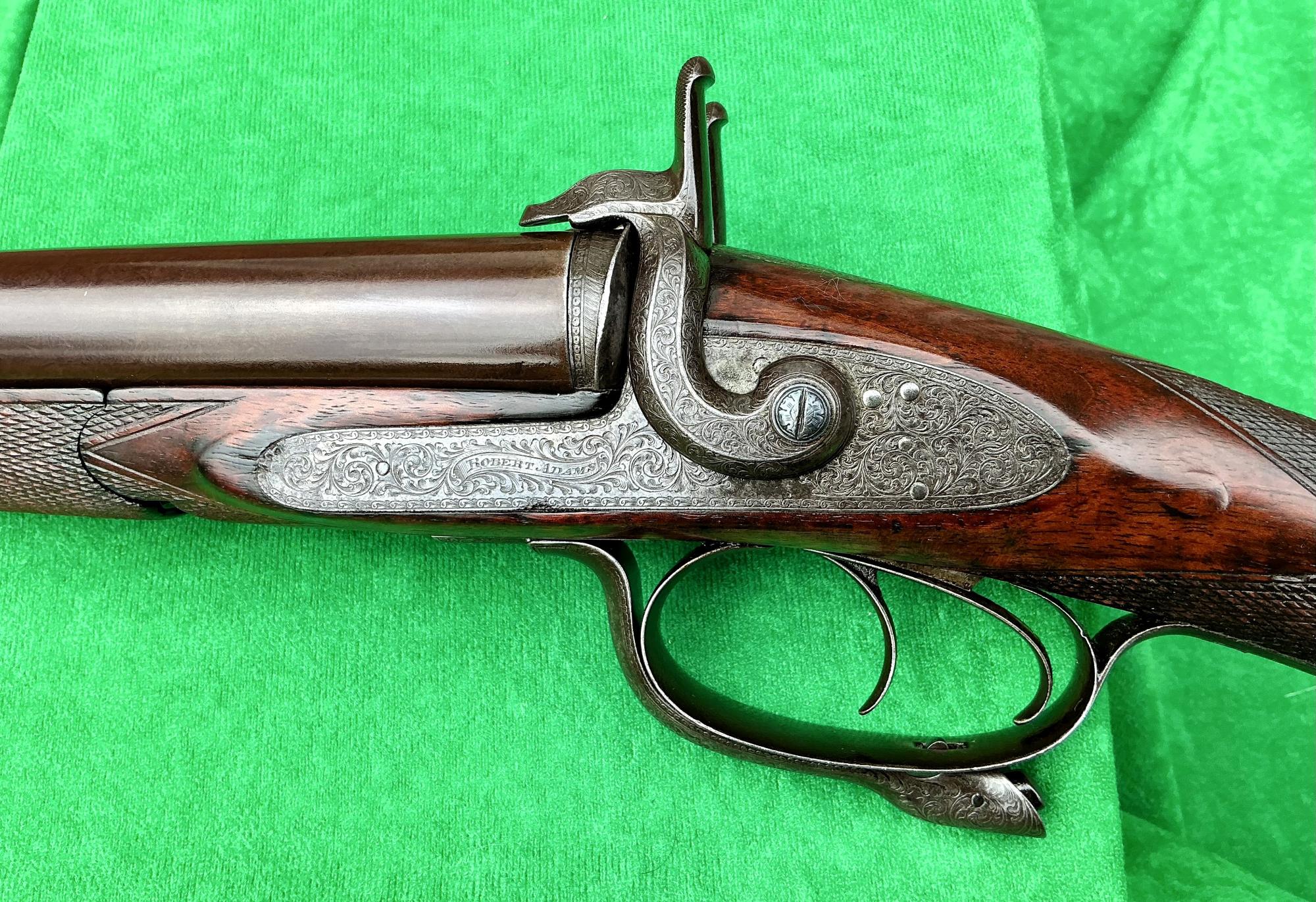
The Half-Moon locking bite - Bar-in-Wood Action - Crab-Joint forend opening.
The Sporting guns’ at this time were primarily Muzzle-loaders, however, the introduction of the breech-loader had started during the mid 1850's, in ‘Pinfire’ form - Robert Adams, a well-established designer and inventor, built patent No. 285 of 1860. This was an improvement on the Casimer Lefaucheaux breech-loader opening design, that was exhibited nine years prior at Alexander Palace. Interestingly, both Lefaucheux and Adams had exhibited alongside each other at the 1851 Great Exhibition – Lefaucheux with his breech-loading game gun, and Adams with his Revolver.
The British breech-loading sporting game gun had been available in Britain from 1853/54 from Joseph Lang, and from that point improvements on the breech-loading design continued at pace.

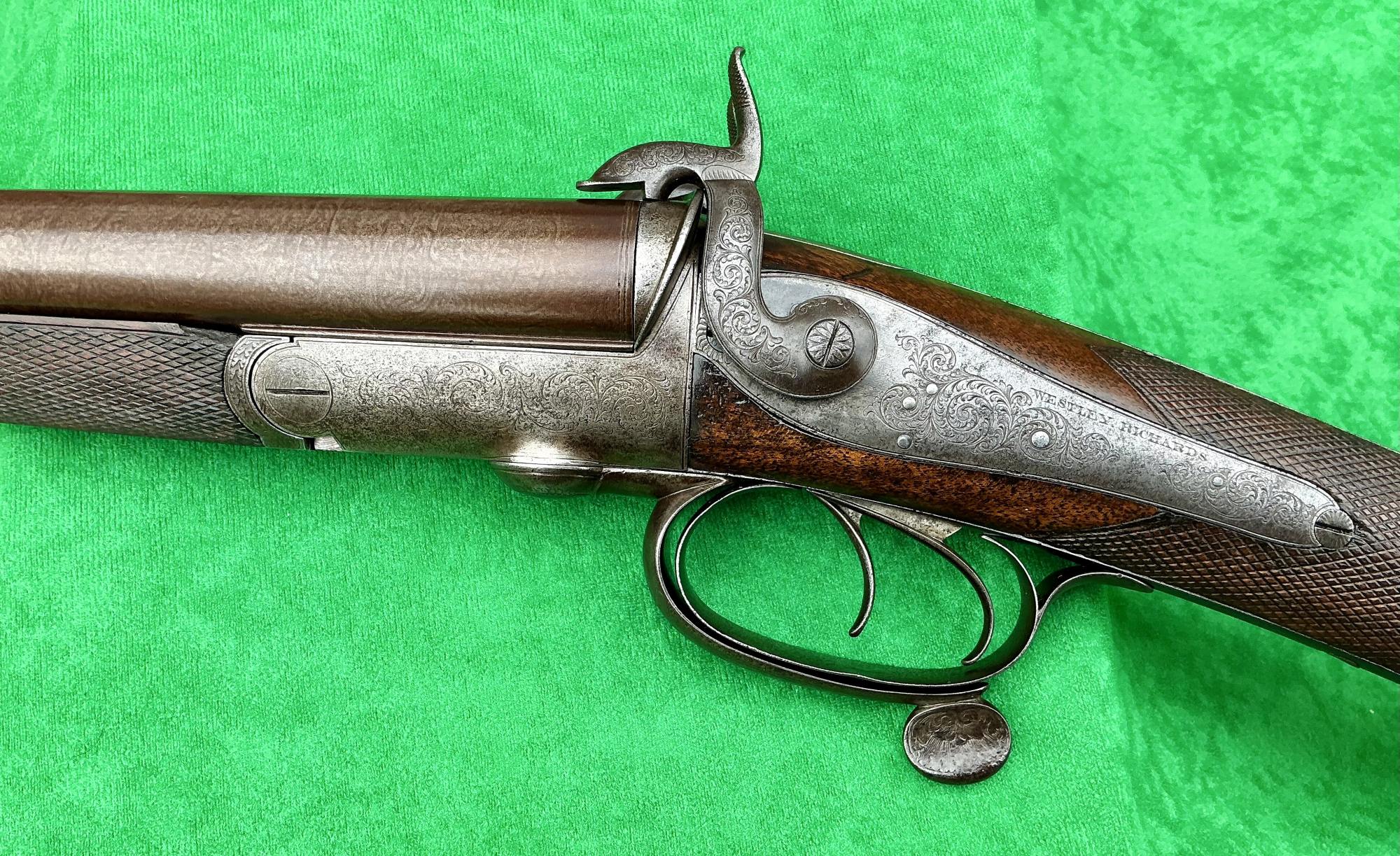
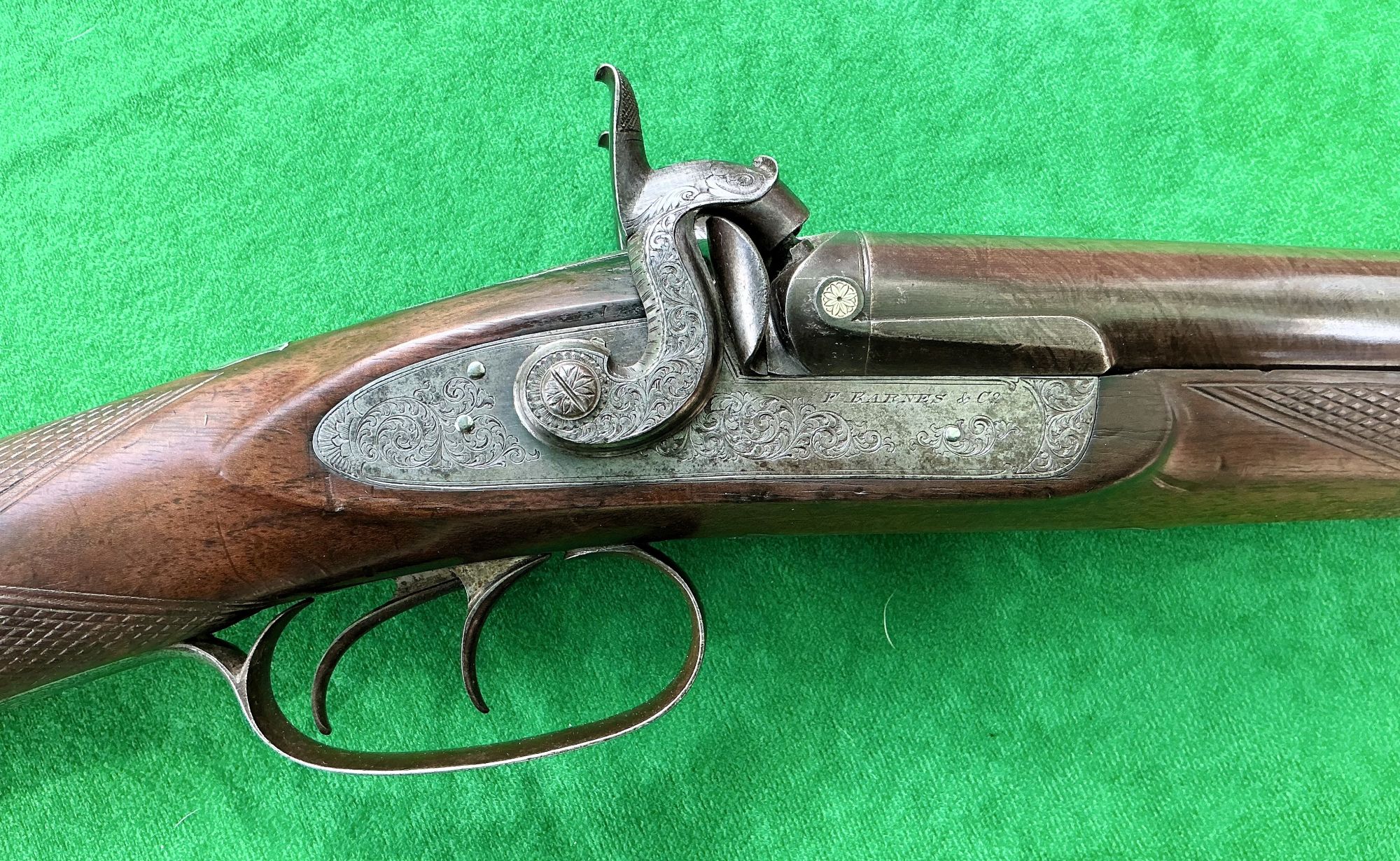
Long throw Hammers - 100% engraving throughout
The superbly designed Robert Adams patent No. 285 applied to this Pinfire gun would have been short lived, primarily due to the following year in 1861 George Daw introduced his center-fire sporting game gun. The Daw gun was recorded as the first gun to use center-fire cartridges with a modern primer in Britain, the Daw center-fire design gained traction quickly. The introduction of the center-fire game gun saw a sharp decline in Pinfire game guns being built as new guns. There were many good quality Pinfire sporting game guns converted to center-fire, as a direct reaction of the Pinfire system becoming obsolete.
The effect on the Robert Adams 1860 design patent No. 285, this has resulted in the number of guns being made with patent No. 285 as Pinfire sporting guns are extremly low. All Robert Adams Pinfire sporting game guns were handmade shotguns, with a price tag to match other London makers. This resulted in the majority of these best made guns being converted to center-fire, and continued to be used well in to the future with modern day cartridges of the latest design.


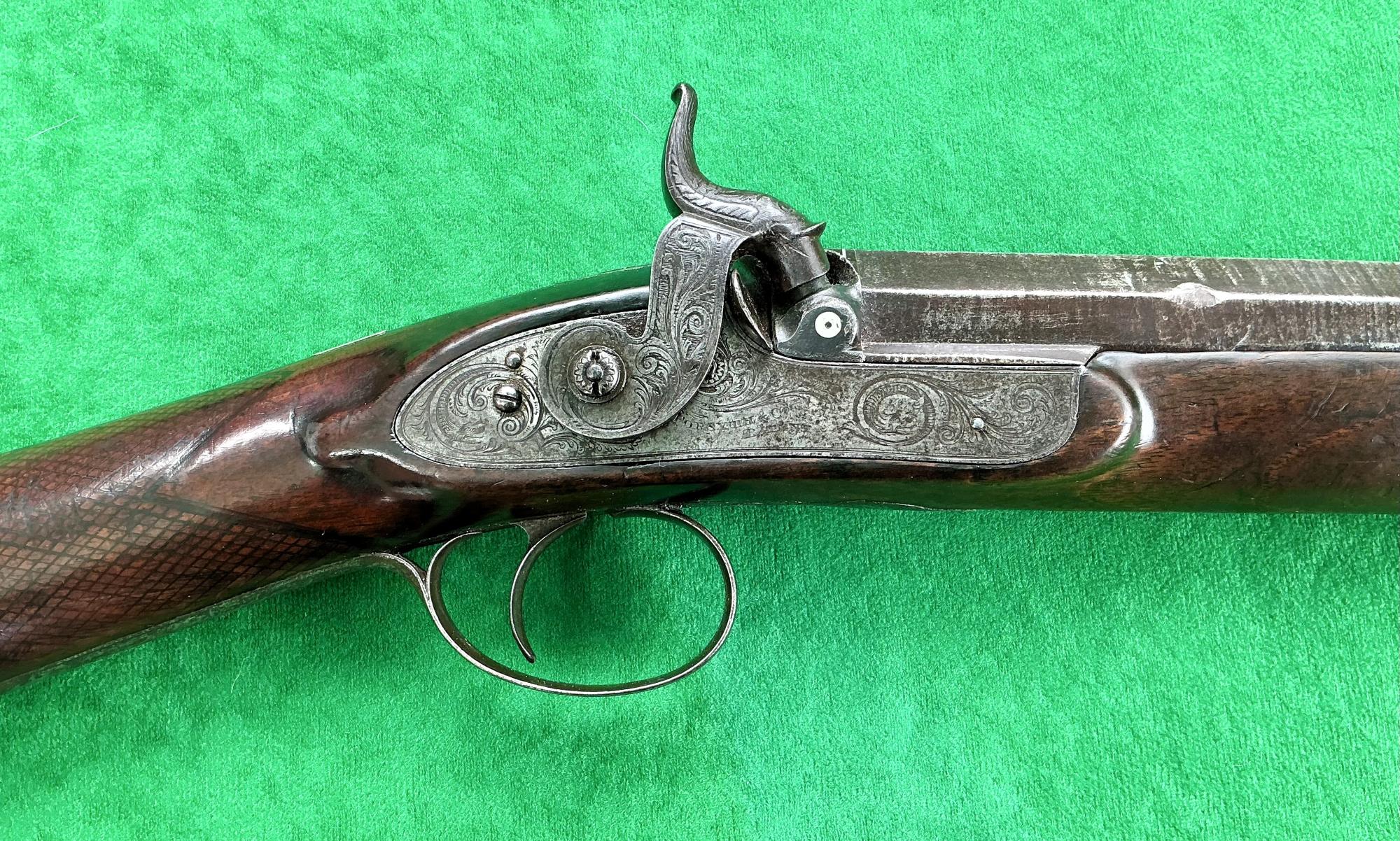
Figured walnut stock and forend, with straighter grain through the hand
An important fact to remember for this time period many breech-loaders were still using the forward facing opening lever, the Jones double bite under lever (Lever over Guard) had been patented in 1859, and would still be finding traction, the Westley Richards Top-lever, although patented in 1858, was not in production until 1862, so the sight of an elegant operating system such as the Adams patent had many supporters.
Conformation of the popularity of the forward facing opening lever was outlined during the following Trials – ‘The Field’ held a ‘Trial of Breech-loaders vs Muzzle-loaders’ during 1859, interestingly all breech-loaders in the Trial were using the forward facing under-lever design. The forward-facing opening levers would soon be replaced. The steady introduction and development of better designs would support sportsmen in the field.

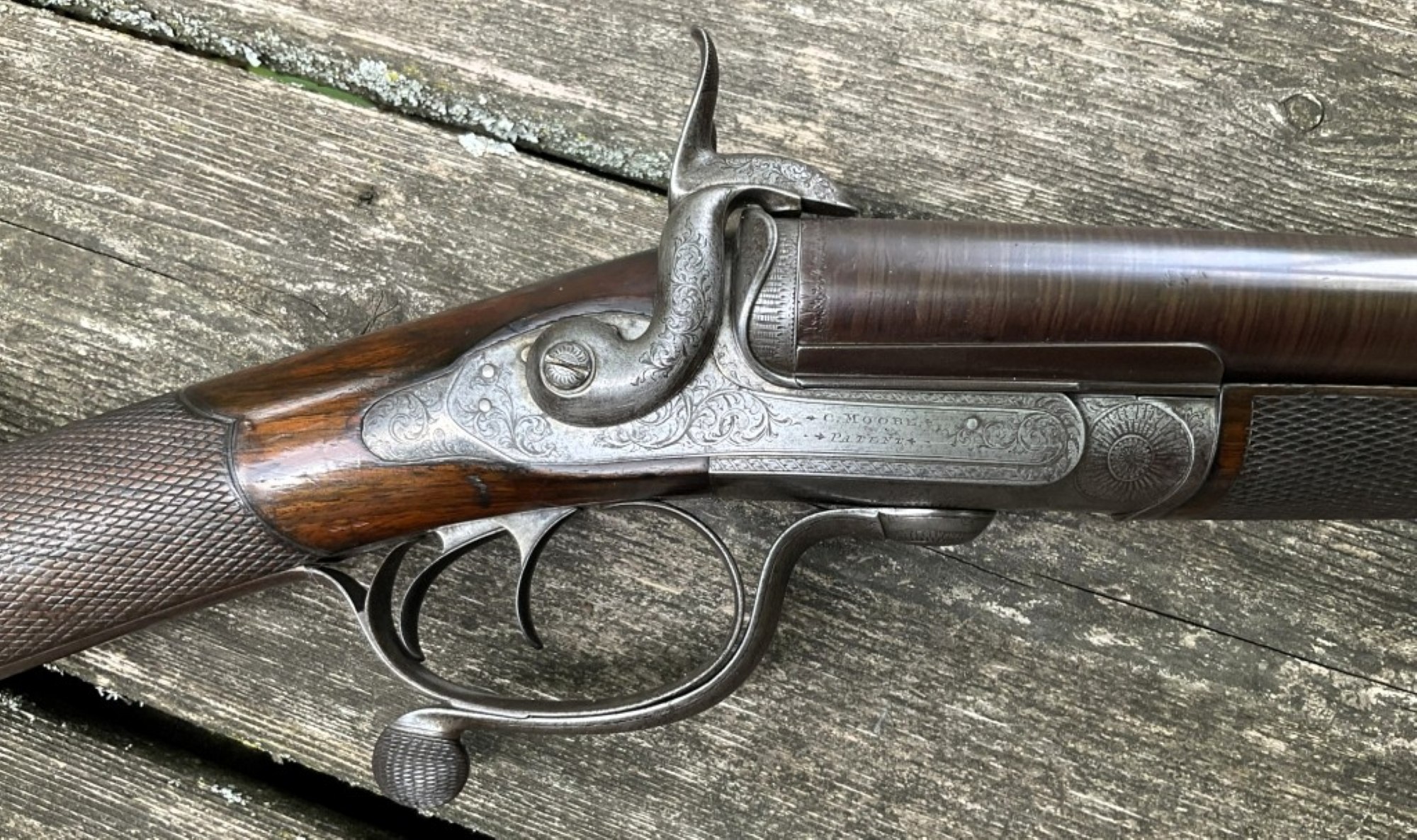
The locking lever fits the close contours of the trigger bow - fully engraved

The sprung-loaded release button and corresponding locking point on the trigger bow
The Robert Adams Pinfire sporting gun in this article was built as a best gun, the gun has an understated elegance and good lines. The introduction of the centre-fire stifled sales, the design survived for a very limited period, the design was highly sort after on its introduction and throughout the early 1860’s.
The underlever and operation of the locking button to the trigger bow is clever, and provides a strong barrel lock-up. The under lever follows closely the contours of the trigger bow, the opening lever incorporates a release button neatly made inside the tail of the lever, and is operated by pushing a spring loaded push button. The lever release button when pressed allows the locking point in the trigger bow to unlock the lever from over the trigger guard, and drop forward on its hinge.
The locking lever protrudes through the action bar with a half-moon double hook bite, the barrel lump has a corresponding double half-moon, the two half-moon surfaces engage in drawing the barrels onto the action bar flats, this operation closes the gun, with the lever locking in to the trigger bow with a click.

The Half-Moon barrel lump - with - Corresponding Hook-Bite in the action base.
Barrels and bar flats carry the serial number 1461 and London proof marks for 1855 to 1868. The top rib is engraved, although very rubbed - ‘Robert Adams, Maker to the Royal Family, No. 76 King William Street, London’.
The Adams patent No. 285 of 1860 is an ‘Inert Under-lever Hook Bite’, this gun is engraved on the lever; ‘ Patent No.141’, this is an identifying number to the number of guns being made with the No. 285 patent. Robert Adams made and sold patented No. 285 actions, including in part, or possibly complete guns to other gunmakers, including Holland and Holland.
This gun has 30 inch barrels, and the design uses a type of ‘Crab- Joint’ opening, the joint surrounds but does not completely covering the hinge pin, the gun is of 'Bar-in-Wood' design. The gun was a top quality 'Best' gun when made.
Finding this gun in its original 'Pinfire' form was thought to be a surprise, however, this gun was never going to be converted from Pin-fire to Centre-fire. The gun has been used by its owner continually and on every occasion over the years, supported by a regular supply of Pin-fire ammunition while available.

The back of the Hammers are fully engraved - All areas of the gun are engraved.
The barrels pitted, dented, and becoming very thin in places, although the gun is in proof by a couple of thousandths of an inch under the pre 1868 proof rules, the barrels have been fine bored, lapped, polished and refinished on numerous occasions, this gun has surprisingly remained on face during its hard life, and after firing in excess of 100,000 cartridges. This gun was used for what it was intended, before becoming naturally obsolete and disregarded.
Robert Adams was born in 1811 in Marldon, Devon. The village of Marldon is situated on the outskirts of the town of Newton Abbot, and would been considered close to the towns of Totnes, Shaldon, Teignmouth, Kingsteignton, Torquay and Paignton.
Robert Adams is likely to have been apprenticed to Gunmaker John Clarke in Newton Abbott. The 1841 census records Robert Adams as a gun maker living in Bridge Street, Newton Abbot, a short distance away from John Clarke's Gunshop in Wolborough Street, Newton Abbot.
Robert Adams cousin John Adams was born during 1832 in Kingskerswell, a village approximately 5 miles away from Newton Abbott. Robert and John Adams, along with a George Stancombe, were all living together and described as apprentice gun makers. In 1843 John Adams was recorded as a gun maker in Bridge Street, Newton Abbott, this John Adams is likely to have been Robert Adams cousin.

Patent No. 141 - is not a Patent, but the number of the gun made using the Patent No. 285 of 1860
Robert Adams moved to London in 1841 to work for George & John Deane at 30 King William Street. They were hardware dealers and gun makers. In about 1842 Robert Adams married Sarah A ( b.1820 in Shadwell, Middlesex ), and in 1843 the couple had a daughter, Sarah A ( b.1843 in Trinity Square, Southwark ).
In 1846 Robert became manager of George and John Deane's gun making business. In 1851 Robert was made a partner in Deane, Adams & Deane, however it appears by then Robert was also trading on his own account.
On the 24 February 1851 Robert Adams registered patent No. 13527 for rifling, a revolver and a barrel with a conical projection at the breech on which the ball, with a conical hollow at the rear, is forced. Also covered was a lock with the mainspring connected to the cock and trigger and no tumbler or sear. He exhibited at the great Exhibition in 1851. Robert and Sarah appear to have lived at 30 King William Street as their second daughter, Florence, was born in King William Street in 1851 as was Constance in 1852. Their fourth daughter, Blanche, was born in Camberwell in 1855, so was Louise in 1857.
On the 1 October 1852 Robert registered patent No. 1 ( This was the first Patent after the Patent Law Amendment Act of 1852 ) – Patent No. 1 was for improvements in ball cartridges. This was for a metal chamber, by preference made of thin sheet copper, fixed to a ball and wad and containing a charge of powder; the end of the chamber being closed by paper or other suitable material.
On the 22 November 1853 Robert registered patent No. 2712 for a revolver lock in which the first pull of the trigger cocked and revolved the chamber and the second pull discharged the revolver.
On the 7 September 1854 Robert registered patent No. 1954 which was for a chambered barrel into which a sliding plug was locked by means of a lever attached to the slide which locked over a projection on the barrel. A bullet being introduced into the barrel first, followed by a cartridge containing powder with a bullet behind, the explosion taking place between the bullets making the rear bullet seal the end of the barrel.

Battered and Bruised, an interesting quality made 1860's Pinfire Sporting Game gun.
On the 14 September 1854 Robert registered patent No. 2000 for a boring and rifling machine.
On the 15 December 1854 Robert registered patent No. 2645 for a revolver cylinder axis with an inclined thread and a safety bolt and lever ramrod.
In about 1854 the firm employed James Kerr who in some reports is incorrectly referred to as John Kerr ( see James Kerr of 54 King William Street ). In 1856 Robert and John Adams and James Kerr became shareholders in the London Armoury Company Ltd. who took over the Deane's factory at 2, New Weston Street. Robert was appointed manager and James Kerr was factory superintendent. It appears that Robert remained a partner in John Deane & Sons.
On the 20 February 1855 Frederick Blackett Edward Beaumont, a lieutenant in the Royal Engineers, registered patent No. 374 for a revolver which could be used in either single or double action mode. Deane Adams & Deane bought the manufacturing rights and made it in several calibers. In 1857 the .450 version was trialed, it was adopted by the War Office in 1862. There were a number of variations and it was converted from cap & ball to cartridge loading.

London Proof Marks for 1855 to 1868, with the serial number of the gun on both barrels 1461

The Barrel Lump - Half-Moon - Locating Lug - Barrel Hook
In 1858 Robert resigned from London Armoury Company Ltd and started his own business as a wholesale and retail gun maker at 76 King William Street. He was appointed gunmaker to the Prince Consort, Prince Albert, and supplied revolvers to the War Department and the East India Company. He also supplied the Orange Free State and Transvaal Republics with arms via the South African firm of Mosenthal Brothers.
On 3 February 1860 Robert Adams patented an under-lever cocking mechanism patent No. 285, which was used by Holland & Holland, amongst others.
Robert was recorded in the 1861 census living at Oakfield, Lewisham, Kent, he described himself as a manufacturer of firearms. John Adams, Robert's cousin, was recorded living with Robert and his family, he was also described as a manufacturer of firearms and almost certainly worked for Robert most probably leaving him to set up his own business in 1863 ( Adams's Patent Small Arms Co. )

No extractors - sight of the sprung-loaded opening button
In 1863 Robert took over the London Armoury Co. premises at Railway Arches, Henry Street, Bermondsey, but in 1865 Robert Adams was declared bankrupt and his assets including his shareholding in John Deane & Sons were surrendered to London Armoury Co. Robert began again in 1866 at 40 Pall Mall but the business closed within the year and he died in 1870.
The 1871 census records Robert Adams widow (Sarah) living at 'Rosemary Villa', Underhill Road, Dulwich, with a previously unrecorded son named Robert, who was an engineer's clerk, born during 1849 in Middlesex.