Westley Richards - 1858 - Presentation Gun
Westley Richards
Presentation Gun – “January 1899”
Looking for another quality made British Vintage gun for the collection, and then something interesting catches your eye ! – A plaque in-let, on the right hand side of a Hammer gun stock, which reads – Presented to John Sidebotham by the late Lord Newton “Jan. 1899”.
This Westley Richards sporting game gun presents itself as a 14 bore breech-loading Centre-fire hammer gun, with the “Presentation” inscription plaque leading us to believe the gun was made just prior to 1899.

A 'Best Quality' 14 bore Hammer-gun, made by the renowned makers Westley Richards & Co.
However, this was not the case, the gun had been ordered and built some 40 years earlier, completed on the 10th August 1858 as Number 2 of a Pair of Best Guns. The Pair of guns had been sold from the prestigious - 170 New Bond Street London address, with the added bonus of the sale being handled personally by, non-other than their London Agent - William Bishop “The Bishop of Bond Street” who sold the Pair of guns on the 5th October 1858, to a W. J. Legh.

Built in 1858, and sold on 5th October 1858 to W. J. Legh
The Ledger entry for this Pair of guns was not overly helpful. Thankfully the plaque and inscription allowed something of a starting point for research and investigation. The name being hand written, and recorded within the Ledgers was somewhat unassuming.
Fortunately, this fine Westley Richards 14 bore sporting double - Number two (2) gun was gaining a voice. The serial number of this gun being No. 9074, records the gun as being made in 1858, as confirmed in the WR ledgers, also confirming the gun was made as a muzzle loader, and No. 2 gun of a pair.

The serial number 9074 was for the number two gun of a pair of guns made for W. J. Legh - 5th October 1858
The gun during the 1870’s underwent the transformation from Muzzle-loader to a 14 bore, under-lever, Breech-loader. The quality of work performed during the conversion had been excellent, which helps us understand the census of opinion the conversion work was carried out by the maker.
At the time of conversion from muzzle-loader to breech-loader, this gun was converted directly to center-fire. The conversion from Muzzle Loader to Breech Loader is a considerable undertaking and incurs a massive amount of skill. The Gunmakers’ art is in disguising the gun from having a previous life. The skillful work of the Gunmakers craft in this case has ensured this Westley Richards was transformed for use in more modern times, with a look indistinguishable from its peers.

Short top tang of the new action body.

The elegant lines of this best quality conversion supports the style and lines of its contemporaries

From Muzzle-loader to 14 bore Centre-fire, this gun is ready for a day in the field.
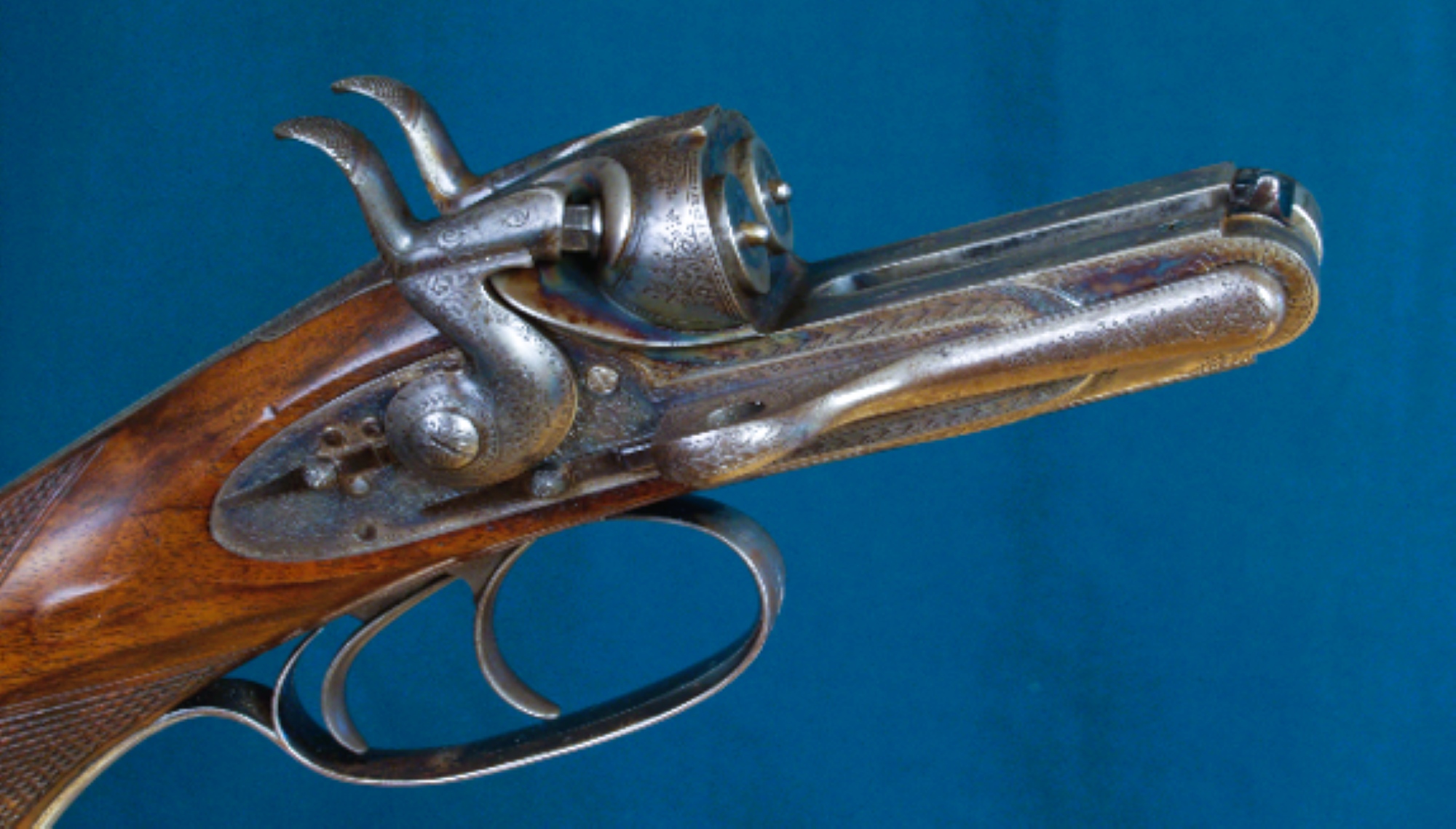
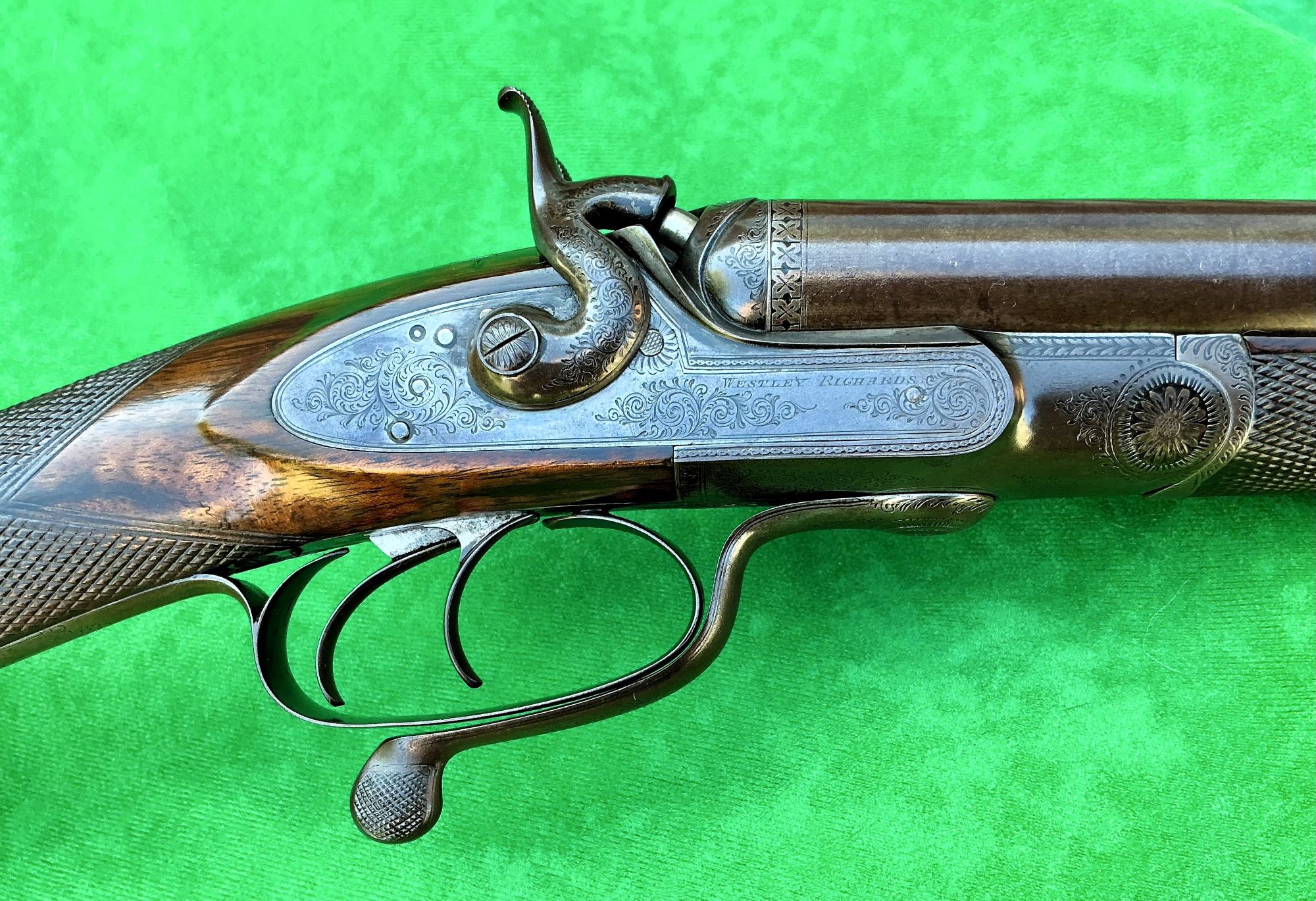
The transformation to Breech-Loader would have been on the lines of; Removal of the breech plugs, Chambering the barrel breech ends to take 14 bore cartridges, making provision for and fitting extractors, Attaching lumps to the base of the breech ends of the barrels allowing the barrel hook and Jones locking system to be fitted and machined within the lump, The fitting of a new action body to incorporate the Jones under lever. The original locks were fitted with modified lock plates and new hammers. The original stock was used, along with the original modified trigger block, triggers, trigger guard, and heel plate. all of which were kept. A new removable forend was made, including forend iron / metal work, new forend wood, making a cross pin fastening latch, not forgetting a new forend loop for the barrels, and fully engraved forend finial.
The details of the gun today – 27 inch Damascus Barrels, with wide muzzle loader top rib, engraved: Westley Richards 170 New Bond Street London, with Cylinder and Improved cylinder choking. The barrels remain in black powder proof, being a 14 bore and proofed at the London Proof House, with 1868 and 1875 proof marks. At this time the rules of proof stated, the gun becomes out of proof at the next full proof size. It is important to remember, ‘Smokeless’ powders had not be introduced at this time, so all proof testing was for to black powder only.

The wide Muzzle-loader rib engraved - Westley Richards 170 New Bond Street London
The barrel measurements of 14 bore ( .693 ) and with the barrel bore measurements now at - .703 & .704, and the next full proof size up being 13 bore ( .710 ) confirms the gun remains in proof. The minimum barrel wall thickness in both barrels are 35 thousandths of an inch.
The stock is cast for a right handed shooter, with a length of pull at 14 ½ inches. The gun weighing 7lbs. 6oz. and an overall length of 43 ¾ inches.
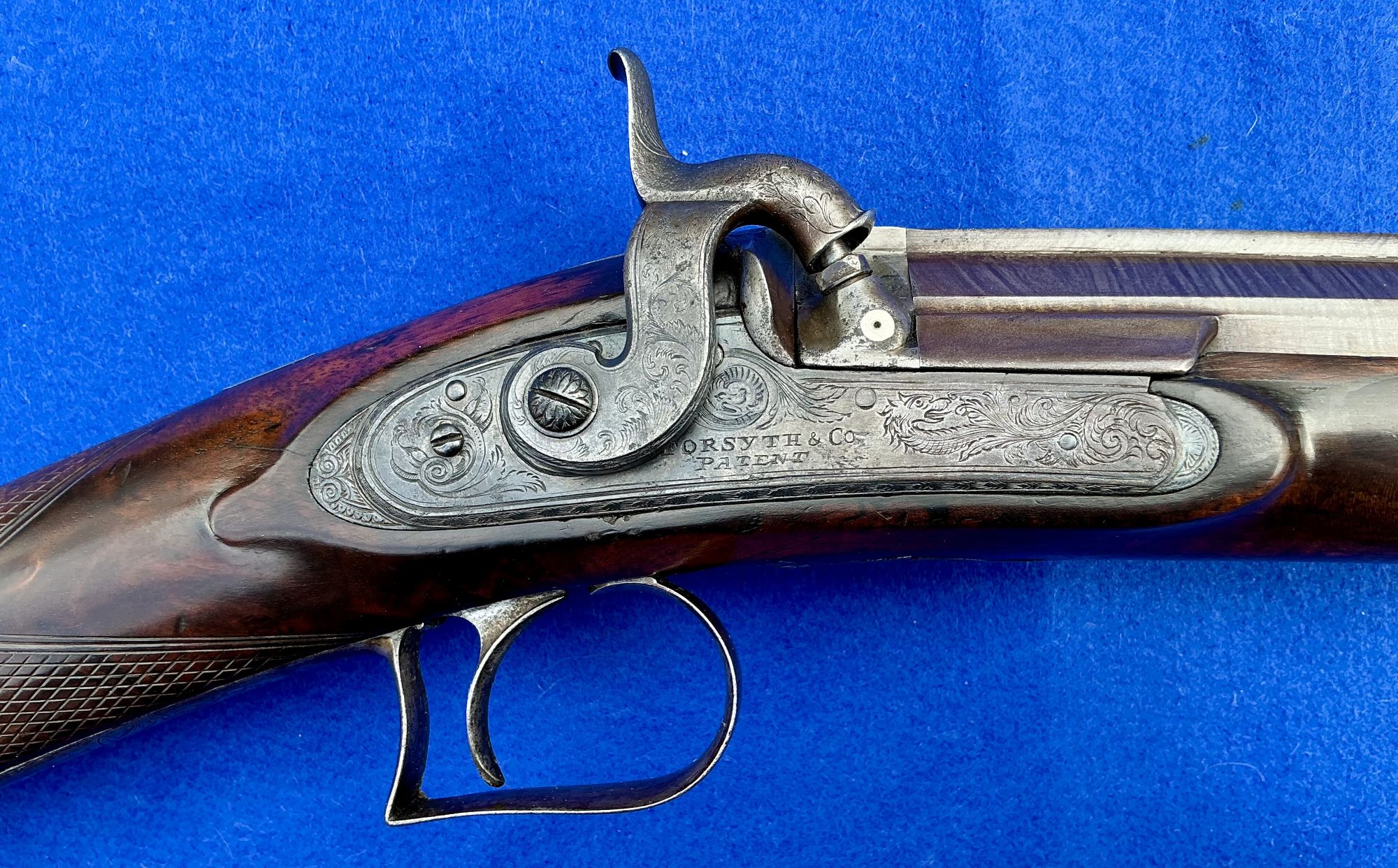
The original, and superb Thomas Brazier locks have been converted from non-rebounding to rebounding locks, using the Stanton & Co. Joint Patent. The Locks are stamped, both with T. B. for Thomas Brazier and Stanton & Co. for the conversion work, along with consecutive patent use, or record numbers to each lock plate.

The lock-makers initials - T. B. for Thomas Brazier, and John Stanton's conversion to rebounding locks.
The rebounding lock originated, like so many other landmarks in the history of gun-making from within the Birmingham gun trade. The man most often credited with the invention was the well-known Wolverhampton lock maker John Stanton. But Stanton’s lock was not the first mechanism to receive protection by a patent. That honor belongs to William Bardell and William Powell from Aston, Birmingham, with patent No. 2287 of 6 September 1866. However, Stanton undoubtedly takes the credit for the type of rebounding lock almost universally adopted by the English gun trade, and is the lock found on most British Vintage sporting hammer guns encountered nowadays.
As John Stanton became the industry Standard for the rebounding lock, I have included an outline summary of his work – John Stanton’s first patent, No. 49 of 8 January 1867, received only provisional protection and used an external spring to lift the hammer to half-cock. Very shortly after this he secured a second patent, No. 367 of 9 February 1867, in which the hammer is returned to half-cock by the mainspring. This he achieved by lengthening one limb of the mainspring the top of the lock in a bar-action lock, and the bottom of the lock in a back-action lock, off which the tumbler bounces. This was the design that became widely adopted, appearing in both new guns, and as conversions to existing locks. John Stanton’s third patent, No. 3774 of 30 December 1869, Stanton reverses the location of the projections on the mainspring limbs for bar-action and back-action locks, adding a characteristic curve to the end of the spring.

The 'Best Quality' locks by Thomas Brazier preform as when first made 168 years ago.
The lock conversion to re-bounding locks in this case; ensures ease of use and takes away any of the shortfalls of the non-rebounding locks in early center-fire guns. This further supports the high-levels of attention to detail, and the no expense spared approach conducted during the conversion work to Centre-fire for this particular gun.
The in-depth search for the second gun to confirm the where abouts of the Number One (1) of the Pair - (No. 9073) in this story, we now have evidence the second gun no longer exists. This information supports how this Presentation gun came to fruition !

The barrels have the serial number for the number one gun of the pair - 9073, these barrels have been used to make the 'Presentation Gun' with serial number - 9074
An overview of past events – The Guns, 9073 & 9074 are recorded in the Westley Richards Ledgers as No.1 & No.2 of a pair of 14g double guns, completed on the 10th of August & sold to W.J. Legh on the 5th of October 1858.
Although, Westley Richards cannot verify or disprove the conversion work and alterations of this pair of guns from Muzzle-loaders to Breech-loaders, the company states this work is highly likely to have been conducted by them, and possibly recorded elsewhere, too which records have been lost or destroyed.
The Pair of Westley Richards Muzzle loading sporting guns No. 9073 & 9074 were returned to Westley Richards for conversion to Centre-firing breech-loaders. The Pair of guns, for whatever reason became one gun, a single breech-loading Centre-fire now carrying the number 9074. The confirmation the second gun number 9073 no longer exists, came about as the 9073 gun was used during the making of the Single gun now known as number 9074 - Many parts of the newly converted gun have the identification numbers 9074, except the barrels ! The barrels during conversion have been fitted with an extremely well-made shoe lump and extractor, importantly the lump does not cover the whole of the barrel base, as is the case when making side by side barrels today, and known as 'barrel flats'. The newly fitted shoe lump incorporates the hook, the extractors, and Jones double bite under-lever locking recesses. Interestingly, the new lump fits between the barrels, leaving part of the breech end of the barrel exposed, this shows the partly covered original proof marks for 1855 – 1868. This also allowed sight of the original serial number of this set of barrels, the number visible being is - 9073, this is the number of the No. 1 gun of the Pair ! This confirming the barrels of the number one gun have been used in building the Presentation gun, and that the pair of guns' have contributed in making the single gun from the Pair.
The available information gives a clearer understanding of when this Westley Richards sporting game gun was originally made, the transition / conversion work involved, and how the gun presents itself today.

Right hand side of the stock - best walnut and glimpses of the presentation plaque.

The Presentation Plaque - Presented to John Sidebotham by the late Lord Newton - Jan. 1899

Left hand side of the stock.
The question of why and how the gun has survived is another interesting part of this guns’ story. To secure the information we returned to the Westley Richards Ledger entry of W. J. Legh, and the inscribed stock plaque stating the gun was presented by the late Lord Newton ! - What we now know, is W. J. Legh was Lord Newton / 1st Baron.

William John Legh - Lord Newton aged 39 years.
William John Legh – Born 19th December 1828 (Father being William Legh) – On the 29th May 1856, William John Legh 1st Baron Newton and Emily Jane Wodehouse were married at St. George’s Church Hanover Square London.
Hardly a year later, On the 8th May 1857, William John Legh, or Lord Newton’s uncle, Thomas Legh aged 64, at Milford Lodge, Lymington, Hampshire, South of England, dies. William John Legh / Lord Newton, 1st Baron Newton, as his nephew, at the age of 28 years, inherited his uncle’s estates including Lyme Park, Disley, Stockport, Cheshire, SK12 2NR – Soon after inheriting his Uncles estates, the pair of Westley Richards Sporting game guns were ordered.
The Lyme estate belonged to the Legh family from 1398 – On 4 January 1398, King Richard II granted the land at Lyme to Piers Legh (c.1360–99) and his wife Margaret Legh (d. 1428). This grant honoured an act of bravery by Margaret’s grandfather, Sir Thomas Danyers (c. 1294–1354), who rescued the Black Prince’s royal standard during the Battle of Crécy in 1346. For this deed - described as ‘replanting the Prince’s banner at Cressi’ - Sir Thomas was promised an annual payment of £40 marks (160 shillings), until it could be exchanged for land worth £20 marks a year. Sir Thomas died in 1354 without making the exchange, and the right passed to his heir, Margaret. More than fifty years later, in 1398, the long-delayed grant was finally fulfilled.

New forend wood, cross pin fastener and engraved finial tip.

New forend iron and splinter forend wood.
Lyme Park became the family’s hunting domain. It stood on the Cheshire - Derbyshire border, its name derived from the Latin limes, meaning ‘frontier.’ The deer park was enclosed soon after, and by 1400 a small house had been built on the site. It served as a secondary residence to Bradley House in Cheshire, which Margaret also inherited from her grandfather.
Moving forward several centuries - Thomas Legh (1792–1857) inherited Lyme Park at the age of four. When he came of age, he revived the estate, commissioning architect Lewis Wyatt in 1814 to modernise the house. They rationalised the layout and added the Library, Dining Room, Wyatt Tower, and Orangery, which concealed an underground service passage to the new Brewhouse and Bakehouse. Thomas also oversaw improvements to the Haydock Colliery, ensuring the coal business thrived.

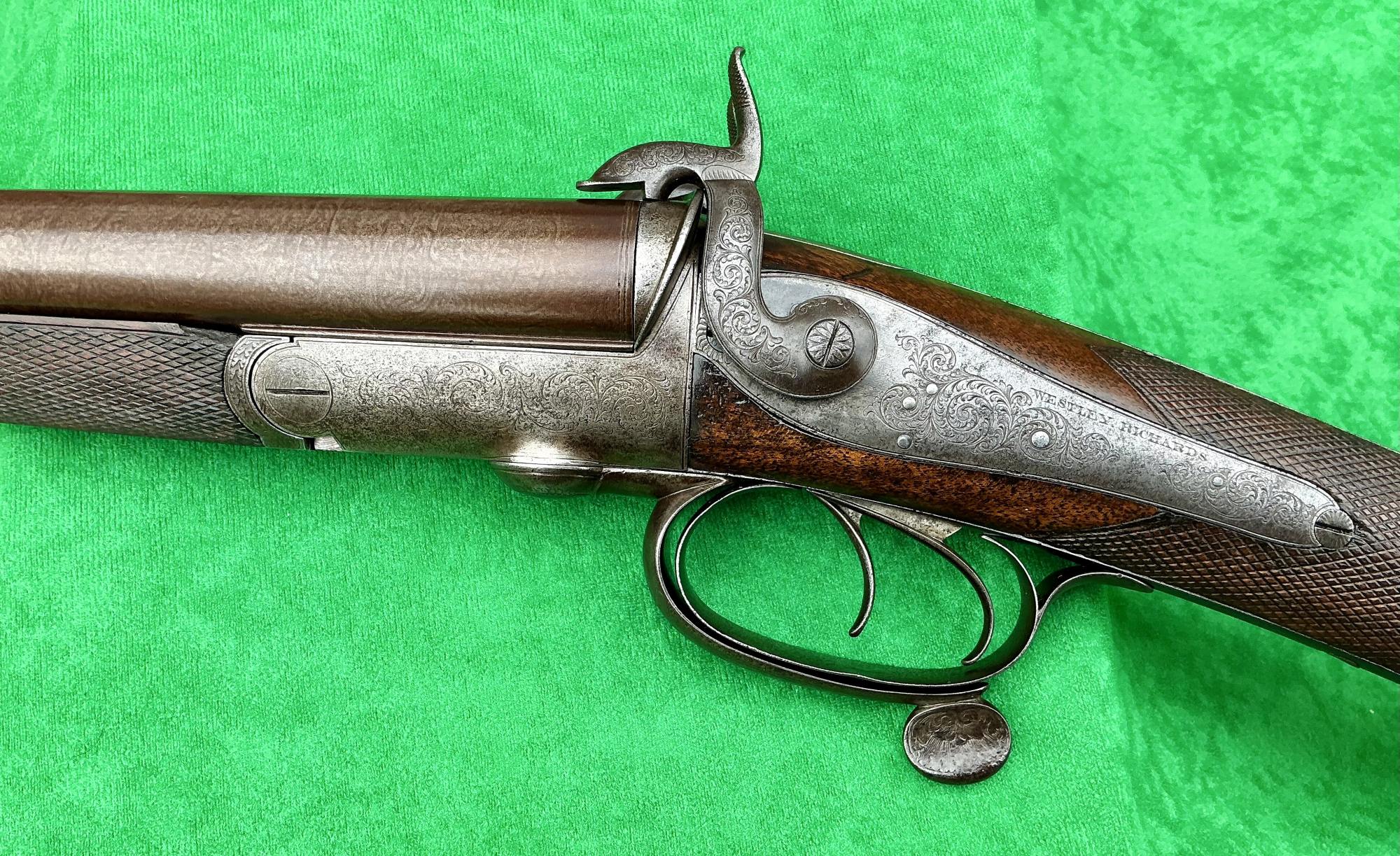
Best scroll engraving throughout including the Jones double-bite under-lever opener.
Thomas was a passionate traveler, and explored Greece, Egypt, and Petra, bringing home antiquities that can still be seen today. He published Narrative of a Journey in Egypt and the Country beyond the Cataracts, describing excavations and the removal of the sculptural frieze from the Temple of Apollo Epicurius at Bassae, these were later sold to the British Museum. Lyme retains a plaster cast of the frieze and three ancient Greek stelae set into the Library walls.
Thomas’s book also records the trade in enslaved people in Cairo. During his travels, he was presented with an enslaved young man, Ibrim Abderazack (1804–23), who returned to England with Thomas’s companion, the Reverend Smelt. A portrait on the Grand Stairs of Lyme Park shows Thomas in Arab costume with an attendant thought to be Ibrim.

Wood to metal fitting is excellent, and attention to detail is of the best quality.
Thomas married twice. His first marriage, in 1828, was to heiress Ellen Turner (1811–31), daughter of William Turner (1776–1842), a wealthy calico printer and Member of Parliament. His second marriage was to Maud Lowther (1818–52) in 1843. With no male heir, the Lyme Park Estate passed in 1857 to his nephew William John Legh (1828–98), later 1st Lord Newton, and the owner of the Westley Richards sporting gun which inspired this article.
Richard William Davenport Legh, 3rd Lord Newton, gifted Lyme Park to the National Trust in 1947 - for the ‘health, education and delight of the people.’ Over the centuries, the house, park, and garden evolved from a hunting lodge into the cherished home of the Legh family. Each generation shaped Lyme in response to changing fashions and the social and economic circumstances of their time.
During 1859 at the age of 30 years William John Legh 1st Baron Newton was elected Member of Parliament for Lancashire South, he held this seat until 1865. On the 5th May 1866 William John Legh 1st Baron Newton aged 37 years was commissioned as Lieutenant-Colonel to command the 4th Administrative Battalion, Cheshire Volunteer Corps. In 1868 William John Legh 1st Baron Newton aged 39 years was elected MP Cheshire East, a seat he held until 1885.

Steel butt plate, extended tang to the comb is reminiscent of the Muzzle-loader period.
From 1859 to 1885 William John Legh / Lord Newton served as a Conservative Member of Parliament, during this period Lord Newton would have been in contact with the likes of; William Ewart Gladstone, Benjamin Disraeli, Henry John Temple Palmerston, John Russell, Robert Gascoyne-Cecil, Edward Smith Stanley, all of which had been United Kingdom and Great Britain Prime Minister’s.
The London Gazette, Whitehall, September 22, 1892 - The Queen has been pleased, by Letter Patent under the Great Seal of the United Kingdom of Great Britain and Ireland, dated 27th August 1892, to grant the dignity of a Baron of the said United Kingdom unto William John Legh aged 63 years, of Lyme Park in the County Palatine of Chester, Esq., and heirs of his body lawfully begotten, by name, style, and title of Baron Newton, of Newton-in-Makerfield, in the County Palatine of Lancaster.
On the 15th December 1898 William John Legh 1st Baron Newton aged 69 years died.
We have identified the original owner of this Westley Richards Sporting game gun, as Lord Newton 1st Baron – William John Legh, purchasing the gun in 1858.

Baron Newton's Crest, in-set to the gun stock - Newton's motto - 'En Dieu est ma Foi' - 'In God is my Faith'
After the death of Lord Newton in 1898, this quality made pair of Westley Richards guns were returned to the maker. The pair of guns became a single gun, the guns were re-made and re-finished as a "Presentation Gun" - on completion of the work the gun returned to the Lyme Park Estate. The "Presentation Gun" was then presented to John Sidebotham in 1899, this leads us to the question who was John Sidebotham, and for what reason did the presentation take place after Lord Newton’s death ? After lengthy research the only John Sidebotham with close links to Lyme Park was Lord Newton's head Gamekeeper, who died during 1905. The link between Lord Newton and John Sidebotham have been kindly confirmed by The National Trust "Collections & House Manager" at Lyme House, with credit given to the Lyme House research volunteers, having sourced documentation regarding John Sidebotham and his work at Lyme Park Estate as Gamekeeper over 38 years for Lord Newton.
The practice of presenting family gifts at prominent points were a typical Victorian gesture of Gratitude, Recognition of service, Political alliance, or Personal friendship. The gift of a 'Presentation Gun' on this ocasion is likely to have been an estate decision to honor a close personal and sporting connection, between Lord Newton and his loyal Gamekeeper.
A “Pair of Best” guns become a “Single Presentation Gun”