Westley Richards - Centre Fire Patent No. 2623 - Article Two
Westley Richards - Centre Fire
Patent No. 2623 - Article Two
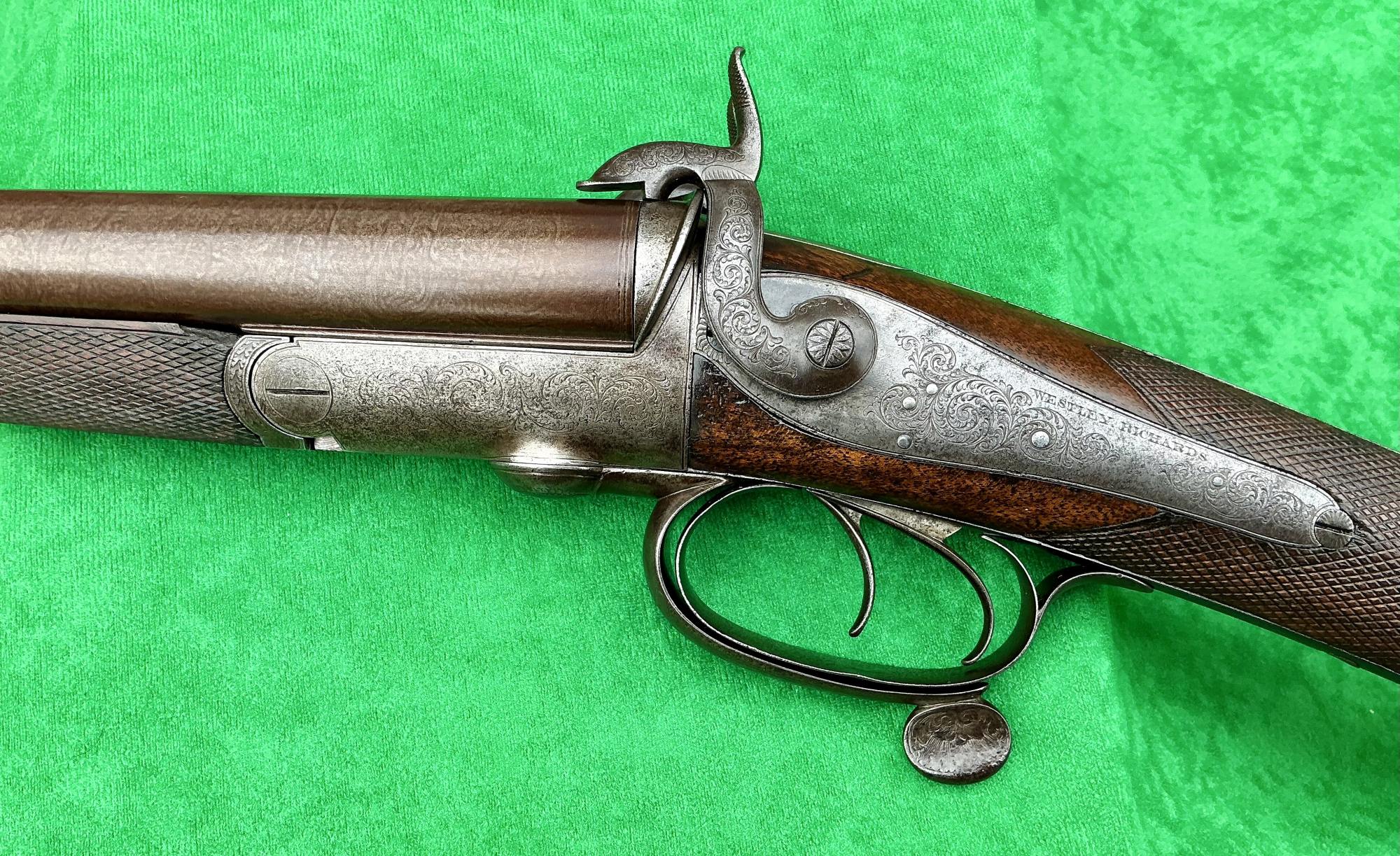
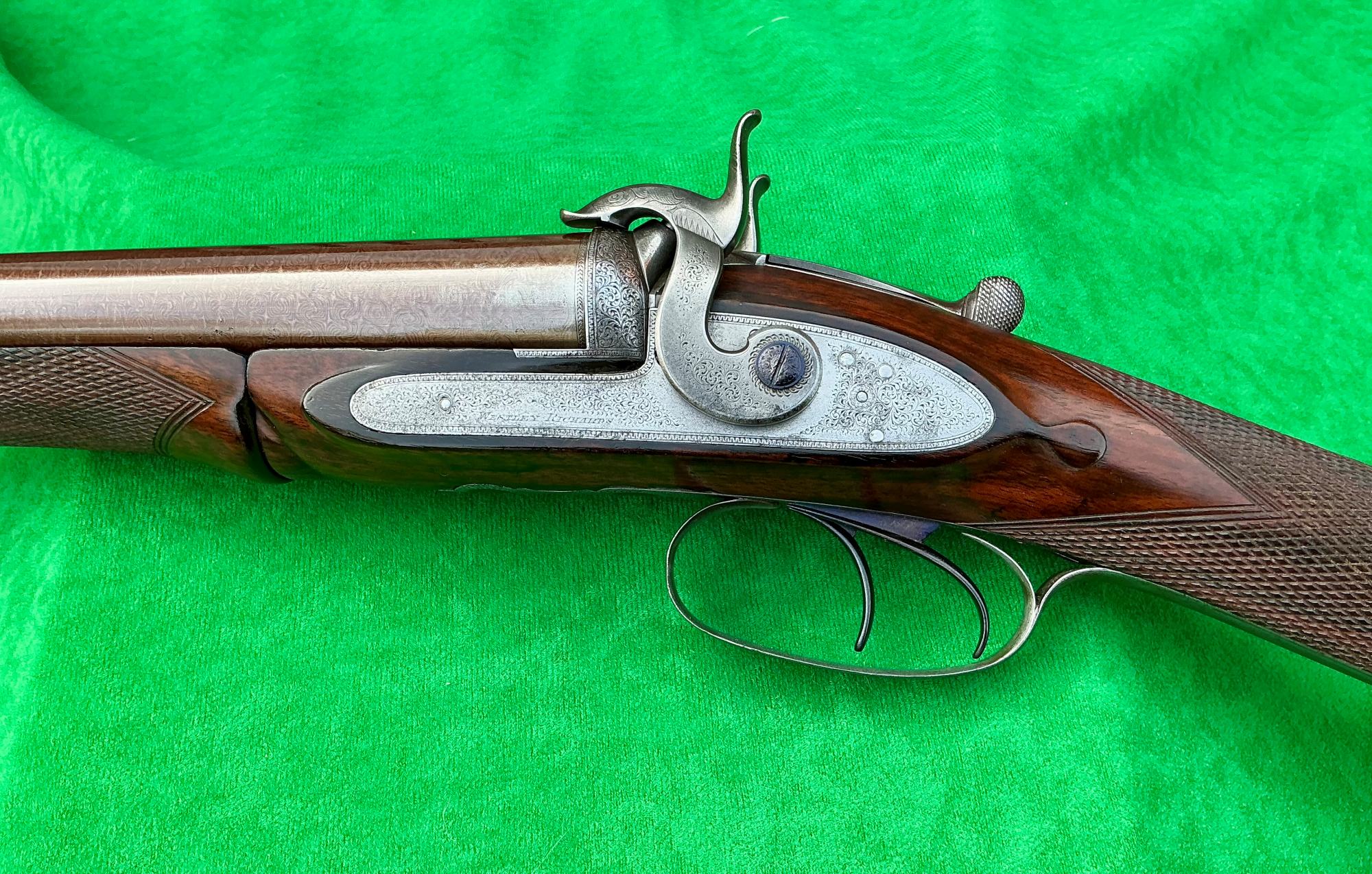
The second of the two Westley Richards sporting game guns featuring the Patent No. 2623 of 1864, for a single bite snap action, is a Westley Richards with serial number 12653 for 1873. The patent bridges the Pinfire and Centre fire transition. The use of the lateral thumb lever, has made the guns in both; Article One & Article Two, look up to date and ahead of their time considering their date of manufacture.

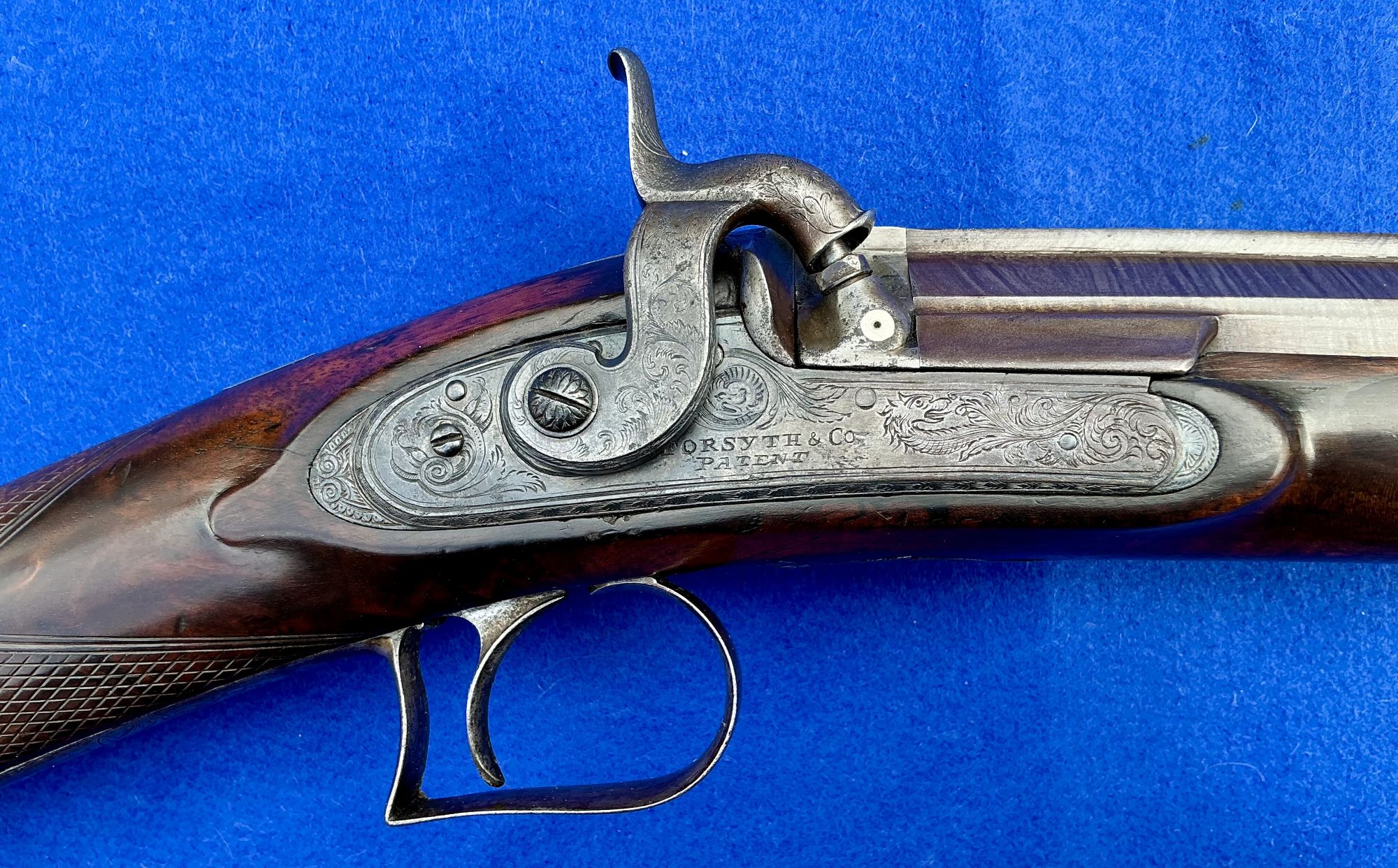
Long Nose Pin-fire hammers used on Westley Richards centre fire guns' into the 1870's
Westley Richards continued to use long nosed hammers in their early Centre fire guns, which in turn created the necessary safety measures needed while a solution to the non-rebounding locks were being designed and implemented. This meant that Westley Richards guns of the pre-1870 manufacture could be all manner of configuration, including; Pinfires, Dual-fires, Centre-fires with pinfire hammers, or Conversions from pinfire to centre-fire, and all others that had been manufactured by Westley Richards. The strong and effective designs from Westley Richards, ensures there should be no surprise that many, if not all the guns involved would look relatively similar.

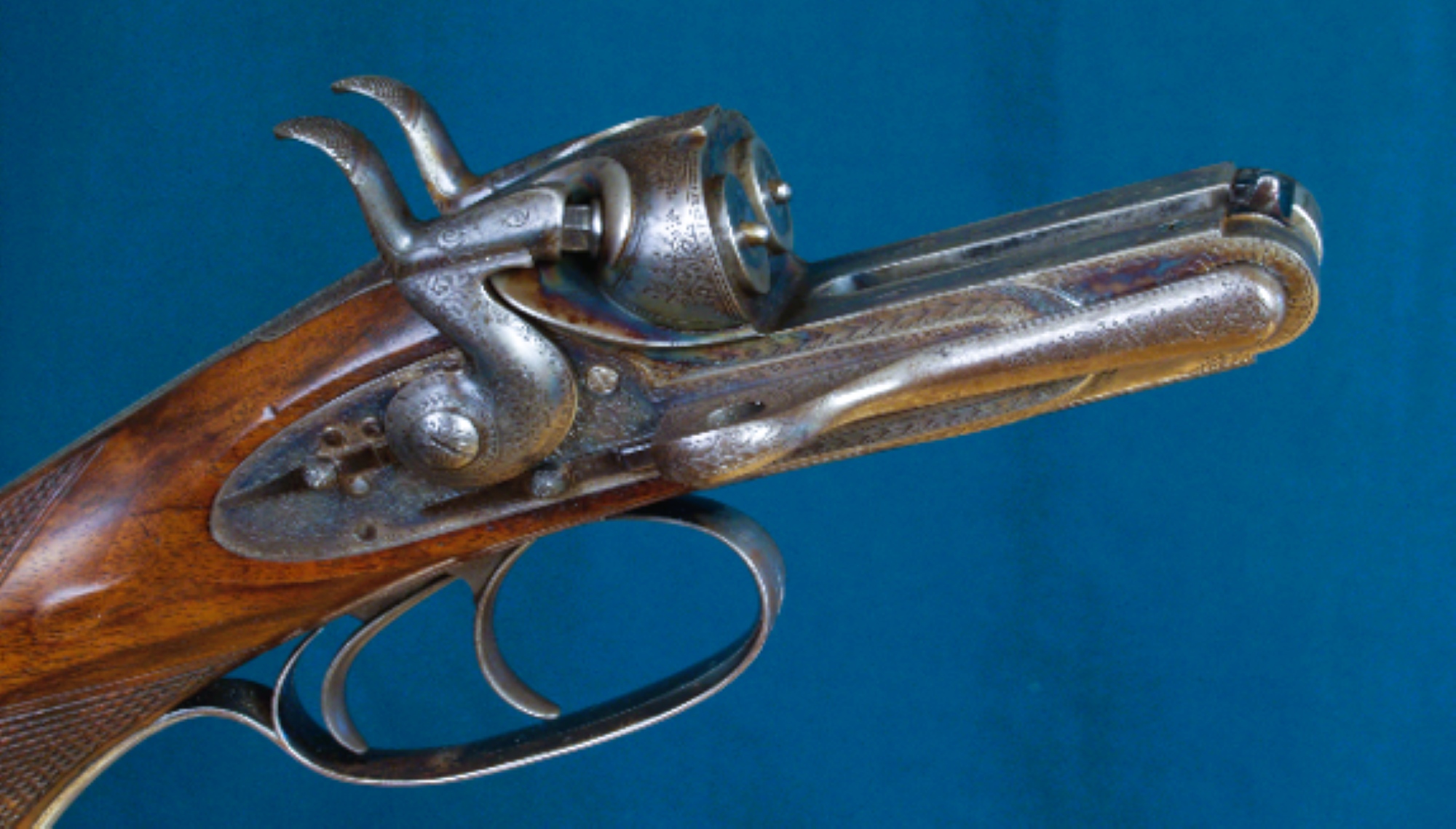
Doll's Head - Single bite - Snap action - patent No. 2623 of October 1864
The early days of the British centre fire sporting game guns were in the sights of British Gunmakers, many ideas were banded about, however, Charles Lancaster, like many British gunmakers were looking far and wide in resolving the development issues surrounding the centre fire. Eventually, through expanding their nets, several ideas emerged from France and Continental Europe. Charles Lancaster purchased the Base-fire patent in 1856, the patent design struck the centre base of a cartridge, although the cartridge had no primer. Soon after came another French patent that was secured and purchased by George Henry Daw in 1861, this patent used a cartridge with a centre fire primer. The Daw patent was recognised and recorded as the first Centre fire breech-loader in Britain. The centre fire cartridge was greatly improved by the use of the E. M. Boxer primer. Edward Mounier Boxer (1822-1898) who was an English Inventor, Boxer applied for, and was awarded the patent for his “cartridge” design in England, on October 13th, 1866. Boxer was also awarded a patent in the USA on June 29th, 1869. The Boxer primer remains widely used today.

Long nosed hammer's need to be in Half-cock position before the gun can be opened.
The Single Bite Snap Action that allowed the lock-up of hinged barrels at a single point, and pull back top lever was Westley Richards patent No. 2506 of 1862. However, it is the second patent, variation - No. 2623 of October 1864 which is basically the same lock up and bolting system. This is the patent that has been used in both guns within Article One and Article Two. This is interesting, as from this, we can evidence and clearly see this patent was used across both the pin-fire and the centre-fire period, for the full production range.
The changes of the first patent design to the second patent ensures, the lever rotates from left to right when operated with the right thumb. This movement draws the top-bolt out of the slot within the dolls head, allowing the gun to open. The single point locking of the top bolt, fits to a precise corresponding slot in the dolls head. This remains the sole means of securing the barrels to the action. The system of single point locking via the Westley Richards dolls head lock-up can appear to lack strength, however the system was used on both shotguns and double rifles, and a good number remain in regular use today.

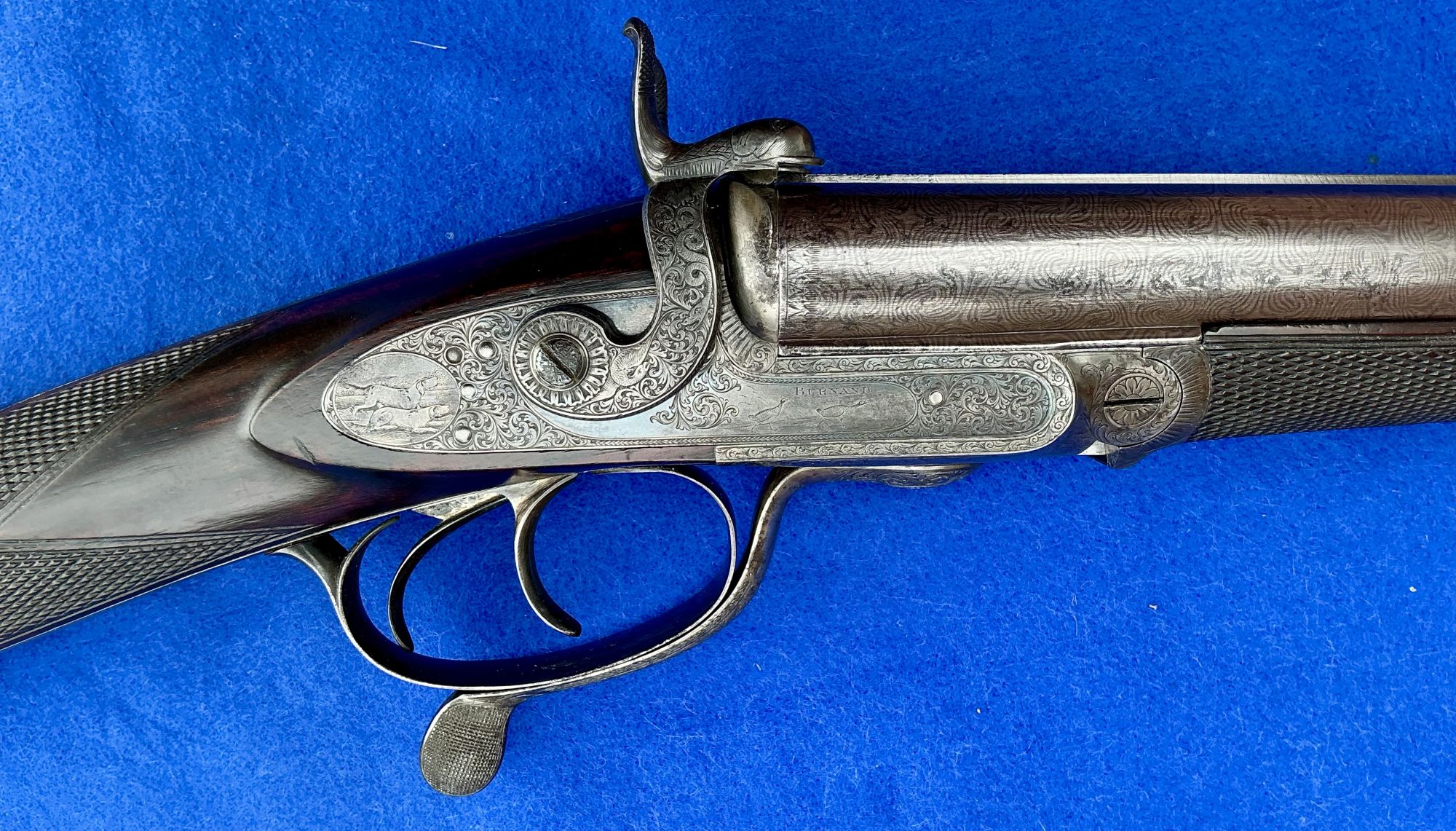
Top rib address engraved - Westley Richards 170 New Bond St. London - Good quality Damascus.

Original 1873 Black Powder proof marks - Each barrel with 1873 serial number.

New Birmingham Nitro Proof Marks - Proof Marks for 1989 to 2005 and 2005 year code.
The gun that inspired article two is – Gun Number 12653, and is shown in the Westley Richards ledgers, and described as – the number 1 gun of a pair - a double breech loader - 12g, snap action - completed on the 12th of July 1873 & sold to Major. G. Ward Fox on the 15th of July 1973.
The gun has Patent use number 2616 stamped on the action flats. The gun has been re-proofed for Nitro Powders at Birmingham with proof marks for 1989 to 2005, and date code for the year 2000. The gun being chambered for 65 mm cartridges, with mirror bright bores and excellent proof measurements, makes the gun very usable today with the correct ammunition. The barrels measure 28 inches, with minimum barrel wall thickness of 21 and 22 thousandths of an inch, at six inches from the muzzle. The barrels have no choke restriction due to the time of manufacture.

Number One gun of a pair.
This gun built as a centre-fire was made using a number of WR patents, including - Westley Richards Patent of 1866, patent number 1960. The Westley Richards patent of 1866 utilizes an interesting mechanism and patent design, allowing the use of primed cartridges in early breech loading guns. This patent supported the design of firearms in bridging the all-important gap between pinfire and centre-fire systems.

Transitional Centre-fire patent - Westley Richards Patent No. 1960 of 1866.
The 1866 patent, details the construction of the breech, which carries the firing pin, and was designed to facilitate the loading and unloading of centre cartridges. The original patent also describes an extraction device and outlines the various cartridges that could be used with the patented arm. This innovation was typical of the dedicated commitment of Westley Richards in firearms development across all areas.


Well figured walnut throughout - Steel heel plate.
There are several production stamps and marks, with Westley Richards stamped on the breech face. The barrels carry the "WR" mark. The top rib is signed "Patent" and "Westley Richards 170 New Bond St London," the barrels are fitted with an extractor that is numbered to the gun ( fitted when made ). The barrel bottoms at the breech ends are rounded, and fit perfectly within the rounded bar-in-wood action body. The hammers are flat-sided, which is typical Westley, in house style at this time. The gun carries good wood, with both stock and forend being well-figured and chequered.

Bar-in-Wood action, and "Crab Joint" forend.

Both the Bar-in-Wood, and the Crab Joint takes considerable time, skill, and effort to complete.
The fore-end opening is operated via the Westley Richards patent number 1422 of 19th April 1873, interestingly the patent document shows the patent being sealed on the 13th June 1873. This gun being completed on the 12th of July 1873, and being fitted with the forend patent in question, ensures this application of the patent, is one of the earliest known, and at the very start its introduction.
The entire catch made as a single unit, is inlet into the forend wood as a whole, this making fitting relatively straight-forward for a skilled stocker. The Deeley & Edge catch was an immediate success; many early examples, as on the gun in this article have the word ‘PATENT’ engraved on the catch lever.

Strong straight grained forend timber, completed with Horn Tip.

The Westley Richards patent number 1422 of 19th April 1873 - Stamped "Patent"
The forend catch patent No. 1422 was adopted throughout the gun making trade, not only Westley Richards, but used by many other makers, and being commonly encountered on hammer guns and hammerless guns throughout the 1870’s and 1880’s. The patent design can be found on scores of current production models across the globe.

Single Bite Snap action - Early Centre-fire Patent - Extractor serial numbered to the gun.
The only serious competitor to the Deeley & Edge catch, is another forend patent, which also emerged from the Westley Richards gunmaking stable, that being the Anson push-rod, patented forend fastener No.953 of 1872. The 'Anson Push-Rod', again was another immediate success, and today remains the most widely favoured means by which to detach a forend from a double gun or rifle.