Westley Richards - Pinfire Patent No. 2623 - Article One
Westley Richards - Pinfire
Patent No. 2623 - Article One
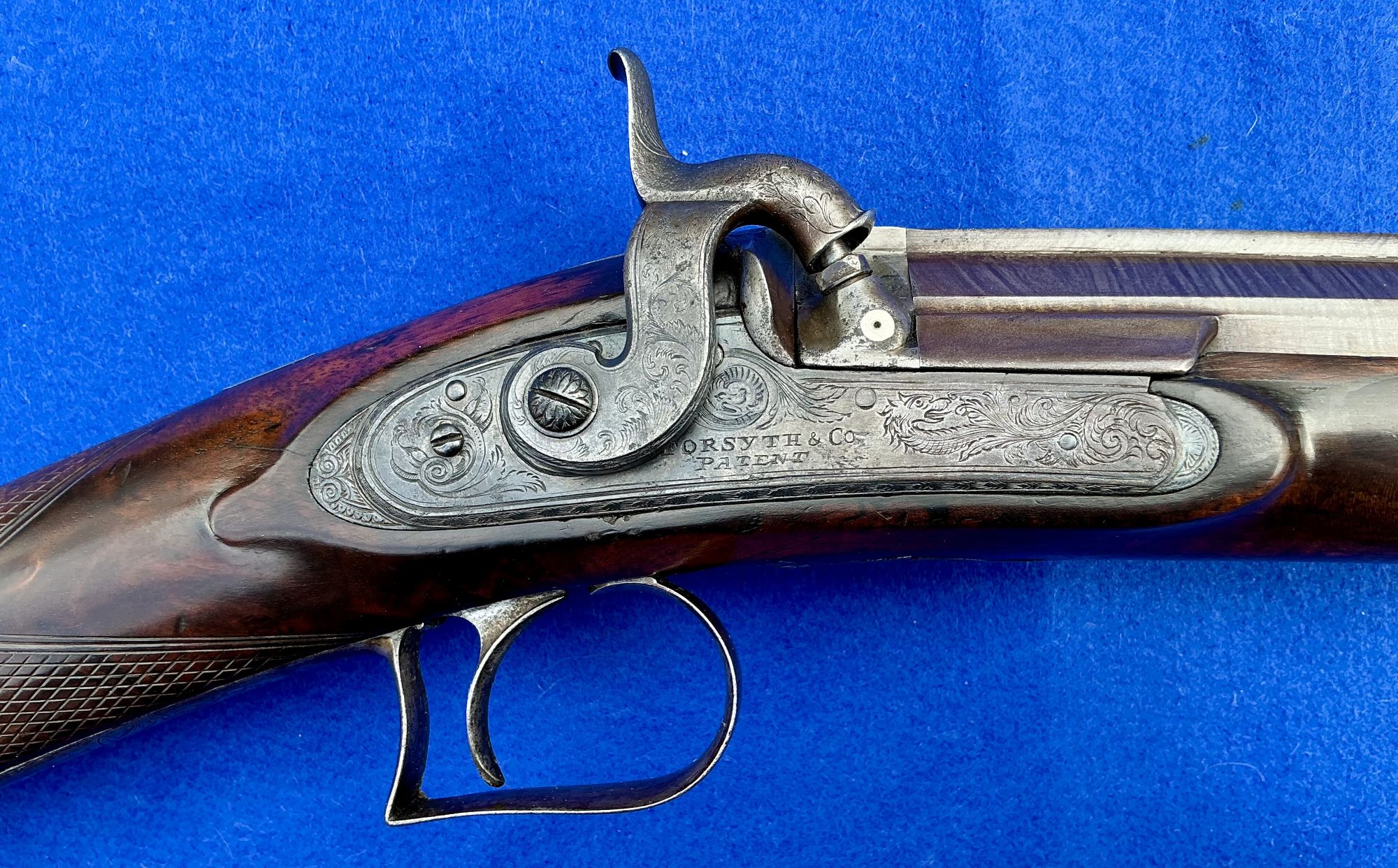
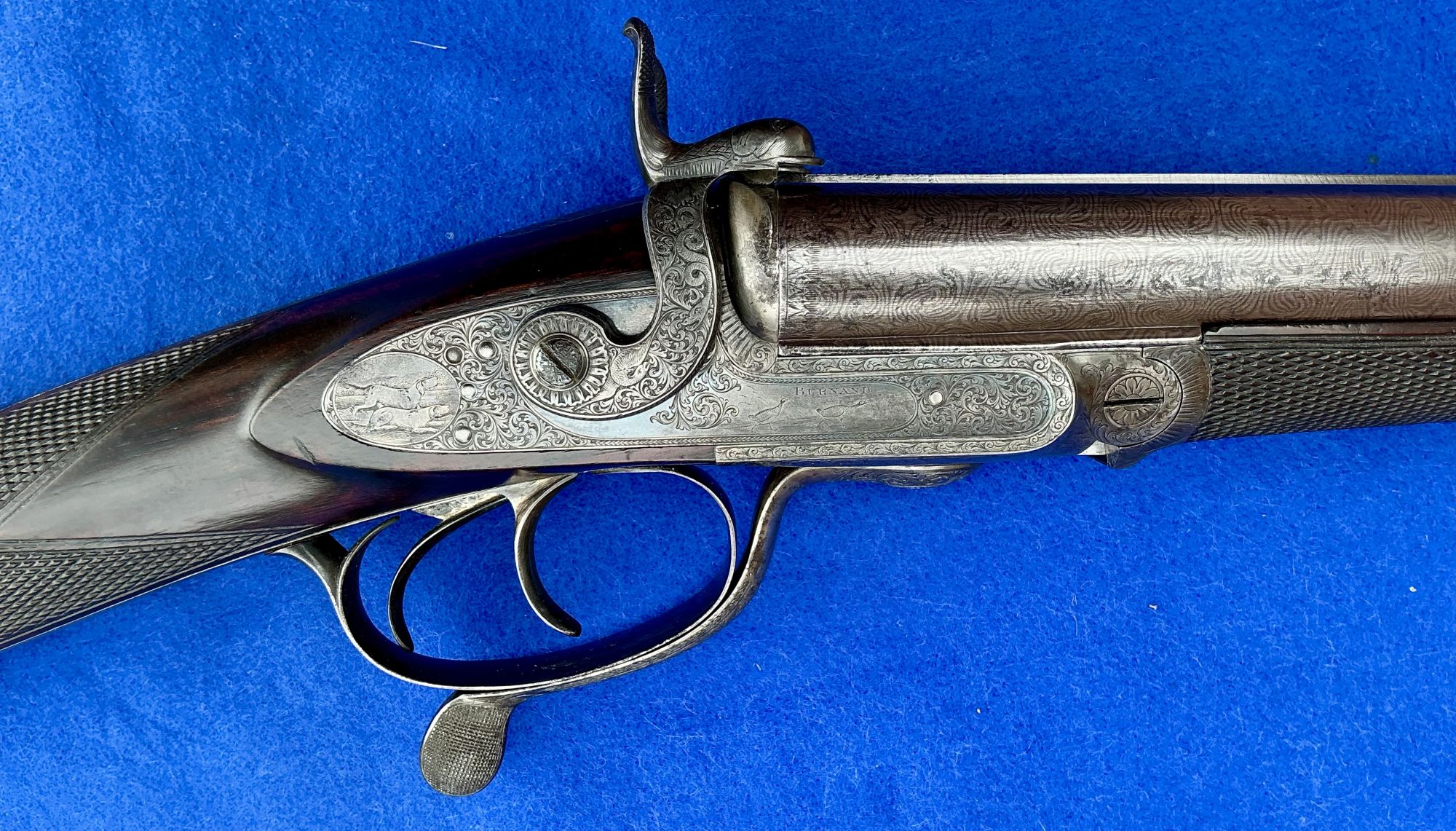
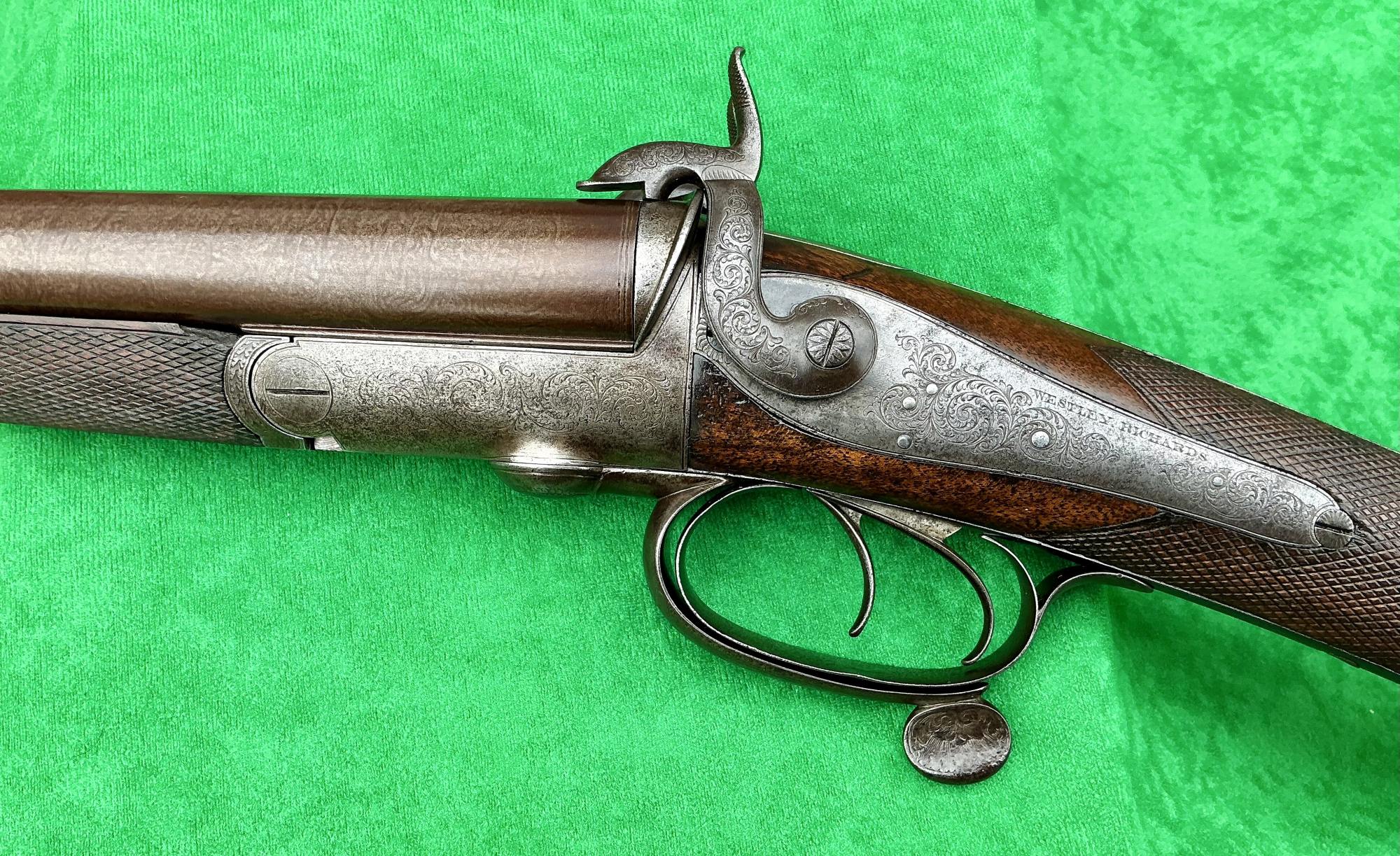
The Westley Richards sporting game gun's covered in "The Crab Joint Gun" - Article's One & Article Two, both use the Patent 2634, the patent bridges the transition from Pinfire to Centre, as these guns use the same single bite snap action patent – Patent No. 2623 of 1864. The use of the lateral thumb lever version of the patent in these two guns, has made the two guns look very stylish, up to date, and modern for their actual time of manufacture.

Westley Richards serial No. 10617 – Completed on the 9th of May 1865.
Westley Richards took over from his father William Westley Richards in 1840, this was of the time when Muzzle Loaders were the order of the day in Britain as Sporting Game guns. However, Continental and European Gunmakers were hard at work developing the Breech-loader, with Casimir Lefaucheux patenting his pinfire cartridge in France during 1836.
The first Westley Richards Breech-loader was built in 1858 as a Pinfire. This took a surprising 18 years from when Casimir Lefaucheux had previously secured his breech loading patent. The earliest of Westley Richards breech loading systems for sporting guns, used the "Under-Lever" designs that initially originated from Casimer Lefuacheux and Beringer. These Under-Lever designs and action bodies were improved, and further developed from the strengthened versions by Edwin Hodges for Joseph Lang's early British breech-Loading sporting guns of 1853/4.
Among the first, and most influential improvements for the new breech-loader from Westley Richards, would have been the Westley Richards ‘Doll’s Head’. The very earliest guns built with doll’s head rib extensions had a simple, long turning lever, which blocked the path of the doll’s head when closed. The early designs, are by which the barrels are opened and held shut. This dates back to patent 2149 of September 24th 1858. It is described as ‘Improvements in Firearms and Cartridges’. The record shows that the invention was dated 24th September 1858 and sealed on 25th November 1859.

The first Westley Richards with the Top Lever design - made in 1862. patent 2149 of September 24th 1858. The record shows that the invention was dated 24th September 1858 and sealed on 25th November 1859.

Westley Richards No. 9448, 16-bore pin-fire. The butt-plate engraved: “This gun was built for John Amphlett of Clent for £45 in 1862. He used no other. This was the first gun the firm sold with a top-lever action.”
The design and development from the WR firm continued, when in 1862 Westley Richards patented the Doll's head and "Crab-Joint" gun. Westley Richards used a "Pull Back" lever, further improving the design by having a laterally-pivoting lever, which did the same work with less effort. This pivoting top-lever action was given the patent No. 2623 in October 1864. The patent design worked well, and supported the bridge between Pinfire and Centre-fire guns’.

Doll's Head Extension - No cartridge extractors - Locking notch to Doll's head.

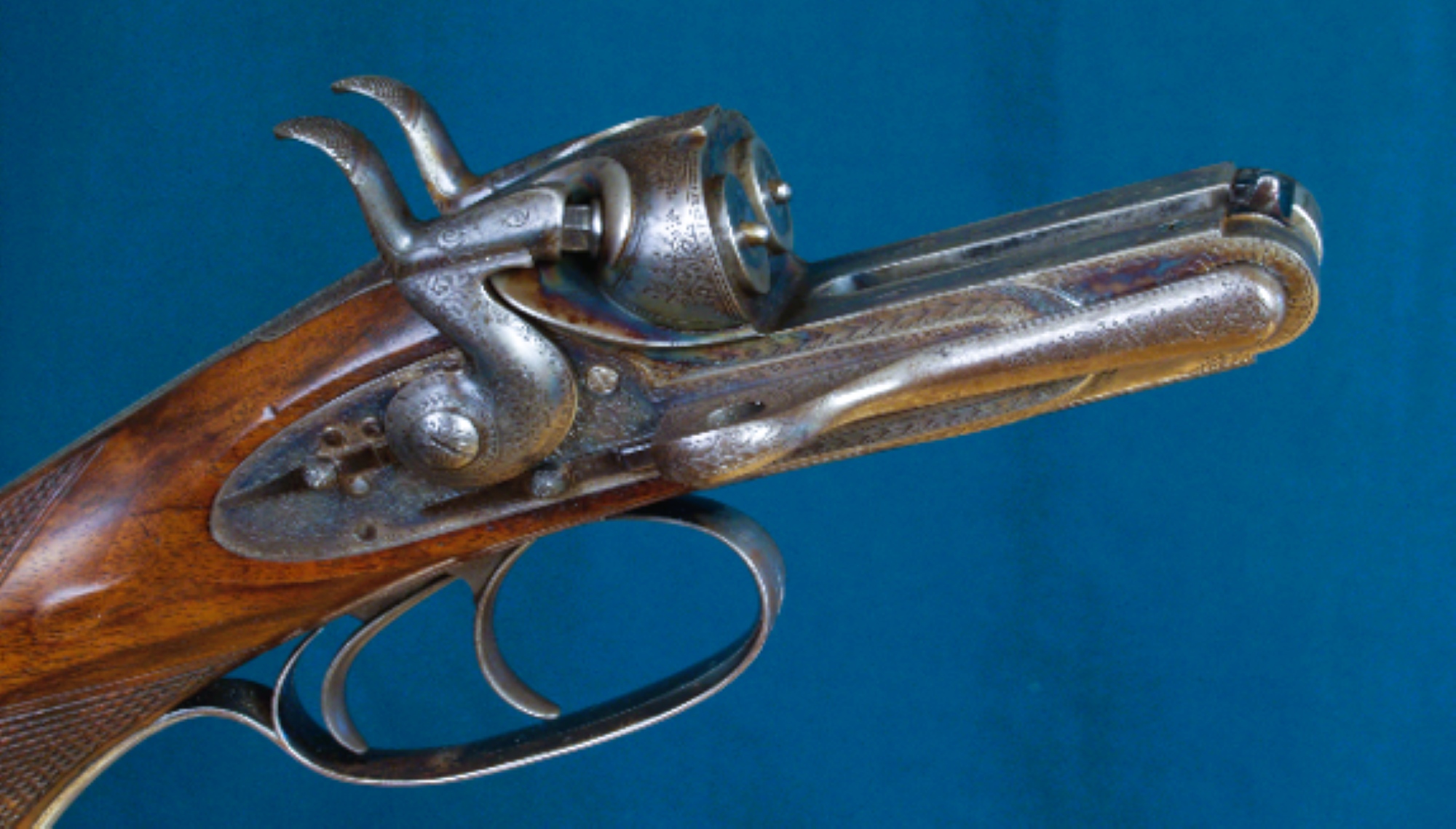
1864 Top-Lever Snap Action locking system.
The initial transition from Pinfire to Centre fire caused some concerns, one of those concerns being the use of the existing non-rebounding hammer locks. We had to wait until 1867 for this issue to be resolved. The primary issue raised - being, the earliest of Centre fire guns with their hammers at full rest, the hammers would sit against the striker heads. This increased the possible risk of setting off centre-fire cartridges, if in the event the gun was loaded and then closed in haste.


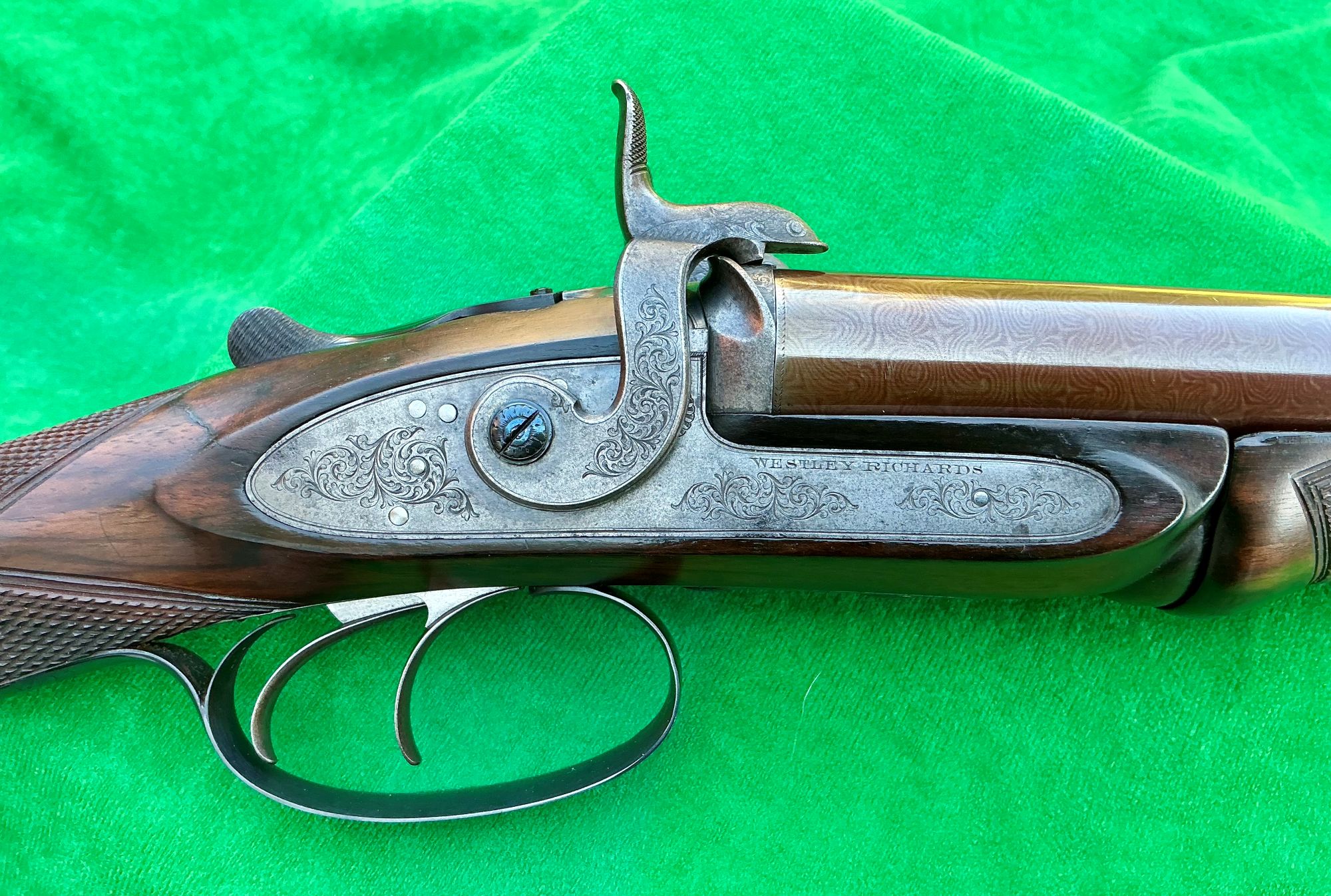
Early use of the Top-Lever, making the gun look very modern and up-to-date for the period.
This element of risk, however small obviously raised concerns for both gunmakers and customers alike. Westley Richards decided to keep the long-nosed hammers of the Pinfire design in place, and continued to fit them on early Westley Richards centre-fire guns. This reduced the risk of accidental discharge, through forcing the user to place the hammers in the half-cock position in order to open the gun for loading.

Top Rib Engraved - Westley Richards 170 New Bond St. London - Using good quality Damascus.
The risks of accidental discharge, or firing when closing the gun in haste were considerably reduced once the rebounding lock was invented. The first re-bounding lock patent recorded is from W. P. Bardell & William Powell, with patent No. 2287 of 1866. There were several Gunmakers hard at work in solving the re-bounding lock design. The industry standard was set by John Stanton, who developed the rebounding lock we best know today. The first re-bounding lock patented by John Stanton was recorded on 8 January 1867, and was patent No. 49. However, on 9 February 1867, John Stanton patented a third re-bounding lock, patent No. 367, it is this patent that became the industry standard.


Strong straight figuring to the stock.
The British Sporting Game gun scene was dominated by the breech-loading Pinfire game gun for approximately fifteen years. Although, the Pinfire system was quicker than the Muzzle loader to operate, the development towards the breech-loading centre fire was only a matter of time.
Westley Richards as gunmakers were excellent at developing and perfecting, both new, and established operating mechanisms. Another challenge was that of developing an effective, quick, efficient and safe method of securing the barrels of the early breech loader’s to their action bodies.

Original Proof marks, and lightly stamped London Black Powder re-proof for 1992.
The inventions and developments of the day were moving at a pace, and difficult to keep up with for sporting game gun users. There were underlying concerns that the new breech-loaders would fail, open, or unlock while in use. There were many traditional muzzle loader users, who could not see how any breech-loader could shoot as well as a muzzle-loader. Many advocates of the Muzzle loader regularly using a regular quip of the period, “No breech-loader would ever ‘shoot as hard’, as a muzzle-loader”.

Short barrel flats, allowing the interaction of the raised action flats - superb attention to detail.

Raised Action Bar flats - Top-Lever locking bolt, which locks the barrels with corresponding Dolls Head.
The second dolls head locking system design used on Westley Richards guns features their 1862 patent sliding top-lever. The Westley Richards patent is simple but effective in operation, using the right hand thumb, the lever is pulled back, as the lever moves back along the top tang the locking bolt moves out of the slot in the doll’s head, allowing the gun to open. The WR patent operates similarly to the Horsley patent of the 1 October 1863 ( patent No. 2410 ) for a pull-back top-lever or slide. The Horsley operating lever was located on the top strap. Patent No. 2410 is the patent for which Thomas Horsley rightfully developed his fame. Importantly, while the system superficially provided a similar operation to the Westley Richards patent No. 2506 of 1862, the locking mechanism is quite different.

The Crab Joint and Cross-pin forend locking latch, Horn forend tip.

The "Crab Joint" and "Bar-in-Wood" action mirrors the quality of build throughout these guns'
The second ( modified ) version, is basically the same lock up and bolting system. This version was patented, and in production during 1864 ( patent No. 2623 of October 1864 ). The changes to the patent ensures, the lever rotates from left to right when operated with the right thumb. This movement draws the top-bolt out of the slot within the dolls head, allowing the gun to open. The single point locking of the top bolt, fits to a precise corresponding slot in the dolls head. This remains the sole means of securing the barrels to the action. The system of single point locking via the Westley Richards dolls head lock-up can appear to lack strength, however the system was used on both shotguns and double rifles, and a good number remain in regular use today.

The bottom barrel rib at the muzzle end retains a Ram Rod clip. ( Throw back from days gone by )
The third version retains the doll’s head and top-bolt, but this is now used as a third bite. The main bolting system now uses the Purdey double under-bolt of 1863. This has now become a triple bite locking system, using the Purdey bolt, and the bolted doll’s head. Westley Richards have continued to keep and use this system on shotguns and double rifles today.
The gun in focus for this article – Gun Number 10617 is shown in the Westley Richards ledgers, and described as – a 12g, double breech loader, snap action, completed on the 9th of May 1865 & sold to a Reverend George Robinson on the 31st of May 1865. Then re-sold by Westley Richards to an A.H. Royds Esq. on the 19th of July, 1865. The gun was inherited by A. H. Royds Son, Colonel Royds of Forest Row, Sussex. The gun was then gifted to a Mr. Paine ( Chauffeur to Colonel Royds ), the gun is then inherited by Mr. Paine’s Son, David Paine who was both a RFD gun dealer and collector. David Paine then sends the gun to G. M. Cruxton ( Gunsmith ) 55 – 56 Price Street, Birmingham B4 6JZ. The gun underwent renovation and overhaul, including London black powder re-proof. All of this being conducted with the intentions of using the gun on special occasions. The gun today remains in perfect working condition and ready for a day in the field.

Westley Richards No. 10617 - Pin-Fire, completed 1865, made seven months after the introduction of patent No. 2623 of October 1864
The gun in this article, although looking very similar to the gun in the second article using patent No. 2623 of October 1864 ( Single bite Snap Action ) in Article Two, they are different, including being a Pinfire breech loader, having no extractor, with 29 ¾ inch barrels, London black powder re-proof in 1992, Proofed in both at 18.7 (.736) now measuring .738 in both. Minimum barrel wall thickness of 20 thou. in both barrels. The bar-in-wood action having raised centre flats to the action body, to correspond with the matching recess under the barrels at the breech end. The barrel bottom rib at the muzzle end having a ram rod retaining extension clip. The forend fastener of the early cross-pin latch type. Breech face with patent use number 530 and stamped Westley Richards.