Charles Lancaster - Base-Fire, Gun & Cartridge
Charles Lancaster
Base-Fire, Gun & Cartridge
The breech-loaders’ popularity gained attention with the Victorian Sportsman, just after the Great Exhibition of 1851. The success of the exhibition was published through sporting papers and magazines. There was an acceptance of the breech-loaders arrival, with the benefits of the new concept being obvious to see.
Joseph Lang began promoting and selling his own manufactured version of the Lefaucheux type of Pin-fire breech-loader, but only after Edwin Hodges had built and improved the design, ensuring the gun was acceptable to both Joseph Lang and his Father. These sporting guns, with Lang’s name on them were available in Britain around 1853 & 1854.

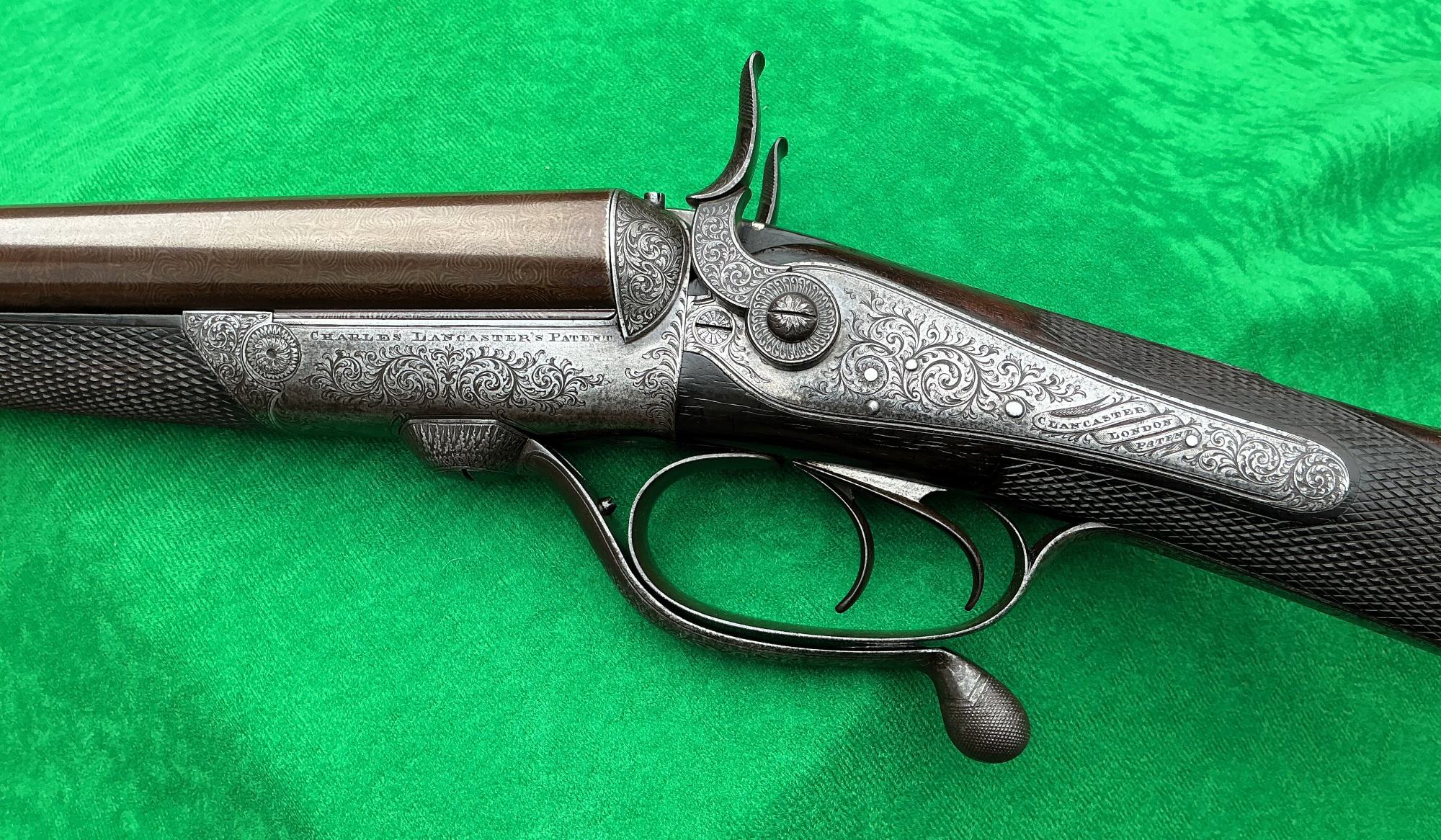
The elegant lines of Charles Lancaster's Patent - Base-Fire sporting game gun.
The finest Victorian Engineering minds were working on ways to develop what was already working, and how to further improve designs, adding strength, durability, and appeal. Charles Lancaster was no exception, and gave us, the Slide and Tilt Action, although research has uncovered some interesting facts in relation to the “Slide and Tilt” patent used by Charles Lancaster. The sporting gun built by Lancaster, originated from contact with Albert Henri Marie Renette of Paris, after Renette obtaining a French patent in 1835 for a slide-and-tilt breech-loading action, it is presumed this patent was initially for a capping-breech loader. This was very close to the time that, Casimir Lefaucheux patented a similar design for his hinge-action capping-breech loading gun, which supported the way forward to the development of the Lefaucheux pinfire invention in 1834.

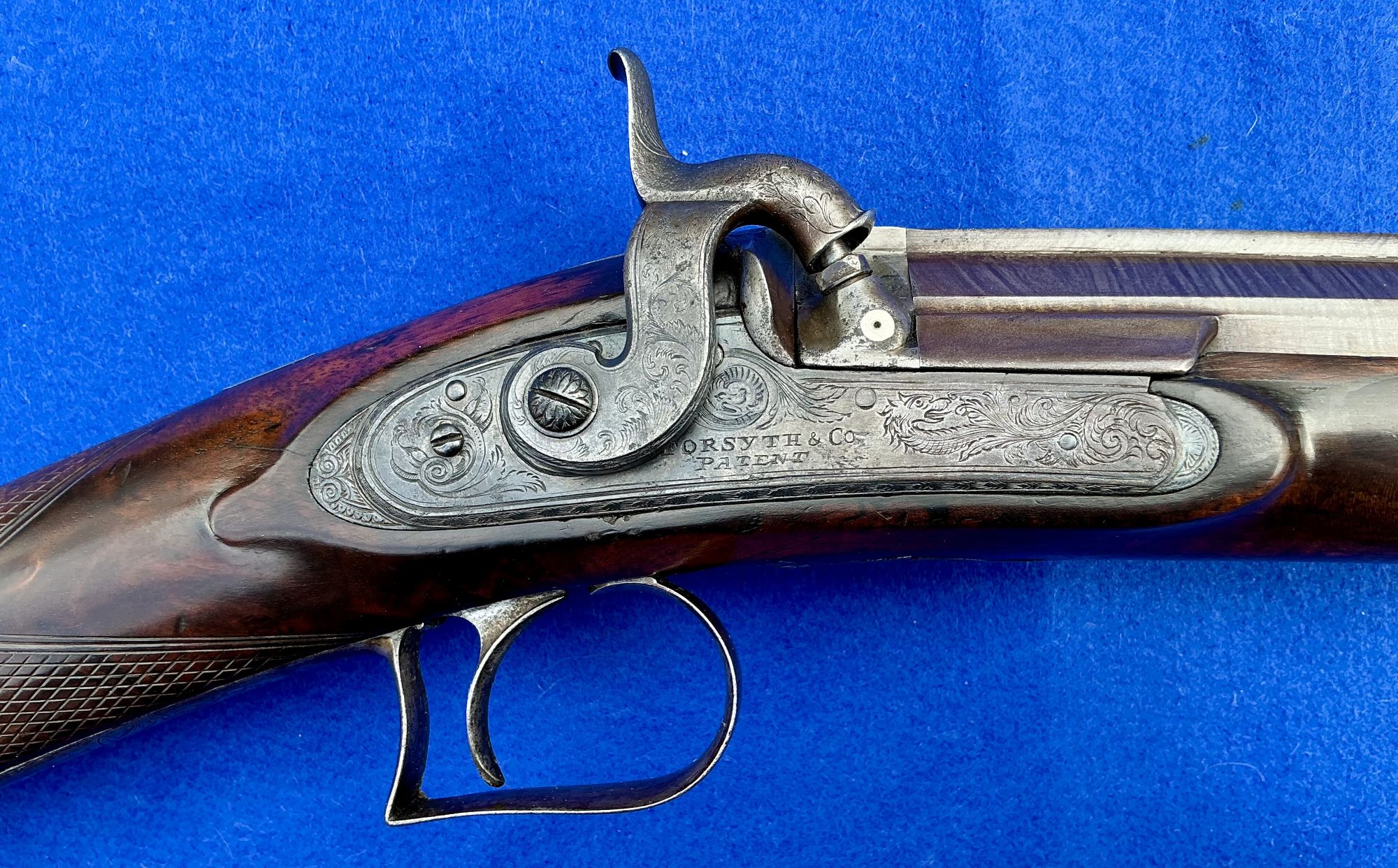
Nose-less Hammers, and fully engraved top tang.
During 1853 Renette's son-in-law and partner, Louis Julien Gastinne, obtained a French patent No. 9058, this was for use on a breech-loading actioned hammer gun. The patent No. 9058 was intended for use with the new internally-primed Pottet/Schneider centrefire cartridges. This patent was secured by the patent agent Auguste Edouard Loradoux Bellford, who patented the French design in Great Britain, and secured the patent No. 2778 of 1853. This patent was assigned to Charles Lancaster during November 1856, and was initially used for his base-fire cartridge, then we see "Charles Lancaster's Patent" engraved on Lancaster’s Base-Fire and Centre-Fire guns. Interestingly, the patent was not taken out in his name, although the gun became a Charles Lancaster production model circa. 1856.

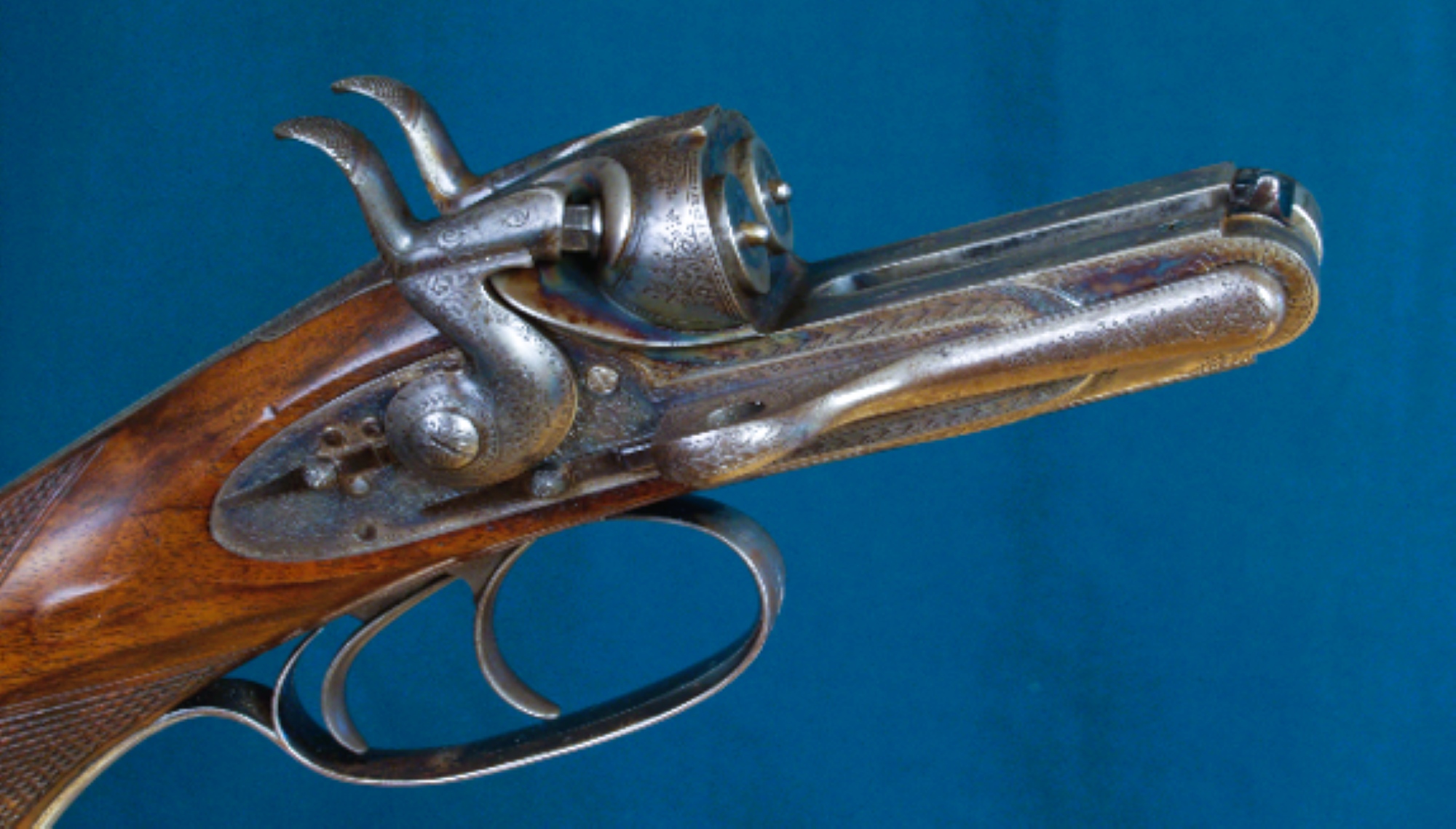
Rotation of the Under-Lever opener, slides the barrels forward.

Hare eared, Nose-less and flat sided hammers.
The process of proclaiming patents by a number of makers during the Victorian period is evident; when the patent rights were purchased, the custom of the day allowed makers to proclaim the patent as their own, similarly to ‘Purdey Patent’ on Beesley designed guns and Stephen Grant placing 'Grant's Patent' on Hodges designed guns.
The 1856 patent ‘Slide and Tilt’ action is renowned for its links with the ‘Base-Fire’ cartridge made by Charles Lancaster. The action durability and strength comes directly through the locking of the barrels to the action in two stages. This makes the locking mechanism exceptionally strong. The patented system operates by way of the under-lever initially moving the barrels forward, by way of a cam, this continues to slide the barrels forward until the hook meets the hinge pin. The two surfaces at this point reach the hinge point, allowing the barrels to open on the hinge, with the gun now open, the insertion or removal of cartridges can take place, before reversing the under-lever process to close the gun.

Strong well figured walnut stock.

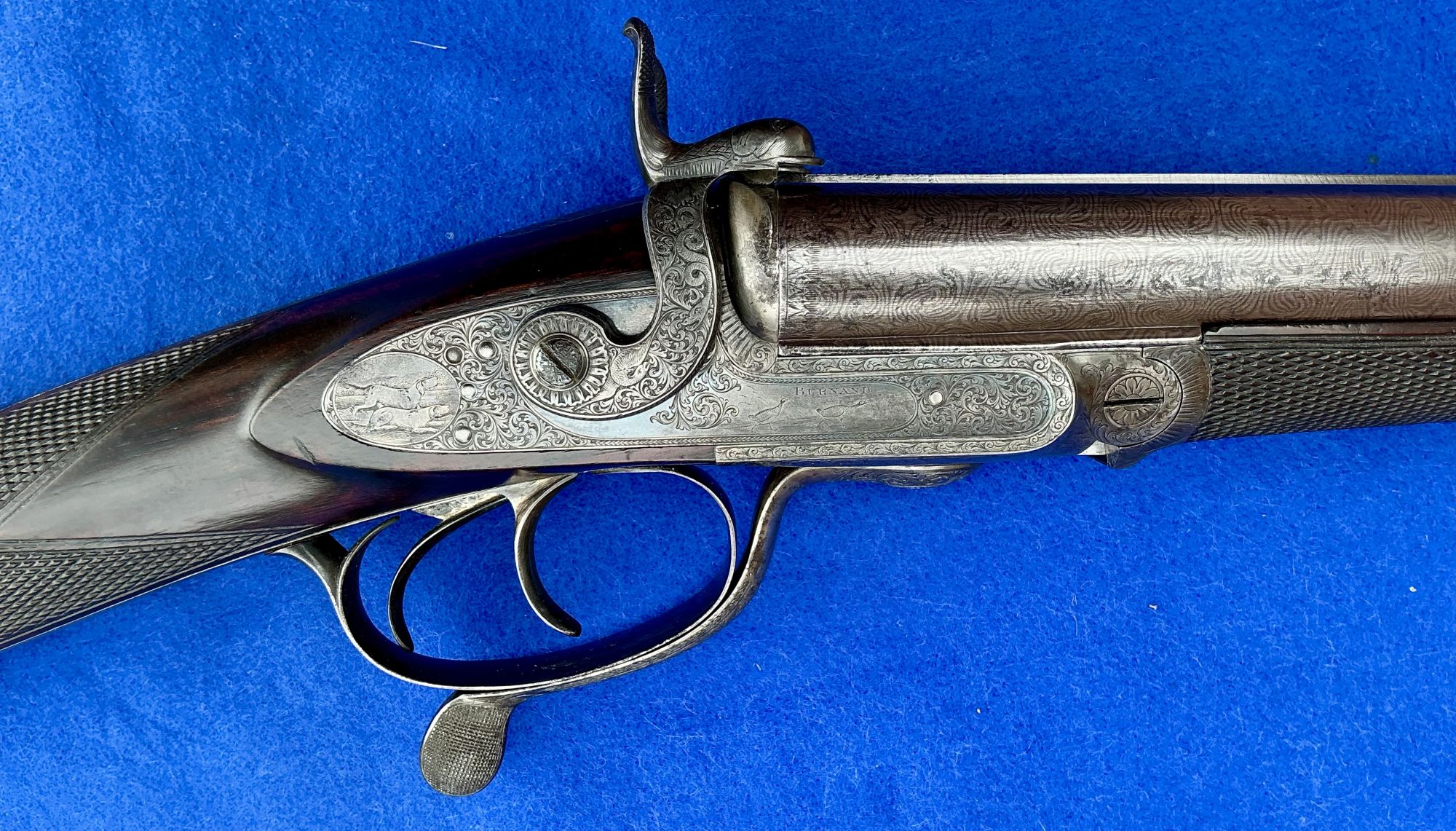
Dark figuring, strongly figured walnut throughout both Stock & Forend.
The original Lancaster built ‘Slide and Tilt Action’ was designed specifically for the Base-Fire cartridge, with all guns using this action design pre 1861 being made as Base-Fires. The cartridge was ignited via a wide based cone shaped firing pin.
What was the reason for the relatively short lived base-fire system, as it was exceptionally strong and could have easily moved towards the full centre-fire system. This could have been achieved with a simple change in firing pin design and the centrefire cartridge we know today.
The transition from muzzle-loader to centre fire took place, using various systems. The Base-Fire system was extremely strong, and a far better design compared to other systems including the Pin-fire. The consensus of opinion for the actual failure of the Base-fire system is linked to the supply of ammunition. Lancaster’s insistence in controlling the supply of ammunition himself, unfortunately a short sighted consideration had a massive impact on the systems’ longevity.
Lancaster having secured both the patent rights to the Base-fire system and the ammunition, gave rise to Lancaster wanting to sell both Gun’s and Cartridge’s himself, in an attempt to achieve maximum income from his design patent.
This was a massive challenge, and likely to have been near impossible. The flip side of this being, the manufacture of Pin-fire ammunition, which was in place with no restriction, available from all ammunition manufacturer’s, and made in massive numbers, without disruption to supply. Eley Brothers made the Pin-fire cartridge from the earliest days of the system. Lancaster’s decision in keeping everything in-house, is likely to have created the early demise of the Base-fire.

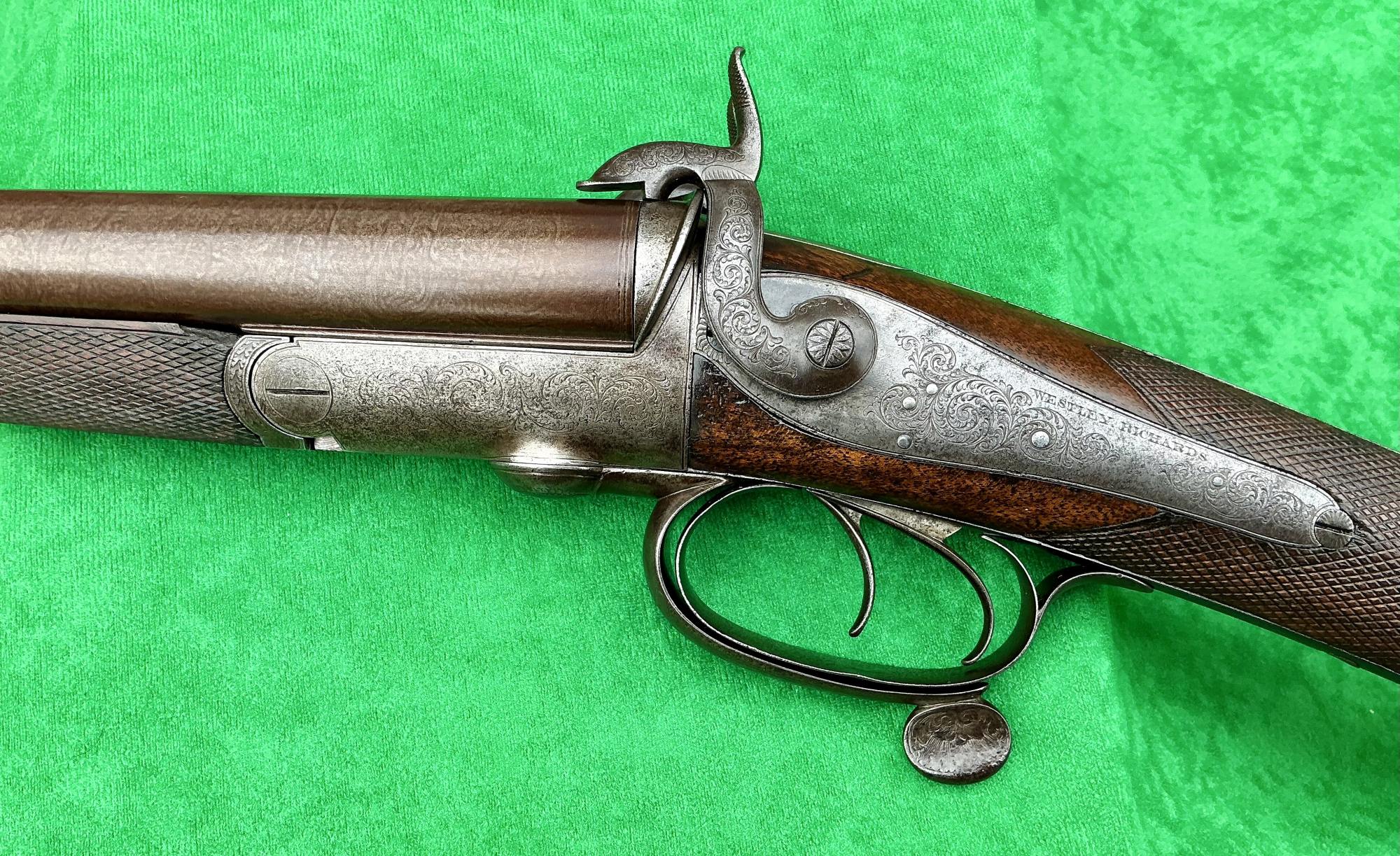
The gun is well engraved throughout, the Under-lever opener hides this guns' serial number.
The gun that inspired this article has the serial number 3888, the gun was made in 1864 for a Mr. R. Atkinson, as a 14 bore, using Charles Lancaster patented Base-Fire system. There is little further information on this gun within the Lancaster ledgers, although, one interesting entry, stating the Barrel length, which is recorded as 2 feet 7 inches.
The Lancaster Base-Fire was one of the more expensive sporting game guns in London at the time, with a price tag of £68 for a single gun. The gun has fine Damascus barrels, and fitted with an extractor, the Lancaster Base-Fire being the first British breech-loading gun to have one. The top rib marked "Charles Lancaster 151 New Bond Street London. Patent Breech Loader", between the breech and forend loop is stamped with Lancaster's initials "CL" on each barrel. The London Black Powder Proof marks are for 1855 to 1868, stamped 14 bore and remaining in proof. Louis Julien Gastinne's patent, for the extractor, was assigned to Lancaster in 1856. The nose-less, Hare eared hammers are attached to non-rebounding locks, the action fitted with the patented cone shaped Base-Fire firing pins. The under-lever operating the Slide and Tilt mechanism retains a firm lock-up of the barrels to action.

A best London gun of the day (1864) with a price tag of £68.
The centre fire versions of Charles Lancaster’s Base-Fire action appeared with the introduction of the Centre Fire gun. The centrefire cartridge was invented by Clement Pottet of Paris, further improvements were made by Francois E. Schneider, also of Paris. The centrefire cartridge was introduced to Britain in 1861 by Mr. George H. Daw who purchased the British patent rights from Francois E. Schneider. The Daw patent is number 1594 of 1862, this patent covers a set of improvements to the Schneider patent number 1487 of 1861, which Daw had purchased the patent rights. The Daw cartridge was similar to the Lancaster Base-Fire, however the Daw priming mechanics presented a more modern, efficient and re-loadable cartridge detonation than Lancaster’s Base-Fire.

Lancaster Base-Fire serial number 3888 for 1864 hidden beneath the opening lever.
Eley Brothers could see the potential in Daw’s centre-fire system immediately, Eley made the decision, they would produce the Daw Centre-fire ammunition, and make it commercially available. Both Daw and Lancaster wanted to control sales of their patents, all of which ended in a court case brought by Eley Brothers, to which Eley won. During 1865, centre-fire ammunition became available to everyone, this supported, encouraged and focused gunmakers in making centre-fire guns from this point forward.

Best Damascus barrels - Charles Lancaster 151 New Bond Street London - Patent Breech Loader.
A number of the Lancaster "Slide and Tilt" actioned guns have survived as sporting shotgun’s and as rifle’s, due to their strength of actions and strong design, most have been converted to centre-fire, however, in original base-fire form these guns remain rare.
The Lancaster history below covers a period ten years either side of the Base-Fire system.
Charles (II) died suddenly on 5 April 1847, aged 56. The firm was inherited by his widow, Mary Warrington Lancaster, and run by Charles (III) who, at this time, was 25 years old; no doubt Charles (II) would have made Charles (III) and Alfred partners in the firm within the next 5 years or so.
Charles (III) was remarkably inventive, he developed the double metal gas check, and in 1848 he registered a design for another pillar breech (No. 1418).
On 3 July 1850 he patented his oval bore rifling (No. 13161) which initially was oval or elliptical for muzzle-loaders, and later varied in shape between curvilinear, trilateral or quadrilateral, and was either cut in a plain or an accelerating spiral. It was said that oval bore "rifling" was less subject to fouling from black powder than normal rifling due to the fact that there were no grooves to be sealed by the tightly fitting bullet. The primary reason for the design was to spin, and thereby stabilise the bullet and improve accuracy, but the smooth bore later made the creation of dual purpose ball and shot guns, as the shot was not damaged by rifling.

The barrels tilt as the opening lever pushes the barrel forward passing over the hinge point.
The ball and shot guns were later (1893) sold as the "Colindian" model and were moderately accurate up to 100 yards, the pistols (.38 to .577) do not appear to have had a model name. Later Colindian oval bore guns were bored with a small amount of choke.
On 16 January 1851 Charles (III) registered patent No. 13454. This patent covered a machine to make his oval barrels, also driving bands for exploding bullets.
In 1851 Charles (III) became a Gunmaker to the Board of Ordnance supplying double barrel carbines. The firm displayed their guns and their oval bored barrels at the Great Exhibition of 1851. They also displayed a double barrelled flintlock sporting gun, one of only 5 that the firm made, which was entered into the Field rifle trials in 1889.

Lancaster's Patent "Slide & Tilt" being the first gun in Britain to use an extractor.
In the 1851 census, Charles (III) was recorded as aged 29, a gun maker employing 60 men which would have made him one of the largest gun makers in the country and perhaps the largest in London. He was living at 151 New Bond Street with Joseph Pargetter and Elizabeth Cooper Brindley, who were described as visitors, and Jane Douglas, a house servant.
In 1852 the firm opened a shooting ground at Wormwood Scrubs. They claimed that this was the first shooting ground in London.
On 7 January 1853 patent No. 47 covered an improved bullet mould. On 27 August 1853 patent No. 1988 covered an oval bore barrel making machine. In 1853 he supplied breech loading rifles to the Board of Ordnance.
At this time, many gun makers in England and France such as Dreyse and Needham were developing new ideas for breech loading guns and self-contained cartridges, and quite obviously, Charles Lancaster was amongst them. His base fire cartridge was something of a cross between the rim-fire cartridge invented by Flobert in 1845 ( his .22 "Gallery Cartridge" which had no powder just the priming compound ), and Daw's 1862 centre fire cartridge, which was developed from Francois Schneider's and Clement Pottet's cartridges ( the latter was later improved by Colonel Boxer's new primer and adopted by the Board of Ordnance ).
The base-fire cartridge had a paper tube with a copper head, inside which was a copper plate with four small holes. The primer, which was a compound of fulminate of mercury, was contained between the head and the plate, it was ignited by a blow from the conical firing pins.

The forend secured using the Cross-Pin latch system.
In the meantime, Auguste Edouard Loradoux Bellford had developed the ideas covered by Louis Julien Gastinne's French patent No.9058/1853 breech loader and came up with his patent cartridge ( patent No. 2778 of 29 November 1853 which was assigned to Lancaster on 22 November 1856 ). On 28 September 1854 patent No. 2089 was registered for the Lancaster base fire cartridge, and a breech loading mechanism, but the base fire cartridge was not perfected until 1857 when, on 16 September, he patented his improvements ( patent No. 2400 ), but even then it was only moderately successful because it tended to mis-fire.
The base-fire cartridge, at its base was a percussion compound coated copper disc with four flash holes. The Base-Fire cartridge was not re-loadable and was eventually replaced by the centre fire cartridge and many base-fire guns were modified to accept them.
In 1855 Charles' younger brother, Alfred (b.1828), had become a partner in the firm which was re-named C W & Alfred Lancaster. In that year the firm designed oval bored carbines for the Royal Sappers and Miners, for which they were paid £6,600 by the Board of Ordnance.

Black Powder Proof Marks - London - 14 bore - 1855 to 1868
In 1856 Charles (III) started to build his first guns for the base fire cartridge, and from this date his guns bore the legend "Charles Lancaster patent". One version of Lancaster's base fire guns were made with an external striker withdrawal mechanism especially for Prince Albert, several examples are in the Royal collection.
On 1 July 1858 Charles (III) became a freeman of the Gunmakers Company by redemption and took livery. On 8 October of that year he registered a design ( No. 2243 ) for a copper and aluminium alloy rifle barrel. At some time in 1858 Charles (III) registered patent No. 1361 (not traced) for a rolled turnover machine. The machine may not have worked too well, but the idea was a major step forward in the early days of cartridge loading after inadequate wadding, sealing and shot retention reduced the efficiency of the early cartridges.
In the mid-1850’s Charles (III) had started to work on multi-barrel guns, although these had greatly increased firepower, they were difficult to handle and even the best guns had loading and ignition problems. In the following years, as breech loading developed, he produced two, three and four barrelled pistols, rifles and shotguns which were reasonably reliable, but the weight of these guns was a significant limiting factor. The development of efficient ejector and magazine mechanisms and the development of the revolver finally curtailed production.
During 1858 Charles (II)’s wife Mary Warrington died.
In 1859 Alfred left the firm, and founded his own business at 27 South Audley Street, and C W & Alfred Lancaster was re-named Charles Lancaster.

Every part of the gun is well engraved - trigger tang with three pheasants ready to be flushed.
In 1860 the Thomas Place workshop was closed, another was opened at 2 Little Bruton Street which, because it backed on to 151 New Bond Street, was much more convenient. On 5 December in that year Charles (III) took out patent No. 2983 for side mounted rifle sights which were used on Lee Metford and Lee Enfield military rifles.
In the 1861 census Alfred was recorded living at 10 Phillimore Terrace, Kensington (High) Street with two domestic servants. In the same census, Charles (III) was recorded as a gun maker but surprisingly unless it was an error, as the employer of only 10 men. It is worth noting that the Enfield factory had opened in 1857, which meant that the firm's production and work on military weapons had all but ceased, and it would seem that from this point in time, the firm concentrated on producing only very high quality "best" guns. Living with him as lodgers at 151 New Bond Street were George Reid, a gun maker aged 42, and Eliza Reid (wife / sister aged 32). John and Ann White were Charles' servants.
On 5 April 1865 he patented an extractor for a sliding breech block.
On 6 January 1867 patent No. 112 covered a second extractor mechanism for oval bored rifles, and on 23 December 1867 patent No. 3642 covered refinements to oval boring. Oval boring was used for rifles of all calibres from .250 to .577.
On 13 July 1868 Charles (III) married Ellen Thorne (b.1840 in Stony Stratford, Buckinghamshire). Two children were recorded, Edith (b.1868) and Kathleen (b.1870) but during their early childhood Charles (III) had taken a mistress, Emma Carstairs and Ellen left him taking the children to live with her mother who had moved to Cosgrove in Northamptonshire. Charles (III) and Emma Carstairs subsequently had a daughter named Ellen.
The 1871 census records Ellen Lancaster living with her mother in Cosgrove. It also records Charles (III) living at 151 New Bond Street with his porter and his wife and child. Alfred was recorded at 10 Phillimore Terrace with his wife Emily Matilda (nee Croft b. 1841), they had a daughter Alice M (b.1869) and employed two servants. Alfred described himself as a gun manufacturer.

Breech face cartridge recesses, non-rebounding locks pushing the cone shaped base-fire firing pins forward.
In 1871 Charles (III) employed Henry Alfred Alexander Thorn as an apprentice, to which Thorn later became Charles' assistant.
Henry Thorn was born at 6 Lansdown Villas, Kensington on 28 April 1854, he was the son of Frederick Thorn, a coach builder, and Emily (nee Hodgkinson). On 28 October 1875 he married Annie Lake Cooke, and in June 1876 they had a son, Henry Gilbert Alexander Thorn. On 6 December 1877 Annie died of typhoid.
When Charles (III) died at 11 Redcliffe Road, Brompton on 24 April 1878, aged 56, he left Ellen one third of his estate which was valued at under £10,000. The other two thirds went equally to his mistress Emma Carstairs and her daughter. Edward Philip Bond, the well-known gun maker of Hooper Square, Minories, was one of the executors. In the event, E P Bond declined to act as executor and the remaining executor, Ellen Lancaster, sold the business to Henry Thorn, aged 23, who re-named the firm Charles Lancaster & Co.
No Base-fire cartridges have survived, or are known to exist
(Only Drawings)
Reference and Bibliography
David Neale - Southgate Collection
Stephen Nash
IGC – Historical background and development
Vintage Gun Journal
Nigel Brown
Crudgington & Baker - The British Shotgun - Volume 1 pages 100-103.
British Guns Editorial Team