Theophilus Murcott - Gunmaker - London
Theophilus Murcott of London
Stories from the Scrap Pile - Rare Murcott Pin-Fire
We all process and gather considerable amounts of information through looks and images. This process can on occasion create shortfalls for all of us interested in British Guns', when presented in less than the best of conditions most guns' are overlooked, and are easily cast aside and disregarded. This raises considerable concern that some of these British Guns' destine for the scrap pile, could be; interesting, rare or important ! - This article by Stephen Nash uncovers just such a rarity, which could have easily been lost.

Rarely seen, a Pin-Fire Sporting Game gun by Theophius Murcott - Gunmaker, London
What can an old gun tell us? There is a mystical allure to guns that have had a lifetime, or several lifetimes, of use in the shooting field. How much game has the gun taken? Who has owned it? Where has it been? Whose hands built it?
In a perfect world, all old guns would be in fine untouched condition, in their original cases with label and tools and accessories, with perhaps the original bill of sale and a copy of the gunmaker’s ledger to top things off. We’re rarely that lucky, or rich enough to take advantage of such rare opportunities. For a limited-budget collector, focused on a theme, a period, or a specific maker, one has to make do with what is available, and on occassion “interesting” and “condition” are polar opposites.
While it is easy to walk away from a specific antique gun purchase, it could well be the only one you will see in your lifetime, and putting up with blemishes and damage might still be worth it in the end. Even the guns that have a whiff of hopelessness about them can still tell us a lot, and maybe teach us something in the ways of Victorian gun making.
Here’s one in dilapidated condition. As a pin-fire game gun it was probably worked hard, followed by a conversion to central-fire and used for decades more, then neglected and eventually stripped of useful parts and finally relegated to the proverbial scrap pile.

Barrel Top Rib signed - “Theops Murcott 68 Haymarket London SW” within a scrolling banner.
The gun is signed Theophilus Murcott of London, an uncommon name that should nevertheless be recognised by many double gun fanciers. In April 1871 Murcott patented the first commercially successful hammerless gun, an underlever-cocking bar-action sidelock, built with a single bolt engaging with the rear lump, or with a Purdey double-bite. The action was desultorily nicknamed “Murcott's Mousetrap” by a competitor, a name that eventually stuck with some affection. Every hammerless hinge-action shotgun can trace their beginnings to the Mousetrap. Murcott advertised his gun widely, extolling its “rapidity of action, perfect security, non-liability to accident, extreme simplicity of construction.” As is often the case, a gunmaker becomes famous after an important invention, or after decades of building quality work. In Murcott’s case, the origins of the gun making business were far removed from the typical story.
Apologies for the long family history that follows, but a number of errors in popular writings need to be corrected. Theophilus William Murcott was born in 1816 in Edgbaston, Birmingham. His father, William (b. 1769), was a cheese and bacon factor, who married the daughter of William Smith, a corn, cheese and bacon factor. William’s business partner was Abraham Murcott (relation unknown), and in December 1808 the partnership of ‘A & W Murcott, Cheese and Bacon Factors,’ was dissolved and William continued on his own. At some point he was in business with John Woodburn, though that collaboration was short and dissolved in 1812. William had another son, William Smith Murcott (b.1809 ?), who did not continue the family business, and instead trained as a gunmaker (he might have completed his apprenticeship around 1830, near the time Theophilus would have been of age to start an apprenticeship). Together they formed a gun making partnership, start date unknown, which did not last long and was dissolved on 7 July 1837. Theophilus is said to have moved to London shortly afterwards, possibly linked to his father’s cheese business. This might have led to his involvement with Mary North, a cheesemonger who ran a shop in Princes Street, Leicester Square. Theophilus married Mary (b. 1814 in Stockland, Devonshire) on 31 December 1838. William Murcott the elder died in March 1839, age 60, and his eldest son, William Smith Murcott, died in May of that year, age 30. It appears that Theophilus and Mary returned to Birmingham in 1841, as they had a son named Charles Ephraim who was born there in 1841. By 1846, Theophilus and Mary were living in London where a daughter named Mary Elizabeth was born in 1847, and a son Theophilus in 1854.

Double Screw Grip ( Jones style lock up patent 1859 ) - The gun built circa. 1870 (Pin-Fire)
The 1851 census lists Theophilus Murcott living in Lewisham, London, as an agent. I believe this was for the Birmingham gunmakers Tipping & Lawden, who maintained a London shop at 26 Bartlett's Buildings, off Holborn Circus, an area frequented by lawyers. In 1854, Murcott is said to have opened a gun shop at 16 Essex Street, Strand, but the business was declared insolvent in 1855. By 1861, Theophilus had moved to live and work at 68 Haymarket. The Haymarket area was popular with gunmakers trying to attract a top clientele. The 1861 census records Theophilus and his wife Mary living at the Haymarket address with his children Charles, Elizabeth Mary and Theophilus, and Charles and Sarah Hanson. Theophilus Murcott, his son Charles, and Charles Hanson were listed as gun makers; Hanson may have been a journeyman gunmaker working for Murcott, perhaps after finishing his apprenticeship with him. On 15 August 1861 Theophilus Murcott senior and Charles Hanson registered patent No. 2042 for a hinged and rising/falling chamber block operated by an under-lever. By 1866, Theophilus was known for his conversions of muzzle-loaders to breech-loaders. Finally, in 1878 the business was sold to William Wellington Greener, and Theophilus Murcott died in London on 19 May 1893, aged 75.
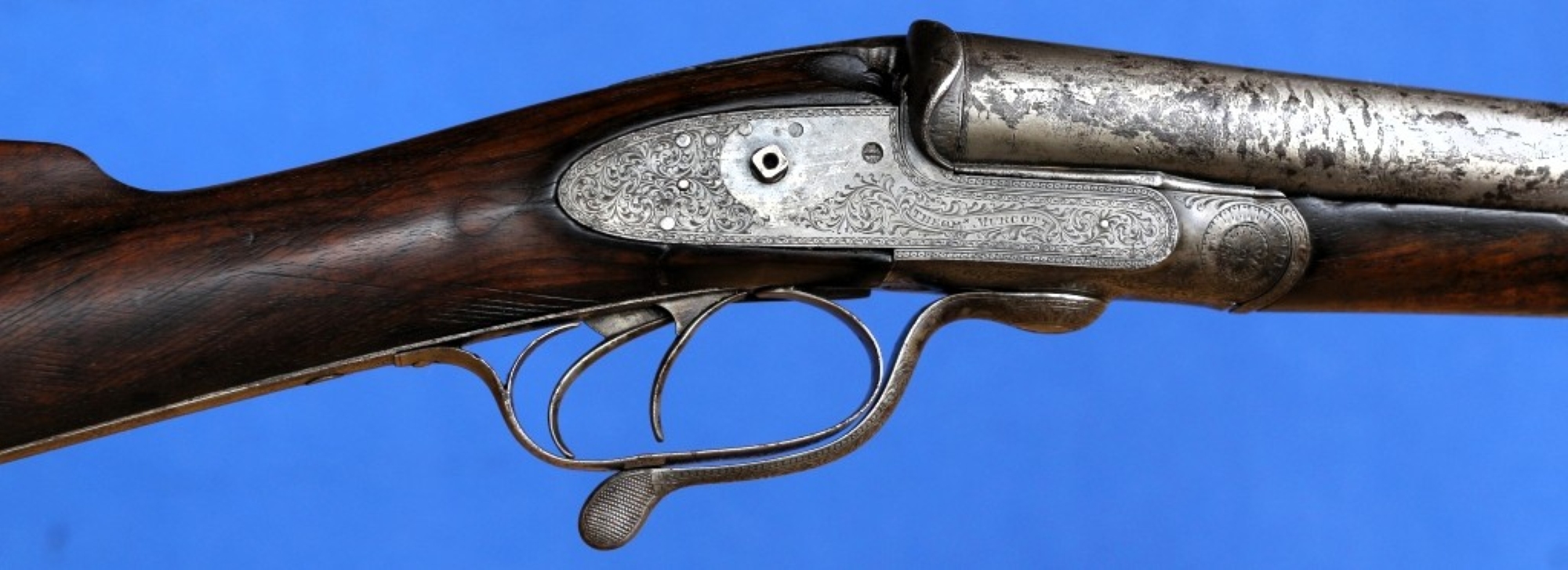
The Murcott gun shown in this article is not one of Murcott's patent actions. It is a 12-bore double-bite screw grip rotary under-lever pin-fire sporting gun made around 1870, and later converted to central-fire. The 29 3/4” laminated barrels have London proofs, the barrel rib is signed “Theops Murcott 68 Haymarket London SW” within a scrolling banner, and the non-rebounding bar locks are signed “Theops Murcott,” also within decorative banners. The locks are internally signed for John Stanton of Wolverhampton, Stanton being one of the best lock makers supplying the London gun trade. There are two raised clips on the trigger guard bow, and the serpentine fences are well-shaped – though now drilled and tapped for central-fire striker assemblies. It has the short top strap in keeping with its bar locks, and the starburst detailing at the breech ends where the pin holes were originally, now filled-in and re-engraved, is particularly attractive, as is the general pleasing quality of the engraving. The initials ‘T&L’ on the barrel flats between the lugs suggest that Tipping & Lawden, Murcott's old employer, had built the gun for Murcott to sell. The stock has a good figure, but the chequering of the stock and fore-end has long since been worn away. It was once a beautiful and glorious sporting gun, someone’s pride and joy. So far, it is an interesting pin-fire from a significant maker not often found in collections. The original quality was high, with superb barrels and locks, possibly once a ‘best’ grade gun.

Pin-Fire holes have been filled and re-engraved - Star-burst decoration to barrel breech ends - Short top tang.
When the gun was converted, a one-piece extractor was added and fitted to the barrel lugs, with corresponding grooves cut into the action bar. This extractor is based on William Sparks Riley’s patent of 1866. This was no minor alteration, and with the pin holes superbly filled in and disguised, the conversion was done with skill. William Sparks Riley (also written as William Spinks Riley) was born in Birmingham in 1825. In the 1851 census he was recorded as a gun finisher, living with his sister Sarah, his brother Frederick (a pistol maker), and his cousin Thomas Cole (an air gun maker). William opened his business in 1861 at 34 & 35 Lench Street, Birmingham, trading as a gun finisher and retail viewer. On 16 February 1866 he patented a firing pin, extractor and loading indicators (patent no. 491). The extractor design was similar to the Schneider design developed by George H Daw, being double legged with a short cylindrical guide; this is the extractor found on the Murcott gun. In 1868, Riley established the Eagle Gun Works, and in 1871 he described himself as a gun maker. In 1878, he opened a shop in London, at 63 Bishopsgate Street. By the time of the 1881 census, the Eagle Gun Works had moved to a new address, and Riley described his occupation as a gun finisher. In 1887 the London shop closed and firm was no longer recorded in Birmingham. However, in the 1891 census, William S Riley was recorded as a grocer, living with his wife and grand-daughter.

The rarely seen extractor system patent - This extractor is based on William Sparks Riley’s patent of 1866.
So, a quality gun from an interesting maker, with a rarely encountered extractor mechanism. What else can this gun tell us? The silver stock escutcheon indicates the gun was owned, and perhaps first ordered, by Captain Robert Burn Singer of the 28th (The North Gloucestershire) Regiment of Foot. While Singer joined after the Crimean War, the regiment had a storied history in that engagement, fighting at the battles of Alma, Balaclava, Inkerman, and the Siege of Sevastopol. The regiment even had a distant Canadian connection in its history as well: it was created in 1694 and posted to Newfoundland; it took part in the Battle of Louisbourg (1758), the Battle of the Plains of Abraham (1759), and the American War of Independence (1776). The regiment fought against Napoleon in Egypt, in Spain (Talavera, Vitoria), and at the Battle of Quatre Bras at Waterloo, earning praise from the Duke of Wellington. Being part of such a storied regiment would have been attractive to an ambitious young man.

Robert Burn Singer - Initials and Regiment engraved on the escutcheon, supported owner research history.
Robert Burn Singer was born in 1842. He started as an Ensign in the 28th Regiment in September 1858 at the age of 16, purchased his first commission as Lieutenant in February 1864, got married in 1865, and purchased his second commission as Captain in October 1868, eventually serving 19 years in the regiment, notably in India and Gibraltar. In the 1871 census he was recorded at 123, High Street, Portsea Island, Portsmouth, Hampshire, with his wife, daughter, and two sons. He died in 1879. If bought new, a Murcott of London pin-fire with Stanton locks would have represented a significant financial investment on a Captain's pay, about a tenth of his annual income of £200. Perhaps the gun was to celebrate his captaincy, taking the trouble to have his initials and regiment engraved on the escutcheon.
Note: The gun may be a sad wreck, but in more than 27 years of searching, I have never encountered another Murcott pin-fire, heard tell of one, or seen one mentioned or illustrated. I wasn’t about to wait for another to come along - Stephen Nash.