Westley Richards – Muzzle Loader – Pair
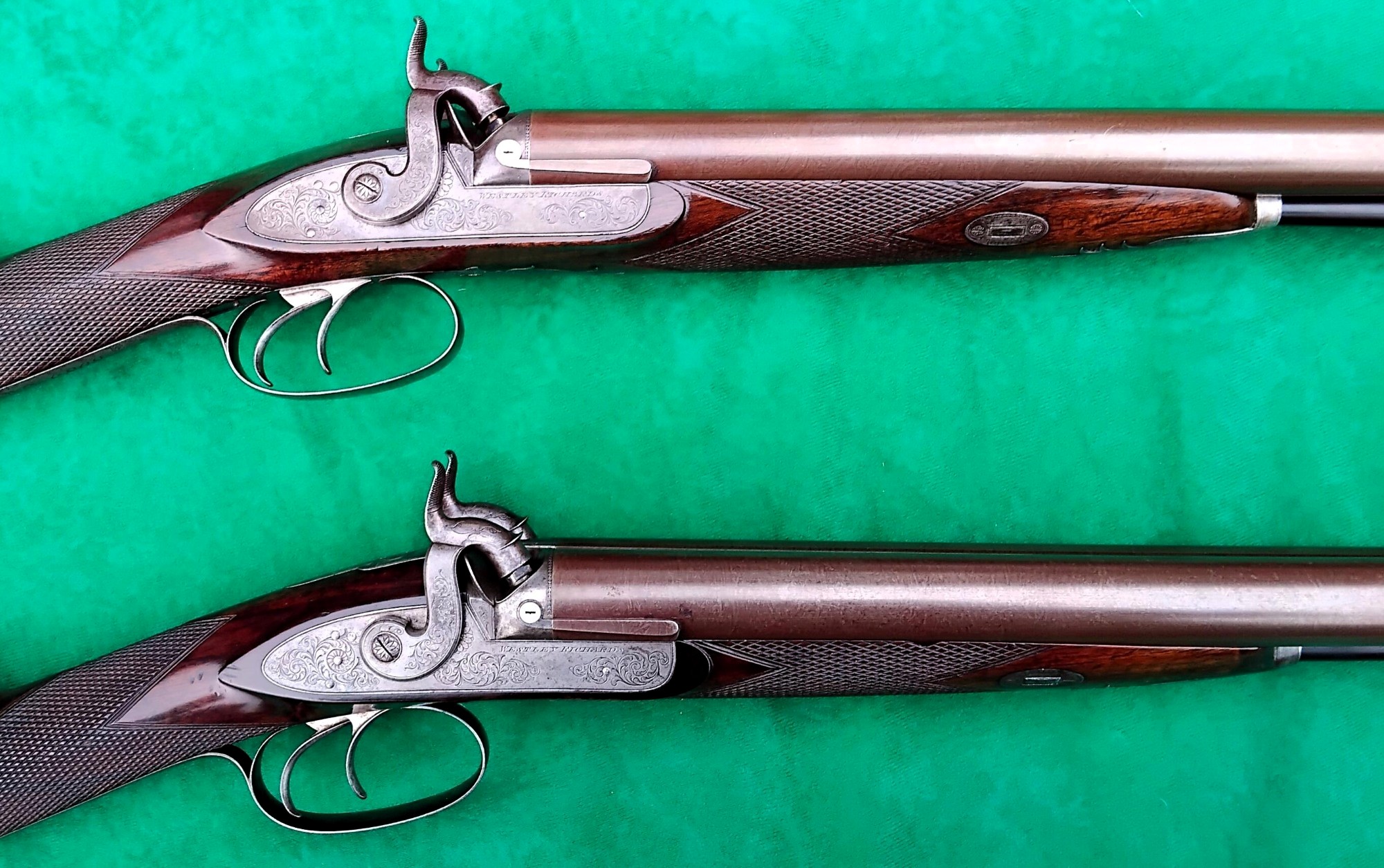
Westley Richards – Muzzle Loader – Pair
Ultimate Guns of the Period
The period from 1850 to 1900 witnessed the most far-reaching changes in sporting gun design that had ever been experienced, however, the guns in this article were made during 1853, and would have been at the pinnacle of the Muzzle Loading design period. It would be fair to say, toward the mid-period of the 1850’s, changes and developments within the Muzzle loader had become extremely steady, almost static.
During the time this pair of guns were made, the muzzleloader prevailed, with these guns’ seen by their owners, and peer groups as an ultimately fine pair of Sporting guns. The Muzzle-Loader concept continued to be ordered, made, and used during the 1850’s and 1860’s as it had for centuries.
The move towards the Breech-Loader and the Centre fire sporting gun took its toll slowly. This along with the continued breech-loading developments were adding pressure on the Muzzle loader, all of which finding considerable traction at the time the guns in this article were made. This was enough to ensure the demise of the Muzzle-Loader, and eventually sealing their fate. As the ongoing developments of the British sporting game gun continues, it is interesting to understand where in the journey this pair of best quality Westley Richards Muzzle loaders are placed at the time.

1853 Westley Richards Muzzle loader Pair - 173 years + old and still in use today.

Traditional English oiled stocks - Best quality materials throughout.
The breech-loading game gun and pinfire ammunition by 1853 were in regular use across France, and had been used throughout, both France and Continental Europe for decades. However for the British sportsman, few had seen any form of breech loading sporting arms, before seeing those exhibited at the Great Exhibition of 1851 at Crystal Palace, which was opened by Queen Victoria and Prince Albert on the 1st May 1851.
The Westley Richards guns in this article, built in 1853, were at the very pinnacle of the Muzzle loader era, however, and interestingly during 1853 / 1854 is when Joseph Lang’s Breech-loading Pinfire game gun emerged, and when production had started, with the new breech-loading system being promoted, the start of the British breech-loading story had begun.
There is a considerable level of rarity in finding a surviving pair of Muzzle Loading sporting guns of the 1850 period, and the fact they have been used for their intended purpose in recent times at over 173 + years old, and still remaining ready for use.

Bold Gold lettering engraved top ribs - "Westley Richards. 170, New Bond Street. London"
The guns themselves are unusual remaining together all their lives, as a pair, and within their original two teared mahogany case. Fortunately, the makers Westley Richards have excellent records, of which these records have kindly supported this article. The Westley Richards Company and staff have been most supportive, the input of Steven Harridence, Showroom Manager at Westley Richards, uncovered information, identifying; not One, but Two pairs of "Best Guns" were ordered by the owner. This showing customers of the period could be highly decadent !
The ordering of a pair of Best Quality Sporting gun, for most would be a considerable milestone, however for Captain Sutton it was simply not enough, so a second pair of Best guns were ordered, possibly guided by the Bishop of Bond Street. The second pair of best quality Westley Richards guns were ordered and collected by Captain Sutton less than one month from collecting his first pair ( Decadent, or what ! ). The Westley Richards ledgers are marked with the initials WB against both Pair’s of Gun’s for the Captain Sutton. This indicated, both pairs of guns were sold by William Bishop, from the 170 New Bond Street address, “The Bishop” himself taking care of Captain Fredrick Sutton.
“The Bishop of Bond Street”
William Bishop (1797 - 1871) 'The legendary manager of the Westley Richards London premises at 170 New Bond Street London.
William Bishop was known as “The Bishop of Bond Street”, Mr. Bishop was clearly a master salesman, with an ability to mesmerize the young bucks of Mayfair, organizing races, boxing matches or cock fights.
Mr. Taylor wrote: “the young bloods, officers, fashionable country squires, in their idle moments could always find a cure for boredom at the Bond Street rendezvous.” These figures obsessed about William Bishop’s foibles and were constantly asking him why he always wore his Top hat, indoors and out, to which one young nobleman was given the cryptic reply: “because . . no one else’s fits me”. Stiff wagers were lost and won on the chance of catching him without his hat.
Mr. Teasdale-Buckell gave a striking portrait in words of the experience of encountering ‘The Bishop’ for the first time: “A large and roomy man, old Bishop, sitting in front of the old white mantelpiece …his gouty leg up on a chair before him. Dressed from head to foot in the blackest of black, a huge white frill proceeding from his breast, and an enormous pair of shirt cuffs turned back over his coat sleeves, and a neatly brimmed hat, which no mortal eye had ever seen off his head. A truly right reverend and Episcopal figure, and worthy of the only Bishop who had ever passed an Act through Parliament, as it was his want to boast concerning the Dog Act, termed “Bishop’s Act.”
This act of public spirit was inspired by the one-time theft of his adored pet dog, Tiny. He was aghast to discover that a man could go to jail for stealing a dog collar but not for stealing a dog, so he threw his weight behind a bill which outlawed the stealing of dogs. He put £1,000 of his own money behind it, and it was the occasion of the passing of this bill into law in 1845 which led friends to commission the full-length oil portrait of him.
When Tiny died, Mr. Bishop erected a marble monument with a full inscription on the front of the New Bond Street shop, the monument which is now housed in Westley Richards Birmingham factory.
Mr. Teasdale-Buckell continued: “If you were a stranger calling upon The Bishop for the first time, the odds were that he would show no more cognisance of your presence than if you had been in the next parish. After sufficient time had been allowed for this to do its work, the shop foreman would probably take some opportunity of making the great man informed of your propinquity, when you would be suddenly discovered and greeted with condescending affability.”
Mr. Bishop, a consummate performer, occupied his position of agent and salesman for the company for over fifty years and died in 1871, aged 74. He was also a close friend of Col Peter Hawker, one of the great Regency shots, who was a faithful client of Westley Richards.
William Bishop was a legendary figure across the entire sporting world ( in his own life time ), ‘The Bishop’ remains an essential inspiration to the sales approach of Westley Richards & Co. today.
The Guns that inspired this article.
The guns that inspired this article, are the second of two pairs of guns ordered by Captain Sutton, the first pair of Guns within the Westley Richards ledgers, are recorded as being made as Thirteen (13) bores, with serial numbers 8064 and 8065, they were collected from 170 New Bond Street on August 19th 1853 by Capt. Sutton.

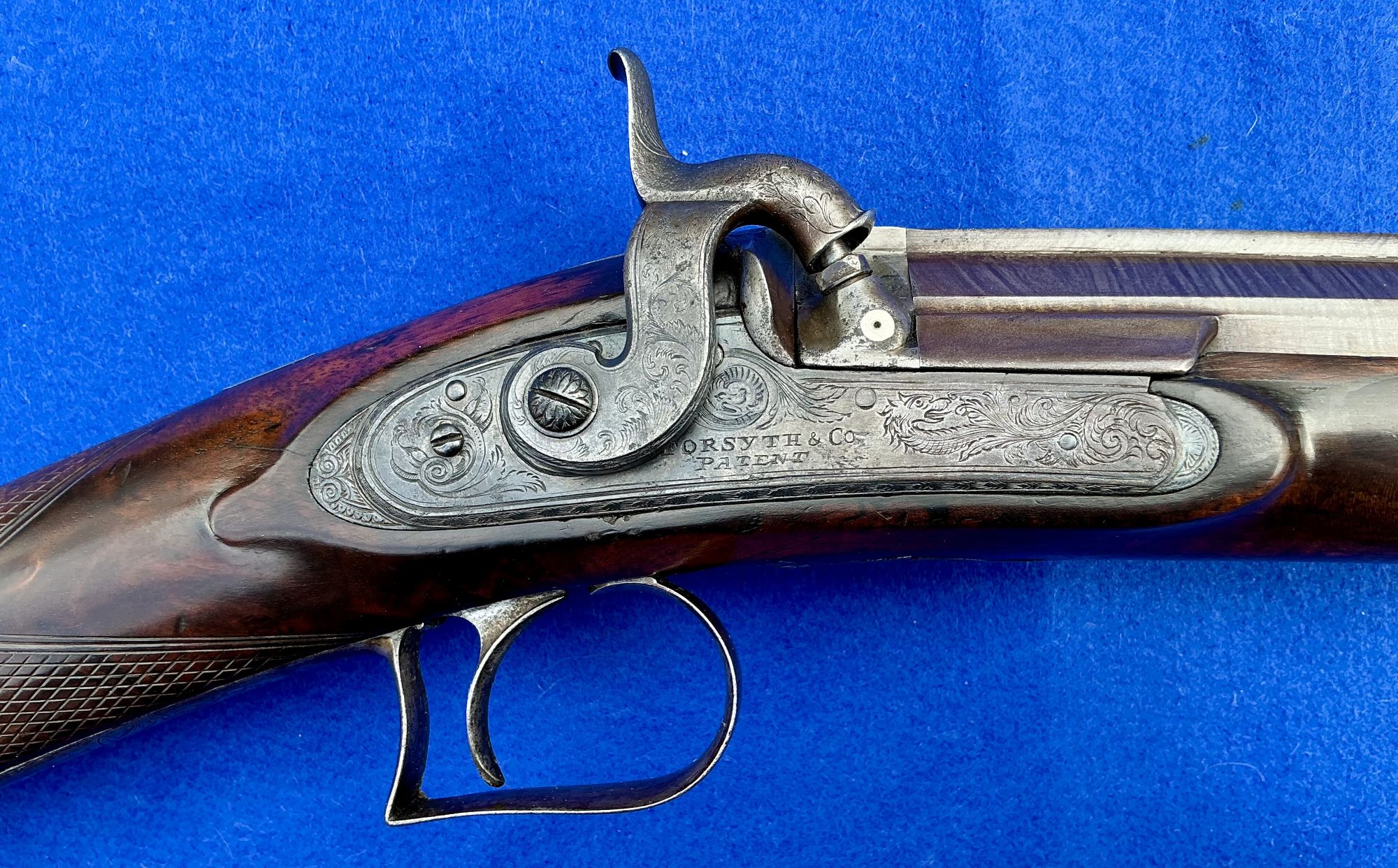
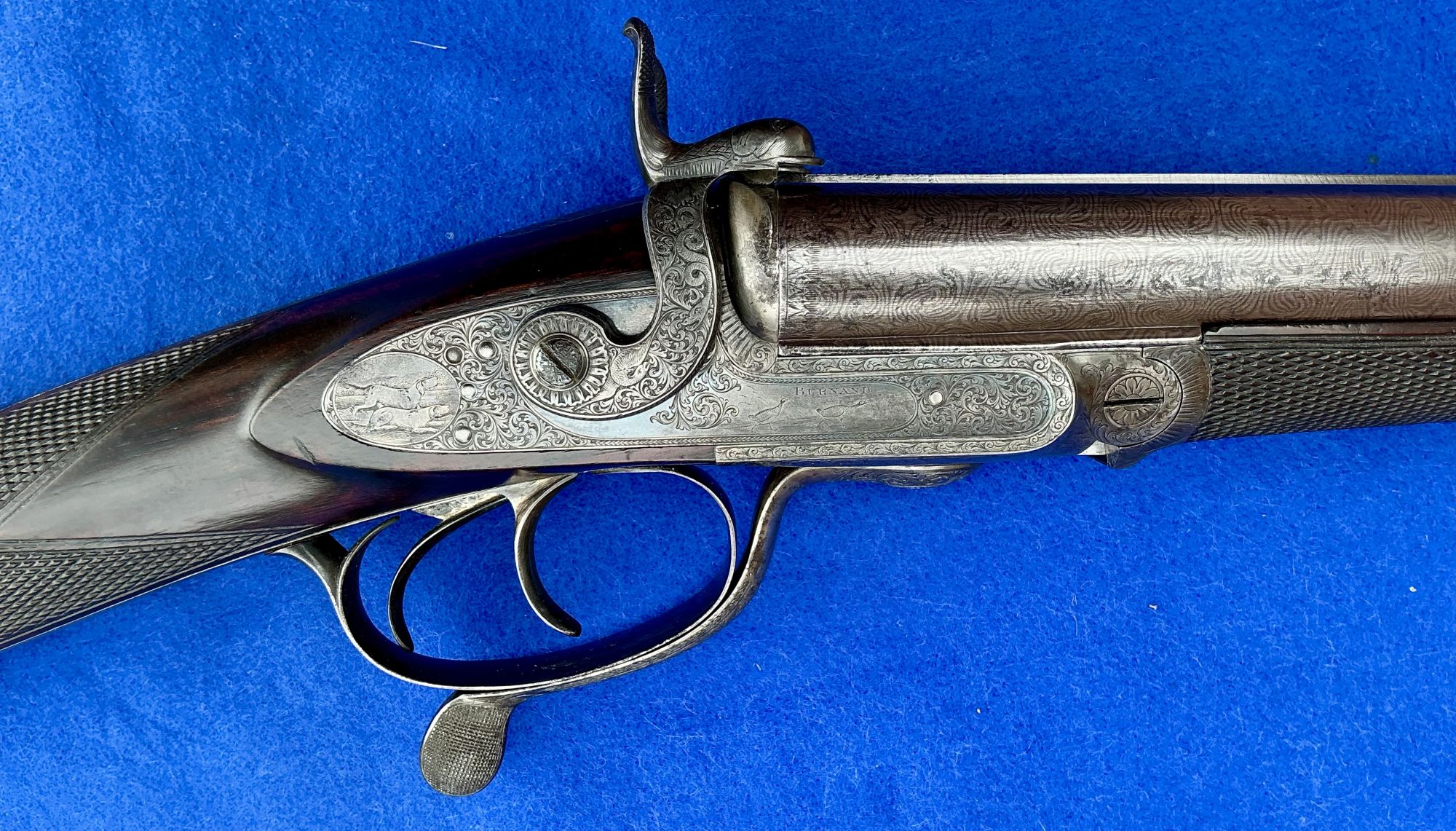
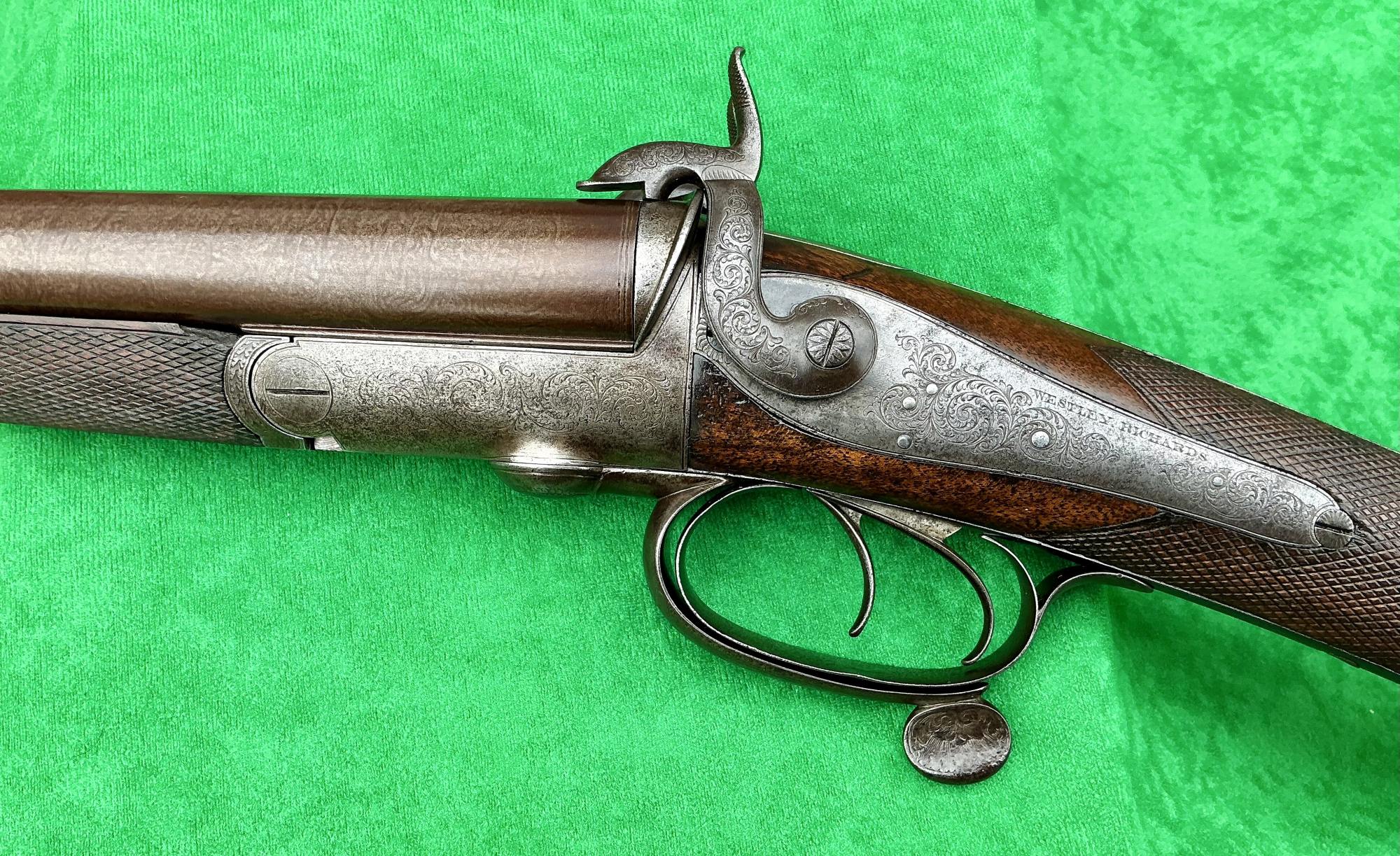
All metal work fully engraved, with the engraving clear and crisp.
The second pair have surprisingly surfaced intact, remaining within their original mahogany case. The surfacing pair, were made as Eleven (11) bores, with serial numbers 8082 and 8083. This pair of guns were collected by Capt. Sutton, this time on September 10th 1853, again from the 170 New Bond Street address, but barely three weeks from collecting the first Pair.
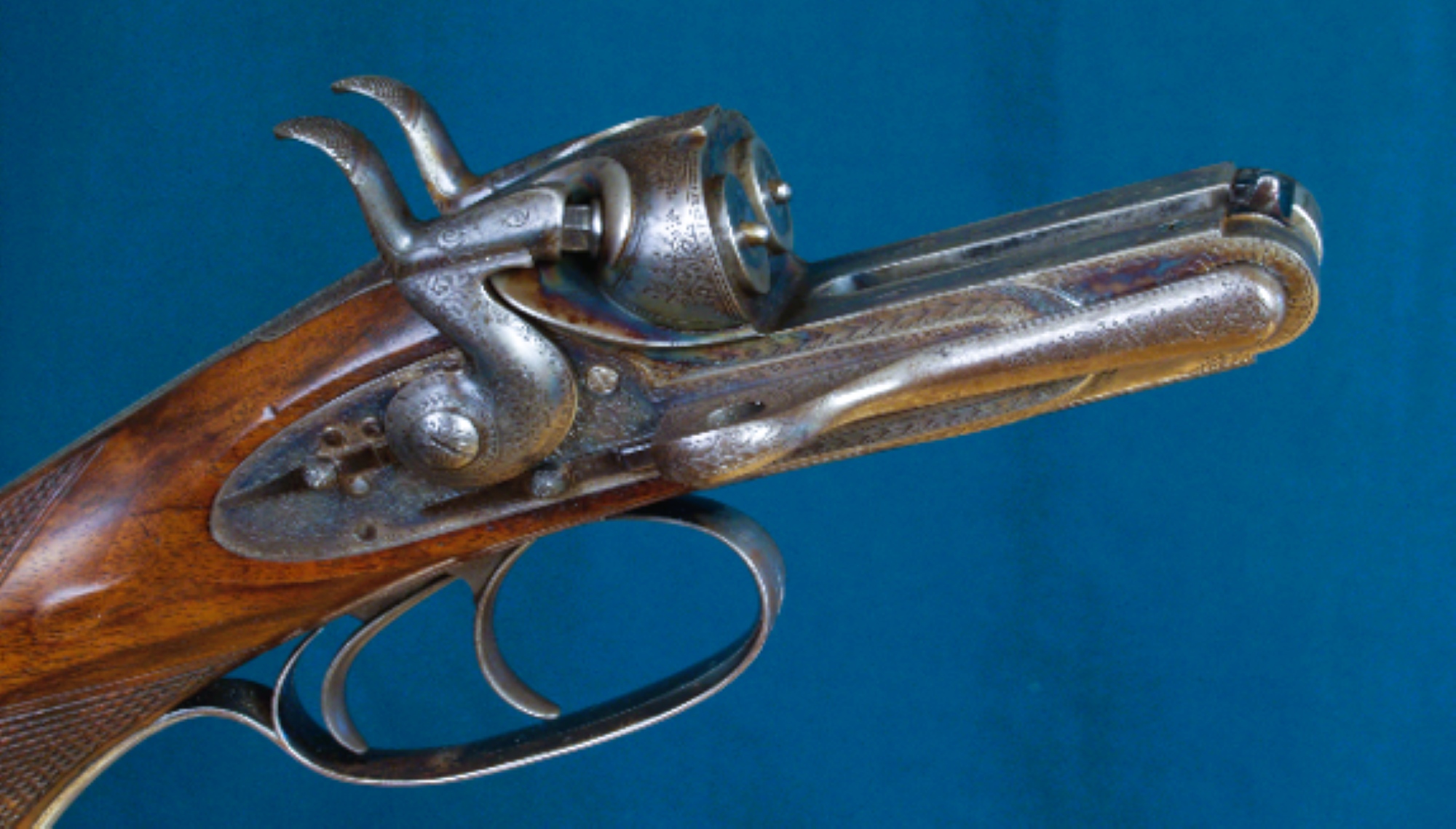
Taking a closer look at this pair of guns has shown them to be of fine quality, and a little unusual in a number of areas. The guns surviving together as a pair, the pair having a symbolic engraving on the elongate butt stock tangs – 8082 having an engraving of “Jack Tar” in bear feet and rolled up sleeves, and 8083 engraved with “Britannia” standing, while holding an upright spear. These engravings together, proclaim: “Britain and her Navy — Strength, Honor, and Empire.” – Further symbolic engraving to the top tang shoulders, with a farmer gathering crops on the first gun, and a Hunter with bow, and hunted deer on the second. The strongly engraved top rib in bold Gold, is something of a statement and would adorn only best guns. The guns being a pair of 11 bore, at 7lbs. 10 oz. makes this pair of guns marginally bigger than the majority of Sporting Game guns, however, their build remains refined.

Trigger tangs with Pineapple engraving, fully engraved trigger bows and consecutive serial numbers.
Although this pair of guns toady meet the Firearms Act section 58 criteria UK - (No License required) they have been used with the correct and necessary licensing by their most recent custodian in the field. This has allowed the guns to be used during quality driven days, in the pursuit and of dispatching game, like Pheasant and Partridge, the pair could be used for Duck, Woodcock and Snipe if loaded with the likes of Bismuth. The guns have a Barrel length of 31 inches, with clean bores.

The barrels overhauled and re-browned approximately 20 years ago, remain in excellent condition.
The actual gauge, or bore size of gun’s pre 1855 were not included with the proof marks, however the makers records confirm the guns were made as 11 bores. The bore measurements for 11 bore being .751, and using pre 1868 proof rules making the bore out of proof at the next bore size, in this case making the guns out of proof at .775, which is 10 bore. The barrels on this pair of guns remain well in proof at .764 in both barrels on gun number 8082, and .765 in both barrels on gun number 8083. The barrel wall thickness minimum are 35 thousandths and above in all barrels on both guns. The barrels are best laminated steel, and weigh 4lbs. 11oz. for 8082, and 4lbs. 10oz. for 8083. The bore information has confirmed the pair of guns are well in proof, and having massive barrel wall thicknesses in both sets of barrels. This has ensured the guns can be safely used today. The guns being built during 1853 has ensured there is no choke, however the patterns with considered loads are exceptionally fine. This is further helped with the pair being 11 bore, allowing a heavier payload of shot for the user, consequently denser patterns.

Pre 1855 Black Powder Proof marks - Various stamps, WR & GT, and serial numbers 8082 & 8083
The stock and forend are of strongly grained walnut, with the primary figuring of the walnut towards the stock tails, and straighter grain flowing through the hand towards the forend. The guns are cast for Captain Sutton, who was a right handed shot. The stock length is at 14 3/8 of an inch, with a steel butt plate and elongated top tang. The stocks contain the all important locks, the locks are identified by the initials T. B. on the inside lock-plate, the quality of the lock work and finishing is impressive. This level of lock work and refinement, combined with the initials T. B. and the fineness and elegance of the bridles would have been produced only by the very best lock-makers. Westley Richards had an excellent working relationship with the Brazier family, the time period fits perfectly for these locks being made by Thomas Brazier.

Best Quality locks with fine bridles - made by Thomas Brazier (TB)
The guns weigh 7lbs 10oz each, and have been made ensuring a balance of movement that can only obtained from a pair of hand made best guns. We are fortunate to have been in contact with Captain Sutton’s great, great grandson, who kindly offered an interesting background, and an in-depth family tree.

Captain Fredrick Sutton aged 30 years in 1847
Capt. Frederick Sutton, of the 11th Hussars, was the son of Capt. Robert Nassau Sutton, of the 58th Foot (1776-1833) and Mary Georgiana Manners-Sutton (christened 1780, died 1846)
Frederick Sutton was born on 26th February 1817 in Kelham Hall, Nottinghamshire. He was christened on 16th March 1817 in Kelham. Frederick married Eliza Jones on 12th May 1841 in Faversham, after Eliza’s passing, Frederick married Georgiana Croft on 19th October 1847 in Elham, Kent. Frederick died on 2th June 1900 at 15 Clarence Parade, Southsea. He was buried on 7th June 1900 in Withyham, Sussex.
Frederick made rank of Captain in 11th Hussars. Initially Frederick joined the regular army as the rank of Cornet (The lowest rank for a Commissioned Officer) he joined the 15th Hussars on 24th Apr 1835. As a Commissioned Officer, promotion was swift, Frederick then transferred to 11th Hussars as a Lieutenant on 8th Feb 1839, and on 3rd June 1842, he became a Captain. After only eight years of service Captain Frederick Sutton finally retiring on the 29th Dec 1843 aged 26 years.
The life of a Gentleman was awaiting !
The 11th Hussars were popularly known as the Cherry-pickers after they were attacked whilst raiding a cherry orchard in the Peninsular War. Their regimental commander was the Earl of Cardigan, and under the Earls’ command they took part in the “Charge of the Light Brigade” at Balaclava during the Crimean War.
Captain Sutton was proud to have lead the escort of Prince Albert at his wedding to Queen Victoria. The 11th Hussars became Prince Albert's Own Hussars after this auspicious event. They then wore cerise colour overalls, the colour’s of Prince Albert's house of Saxe Coburg Gotha. Frederick lived part of his life at Westgate House, Bury St Edmunds, Frederick also lived in Kent and outer London, and later at 15 Clarence Parade, Southsea. Whilst at Southsea he became Vice-Commodore of Portsmouth's Royal Corinthian Yacht Club.

The Pair of guns have different engraving, all of which symbolic to the strength of the British Empire.

Britannia with Union Flag emblem on shield, and holding a spear.

Jack Tar with sleeves rolled up in bear feet, anchor at hand, and a sailing ship in the background.
It was reported in the Newspapers, during a house dinner at the close of the yachting season "Captain Sutton presided, and was supported on his right by Admiral Hornby and his the left by Lieutenant General Sir George Willis, KCB ….. in proposing the health of the Prince of Wales and the rest of the Royal Family, saying that they all knew the encouragement His Royal Highness had given the club, and but for that, they would not occupy the prominent position that they did that day.
The announcement of the death of Captain Frederick Sutton, son of the late Captain Robert Nassau Sutton and grandson of Sir Richard Sutton, 1st Baronet, which occurred at 15, Clarence Parade, Southsea, on Saturday 2nd June 1900. Captain Frederick Sutton was born at Kelham House, Nottinghamshire, and educated at Eton. He entered the 15th Hussars in 1835, then to the 11th Hussars, exchanging into the 11th Light Dragoons in 1839, becoming Captain on the 3rd June 1842.

Captain Frederick Sutton on his yacht Circa. 1880
The family tree allowed the questions regarding affordability of Captain Sutton’s lifestyle of a gentleman to be answered, well simply put – Captain Frederick Sutton was a true gentleman from long line of family with personal wealth and means.
Captain Sutton’s Family Tree and his second wife Georgina Croft contains some interesting family members, including - Sir William of Averham, - Robert Sutton 1st Baron Lexington, - Robert Sutton 2nd Baron Lexington, - Robert Sutton of Kelham, - John Manners 3rd Duke of Rutland, - Honourable Bridget Sutton, - Sir Robert Sutton PC, KB of Broughton Lincs., - Lord George Manner-Sutton, - John Manners Marquis of Granby, - Sir Richard Sutton 1st Baronet of Norwood Park, -Most Reverend Charles Manners-Sutton Archbishop of Canterbury, - Lt. Col. Hon. John Manners-Sutton Coldstream Guards MP Newark, - Ven. James Croft Archdeacon of Canterbury, - Captain Robert Nassau Sutton 58th Foot, - Sir Richard Sutton 2nd Baronet of Norwood Park, - Sir Richard Francis Sutton 5th Baronet, - Sir Arthur Edwin Sutton 7th Baronet, - Captain Sir Richard Vincent Sutton 6th Baronet MC 1st Life Guards, Guards Machinegun Regiment, - Sir Robert Lexington Sutton 8th Baronet.
The Second Owner and Custodian of 8082 & 8083
Another careful custodian of this rare pair of Eleven bore percussion game guns, was yet another Gentleman of personal wealth and means - Sir Brydges Powell Henniker, 4th Baronet. Sir Brydges Powell Henniker was born on 3rd September 1835, and was the son of the Reverend Sir Augustus Brydges Henniker, 3rd Baronet and the Honourable Elizabeth Henniker-Major.
Sir Brydges Powell Henniker married Justina Louisa Hughan, the daughter of Thomas Hughan of Airds and Lady Louisa Georgiana Beauclerk, on 14 July 1860. ( Thomas Hughan 1811–1879, who married Lady Louisa Georgiana Beauclerk, was the younger daughter of William Beauclerk, the 8th Duke of St Albans and his second wife, Maria Beauclerk, the Duchess of St Albans ).

First gun engraved with a Farmer gathering crops.

The second gun with a hunter, bow, and hunted deer.
Sir Brydges Powell Henniker succeeded as the 4th Baronet Henniker, of Newton Hall, Essex on 28 January 1849. Sir Brydges gained the rank of Captain in the Royal Horse Guards, he also gained the rank of Captain in the West Essex Yeomanry Cavalry. After his retirement from Royal Horse Guards and West Essex Yeomanry Cavalry, he took and held the office of Registrar-General of Births, Deaths and Marriages between 1880 and 1900. He also held the office of Justice of the Peace (J.P.) and also held the office of Deputy Lieutenant (D. L.) - Sir Brydges Powell Henniker died on 12 July 1906 at the age of 70.
Sir Brydges Powell Henniker, 4th Battalion and Justina Louisa Hughan had four children, all of which did well in life.
Mabel Sophia Henniker - died 13 December 1942
Edith Janetta Henniker - died 20 February 1940
Louisa Mary Henniker - died 1946
Lieutenant Colonel Sir Frederick Brydges Major Henniker, 5th Battalion born 12 August 1862, and died 19 August 1908
Admiral Sir Arthur John Henniker-Hughan, 6th Battalion born 24 January 1866, died 4 October 1925

The “Henniker” Crest and Motto, engraved in Gold, “Deus Major Columna” (God the Greater Support)
This rare pair of Westley Richards have fortunately had something of an unusual life, and have been well cared for throughout their 173 + years. The pair of guns’ stocks, have fortunately retained their stock ovals adorned upon them from their second owner and custodian, Sir Brydges Powell Henniker 4th Baronet, of Newton Hall, Essex. It should not be any surprise, that stock ovals have the “Henniker” Crest and Motto, engraved in Gold, and reads “Deus Major Columna” (God the Greater Support)
Family links between the two primary custodians of 8082 & 8083
Mary Georgiana Manners‑Sutton is the aunt of the Manners‑Sutton line, that later intermarried with the Hughan family — and the Hughan family is the one that directly married into the Henniker Baronets through Justina Louisa Hughan and Sir Brydges Powell Henniker. So the link is not direct, but through the Hughan sisters, who connect the two families.
The two primary custodians of this pair of Best Sporting Guns, being Captain Frederick Sutton and Sir Brydges Powell Henniker, had a number of links that would have ensured their paths would have crossed on many occasions, including close family links, Military and Church links, Sporting links, and of course, due to their social standing, they would have been both involved in the social season, or, simply “The Season”, which refers to the traditional annual period in the spring and summer when it was customary for members of the social elite to hold balls, dinner parties and attend charity events. The London social season evolved in the 17th and 18th centuries, and in its traditional form it peaked in the 19th century. In this era the British elite was dominated by families of the nobility and landed gentry, who generally regarded their country house as their main home, but spent several months of the year in the capital to socialise and to engage in politics. The most exclusive events were held at the townhouses of leading members of the aristocracy. The Season coincided with the sitting of parliament; beginning sometime after Christmas and ran until midsummer, roughly late June.

The first tier of the Case provides fitted areas for the pairs' Actions, Stocks & Forends.

The second tier of the Case provides fitted areas for the pairs' Barrels & Accessories.

The final Case image shows the extent of the case depth & volume.
The ugly question of value is regularly raised when something rare surfaces. To put a cryptic spin on speculative value - The wages for a qualified labourer in his prime would realise £20 per year in 1853. The cost of having a Matching Pair of Best Sporting Guns / Mahogany cased made by Westley Richards during the same period would cost the owner as much as £80. The cost for similar from other top quality maker’s would be even more – Boss & Co. £45 each, or £95 for a matched pair, James Purdey £55 each, or £115 for a matched pair, William & John Rigby £39.18. 0d. each, or £95 for a matched pair. Holland & Holland were not established, or in business in 1853.
This pair of guns have recently joined the “Southgate Collection”