James Beattie - Deer Park Rifle
James Beattie – Gunmaker - London
Pinfire Deer Park Rifle
Deer parks were created between the years 1200 and 1350. There were over 3,000 deer parks across the British Isles. Their size varied from a few acres, to massive entities spanning several thousand acres. The number of identifiable deer parks today, are just a handful.
The Deer Park across England, Scotland and Wales, were a prominent feature until the end of the English Civil War, at this point, parks were either broken up into smaller land parcels, converted into agricultural land, or incorporated into post-medieval country estates.

Barrel breech fitted with Muzzle-loader style breech plug - leaf sights set for 50 yards.
The creation of a Park during the Tudor period was an elite privilege, to which many Lords and prominent land owners needed to obtain Royal permission, and a licence to embark on enclosing lands as Parks (Empark). The creation of, and securing of Park land was expensive, time-consuming and disruptive. Deer Parks by design, are intended to keep people and intruders out, and the managed animals within.

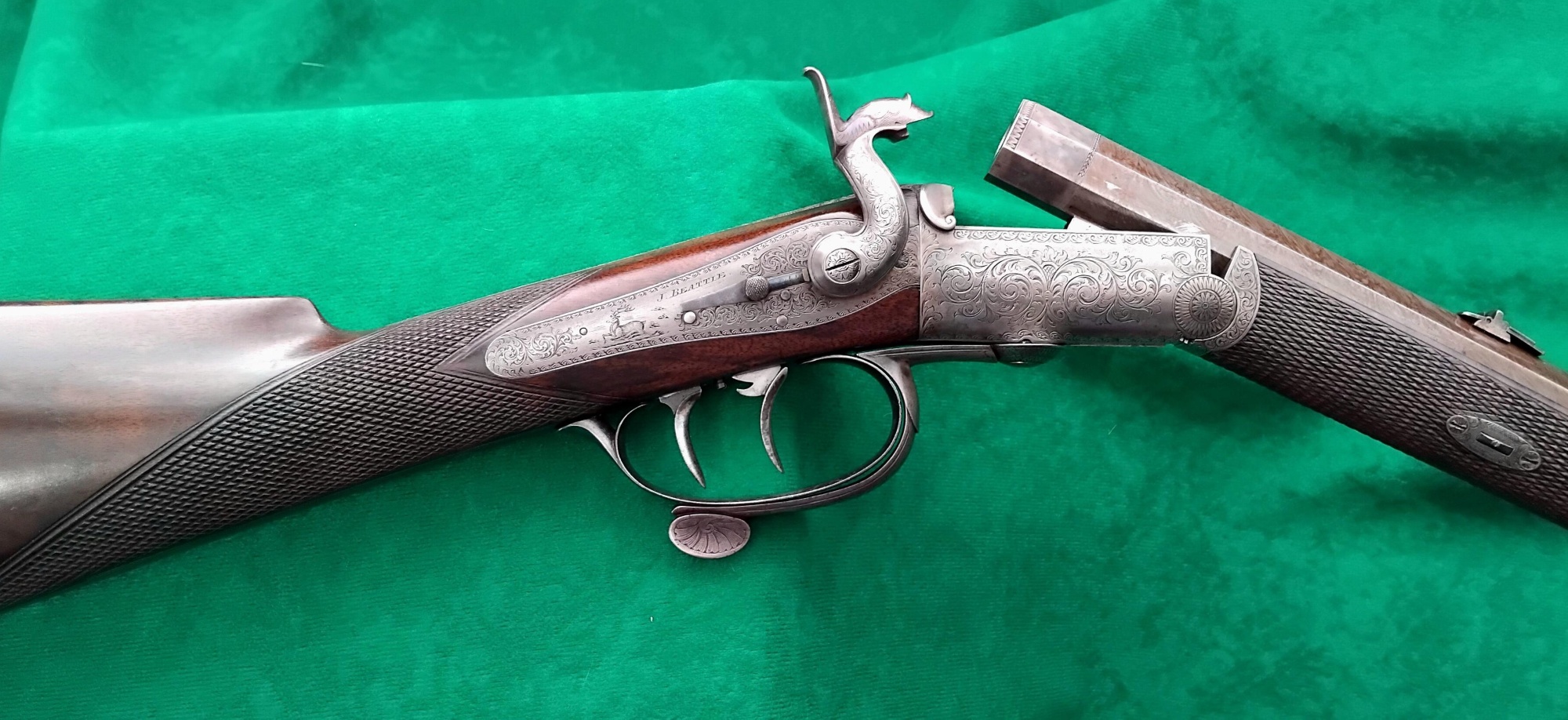
Dolphin headed hammer and low percussion fences.
The boundaries of Deer Parks used many different forms of containment, including ditches and banks, along with either a fence or wall. These could be of tall, closely spaced wooden stakes, traditionally sharpened at the top and driven into the ground, or if money was no object, then made of walls using stone or brick.
This article covers a period during the reign of Queen Victoria. The development of Sporting game guns during this period was rapid, and makers were happy to build guns for specialised tasks. One such development was that of the Park Rifle, the owners of Deer Parks began using small bore, light weight sporting rifles, that were designed by Gun-makers for use within these well-manicured parks, and for the purpose of supporting Park owners in Park management and sporting pursuits.

Full cover engraving to action body - Beatus Beringer style under-lever, with close fitting to the trigger.

Double set trigger, with bolted safety for half-cock.
These Park activities were primarily for the landed gentry and their country house guests. Although the ongoing development of Deer Parks have been with us for centuries, as the 19th century is established, the Park rifle begins to emerge, initially in muzzle-loader form. Today the majority of Park rifles encountered are percussion guns, this is simply due to the time-frame of the period, and this then popular pursuit.
Victorian Deer Parks were not simply ornamental landscapes dotted with fallow deer, manicured woodlands, with managed game, fish ponds and lakes for the landed families who owned them. These beautiful Parks supported and developed many of the managed sporting environments and practices we see today.
The introduction of the Deer Park Rifle is likely to have been as far back as the late 1700’s, their uses would have been a part of deer park management, for example; selective culling, the removal of old, injured, or malformed bucks, also the direct management of herd size, the maintenance of antler quality, the protection of the manicured environment, and the protection of ornamental trees and young plantations, and of course a source of good quality meat.

Lock-plate with J. Beattie signature, and Fallow deer in the prone position.
The primary function of the Deer Park Rifle would be for close range dispatch. The dispatch at shorter distances were achieved as the deer within these parks were accustomed to human activity, and often could be approached within ranges of 40–80 yards. The relatively short targeted range would outline the rifle needed; a modest level of power, excellent accuracy and for the shot to result in minimal meat damage.
Deer‑Park rifles due to their expectational needs were generally of small‑bore, these rifles initially percussion ignition / muzzle-loading guns, were often of .40 to.50 calibre, however the calibre sizes became smaller due to the introduction of the breech-loader circa. 1855 and the development of more effective and efficient ammunition.

The top tang fully engraved continuing to the barrel breech.
Deer Park Rifles are regularly made as good quality firearms, with fine sights, high quality barrels, and on occasion made with set triggers. Although numbers of Park Rifles made were relatively small in number, several have survived in reasonable condition. This confirming, that deer park rifles were used regularly, however, most would have been used in favourable conditions and well cared for.

Good quality lock, unsigned, likely to be from a quality trade supplier - Fine bridle, with all components hardened.
The opportunity for estate owners to demonstrate new technology, the deer park was the perfect “laboratory.” Which included Social and Ceremonial Uses - Deer parks were also a theatre for Victorian social events within the owners country residences, with estate tours, owners often taking guests on walks, or carriage rides through the deer park. The deer park was many things in Victorian times, being seen as a status symbol, a conversation piece, a demonstration of the owner’s taste and modernity. These estate tours occasional included sporting outings, while not “hunting” in the traditional sense, guests might be invited to stalk a selected buck, and shoot a park deer as part of a dinner. The whole process was genteel, controlled, and very different from Highland stalking.

Good Quality throughout, well finished and hardened.
The Deer Park Rifle is something of a Victorian invention in what it has become and how it has been used. These fine, well-engineered rifles have their own distinct category, a general overview of a Park rifle would be; never made in massive numbers, with the majority being made to order for the unique environment they were to be used.
The deer‑park rifles for collectors and enthusiasts have developed recognisable traits, those being - Small to medium in calibre / bore (.30 to.50) - Fast twist rifling - Precision at 40–120 yards - Fine sights or early telescopic sights – Of light elegant build - Carried on walks, or in carriages – Occasionally made with set triggers - Precision shots on calm, stationary deer in favourable conditions - Minimal recoil - Made for the Landowner, Estate Keepers, and suitable for all visiting guests to use.

Well figured walnut stock, with steel butt plate and engraved top tang.

The figuring strongest at the stock tail, becoming straighter through the hand for strength.
These well-made and hand-crafted Park Rifles were seen as drawing‑room instruments, for discussion, with most having a refined in finish throughout, and carefully selected figured walnut. These rifles were built to be admired as much as used, often shown to guests or kept in a gunroom where their elegance could reflect the owner’s taste. These rifles were not designed for Highland red‑deer stalking, which required heavier bores, more power and a more robust weapon.

The barrel fully signed at the breech end - J. Beattie. 205, Regent Street. London.
The Rifle that inspired this article was built by James Beattie, hand-made to order as a Park Rifle, for dedicated use within the confinements of the Deer Park. The rifle made between 1859 and 1863, using a single bite under-lever locking, with heavy octagonal laminated twist steel barrel, and in the calibre .350 (100-bore). This particular Park Rifle is something of a rarity through using the early breech-loading Pinfire ignition system, with Dolphin headed hammer. The top of the barrel flat at the breech end is engraved in full: J. Beattie, 205 Regent Street, London. The barrel is rifled with three spiral grooves, with the barrel having London proof marks for 1855 to 1868, interestingly the Proof Rules did not require a bore‑size stamp on rifled arms in this period, therefore many London and Birmingham proved pinfire rifles show no gauge or calibre mark at all during this period. The barrel is leaf-sighted from 50 to 300 yards, with each leaf having a central platinum line. The rifle is border engraved, with a case-hardened steel breech, the action has been decorated with a foliate scroll, with further foliate scroll along the top tang. The lock is border engraved, signed and decorated – the lock internally is very well made with a fine bridle, and likely to be made by Joseph Brazier as an unsigned Trade-Lock, the action body case-hardened in rounded form. The rotary under-lever is single bite of Beringer type, and prior to the regular used of the double screw grip Jones patent (1859). The under-lever closely follows the form of the trigger guard in the style of Beatus Beringer. The lock is signed J. Beattie, border engraved including a prone stag in a landscape complete with chequered safety-stop for half cock, the dolphin hammer also decorated with foliate scroll. The stock is of highly figured walnut with chequered grip, the forend is chequered and detachable using a cross pin latch, finished with a horn tip. The mounts on the rifle comprising of a steel butt-plate decorated with a standing stag and scrollwork on the heel tang, the trigger-guard and trigger-plate tang each retaining some blueing, the former with serial number and decorated with foliate scrollwork, and a running stag in a landscape between borders of repeated flowering foliage. The rifle has the added benefit of an adjustable set trigger, the silver escutcheon remains vacant, the rifle having sling mounts, and some original finish. The rifle’s various parts are marked throughout with the assembly number 141 to support hand fitting, and importantly with its serial number of 3051 on all main components.
Barrel Length - 73.5 cm is approximately 28.94 inches.
Overall Length - 115 cm is approximately 45.28 inches.
James Beattie is recorded at 205 Regent Street, London between 1848 and 1863.
James Beattie was a quality London Gunmaker, and is known to have exhibited rifles, double guns, and duelling pistols at the Great Exhibition in 1851. James Beattie was in business between 1832-1894, with all his business addresses in the centre of London.
James Beattie was born in 1793 in Chilton, Buckinghamshire. In 1832 he was recorded as a gun maker and percussion cap maker at 43 Upper Marylebone Street. In 1836 he bought the business of Collinson Hall and moved to his premises at 52 Upper Marylebone Street. In 1841 he opened an additional shop at 223 Regent Street. In 1842 he married Sarah Ann (b.1819 in Marylebone). In 1846 the 52 Upper Marylebone Street shop closed and another was opened at 205 Regent Street.

London Proof Marks for 1855 to 1868 - No requirement for bore size at this time for rifled bores.
The Beattie business advertised his business in “Bell’s Life in London, and Sporting Chronicle” a British weekly sporting paper:
“Gun and Pistol Repository, 205 Regent Street, next door to the Cosmorama, Gentlemen proceeding to India and the Colonies are invited to inspect the stock of Double and Single Barrel Guns (a variety with extra rifle barrels to fit the same stock) the shooting of which have been regulated with the greatest care”.
The Cosmorama was a well‑known London exhibition venue located at 207–209 Regent Street during the Victorian period. It displayed illuminated perspective views of world landmarks and exotic scenes, using optical devices to create a sense of depth and realism. It was a fashionable stop for Londoners in the 1820s–1850s, often mentioned in guidebooks as a must‑see attraction.
In 1847 James and his brother Henry formed a partnership, J & H Beattie, and traded from both 223 and 205 Regent Street. The partnership lasted only about 18 months, Henry left, retired or died in 1848. The business name reverted to James Beattie trading at 205 Regent Street only. The 1851 census records James living at 205 Regent Street with his wife and three daughters. The 1861 census records James as a 68 year old gun maker at 205 Regent Street with Sarah Ann, another daughter and a son, James Frederick (b.1860).

Sights for 50 yards, plus leaf sights for 100, 200 and 300 yards, all with a platinum centre line.
In 1864 the firm was reportedly re-named James Beattie & Son but James Frederick was only 3 years old. As James and Sarah Ann had married in 1842 and the first of their daughters was born in 1847, it is possible that they had a son in about 1843 and he would have been 21 in 1864. The 1871 census records James and Sarah Ann and five daughters, James Frederick was not recorded. James described himself as a gun maker employing 3 men.

Action underside with elongated through lump.
James died in March 1877 aged 83 years. Presumably, the business was sold. Its name was changed in 1879 to James Beattie & Co and it moved to 104 Queen Victoria Street. W A Jackson took over the Regent Street premises. Sarah Ann and three daughters were recorded in the 1881 census living at 10 St Margaret's Terrace, Hampstead. The 1891 census records her, a daughter and granddaughter and James Frederick, a bank clerk, living at 70 Tierney Road Streatham. The firm traded in Queen Victoria Street as wholesalers and contractors for military arms, they closed in 1894.