William Moore & Co.
William Moore & Co.
Inexpensive London Breech-loader
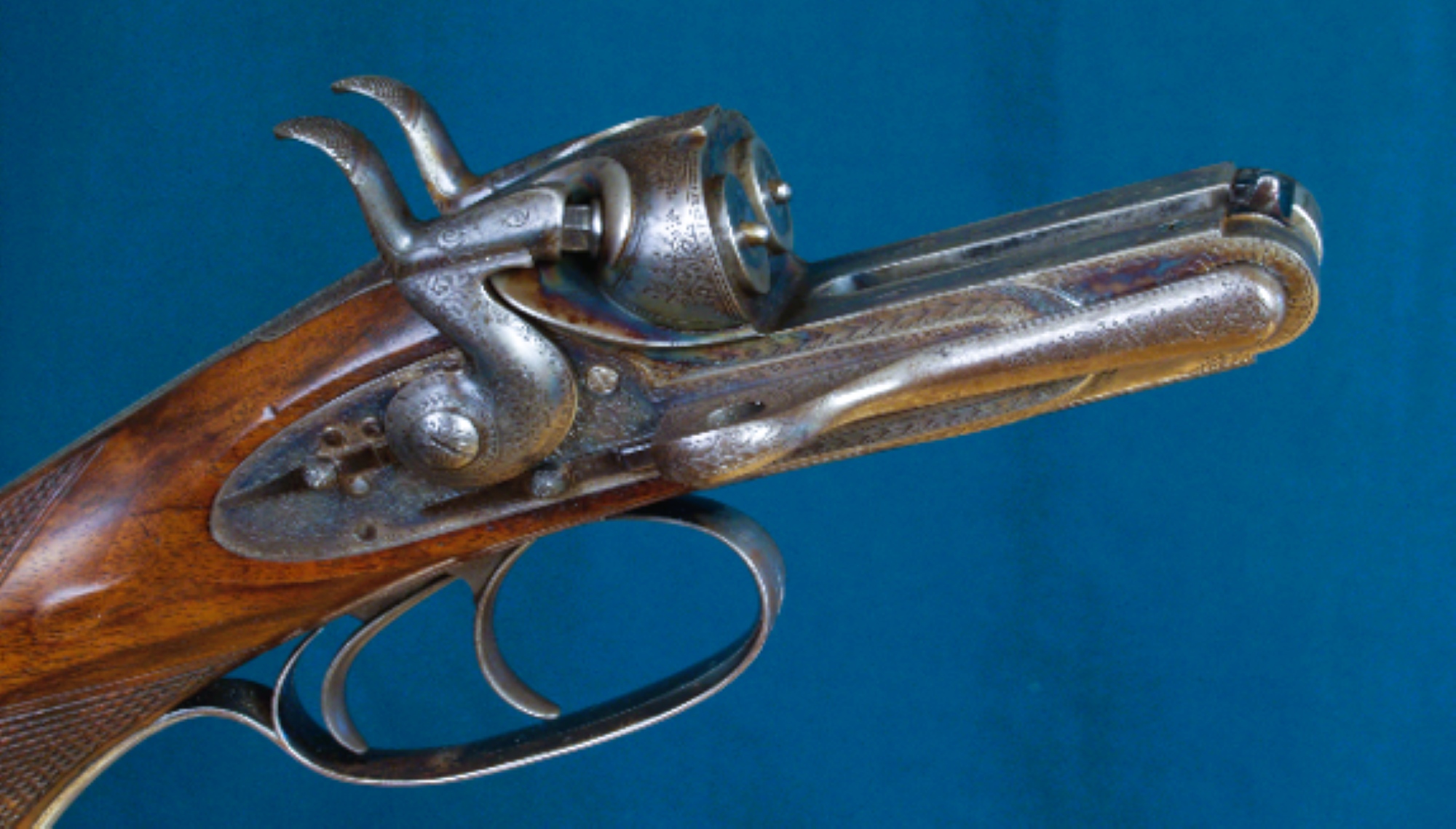
Patents are an interesting area of study regarding British hammer guns, but not all good ideas were patented, including some innovative ones. For example, when under-levers first appeared on breech-loading guns, they were forward-facing, after the original French design. Having a rotary under-lever wrapped around the trigger guard bow is a great idea, as it is less awkward to operate than a forward-facing one. The first British breech-loading guns with a reverse under-lever likely appeared around 1856, predating by several years the Henry Jones patent action with which the rearward underlever is usually associated. However, the original rearward-facing under-lever is another French invention that made it across to Britain in the early 1850's. These early actions, inspired by or based on those of Beatus Beringer of Paris, are of the single-bite design, meaning the screw bolt engages just one notch in the barrel underlug (not two, as per the Jones patent). The Beringer design, in use from as early as 1837, this also included a stud rising from the action bar to assist in opening the barrels and closing the action.

Single Bite lock-up with Beringer style under-lever and rising stud, Action not the work of Edwin Hodges.
After Henry Jones let his patent lapse in 1862, gunmakers were free to make double screw grip actions without having to pay any patent usage fees, and it wasn’t long before makers did so in ever-increasing numbers, which were by then competing with the new snap actions. The earlier single-bite design was never patented in Britain. Perhaps those who used the single-bite underlever knew it was French in origin and didn’t want to risk expensive, reputation-harming legal disputes, in the same way no one attempted to patent the pin-fire system in Britain.

Second or Third quality Pinfire sporting gun, having had a hard life, and well worn - but still in working order.
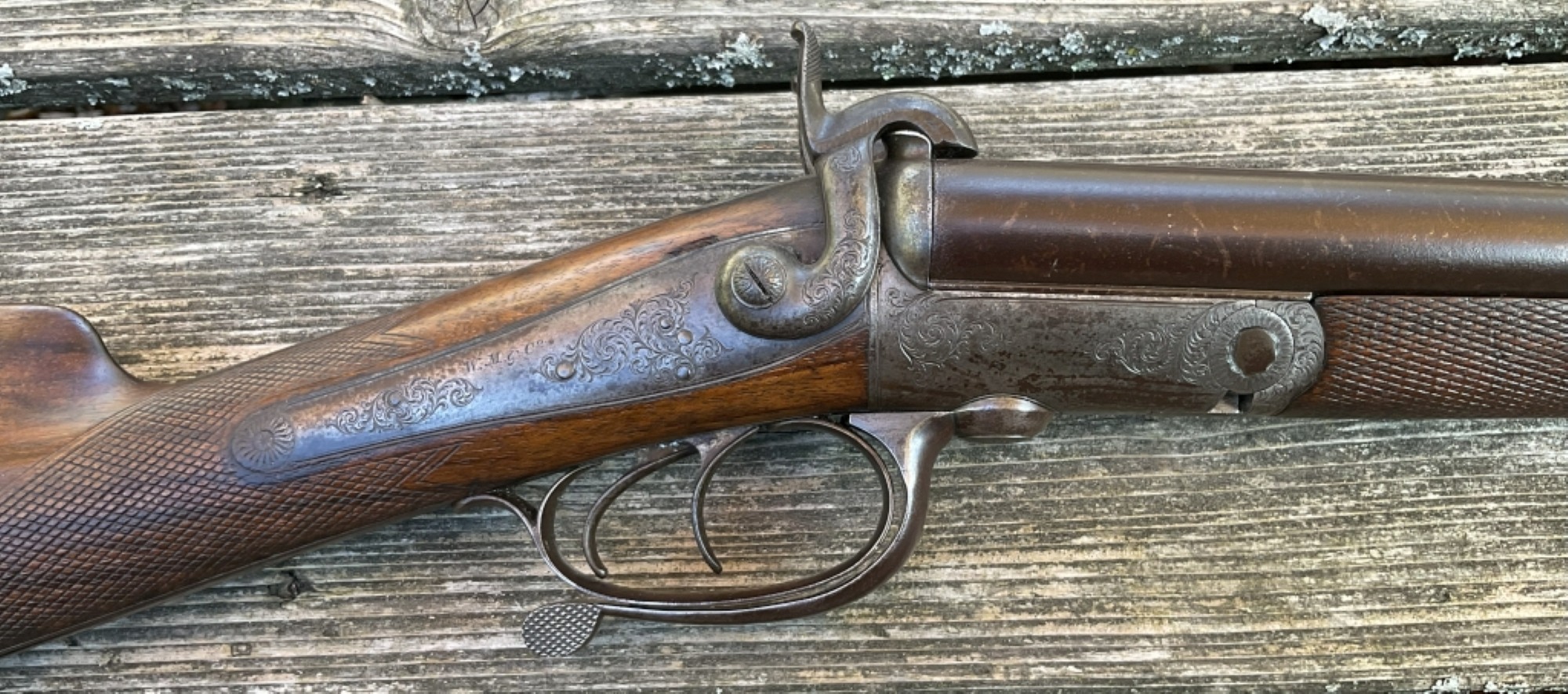
The gun featured in this article is a 16-bore, single-bite, assisted-stud opener action with the lever-over-guard by William Moore. William Moore was one of London and Birmingham's most highly regarded makers. I cannot verify the date of this gun, but I’m guessing 1860, plus or minus two years. It looks to be of second, or third-quality. The barrel rib is signed “W. M. & Co.,” as are the lock plates. Although cryptic today, at the time, everyone was familiar with the Moore name and its variations. Originally a stocker for Joseph Manton, William Moore established his own stock-making business in Birmingham in 1829 and became a gunmaker shortly thereafter. In 1836, the firm's name changed to William Moore & Co., and Moore also entered into several partnerships in addition to operating his own business. In 1838, he partnered with William Harris, creating the firm of Moore & Harris at 35 Loveday Street. In 1847, Moore partnered with William Patrick Grey and operated under the name Wm. Moore & Grey. In 1854, William Moore & Co. moved to 43 Old Bond Street, London, and Moore and Grey began trading from this address under the name William Moore & Grey. Guns marked Wm Moore & Co. were mainly export-quality guns with a different serial number range. William Moore may have died in 1864; the records are unclear.

Guns marked "Wm Moore & Co." were mainly export-quality.
The 30” damascus barrels have London proofs and bore markings (14). This is a narrow bore for a gun chambered for 16-gauge shells. The single-bite rearward under-lever action features Beringer’s assisted-opening stud. The square cuts of the action bar suggest the gun was not actioned by Edwin C. Hodges, who preferred the lightening cuts introduced by Beringer. The thin fences, also a sign of an early 1860-era gun, have raised percussion-style collars, and there’s an attractive rabbit engraving on the top strap. The hammer noses are arched, another early pattern. The underlever is of the style that fills the space between it and the guard bow, another preference seen on Beringer guns.

A heavy 16 bore London Pinfire, weighing in at 7lbs. 11oz. - Built to last, and it has !
The gun shows considerable use, and the bores are pitted. Although the engraving is limited in coverage, it is nevertheless done with style and skill. The gun weighs 7 lb 11 oz, heavy for a 16-bore. When new, it would have been a handsome gun, even if it was possibly one of the least expensive ‘London’ breech-loaders at the time.