William Anson
William Anson
The Legend behind the Boxlock
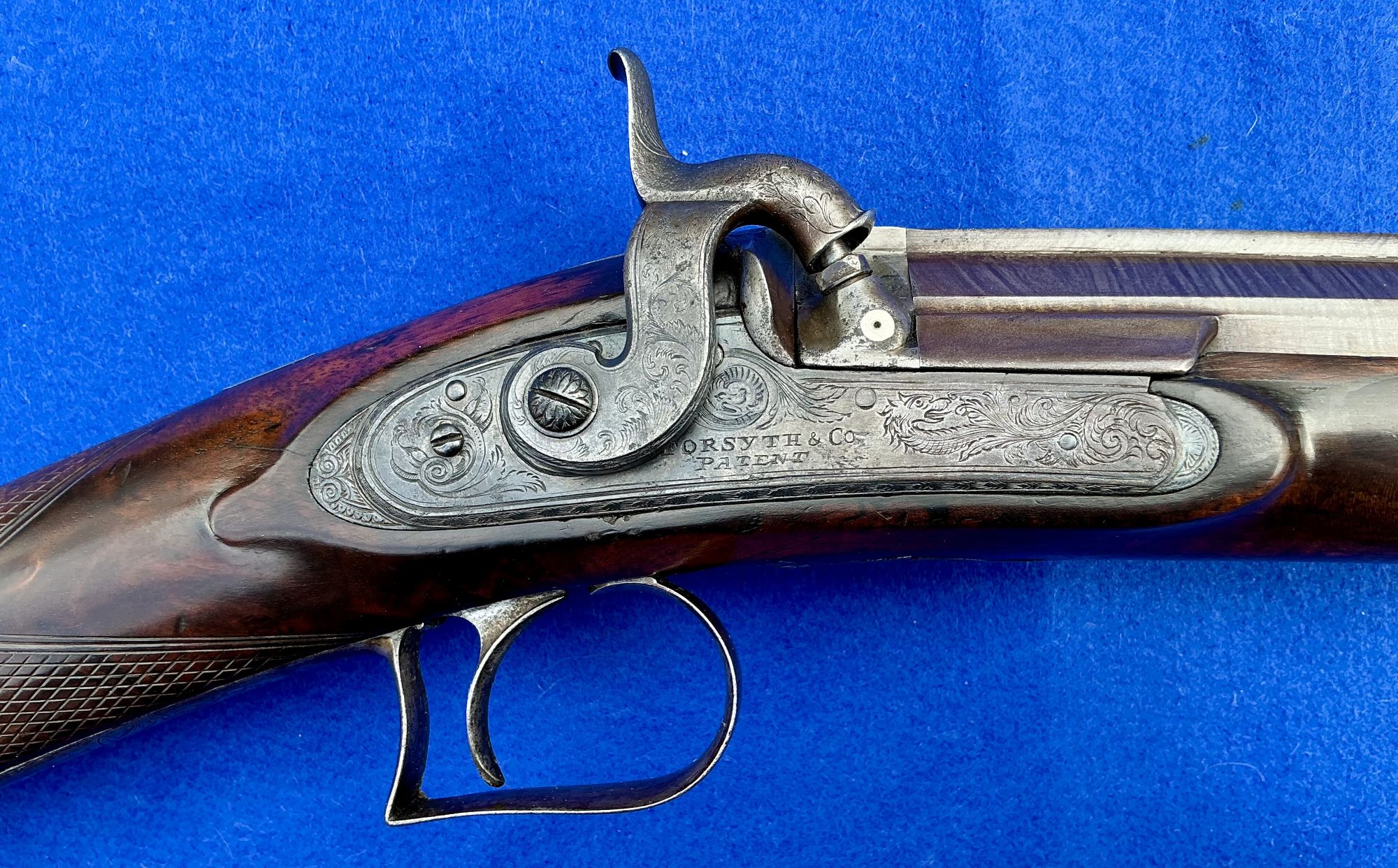
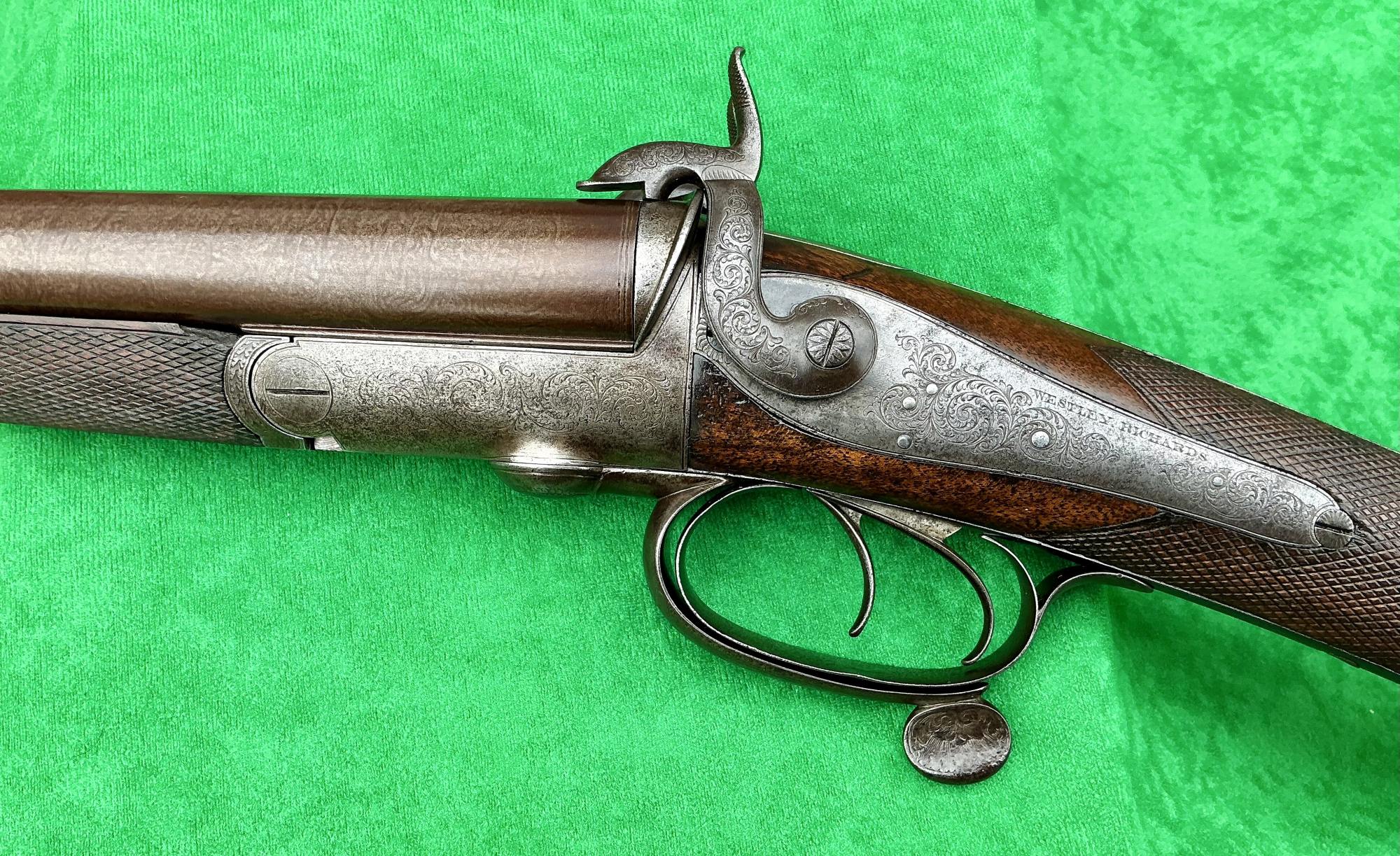
William Anson was the founding Father of the Legendary Boxlock action design, developed and built through the foresight of the Westley Richards Gun-making business.
Westley Richards was the birthplace of the most widely-used concept for building a shotgun or double-rifle action yet devised. The “Body-Lock” has become better known throughout the Gun making World as the 'Boxlock'. The design and invention being the brainchild of two Westley Richards employees: William Anson & John Deeley.
Westley Richards Co Ltd. writes – “The John Deeley links to the Boxlock patent is well documented in the firm's historical records, with photographs of him hang in our offices, the Deeley name appears regularly in patent applications and business correspondence”.
However, this John Deeley is the elder of two John Deeleys that worked for Westley Richards, both John Deeley's have patents assigned to their name. The John Deeley linked to the Boxlock patent was not a Gunmaker through training or profession. In fact, he was a managing director for the Westley Richards Company, and father to John Deeley Jnr. who went on to co-patent the Westley Richards ejector.

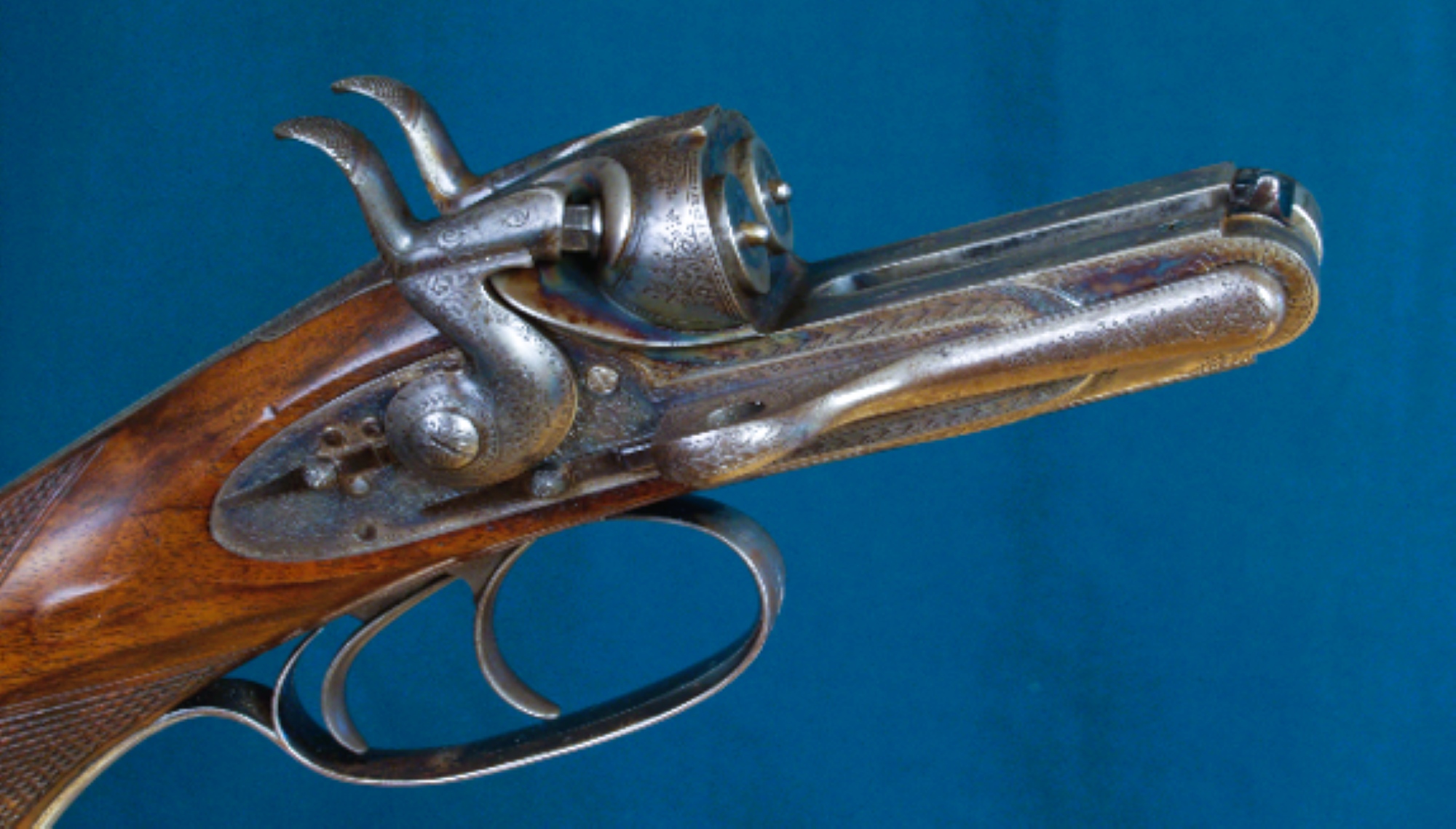
The first Anson and Deeley patent 12 bore - Serial number 5056
Research of facsimiles of the makers' records, has shown the gun was started in 1875 and completed in 1879, and described as 'Mr. Deeley's Gun'. The stock was originally recorded as 16¾ inches, but shortened to 14½ inches, at the time it was finished.

The engraving on the bottom of the action body tells us everything.
The first Anson and Deeley patent 12 bore boxlock non-ejector gun by Westley Richards, was serial number 5056. The gun was built for John Deeley senior. The gun was auctioned by Bonhams Auction House, London, on the 8th December 2010. The gun sold for £7,800 including premium. (Pictures Courtesy of Bonhams)
The rare Edwin Anson shotgun that has only recently surfaced has inspired this article.

William Anson's Son, Edwin George Anson created this gun, using the two further modifications to the 1875 Boxlock design, in 1883 and again, with Patent 4292 of March 1884.

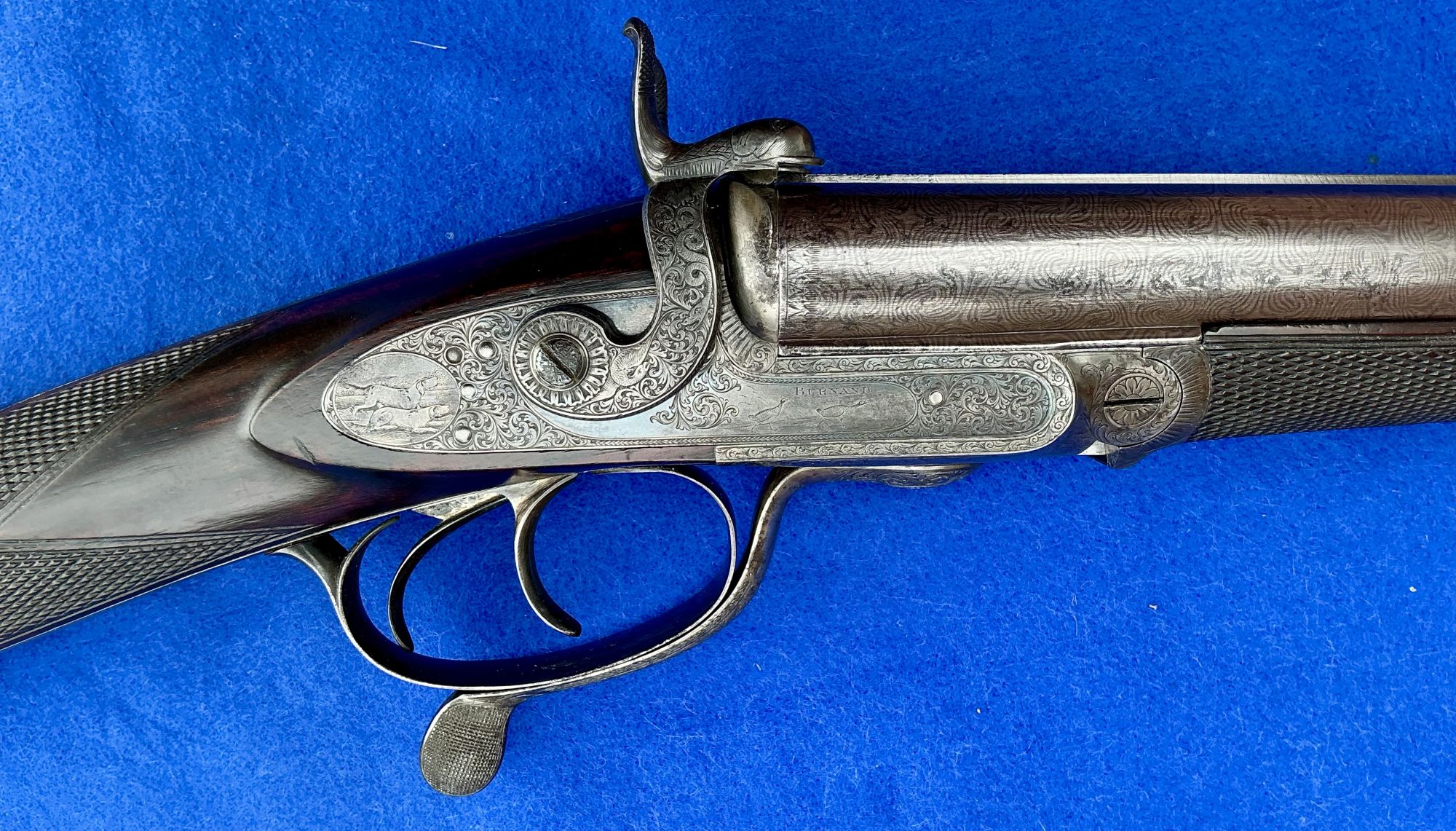
A rare example of an Anson Boxlock, very few Boxlocks are seen, being made by "William or Edwin" Anson.
The gunmaker at the centre of the Anson & Deeley Boxlock patent of 1875, was William Anson, who was an actioner. William Anson was appointed foreman of the action shop at the Westley Richards company in 1873, at the age of thirty three. This appointment came a year after he patented his forend opening / fastener (No.953 of 1872). The 'Anson Push-Rod' which was an immediate success, and it remains the most widely favoured means by which to detach a forend from a double gun or rifle.

William Anson's forend opening / fastener (No.953 of 1872). The - 'Anson Push-Rod'
Willian Anson having established his flair and ability for invention had been promoted in 1873, Anson collaborated with John Deeley (the Elder) to create the revolutionary new action (Boxlock) which took the gun trade by storm. Patent 1756 of May 11th 1875 was his finest work.
At the time, centre-fire hammer guns with rebounding locks were the prevailing technology. The Hammer Gun actions were beautiful, functional and, for many sportsmen, would, or could never be surpassed for elegance of form and function. But, surprisingly, like so many things, the elegant Hammer-gun was surpassed. The new Boxlock patent was essentially a variation of the hammer-gun lock plate, whereby the external hammers were reversed, placing the hammers and locks neatly within the confinements of an action body (Body-Lock).

Strong straight grained walnut through the Hand towards the Head.

Strength at Head and Hand, with figuring towards the Main and Tail of the stock.
The demand for improvements was constant, especially for guns with internal hammers which cocked automatically, these were destined to be the future. During 1871 Thomas Murcott had patented his 'Mousetrap' action, and had shown that 'hammerless' guns could be made in a manner that was aesthetically acceptable and functionally workable. These early 'hammerless' guns were cocked by the means of operating a lever.
The Latest design concept from Anson & Deeley used the barrels as the lever instead; the barrel weight, rotating on the hinge pin, activating cocking dogs which they in turn, cocked the locks. This new design concept was simple, with robust parts, and few in number. It was a total departure from anything built before. The system was ideal for factory production and would soon become the gun for everyman; a strong, reliable, pleasant, largely waterproof and dust-proof design, requiring little attention.

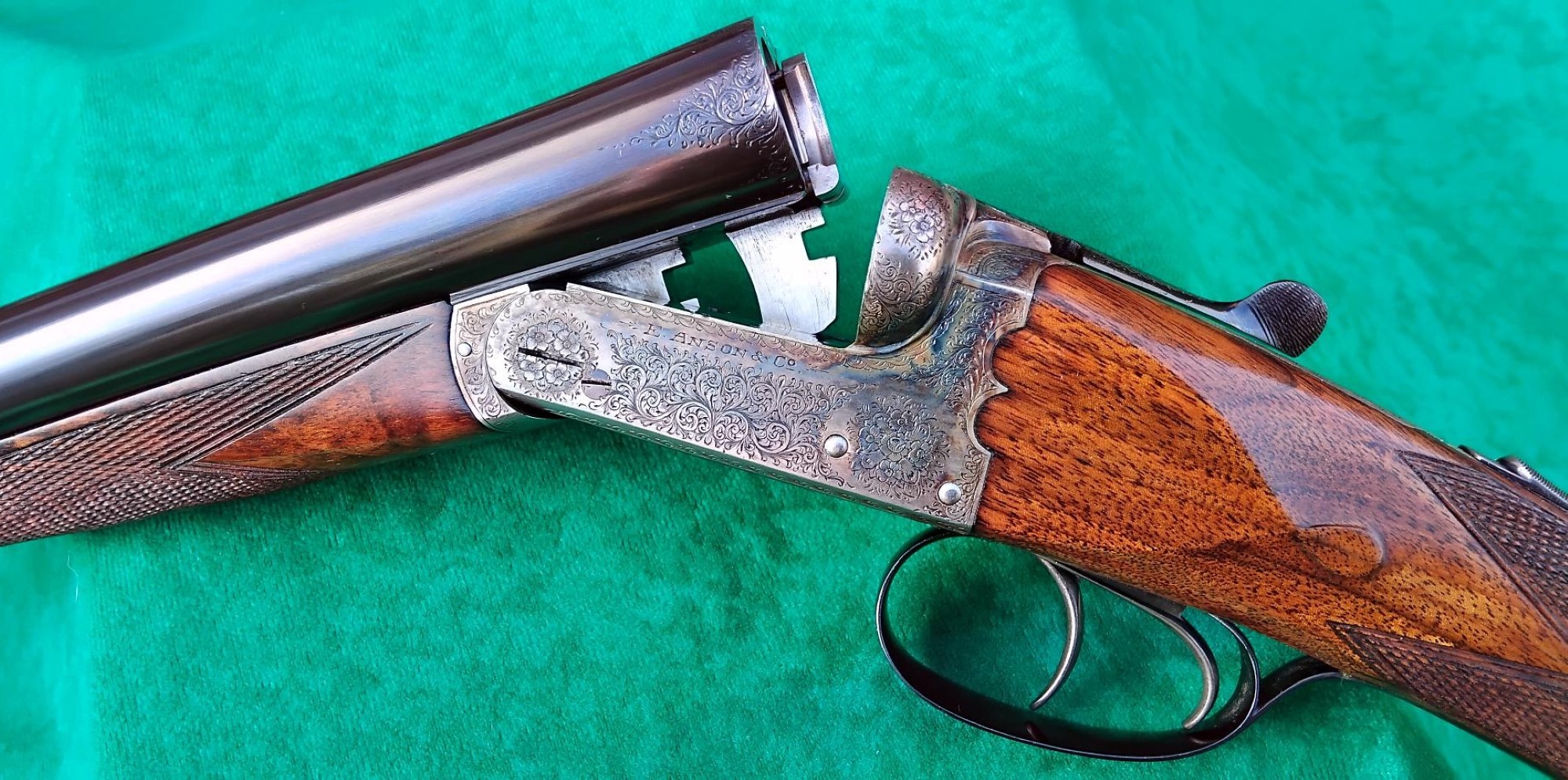
High level of finish on the Edwin Anson "Best Quality Box-lock"
The reason so many patents at the time were filed using two names is, one name is generally the actual inventor and the other some kind of patron or financial collaborator. Typically, the latter often gets the credit. For example, the treble-grip, side-lever with 'Grant's Patent' engraved on many of Grant’s hammer guns, this actually refers to the 'Grant & Hodges' patent of 1871, which was the invention of E. C. Hodges, for example. So, it is highly likely that William Anson who had invented the boxlock, took the invention to his boss, John Deeley, and they agreed a deal to co-patent William Anson’s invention.
William Anson remained at Westley Richards for only two more years after the patent was registered, leaving in 1877. The reason for William Anson’s departure from Westley Richards, is not all together known; perhaps Anson’s invention had netted him sufficient income to establish his own business. William Anson set up initially during 1877 at Egyptian Hall, 77 Slaney Street, and later adding 123 Steelhouse Lane to his portfolio.

All parts of this Edwin Anson BLE measure and remain when made.
Whatever William’s reasons for leaving Westley Richards, they appear not to have been acrimonious, as William continued to collaborate with John Deeley. They worked together, patenting two further modifications to the 1875 Boxlock design, in 1883 and again, with Patent 4292 of March 1884.
William Anson continued to lodge patents until May 1888. He was then forty eight years old and by this time had brought his son, Edwin George Anson into the business. William went into semi-retirement in 1891, the firm in the name of William Anson traded until 1897. William Anson passed at the age of Fifty-nine on May 28th, 1889, at Church Road, Mosley, Kings Norton. Worcestershire. This was not a great age for a successful artisan even during the 1880's, so we speculate, that William must have been suffering from an underlying condition, or from poor health in his last decade.
William Anson’s son, Edwin, continued the family business, changing the business name to 'E. Anson & Co', in 1898 trading from the Birmingham Gun Quarter, in Steelhouse Lane. Surprisingly few guns are recorded as being made with the name Edwin Anson's name on them, Edwin died in 1936, at that point the Anson company ceased to trade.

Proof Marks for 1925 to 1954 - Attention to detail, with all information marks accurately stamped.

Last business address of Edwin Anson - "E. Anson & Co. 126 Steelhouse Lane. Birmingham.
As an Inventor William Anson also deserves recognition, for his push-rod forend catch. This catch is still used by most major gunmakers, from Purdey and Holland & Holland in England, to Bosis in Italy and Dickson in Scotland.
The William Anson's 'Boxlock' design is the most successful sporting gun action ever devised. The Westley Richards Company is where it all started, to which they still build the Boxlock to this day, over 150 years after it was patented.
The Gun that inspired this article is a 12-bore boxlock side by side ejector gun by E. Anson & Co., no. 8382. The gun was built between 1925 and 1936. Made by William Anson’s Son - Edwin George Anson, the gun has Scalloped-backed action-body with bouquet and foliate-scroll engraving, and much colour hardening remaining. The gun is a 12 bore Ejector, with a barrel length of 28 inches, the barrels with game-rib, are engraved E. Anson & Co., 126 Steelhouse Lane, Birmingham. The barrel breech-ends are scroll engraved (Both on the Top & Sides of the barrels). Barrels with wall thickness of; Left 22 thou. and Right 26 thou. (As made) - The barrels are ready for Standard Steel Loads, being Choked at ¼ (9th) & ½ (19th). This gun is a Best Quality Boxlock in exceptional condition. The stock is cast for the right handed shot, is well-figured, and has Drop points, the length of pull is at 15 inches including an ebonite butt-plate. The gun weighting 6lbs 9oz, and Chambered for 2 1/2" cartridges.

Edwin Anson following in the steps of his father, producing Top Quality guns, although very few made.
The History of William Anson and his Son Edwin Anson, Edwin being an apprentice under his Father during their time at Westley Richards together, makes interesting reading, hopefully gives the Anson family more of a voice. There are a number of Gun-making enthusiasts and historians that feel the Anson family did not get the recognition they deserved, even though the impact on the shooting world through William Anson’s invention of the Boxlock is immeasurable.

Well made, strong, reliable, and elegant - Classic Boxlock from Edwin George Anson.
Edwin was a talented engineer and gunmaker, although he could not claim the inventions of his father, it is important to recognise that Edwin was himself creative, and had an ability in designing patents –
On 30 September 1886 Edwin registered patent No. 12402 for a sidelock ejector mechanism.
Patent No. 144444 of 1887
Patent No. 6260 of 1891
On 21 February 1893 Edwin registered patent No. 3789 cocking and trigger locking safety mechanisms on a drop-down barrel action.
On 9 November 1907 Edwin registered patent No. 24837 for a drop-down air pistol mechanism, this was made by Westley Richards and sold under the name "Highest Possible".
On 17 January 1918 Edwin registered patent No. 117043 for a lever or cocking key on a removable joint pin for Anson and Deeley type box-lock actions.
On 19 February 1918 Edwin registered patent No. 122299 for top lever operated crossbolt.
On 21 February 1918 Edwin registered patent No. 118390 for a trigger bolting sliding safety.
On 17 December 1920 Edwin registered patent No. 178048 for an air pistol mechanism. This patent referred to 24837 of 1907.
Edwin was productive in designing patents, and the Anson business were busy Gun makers to the Gun trade. The Anson business model, has in turn limited the number of complete guns made by the Anson Gun-making business. The number's being very few, and scattered. The question is why ? With the number of workshops, and business addresses operated by the Anson business, it would give a clear indication there was plenty of capacity to make large numbers of complete guns. The consensus of opinion from researchers is, the Anson business model was based toward, making Patented action bodies, patented parts, and other gun-making parts for the gun-trade, as trade makers.

Forend tip with Anson push-rod opener.
John Campbell’s book unlocks the Anson’s business model for America, through Edwin and William going to America to set up the Harrington and Richardson gun-making factory. This would enable H & R to start production, making the Anson and Deeley Boxlock. Once the finer points were in place and the contracts signed, William returned to England, however William Anson had another son, Claude Alonso Anson, during the H & R setting up, Claude had brought his own son Wilfred Alonso Anson to America, Claude had come to work for Edwin (Brother) while Edwin was at H & R. setting up production, Claude stayed in America for the rest of his life, with Wilfred staying on in America as well, Wilfred also eventually worked for Harrington and Richardson.

Strong straight grained forend wood, engraved forend iron and forend tip.
Edwin Anson is likely to have been in America at the Harrington and Richardson factory, this would have been for the sole reason to set up machinery, demonstrate best practice, and oversee quality control at the Worcester Massachusetts Factory. The time period for Edwin’s stay in America is not exactly known, but likely to be within the period of the Anson & Deeley Boxlock licensing period with H & R - 1880 to 1885 – We are aware Edwin was something of an artist, painting a Hunting scene at the H & R factory during 1883.
With Edwin’s return to the UK, and having built up a working relationship with H & R, this raised speculation that the H & R company acted as agents for E. Anson & Co. selling his Anson & Deeley Double Barrels guns, hence the fact, that more E. Anson & Co. shotguns of “A” and “B” quality grades are surfacing in America than elsewhere. However, on the very rare occasion an Edwin Anson Shotgun is uncovered and offered for sale in the UK.

Engraving to the barrel breech ends, are on both the tops and sides of the barrels, and extend down the top rib.
Although there is limited information about William Anson and Edwin Anson, a publication by author John Campbell “Birth of the Boxlock Shotgun” tells an intriguing inside story of the men behind the greatest break action gun in the world. The publication for those who are interested in the Anson and Deeley story is essential.
During 1923 E. Anson & Co. moved to Back of 126 Steelhouse Lane. Edwin George Anson (Gun-maker) died on 29 August 1936.