Webley and Scott - Usable British Classic
Webley & Scott
Usable British Classic from a Gunmakers Gunmaker
Many who have an interest in the history and collecting the British gun, can find themselves wanting to own, or even use a usable British Gun. This maybe for the occasional Game Day, Pest control, or a morning with friends Clay target shooting. There are a few considerations for those of us who are drawn to these wonderful old guns, especially when owning, researching, and handling them is not enough !

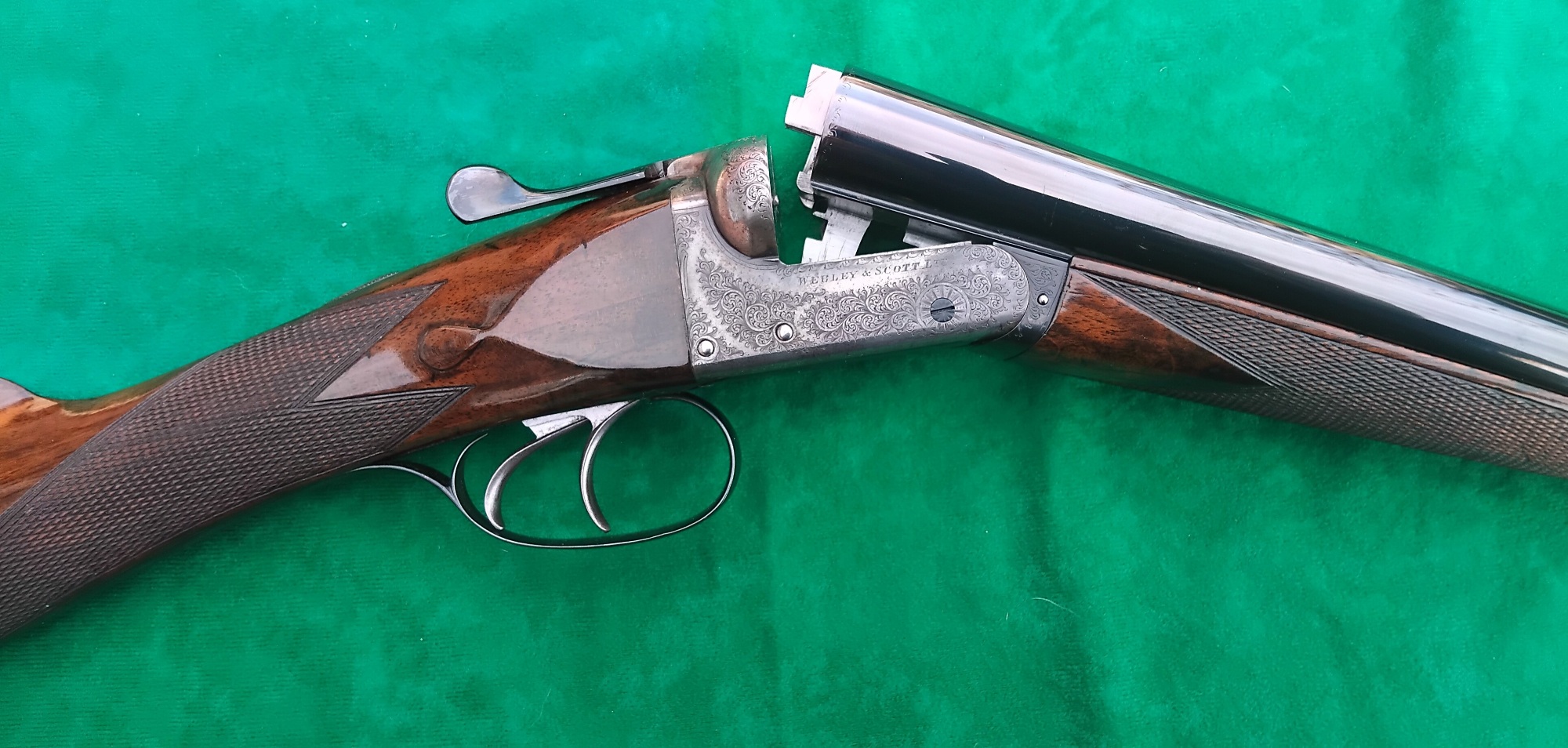
Webley & Scott - Model 400 Grade two - 12 bore - Built in 1916 ( 110 years old )
There have been many excellent British Gunmakers, so fortunately we still have many wonderful British Vintage and Classic guns available, but not always at a budget for everyone. This article covers a notable, practical and reliable British gun, that could be in reach of many, allowing the whole British gun experience at a cost that won’t break the bank.
For those looking for a Vintage British gun, with a view to use in modern times, then this could be a good time to look closer and see what could fit the bill. It may be quite easy, if you own a favorite British gun and the urge to use it has to be quelled. There are other considerations if you want to leave your family heirloom untouched, or there is nothing suitable in your collection for that odd day out.

An accessible British Gun for regular use by the British Gun enthusiast.
It is a rare thing to pick up a British gun, and for that gun to do everything you dreamed from the start. The majority of British guns were ordered and made to fit their original owners, these guns have now been moved on, or sold. It is not likely, that all British guns purchased second hand can deliver the exact results required immediately for its new owner, but there remains a massive choice.
Fortunately, the majority of British hand-made shotguns made within the mid to lower quality ranges, would have been made primarily as off the shelf, ready to go guns – these guns were made to fit the majority and not just an individual or the few, in turn this range of handmade guns would accommodate the average British game shot at the time. These guns are more likely to meet our criteria and needs, or at least need a minimum amount of alteration.

A hand made gun, with off the shelf measurements - lengthened with a modern day Kick-eez Pad.

Strong straight grained Walnut through the grip with light figuring at the tail.
Good advice would be to handle any possible purchases, this could give an idea whether the gun might meet your own criteria, and, or what might need to be altered to suit you. What do you need ? Ideally something reliable, long lasting, value for money, something with a good name, something that shoots modern cartridges, something that shoots in the right place, and something in budget !!
There are more considerations for British guns with Damascus barrels, and for those with steel barrels and short chambers. Its important to do your homework, or take sound advice from someone qualified to help. The original owners and users of the older Vintage gun were generally of a smaller stature, so in turn the guns if original are generally shorter in the area of “Length of Pull” many of these guns with original measurements today may not always come to hand, or move as well as a gun that fits, fortunately lengthening a gun to give a better fit is relatively straightforward. It would also be fair to say a short stocked gun is easier to use than a gun with excessive length.

Well care for example - original proof with good measurements, and decent barrel wall thickness.
Having fun using a Vintage British gun is primary. However we are already seeing there are compromises needed through choosing the guns we want to use. Looking at this from a different angle, by collecting information, cross referencing with the compromises raised, could support a gun that matches. More British guns could be short listed through understanding the compromises. The focus can now can be directed in finding something that ticks your own boxes.
Theoretically there could be something for everyone ! We are all different, with different ideas and different budgets. I am personally drawn to the development of the Breech-Loader, so, my initial thoughts, were of shooting an early breech-loading Pin-fire game gun for fun, this seemed like a good idea at the time ! However going through the compromises, and looking at things more practicality, and thinking more sensibly, there was an unexpected draw towards the maker Webley & Scott, Why?

The gun has a strong lock-up using a Third bite.
Through the in depth research for a British gun for fun, trying to cover the widest criteria from Clay targets to Game and Pest control. The available information surrounding Percy Stanbury and Joe Wheater immerged ! Both these British Vintage expert shots, were British Champions over several decades, and both won titles far and wide. These British Champions both used Webley & Scott, Side by Side, 12 bore shotguns - a “British Classic”, the gun and brand being a staple diet of the British shooter, and the Gun trade, this had ensure many were made, and being strong and reliable many are still with us.
Both Percy Stanbury and Joe Wheater as competition shooters, would have needed total dependable reliability from their Competition Guns. The guns they both chose to use were Webley & Scott. The models they used to good effect are regularly offered for sale today from the advertising British Gun trade, and at a cost that is in reach of many.
The Webley & Scott model used by Percy Stanbury was a Model 400 serial number 95188, made in 1921, the model used by Joe Wheater was based on a model 700, although Wheater’s Webley & Scott shotgun is said to have been a very much bespoke affair, the gun was based on the model 700, and was used to dominate British clay shooting for decades. We have confirmed both the competition guns used by Stanbury and Wheater were made by Webley & Scott. Although, the two models were different, they both had a number of similarities, one important feature of the 400 and 700 models, being the use of a modern principle and designed of the interchangeable principle, many British gunmakers at the time use machinery to shape parts. However, Webley and Scott’s interchangeable principle took this a step further, the company ensured the machining was conducted to precise dimensions, reducing final hand fitting time, this in turn supported, any necessary repairs could be carried out promptly.

The gun in 1916 had a price tag of £25. With the average working mans wage at £1-10s-5d per week, this was a considerable investment at the time, and during World War 1
The two Webley & Scott models used by Percy Stanbury and Joe Wheater, were: The Model 400, that was made from 1900 to 1946 in three different grades – One to Three. The Model 700 which was made from1947 to 1979, that was initially made in grade three only. The models 701, and 702 were introduced as higher grades in 1951, and the model 704 made from 1960 to 1964. There were also four models designed for the American market, the model 710 (28 bore, in 701 grade finish), the model 712 (12 bore), the model 720 (20 bore), and the model 728 (28 bore)
The Webley & Scott brand of shotgun is woven into the fabric of the British gun trade, the Webley & Scott company were seen as Gunmaker to the Gunmakers, supplying fully finished ready to go guns, or part finished guns “In the White” for completion / finishing by the receiving gunmaker. The W & S company supplied barrel tubes to the gun trade for sleeving, or offered the sleeving process for the customer, or new barrels from start to finish. Every conceivable gun-making service, including parts was available direct from Webley & Scott. In turn quality makers throughout the British gun trade used the Webley & Scott services for repair, through to making, and total re-building of best guns.

Anson Push rod forend opener, with engraved forend tip.
Prior to the Trade Descriptions Act of 1968, the Webley & Scott company would supply fully finished guns, with the name of the retailer engraved on the action and top rib ( Ready to go ). The new Act replaced the Merchandise Marks Acts, this covering method of manufacture, date and place of production, and identifying the manufacturer. It made it an offence to apply, or supply goods with a false trade description, including misleading claims about who made the item.
Webley & Scott made several models of note, that could make the foundation for a reliable British shotgun that could be used for occasional use, through to the professional every day user. The necessary considerations towards Chamber length, barrel length, barrel wall thickness, choke restriction, cartridge choice, and the ability for the use of standard steel in the future, all need to be checked thoroughly to ensure personal needs and safety is ensured.

Rib address, a little rubbed, but reads - Webley & Scott 55 Victoria Street London & Birmingham.
The gun that inspired this article was a Webley and Scott Model 400 made in 1916 ( Middle of WW1 ) and for this reason the article briefly covers the Webley and Scott brand story. The images and footnotes are of the gun in question. It is important to remember, there are a number of reliable strong British Gunmakers to choose from. The strength, simplicity and reliability of the Boxlock are for many a comfort, but choice is for the individual, along with their needs and depth of pockets.
The details of the British Gun chosen for personal regular use are as follows - A Webley & Scott Ltd. Model 400 Grade 2, Box-Lock, with disc set strikers, and third bite, and as an ejector, made in 1916 at the cost of £25. The gun weighing 6 lbs. 15 ½ oz. The address on the barrel top rib – Webley & Scott Ltd. 55 Victoria Street London & Birmingham.
The Barrels are 30 inches, weighing 3lbs. 2 oz. The original chokes when made, being Modified and Full, these have been eased, and now measuring Quarter and Half. The guns’ new choke measurements have been created using long slow tapers of between 3 ½ & 3 ¾ inches respectively. The barrels except for altered chokes remain original, and on their original their Nitro Proofing of .729, now at .732 & . 733, The barrel wall thickness are 22 & 28 thousandths of an inch. The original stock measurements of 14 1/4 have been increased, and are now at 14 7/8 ( modern day Kick-eez recoil pad ), right hand cast, grade 2 walnut, with drop points.
The finer details: The Gun is based on an Anson and Deeley Hammerless action, patent no. 1756 of 1875, with Double triggers bolted by an automatic top tang safety slide, with an Anson & Deeley's safety catch no. 907 of 1879. The Top lever opening, operating a “Purdey Bolts” patent no. 1104 of 1863, by way of a “Scott Spindle” patent no. 2752 of 1865 – The strength of this gun being supported using the three point bolting, via the Webley 'Screw-grip' top extension patent no. 3053 of 1882, in turn giving a Third Bite. The forend is secured via a fastening latch using an Anson's push rod forend fastener patent no. 3791 of 1872. The gun in the hands of its new custodian has already given many memorable days out, and fired several thousand cartridges.

A well fitted aftermarket recoil pad, giving a LOP of 14 7/8.
Webley and Scott, a brief history –
In 1827, 14 year old Philip Webley was apprenticed to Benjamin Watson, a gun lock filer. Having completed his apprenticeship, Philip joined up with his brother James in 1835 and formed the company Webley Brothers - Percussioners, Gun Lock & Gunmakers in Weaman Street, next door to William Davis.
Philip began courting Caroline Davis, who following the death of her father three years earlier was running the family business alongside her mother. When Philip and Caroline married in 1838, and the two firms amalgamated. Over the next sixty years Philip Webley and Sons prospered and grew, sons Thomas and Henry joining the company.
During the 1850s the company began manufacturing percussion cap and ball revolvers. This was a time of unrest across the globe with the Crimea War, Indian Mutiny and the American Civil War, the unrest created great demand for Webley's products.
The last quarter of the 19th century witnessed the rise of muzzleloaders, the breech loading rifle and the conversion from black powder to smokeless powder. In 1887, the Webley and Sons company took over the well-known firm of Tipping & Lawden of Constitution Hill, Birmingham, England. In the same year saw the award of the first of many Government contracts for the supply of revolvers from its new, modern and automated factory.
Philip Webley died in 1888 aged 76 leaving the firm in the hands of his sons. In 1896, they built a second factory in Weaman Street for the production of rifles, notably the Martini-Henry Target Rifle. The Company W & C Scott was founded in 1832 by the brothers William and Charles Scott, who had moved to Birmingham from their native Suffolk, by the mid-1840’s the Company were gaining a reputation for the production of high quality double guns. Two of William's sons, William Middleditch and James Charles, joined the company and it was renamed as W & C Scott & Sons, and in 1855 moved to larger premises at 94-95 Bath Street, Birmingham.
In 1864 the continued success of the W & C Scott company necessitated a move to larger premises and the building of the world famous Premier Gun Works on Lancaster Street, Birmingham. The Scott brothers were innovators with many patents to their name, some of them truly historic. One of the earliest was the Scott spindle in connection with the top lever, this is still used today by makers of high grade breech loaders. They introduced the block safety catch for hammerless guns and later still the double catch hammerless lock which is still in use today.
William Middleditch Scott was a brilliant engineer, having his first patent filed in 1865 and in 1878 he became the first man to design and patent a successful sidelock shotgun. This shotgun was manufactured under royalty arrangements by a number of firms, including Holland and Holland. William Middleditch Scott retired from the firm in 1894 and James became head of the company until he too retired at the time of the amalgamation of the three companies in 1897.
The amalgamation in 1897 of the three companies created a new public company registered under the name Webley and Scott Revolver and Arms Co Ltd, with a total capital of £335,000. Thomas Webley became Managing Director. Martin Scott, Richard Ellis, William Henry Ellis and Albert Ellis became departmental managers. Webley revolvers and Scott shotguns were popular and the new company prospered.
Over the 20th century, many forces came to bear on the company such as the 1920 Firearms Act that virtually barred individuals from owning handguns, the compulsory purchase of the Weaman Street factory for a road widening scheme and a general increase in competition from abroad. The company changed hands several times, and in 1965 the company took over the gunmakers W.W. Greener who had moved to Birmingham in 1844. The Webley & Scott company, as well as making guns diversified, producing parts for cars, air guns and general engineering components. At the end of the 1970’s the production of shotguns was terminated at Webley and Scott and a separate company was formed, W&C Scott (Gunmakers) Limited. In January 1985, this entire business was sold to the world famous shotgun makers Holland and Holland.
Holland and Holland had been one of the companies which originally bought firearms "in-the-white" from Webley and Scott. Shortly after W & C Scott had been acquired by Holland & Holland, the whole of the firearms manufacturing side was discontinued, while Airgun production resumed. In 2006, Webley & Scott part of the business was purchased by AGS – ( Wolverhampton-based company Airgunsport (trading as AGS) acquired the assets, intellectual property and brand name of Webley & Scott following the closure of its Birmingham factory ) once again making guns, including shotguns under the name Webley & Scott. To list all the types and models of guns and rifles produced by the company over the centuries would fill a book, but some of the more famous guns are the Webley falling block rifles, the Scott Imperial Premier Sidelock Hammerless shotgun and the Model 700 Boxlock Hammerless Sporting Shotgun.
These guns previously used by British Champions, remaining reliable and an available British classic could fit the criteria for many British gun enthusiast, and those wanting to shoot a classic mid twentieth century British gun for recreational pleasure.
Bibliography and References
David Neale – Southgate Collection
Historical information courtesy of Webley & Scott.
Paul Garrity
British Guns Editorial Team