Robert Watmough
Robert Watmough
Quality Maker Overlooked - 1854 to 1869
Manchester, a city that boomed during the Industrial Revolution, is a good example of where several gunmakers competed for demanding clients, and were driven to produce high-quality work. In the 1850s and 1860s, cotton and finance were the main areas of development in that city, and with this wealth came the possibility of country pursuits and orders for sporting gunmakers. At least 19 gunmaking firms were active in Manchester during this time: John P. Agnew, William Burtinshaw, Thomas Conway, John William Edge, Gasquoine & Dyson, William Griffiths, Griffiths & Worsley, Reuben Hambling, Hamer & Co., Thomas Hepplestone, John Kaye, Thomas Newton, Charles Pearson, Francis Preston, Francis Robinson, Henry Steel, Robert Stensby, Thomas Warhurst, and Robert Watmough.

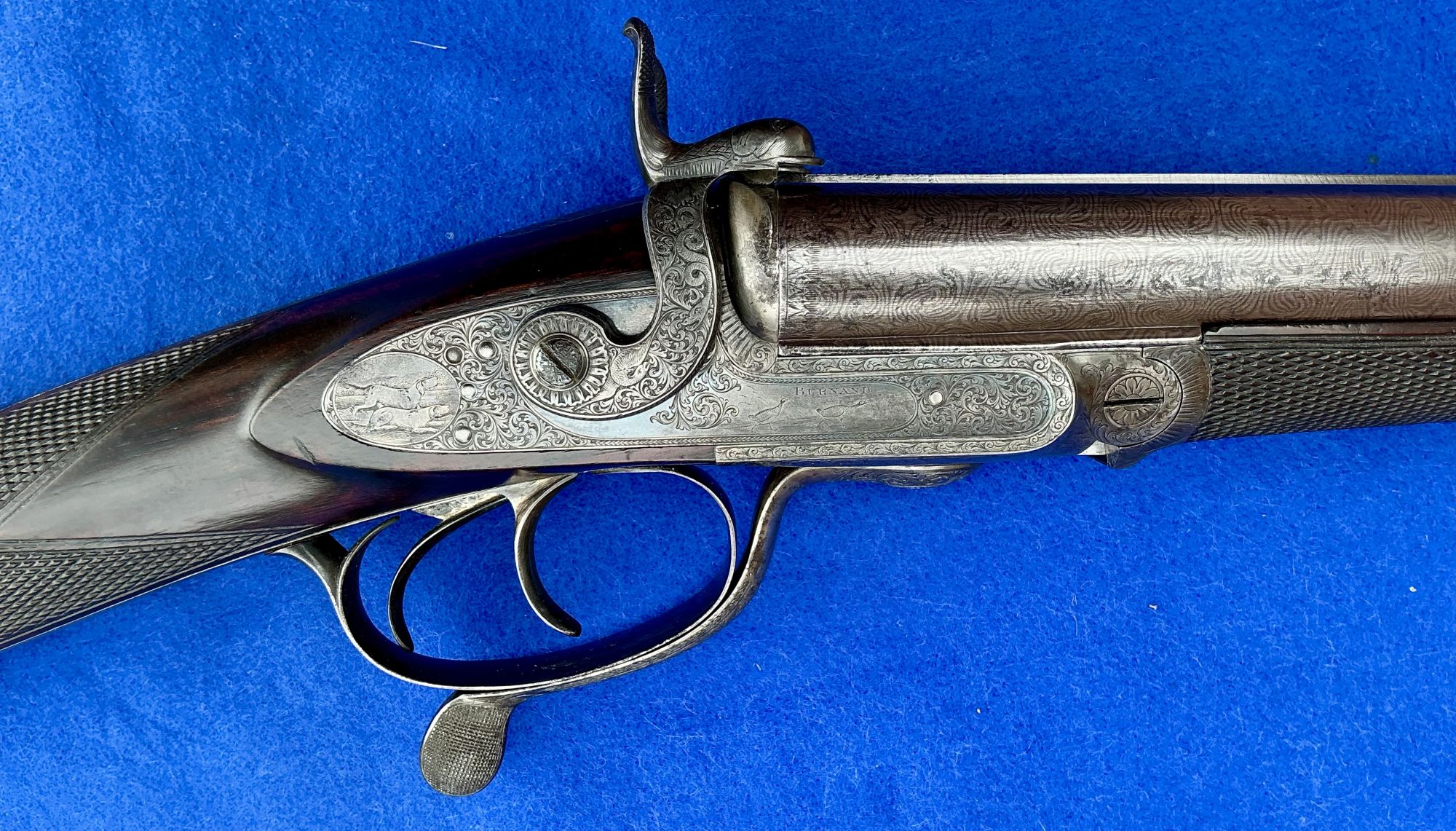
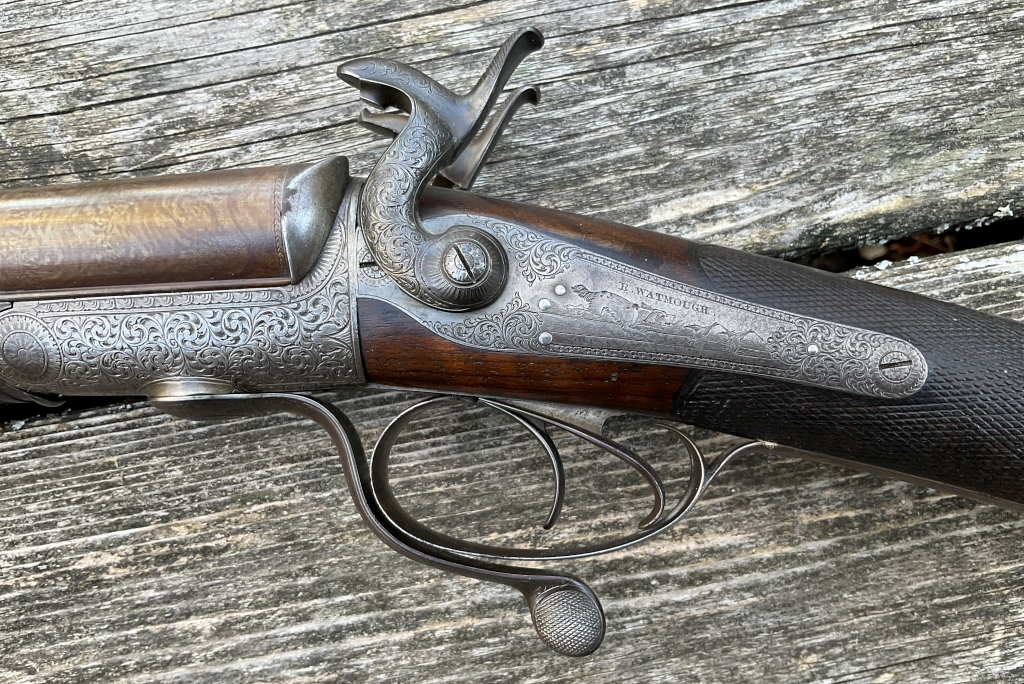
Unusual Heavily engraved action body, and game scene engraved back action locks - Laminated Damascus barrels
Robert Watmough was born in Lancashire in 1821, and he worked for the gunmaker Thomas Conway, who operated at 4, and later 15, Blackfriars St. in Manchester. Conway was a well-known gunmaker who was renowned for his pistols. Whether Watmough apprenticed under Conway or was a journeyman in his employ is not known. The 1841 census has him listed as a gunsmith. The 1851 census lists him as ‘Head, Salesman To Gunmaker,’ presumably to Conway. Robert Watmough set up his own gunmaking business at 13 Blackfriars St. in 1854. The 1861 census lists Watmough as ‘gunsmith,’ together with his son, Henry, age 19, also as a gunsmith (presumably working for his father). Watmough and his family lived at 6 Sloan Street, in the Moss Side area of Manchester. The business closed in 1869. In 1870, Robert Watmough was an honorary member of the 8th Lancaster Rifle Volunteer Corps. Watmough may have died in early 1873. There is no further record of Henry as a gunsmith; the 1881 census lists him as a clerk, and in the 1891 census as a domestic labourer. Henry died in 1921, at the age of 79. Unfortunately not much else can be traced in relation to this maker.

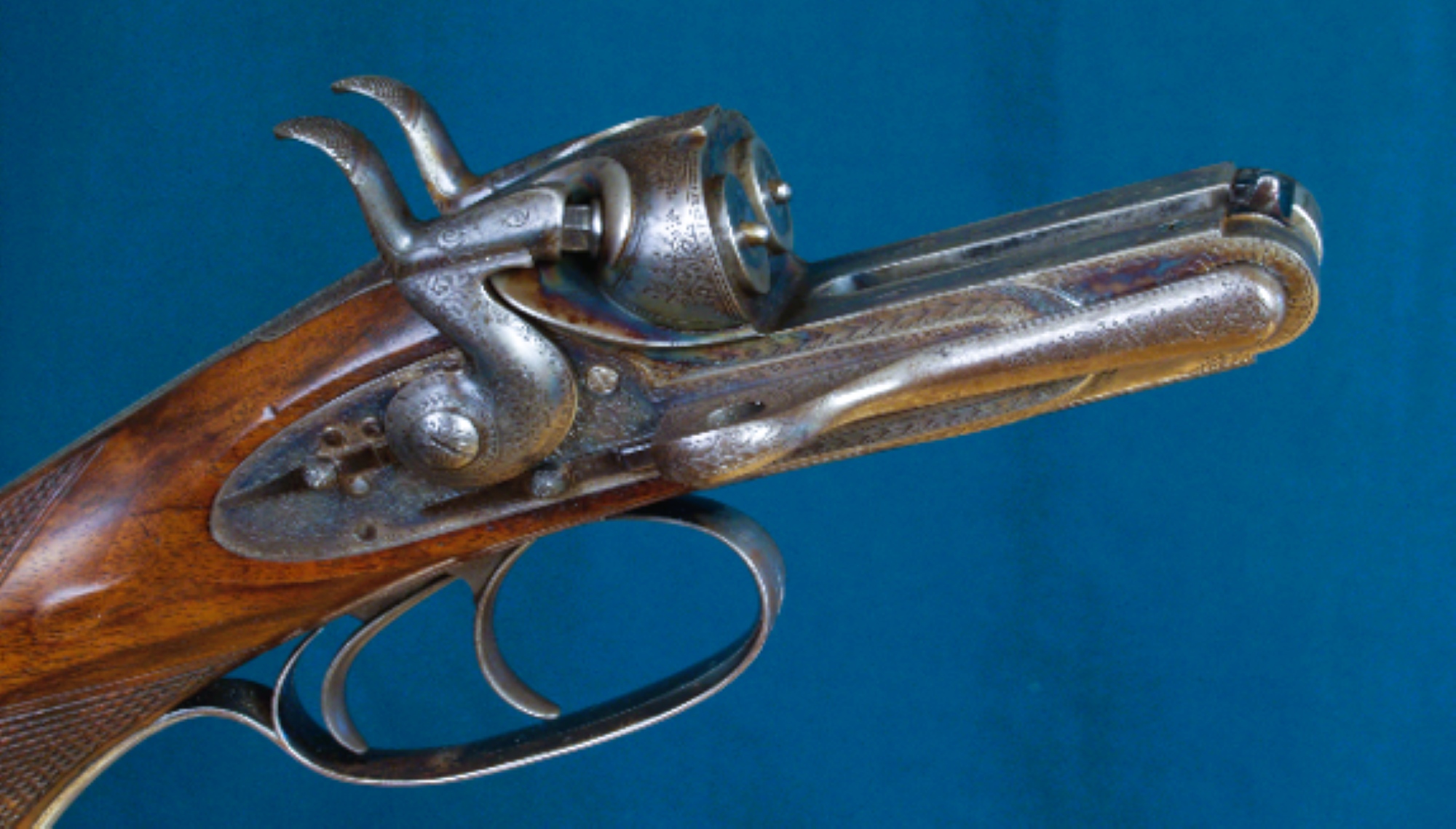
Elongated Jones style under lever - delivering a strong and reliable Lock-Up
Thankfully, a handful of Watmough’s guns have survived. Here is a 16-bore double-bite screw-grip rotary-underlever pin-fire sporting gun of high quality. The 27 3/16” laminated barrels have Birmingham proofs, and the top rib is signed “RobT. Watmough. 13. Blackfriars. St. Manchester.” The barrels also have a maker's mark for W. Marshall, a gun barrel maker at 10 & 14 Vesey St., Birmingham, who was in operation from 1865 to 1868, which helps narrow the gun's date. The back-action locks are signed “R. Watmough” and are nicely decorated with dog and game scenes (curlews and pheasant). Despite their obvious appeal, game scenes are uncommon on pin-fire guns.


The bores are still very good with only slight pitting at the breech, and the right-hand hammer is a period replacement. The gun weighs a light 6 ½ lb.
The full-coverage engraving of the action is nicely done, another feature that is uncommon in pin-fires of the period. The gun evidently changed hands during its shooting life, as it has a stock extension. While on the surface it looks like just another Jones-type double-grip action, upon closer examination, there are some structural/mechanical differences. The action bar is slightly longer than usual, and the space between the locking lugs is quite wide, making the interrupted locking nut correspondingly wide. These two superficially minor adjustments probably meant a very secure and sound lock-up. Whether this is typical of Watmough guns is unclear, without others to compare it with. Gunmakers were experts in mechanical engineering, even if unschooled.

What this gun has is an aesthetic balance, where the action, stock and fore-end are beautifully proportioned, and the game scenes successfully distract from what might have seemed oversized lock plates on a slim-handed gun. While not finished to the standards of a ‘London Best,’ this product of a small gunmaker is still a fine gun, although carrying age related ware.