Samuel and Charles Smith - London
Samuel and Charles Smith
Samuel and Charles Smith, 64 Princes Street, 1834-1869
When dealing with bespoke sporting guns, anything is truly possible. Makers would fill any reasonable request, resulting in a wide array of features, details, and finishing touches. Personal preferences in barrel lengths, stock dimensions, and ornamentation choices abound. But every once in a while, a peculiar choice pops up which defies the usual conventions and is difficult to understand.

This Pin-fire Game gun was ordered with "Inverted Lock Inscriptions"
This is the case of a game gun with inverted lock inscriptions, involving a gun making name of considerable repute amongst London high society. The story begins with the London gunmaker William Smith, who apprenticed to John Joyner in 1766 and then to William Shepherd in 1771.
In 1817, William Smith was appointed Gunmaker-in-Ordinary to the Prince Regent, and he moved to 59 Princes Street, Leicester Square. In 1820, when the Prince Regent became King George IV, Smith was appointed Gunmaker-in-Ordinary to the king and moved to 64 Princes Street the following year. Smith was appointed Gun Maker to Tsar Alexander I, Emperor of Russia, and Maximilian I Joseph, King of Bavaria. This recognition says a lot about the quality of Smith guns and the regard in which they were held. In 1825, William was succeeded by his son Samuel, and in 1834, Samuel’s brother, Charles, joined him, forming the firm Samuel & Charles Smith. Continuing the family’s reputation, between 1835 and 1837, they were appointed Gunmakers to His Majesty (William IV) and the Duke of Gloucester. By 1855, Samuel and Charles had died, and Samuel’s two sons, also named Samuel and Charles, took over the firm. All in all, a very solid multi-generational pedigree of top Gunmaking. Like most makers of the pin-fire period, Samuel and Charles Smith appear to have offered different grades of guns, including some with patented actions from other makers, and inventions of their own design.

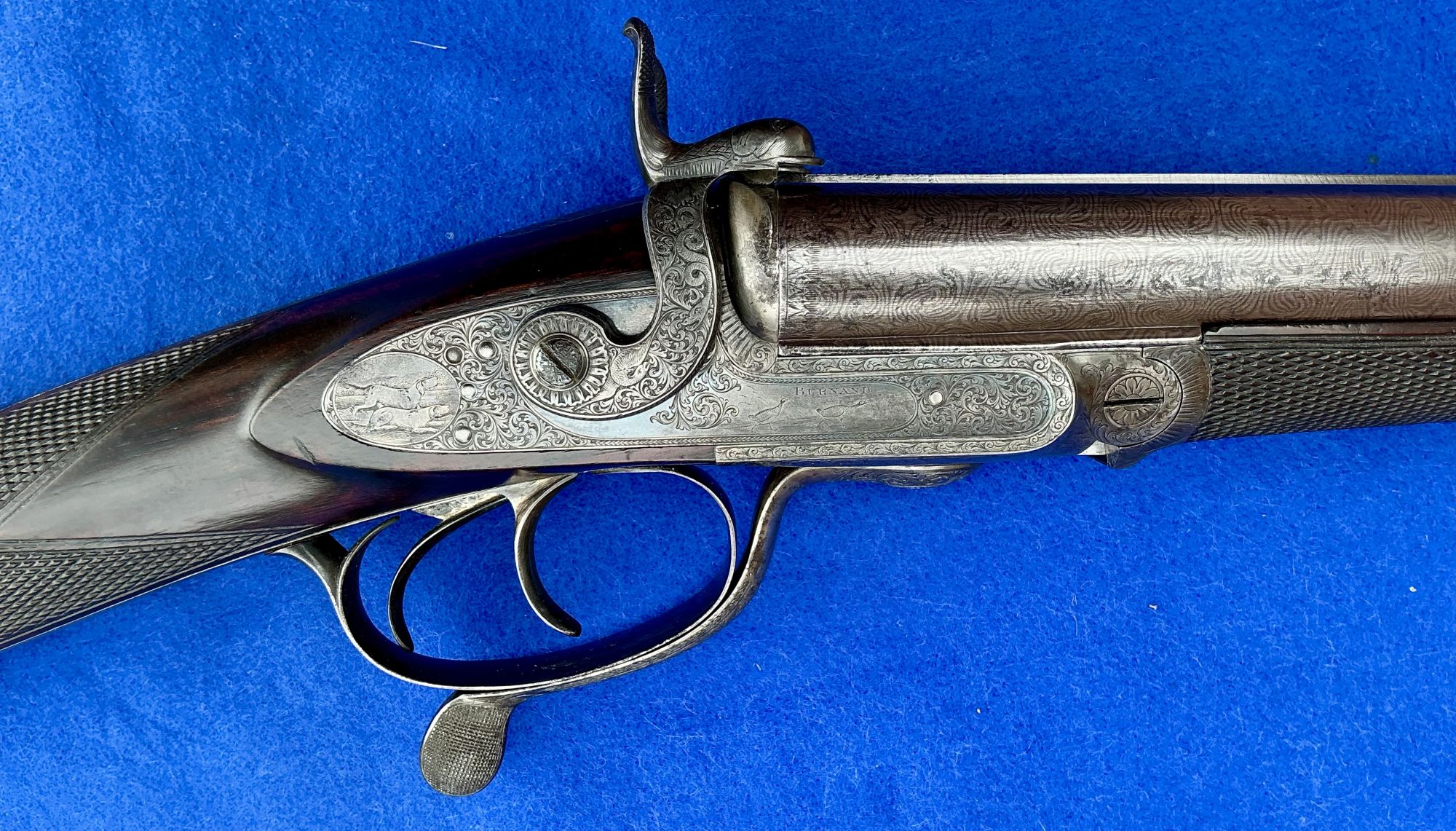
Just a reminder of Samuel and Charles Smith's higher end offerings during the same period
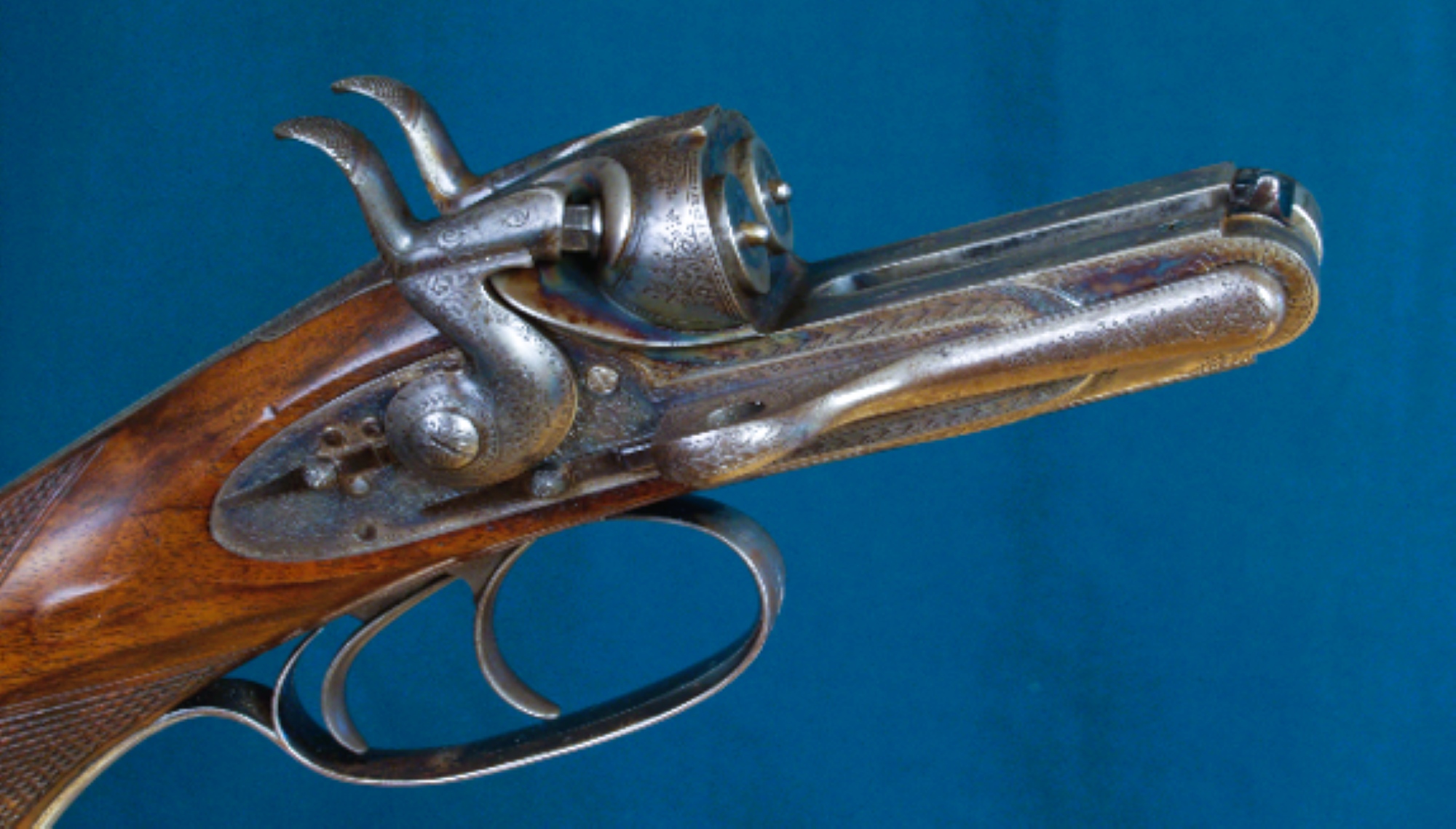
The gun that inspired this article, however, is a ‘standard’ 12-bore double-bite screw grip action, and its serial number places it about mid-1860s in date, compared to known Smith guns. The gun is in a very sorry state – with a broken mainspring, parts missing, worn engraving, pitted bores, and an overall tiredness. The 29 3/4” Damascus barrels are signed “SamL & C Smith Princes Street Leicester Square London” on the top rib (Samuel and Charles Smith were at 64 Princes Street, Leicester Square, London from 1821-1870). The barrel maker’s mark is ‘HS,’ which is believe to be for Henry Squires of Upper Seymour Street, a known supplier of quality barrels. The gun has typical percussion-style fences, an extended top strap, and flat-sided hammers — attractive but of no particular note. Engraving is sparse, but well-executed, and the underlever is finished with stylish flair.

Medium quality gun, however good quality locks made by Noah Butler, Staffordshire - quality bridles !
Inside the lock-plates is the mark ‘NB,’ for Noah Butler of Darlaston Road, Wednesbury, Staffordshire (or 4 King’s Hill, Wednesbury). Butler was born in 1827 or 1828, and his trade was common in Wednesbury and nearby Wolverhampton, sources of the best gun locks. These are quality locks with nicely shaped bridles, befitting a Smith gun. This is a typical pin-fire game gun of the mid-1860s, and no different from the mid-level offerings of many London, Birmingham, and provincial makers.

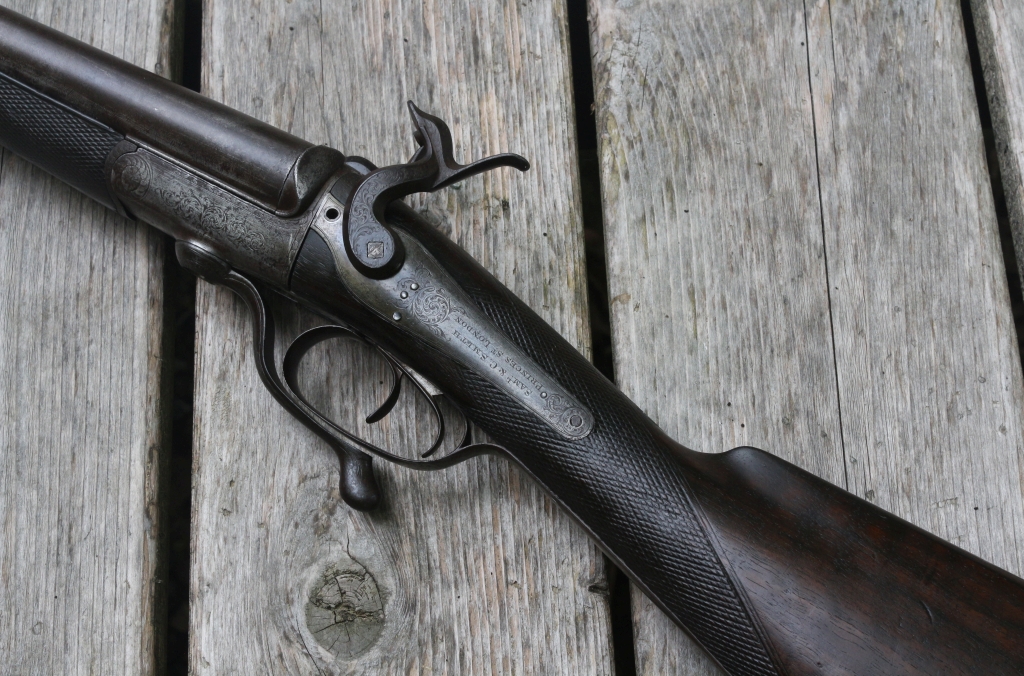
Inverted Lock Inscriptions on both back action Locks Plates - Rare & Unusual, Yes ! - But Why ?
Where this gun becomes highly unusual is with the back-action lock plates. Look closely: the name inscriptions, “SamL& C Smith Princes St. London,” are inverted. This inversion was undoubtedly not an engraver’s mistake (other Smith pin-fires have normal inscriptions) but a special request from the client. The question remains as to why?