Masu Brothers - London
Masu Brothers – London
Pin-fire - Made for the British market
What, exactly, makes a gun British? Does it need to be made in Britain? But what if the component parts are not all British? If, for instance, the barrel tubes are Belgian, the steel is Swedish, and the wood is sourced from around the Mediterranean? Is being finished in Britain enough? How about just retailing in Britain?

A Victorian gentleman ordering a new Purdey or William Moore for the Season probably already knew the barrels came out of a Belgian forge, and that the beautifully figured wood did not come from the forests of Old Blighty. If ordering a breech-loader, the gentleman would have been aware of its French origins. The odds are fair that he might have already seen some Continental breech-loaders in use, of French or Belgian make; after all, the breech-loader was in wide use there for several decades before appearing in Britain. Decorative motifs would be predominantly Greek and Roman-inspired. Depending on the year the gentleman ordered his gun, the fellow would have been aware that all the ammunition was imported, and not home-sourced. And despite all this understanding, there might still be a hesitation or wariness when it came to anything ‘foreign,’ and only a gun with a proper British address would do, decorated to British sensibilities.

Overall styling in British gun-making has been heavily influenced by Joseph Manton, in the shaping of stocks and the overall flowing lines. Even when breech-loaders first appeared on the scene in Britain, the general rule was to adhere as closely to the geometry of the British muzzle-loader as possible (and taken to an extreme in bar-in-wood guns). Awe-inducing sporting guns were being made on the Continent, with fantastical metal and wood sculpting. But these were, to the British sportsman, too garish and over-the-top for a day’s sport in the hedgerows (just as today we might balk taking a presentation-grade gun, festooned with gold inlay and stocked with highly-figured wood polished to a piano-gloss, into the field).

What constitutes a British gun is a subject worthy of debate. On most, if not all, mid-Victorian sporting guns, the barrel tubes would have likely begun in a Belgian forge, and the stock wood would have originated from somewhere on the Continent. A British gun would have a British address, but that would not necessarily be a guarantee of origin, or even of the workmanship. Here is an example of a Belgian gun made for the British market, retailed from a well-situated London shop. Providing Belgian-made guns to a British clientele is the niche that the Masu brothers aimed to fill. Gustave Masu (also known as Gustav Masu) is recorded as a gunmaker in Liège, Belgium, in 1845. In 1864, he established a business in London at 3a Wigmore Street, when the demand for pin-fire guns in the British market was increasing. The firm became Masu Brothers in 1865, and in 1869, it was renamed Gustavus Masu, relocating to 10 Wigmore Street. Evidence suggests Masu guns were built in Liège (by the other brother, whose name I’ve been unable to trace), and retailed in London by Gustave. Wigmore Street is in London’s fashionable West End Marylebone district, and a stone’s throw from Cavendish Square. Gustave Masu did well at providing fine guns to London’s elite until the closure of the business in 1892.

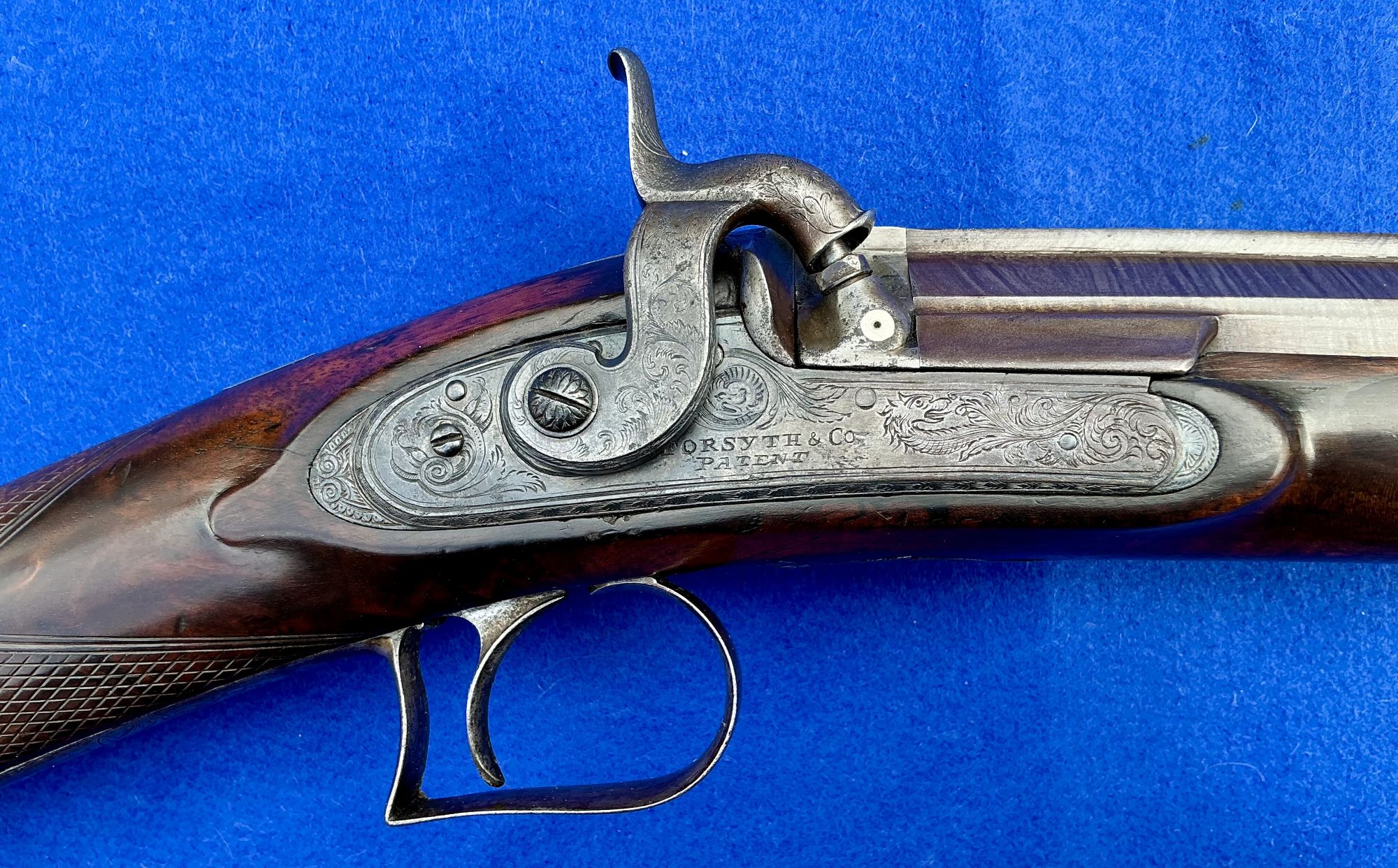
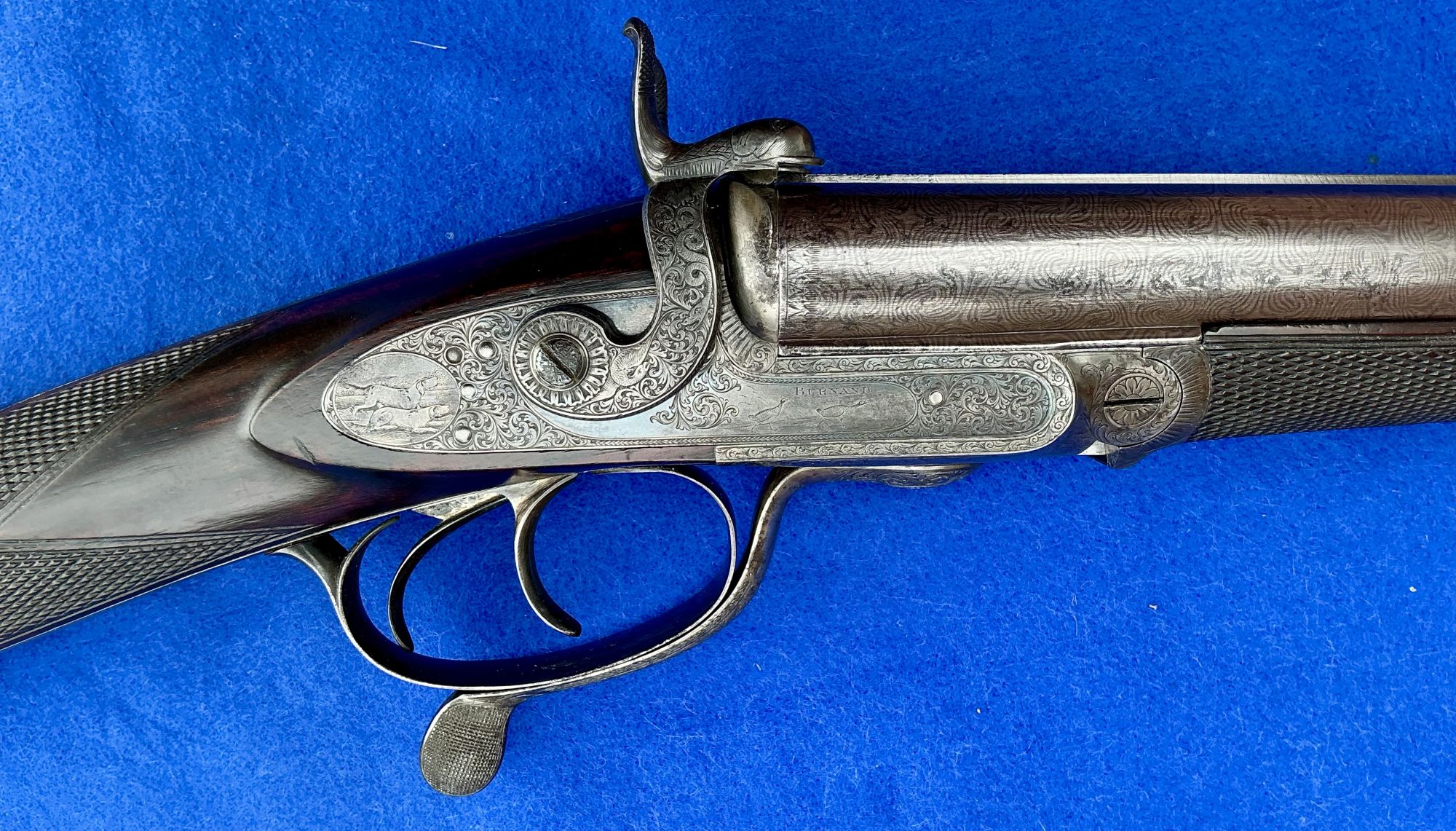
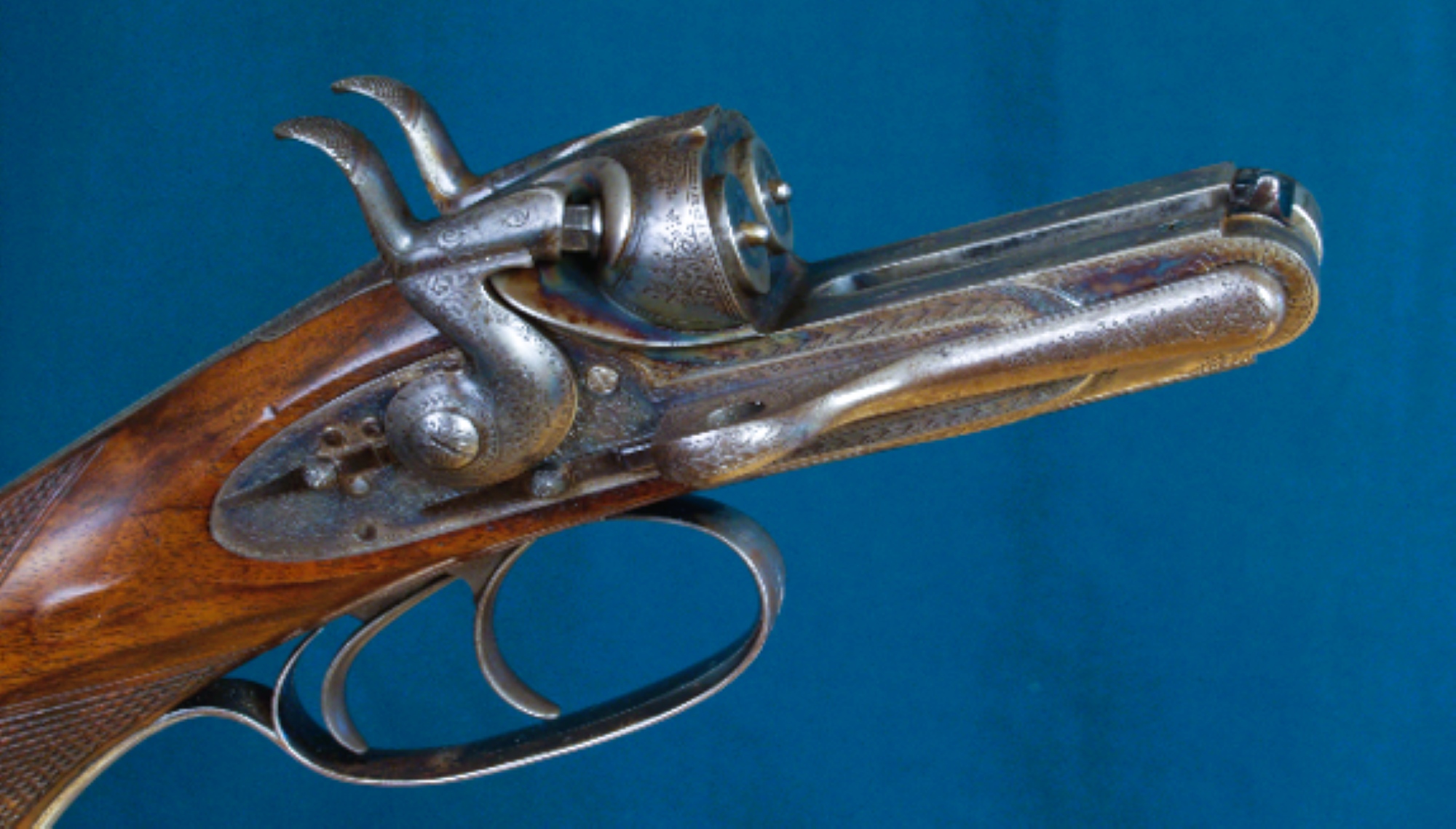
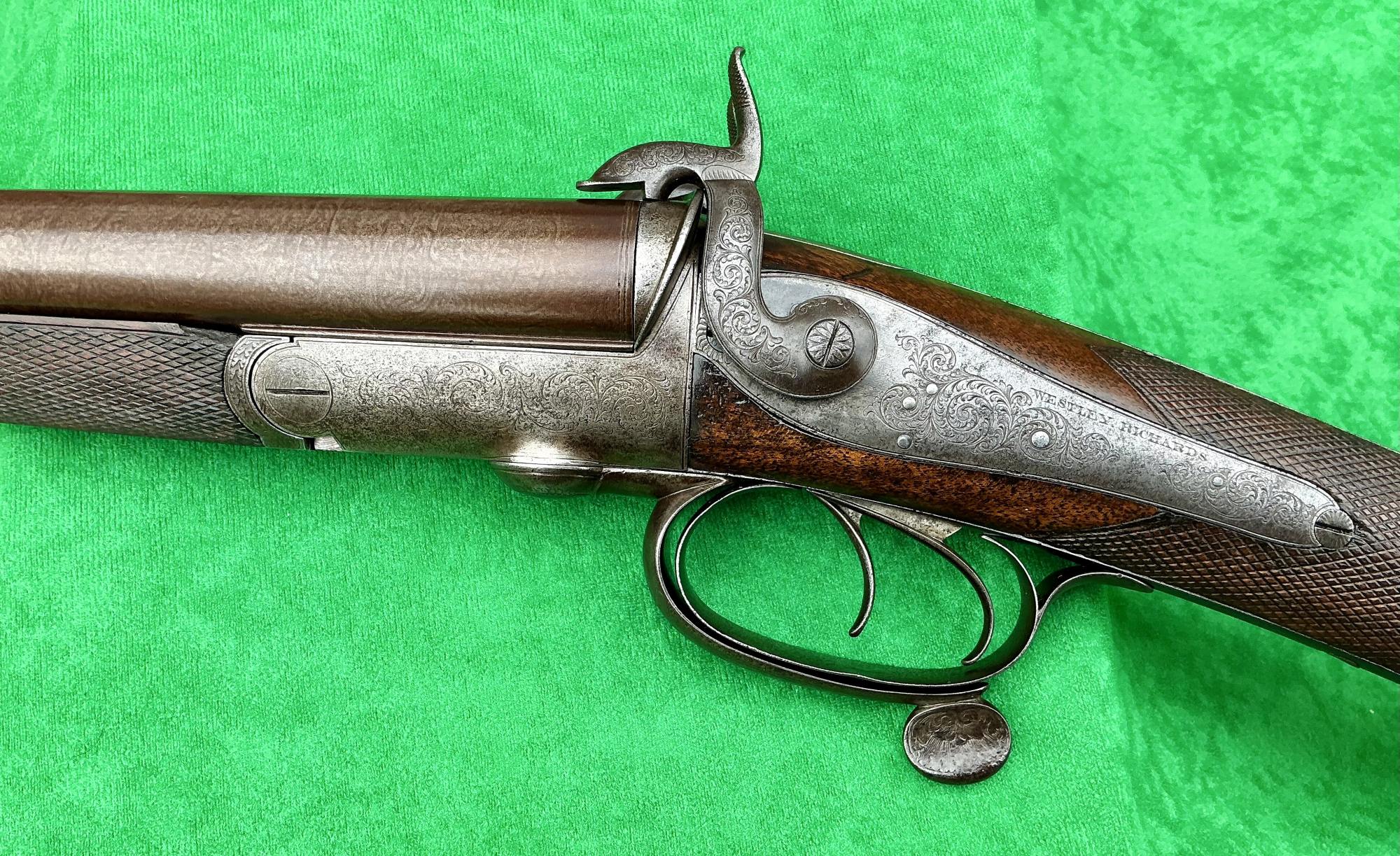
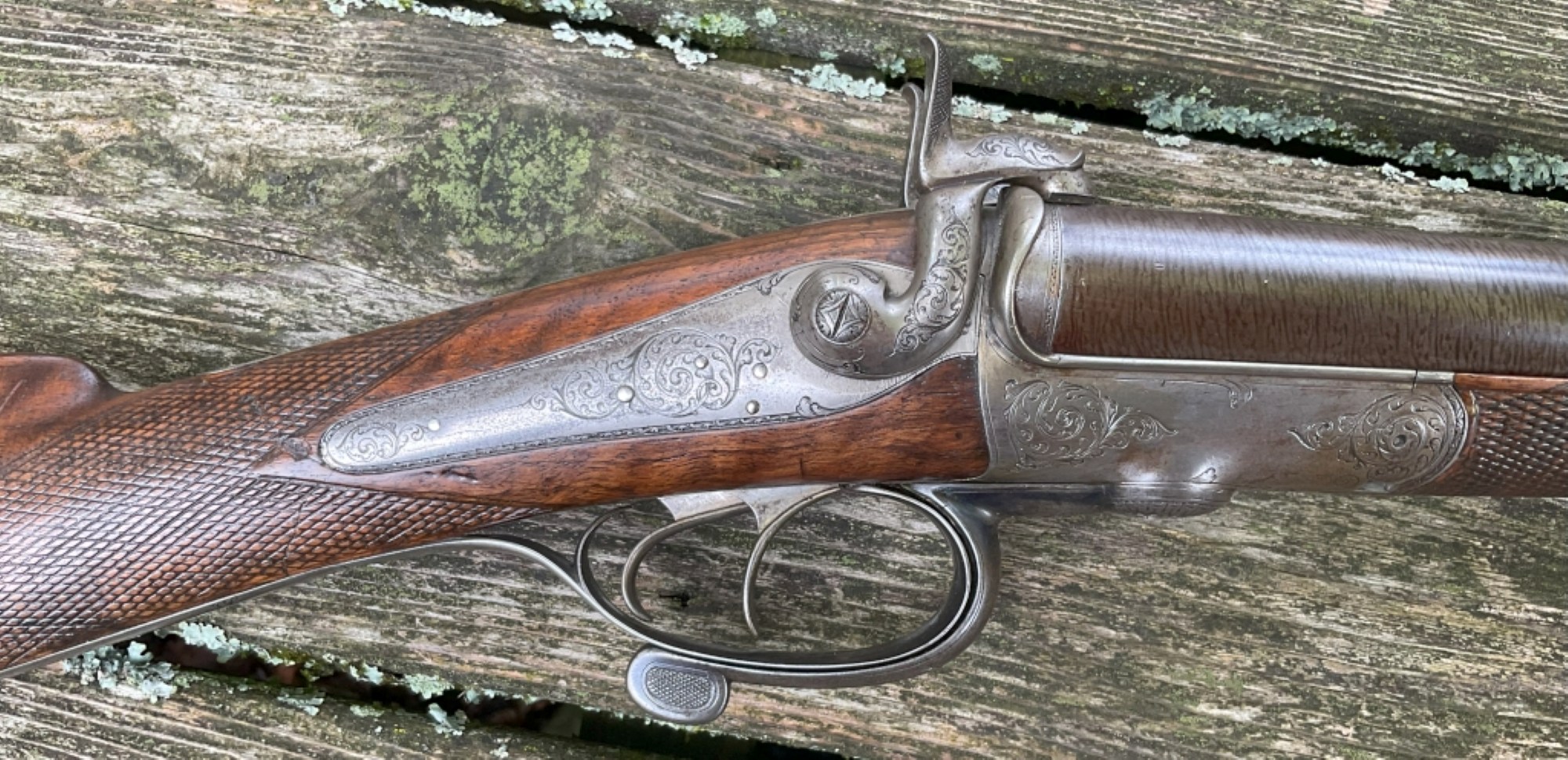
The gun, at first glance, appears to be a typical British pin-fire game gun, but upon closer examination, its Continental heritage is revealed. It is a 12-bore rotary-underlever double screw grip pin-fire sporting gun of usual form, with the top rib marked “Masu Brothers London.” London makers usually specified a street address, so this is the first clue. A close examination of the open floral engraving style reveals a distinct difference from the typical acanthus scrolls prevalent at the time. The engraving designs on the pins are also distinctive and typically Continental in style. The locks are unsigned. The back edge of the action lock is slightly curved, and the front of the lock-plate is notched into the action, another clue to its European construction. The 28” Damascus barrels display not the typical crolle swirls, but a fine pattern welding not commonly seen on British guns. Only apparent upon removing the barrels, the fore-end is articulated to the action bar and is not removable. Finally, the gun has Belgian proof marks and is lacking British proofs altogether.


This latter point helps date the gun, as in March 1866, Gustave Masu was convicted by the Marylebone Police Court of an offence under the Gun Barrel Proof Act of 1855, selling guns lacking British proofs, for which he was fined five pounds. I presume the gun was made no earlier than 1865, based on the address (it would have been retailed from 3a Wigmore Street), and assuming Gustave didn’t want a repeat offence, no later than 1866 (I have a later Masu gun with British proofs, showing that he did learn his lesson). The gun is well-made, with no signs of shortcuts or simplifications. For example, the action bar is shaped to fit the curves of the barrel, rather than being filed flat. Another detail worth noting is the careful shaping of the underlever, matched to the trigger guard bow. The barrels still have mostly mirror bores, and the gun weighs 6 lb 14 oz.