John Blanch 1863
John Blanch - Muzzle Loader
William Fletcher - 1863 patent 2554
This interesting John Blanch Breech Loader, was originally made as a Muzzle Loader between 1820 and 1848. The development of the Breech Loader was rapidly taking traction, with muzzle loaders becoming obsolete during the early 1860’s. This gun being of good quality, was seen by its owner, as far too good to stay in the Gunroom. The decision for the gun was a new life, with plans to make the gun ready for use alongside its contemporises as a breech loader. The only option at the time was for conversion to a Pinfire Breech loader, although nobody knew the gun would become obsolete again within only a few years of the extensive and expensive conversion work being completed.

Classic Muzzle loader lines transferred to an early and rare Breech loader conversion using Fletchers patent No. 2554 (1863)
The Importance of John Blanch as a British Gun-maker should not be understated, for those who have heard little about him, he was extremely influential in the development of the Breech-loader, and renowned for his understanding of sporting gun development, Blanch had the ability to change with the times. He was well connected, an excellent Gun-maker and respected within the gun trade.

Broad Muzzle loader Top strap, Wide Muzzle loader Top Rib, Blanch Top Rib signature pre 1848 - (1820 to 1845)
In 1853 the John Blanch firm were suppling Ordnance, sporting supplies and sporting guns, far and wide including all parts of the British Empire, in the same year the firm built a repeating rifle, that was supplied for an African expedition. And in 1858 the Blanch firm presented a revolver with a detachable shoulder stock to Dr Livingstone for personal use during his African expedition.

Stylish Single Bite Snap action Hook
As we are aware, Casimir Lefaucheaux famously exhibited his breech loading pin fire gun and cartridge at the Great Exhibition held at London in 1851. Joseph Lang, and to a lesser extent Joseph Reilly, are credited with popularising the breech-loader in Britian, however John Blanch was also doing his part in the development and popularisation of the Pin-fire concept. In 1855 John Blanch bought from Beatus Beringer of Paris and St Etienne a Pin-fire breech loader for the sum of £27. Blanch openly copied and improved on the design, however due to the lack of Pinfire ammunition, he imported Pinfire cartridges from Chaudun and Gevelot for use within the guns he had copied and built, as should be noted there were no English Pinfire cartridge makers at that time. Once the new concept gained full traction, the transitional period from muzzle loader to Pin-fire and the centre fire system was relatively short.

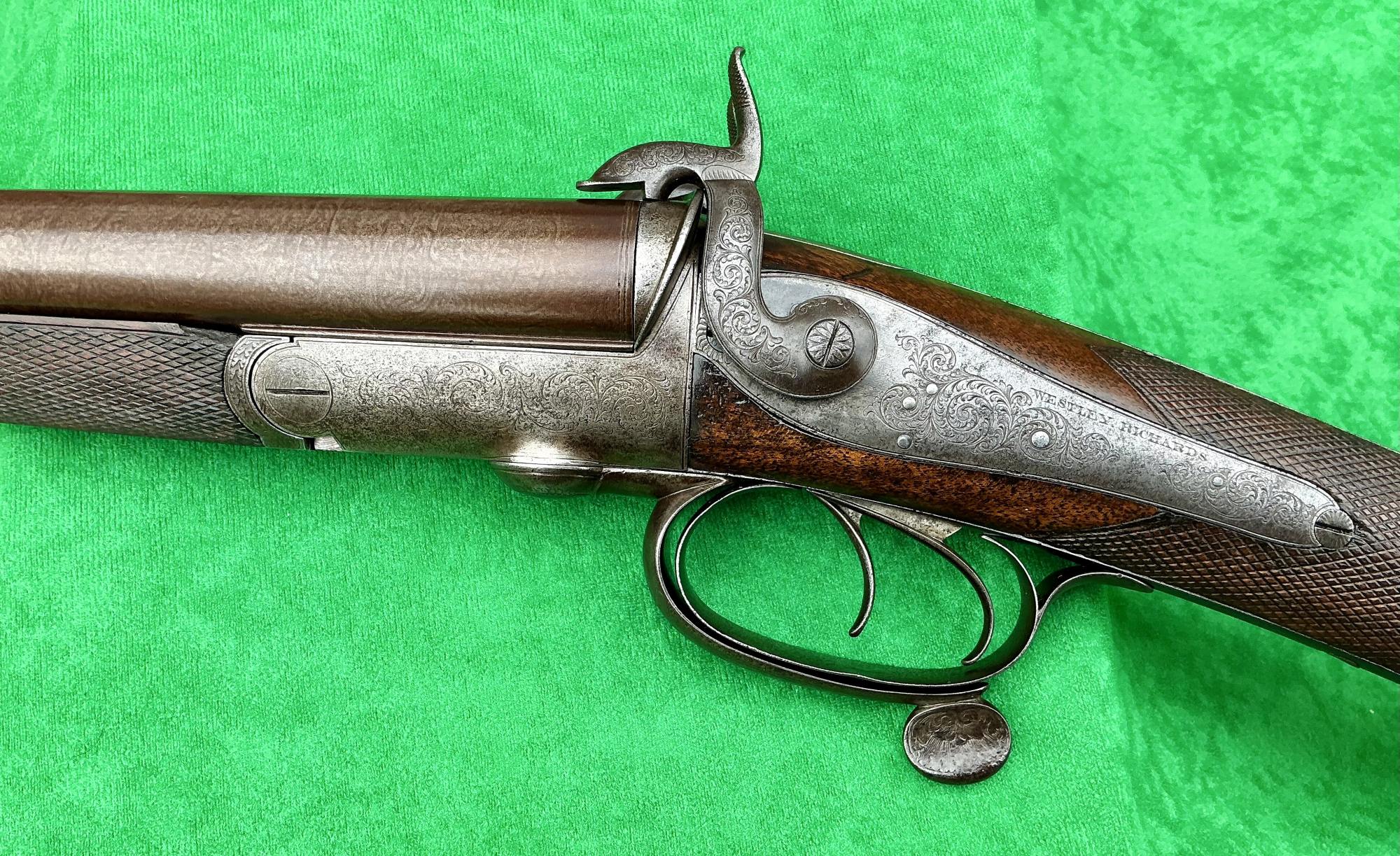
Elegant strong Muzzle loader lines used as the base geometry for the Pin-fire conversion.

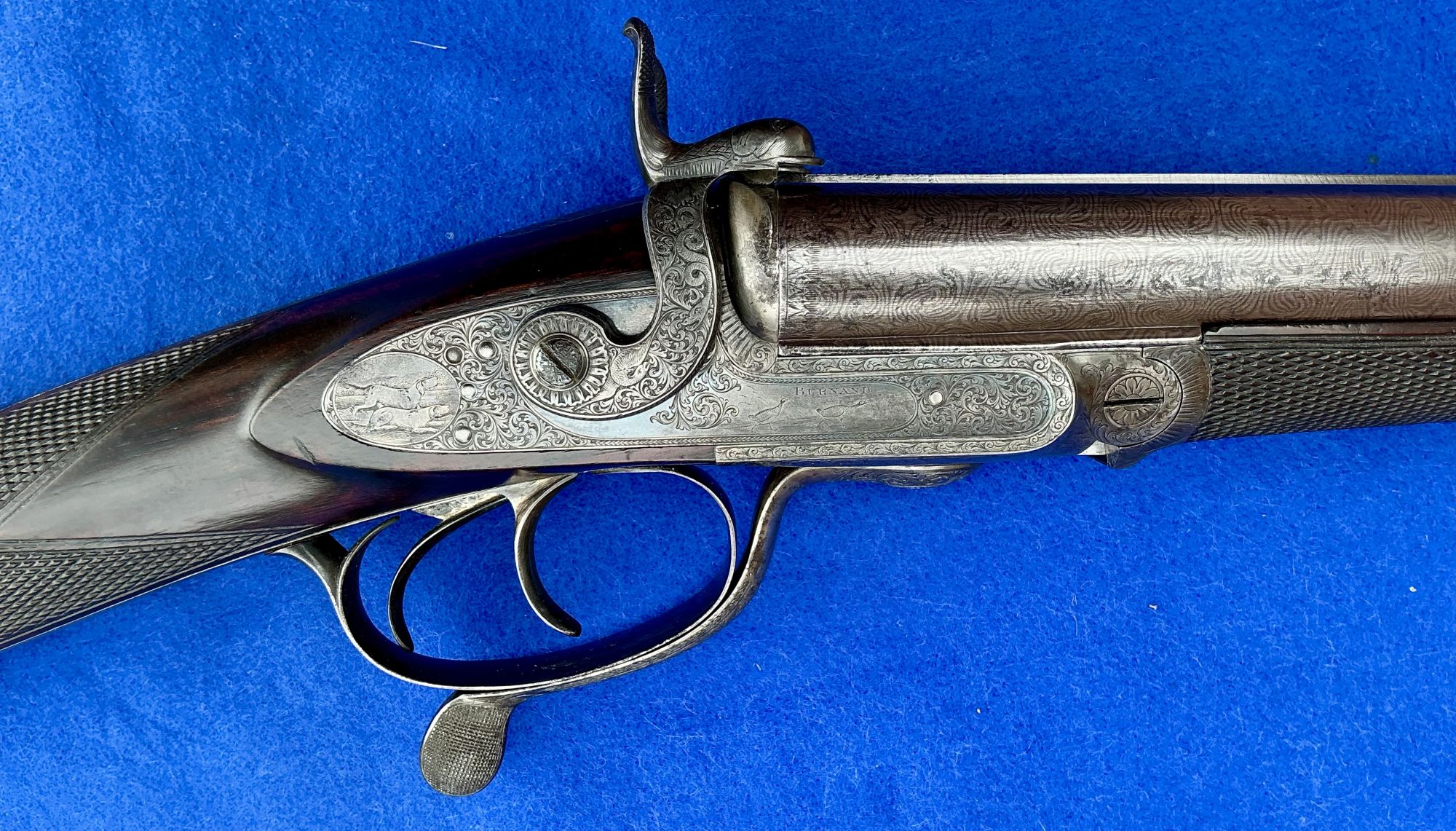
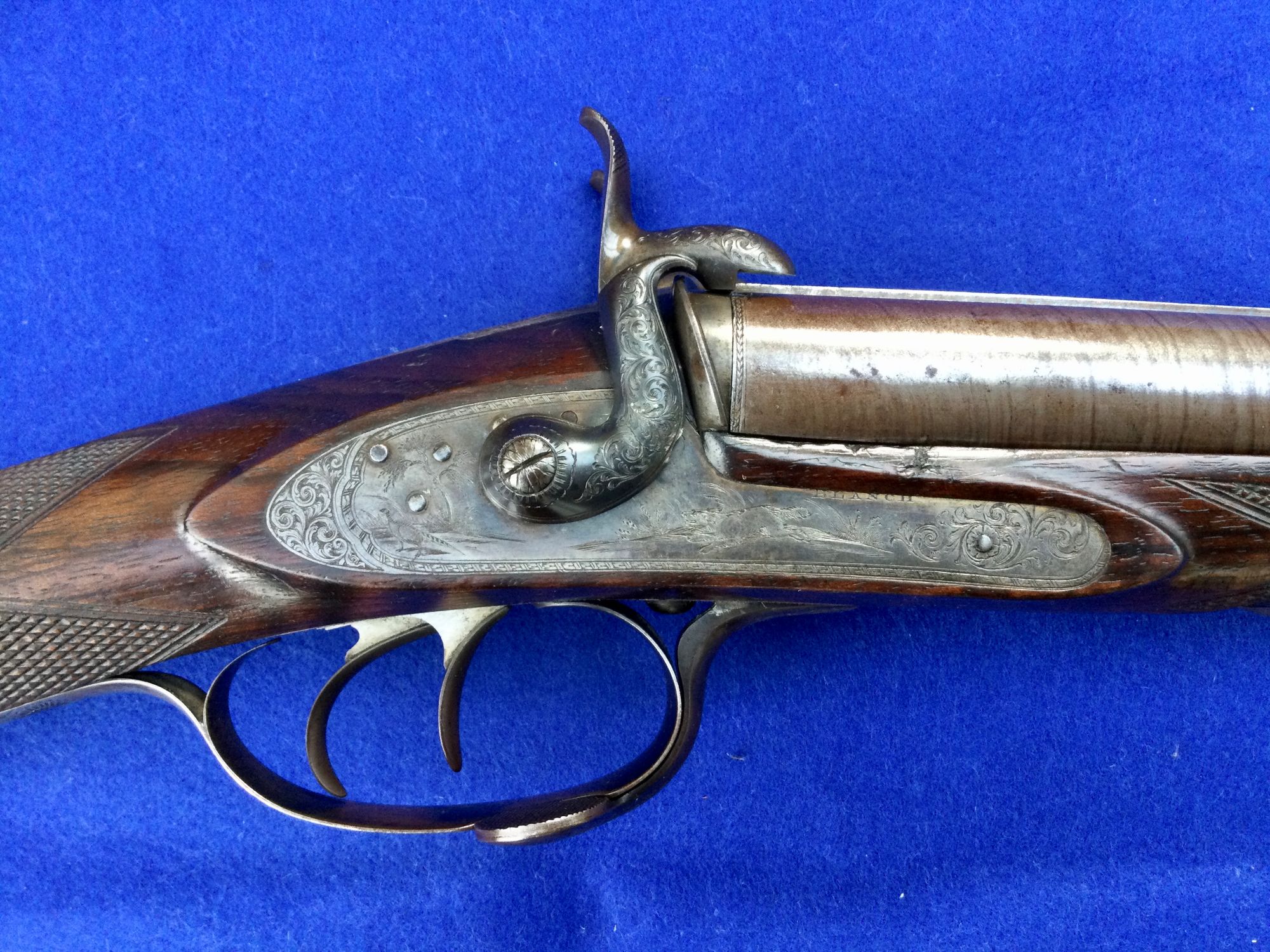
Muzzle loader triggers, within a modern design trigger guard, showing the sleek line of the opening lever.
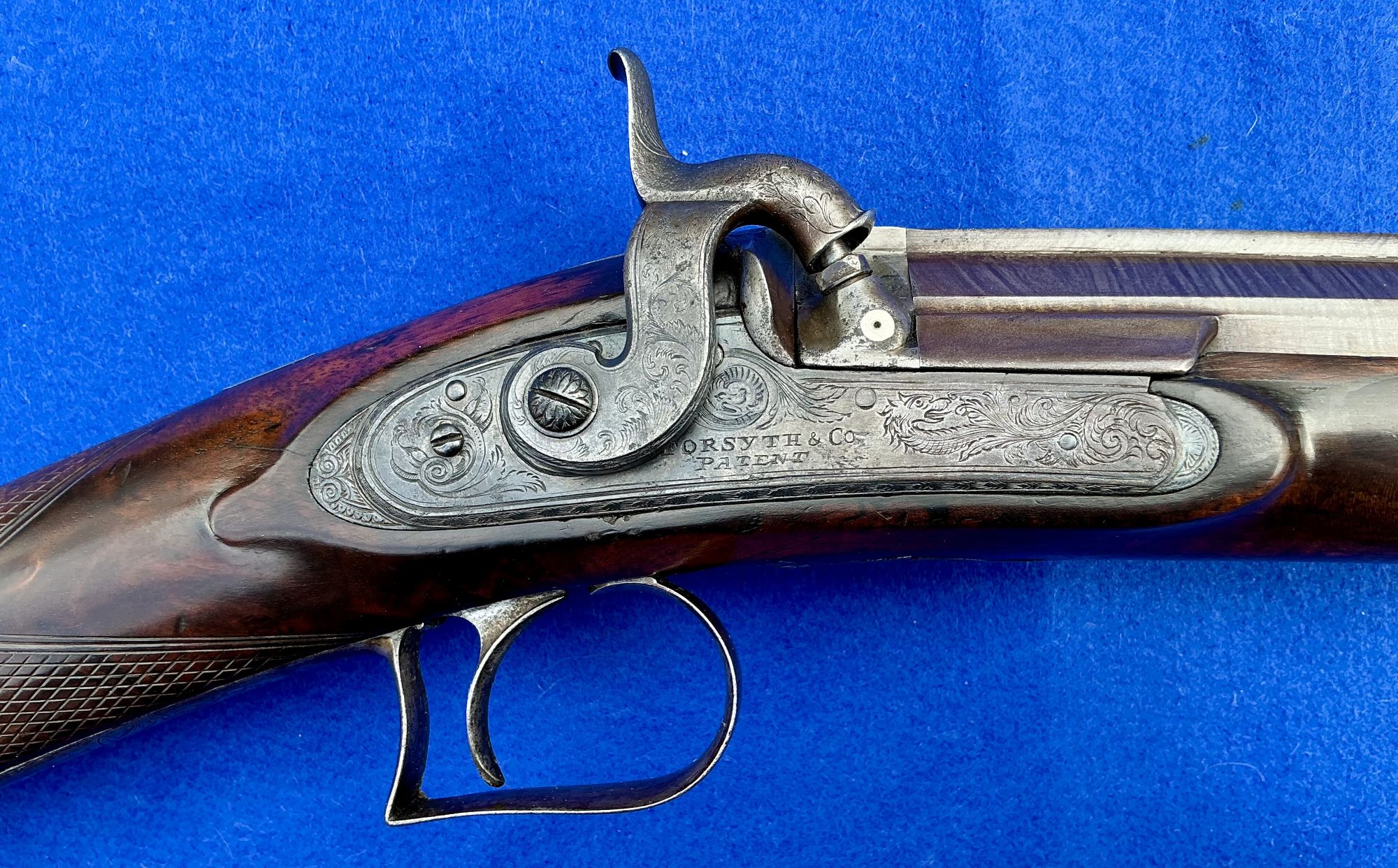
This particular gun has had the good fortune in being looked after by a number of careful custodian’s, allowing its safe passage through time, and to remain in excellent condition. The gun has no visible serial number, however, stamped on the Action flats is a patent, “Fletchers patent 2554” of 1863, with a patent use number of 34, this number would support an early date use of the patent, evidencing an approximation of when the conversion took place.

Patent use number 34 - Plus attached and articulated, hinged forend.
The barrel measurements of this Blanch gun, would signify the gun has had limited use, and has seen very few trips to the Gunmakers or Gunsmiths for general work. The Barrels of 29 1/8 inches, being Chambered for 14 bore, and the barrels proofed at 15 bore ( .677 ). remarkably the barrels remain well in proof on their conversion re-proofing. The Barrel wall thickness 9 inches from breech are at 70 thousandths of an inch in both barrels, with minimum barrel wall thickness of 25 thousandths in both approximately 4 inches from the muzzle.

Recessed Hammer screws, Thumb release trigger guard opening lever (attention to detail)

Thumb release opening lever - close fitting and shaped for minimal intrusion

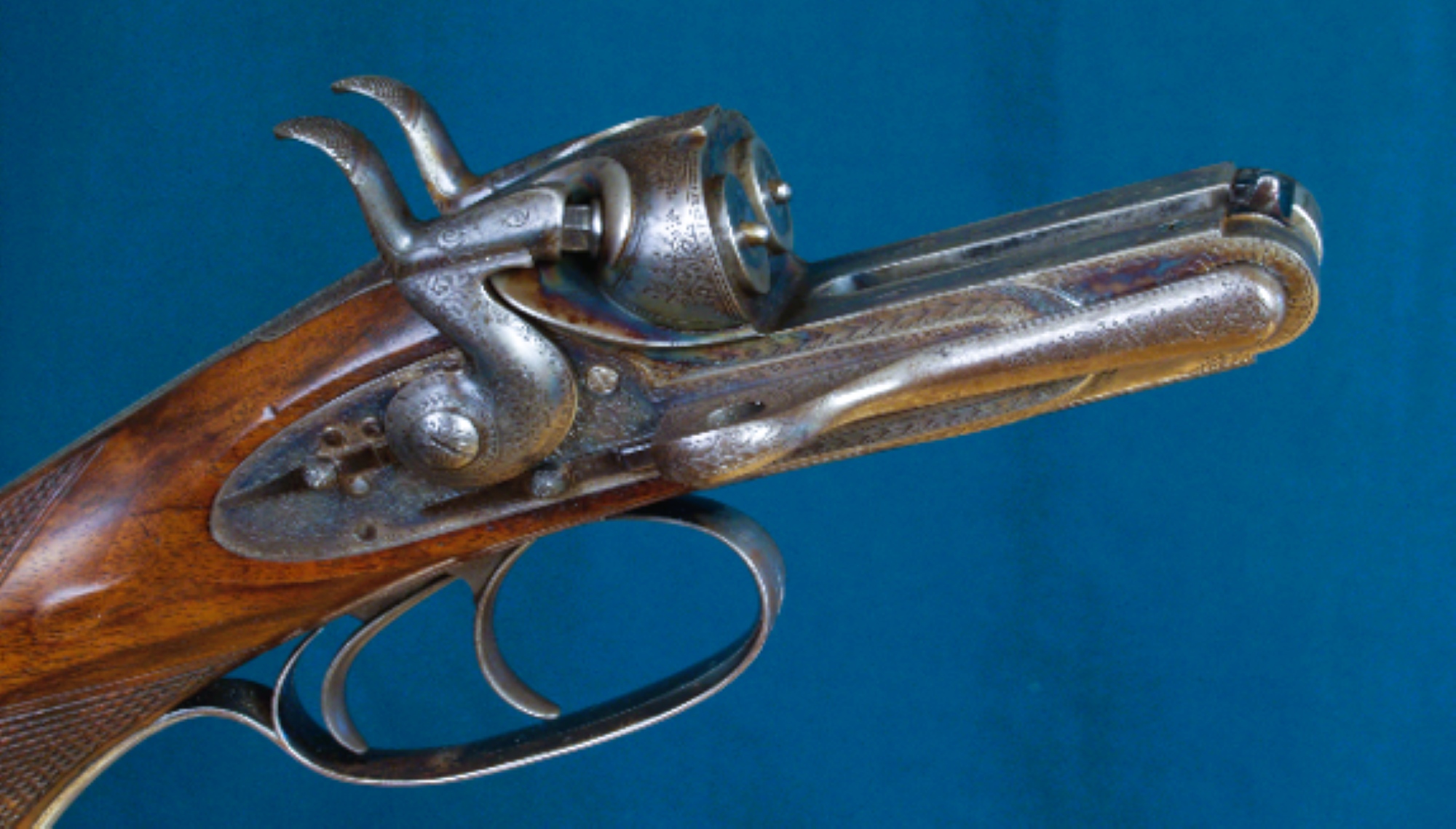
Forend Joint and Stock hinge point, Stock and Forend timber from original Muzzle loader wood-work.
With the original gun being made close to 200 years ago ( 1820 - 1840 ), and being converted circa. 1863, using a rare example of the Fletcher 2554 patent, and with the additional feature of an attached, and articulated hinged forend, its survival and existence is surprising. To top it off, the gun remains in proof and ready to shoot game today - just incredible !!!
William Fletcher of Westgate Street, Gloucester, used his patent no 2554 of 1863 to convert this gun. There is a strong possibility that William’s older brother, Thomas Fletcher used his brother’s patent to do conversions for his customers and maybe the general gun trade. This Blanch gun is likely to have been converted in the Thomas Fletcher workshops in Gloucester for a local customer. There is little or no reason why Blanch would have outsourced their own conversion work, or if so, to someone so distant.
There being no existent records, it is difficult to research this gun through normal channels, like serial number or makers records, so the information about the gun needs to come from the gun itself.

The Wide Muzzle loader Top rib

The underside of the barrels showing a narrow bottom rib
This Blanch gun tells us, the gun is undoubtedly a conversion from a muzzle loader. The features that support and indicate this being; the lock plates, which have been reworked, with attention towards the engraving at the front of the lock plate that ‘disappears’ off the front & upper edge of the bar. The barrels & locks are signed as ‘BLANCH, LONDON’ this is very much of the Muzzle Loading era, as is the wide top rib (typical of muzzle loader era). In 1843 John (I)’s third son, William (II), was made free of the Farriers Company. In 1848 he was made a partner in the firm which was re-named John Blanch & Son, so from that, we can presume this gun without being signed on the rib as such, would have been made prior to 1848.

Shoe Lump attachment facilitating the Hook, and Single Bite Snap locking
All the breech loading Blanch guns seen, have always been signed ‘J(ohn) Blanch (and if later ‘and Son’) and the barrels would have carried the Gracechurch Street address. The lump appears to be attached as a ‘shoe lump’, this being brazed onto the bottom of the barrels as an addition, not dovetailed into the barrels, as if making a quality gun from the start. The type of Damascus barrels used on this Blanch gun is of the muzzle loading era. The Damascus used on later guns, and in the breech loading era are more pattered. The massive thickness of the barrel walls is directly linked to the muzzle loader era. The stock and forend were obviously a single piece of wood originally. The chequering that surrounds the visible hinge underneath, and the way the chequering runs over the joint on the sides, all point towards one piece of timber prior to being re-worked.