J. H. Linington - Newport, Isle of Wight
J. H. Linington – Isle of Wight
Iron Monger or Gunmaker ?
The purchase of a plain vintage gun from a provincial maker, sparked some interest for the owner living local to the maker. Like so many smaller provincial makers, they are not well recorded. The entries in reference literature is often just an address and date of when the company was in business. This was just the case for J. H. Linington, Newport. Isle of Wight. This well-established Isle of Wight gunmaker, was well known in local shooting circles, however, the maker is unfortunately nothing more than an Iron mongers name today for anyone enquiring.

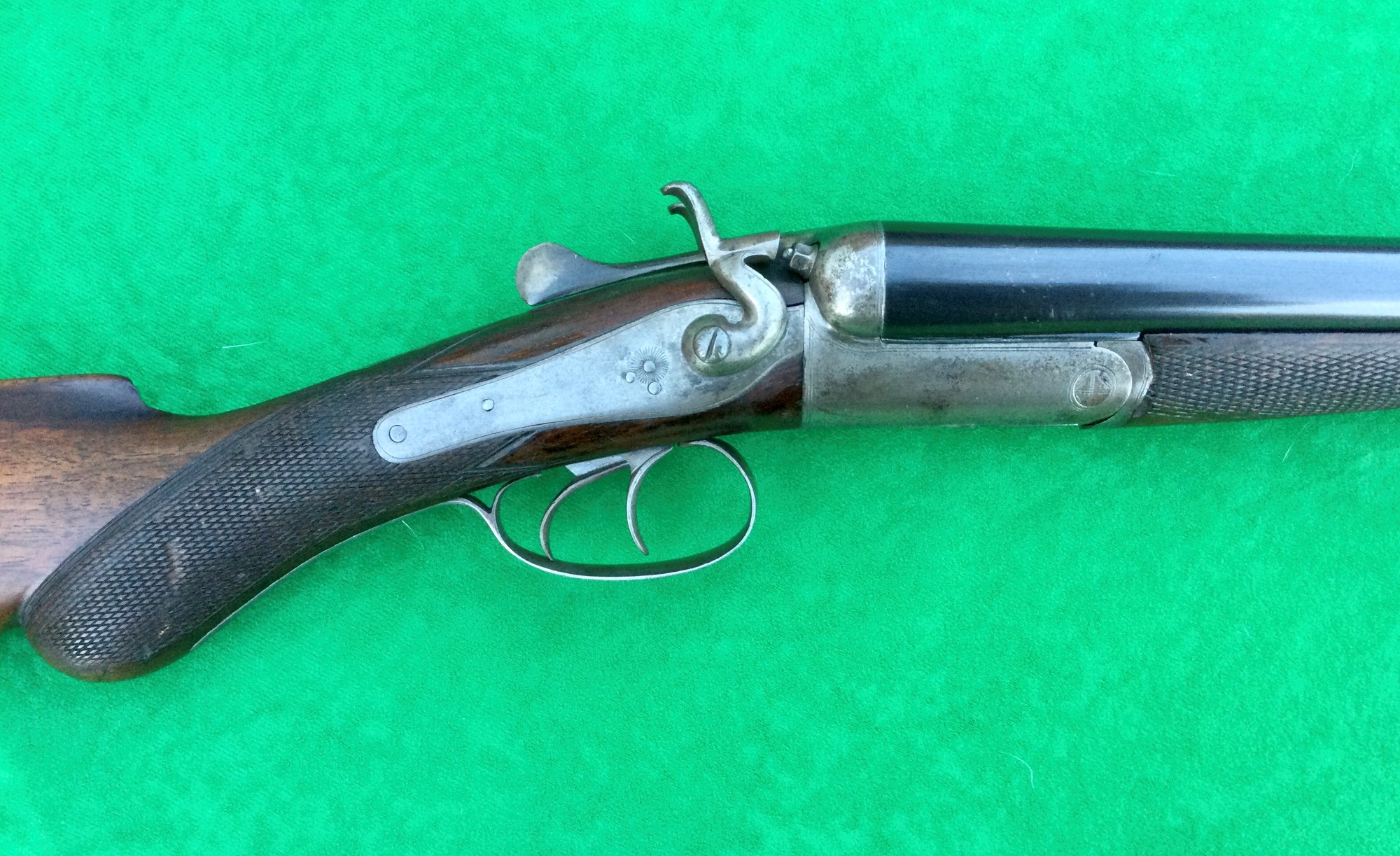
A plain J. H. Linington 1905 hammer gun - untouched, except for re-blacked barrels - 120 years old, and still in use.
The gun that inspired this article and local research was a plain medium quality Hammer Gun - J. H. Linington - Newport (Isle of Wight) - 12g side by side "Hammer Gun" made circa. 1905 – Barrels are 30 inch clean, pit free, with the benefit of "Nitro - Proof". Chambered for 2 1/2 inch cartridges, chokes – “Improved Cylinder” and “Half”. Using Purdey bolts, operated through a top-lever opening, via a Scott Spindle. Traditional trade design Action, with main body of rounded form, Double triggers, Back action locks, with Rebounding hammers, Top lever opening, operating a 'Purdey Bolt' patent no. 1104 of 1863, and the forend being, Snap-on forend design “Hackett's forend fastener patent” no. 964 of 1878. The gun remains in good shooting condition, with good proof, and good barrel wall thicknesses of 30 thou. in both barrels – This classic vintage workhorse is an interesting piece of Isle of Wight social history. At this point research, and information was needed to give this gun more than just a local name.

Information was surprisingly sparse, with nothing within the usual lines of research, and reference literature only stating that J. H. Linington, Newport Isle of Wight, was simply an Iron Monger. As a last resort, with telephone directory in hand, and several calls later, a conversation with a distant relation, offered directions to a local care home, and a possible break !
Notes taken during two interviews conducted during the spring of 1997 - The interview being with Miss Linington who worked for her Uncle, J. H. Linington during the 1920’s, Miss Linington was employed by her uncle, as an office clerk and book keeper. Miss Linington understood the day to day running of the J. H. Linington business at this time better than anyone.

Strong straight grained woodwork, with pistol grip and white metal oval.
Miss Linington was the last living relative / former employee of J. H. Linington. Miss Linington was in her mid-nineties at the time the interviews took place, like so many older people, her memories were vivid and detailed in the period of her youth. The joy in the fact someone was interested in the Linington family history, and a promise that her story would be relayed to enthusiasts, and researchers interested in vintage guns bearing the J. H. Linington name created some clear and concise thinking. On asking Miss Linington where best to start, and how far back in family history could be remembered. The first surprise emerged, as the date given was 1795. Miss Linington was proud of her family history, and explained, we all knew about our family history in those days !

The Linington family were a family of Blacksmiths, and lived in the county of Dorset circa 1750, due to the lack of work and poor prospects with in the area, the biggest part of the Linington family came to a decision, the decision was to relocate, and move as a family, hoping to gain regular work and a permanent positions that would allow the family to expand and prosper.
The family travelled through the new forest to a small village approximately two and a half miles south of Langley called Lepe. Linington the elder had been reading, and studying the Solent tides for just over twelve months. His priority focus being between the shores of Lepe, and what we now know as Gurnard on the Isle of Wight. The gap between the mainland village of Lepe and the Isle of Wight was two and a half miles. Surprisingly it was possible to cross on foot during low neap, and spring tides during the mid to late eighteenth century. The Linington family made their historic journey by foot, and horse and cart to the Isle of Wight with all their worldly goods during the spring of 1795.

Border engraved only, and minimal engraving throughout for this practical working tool.
The Linington family’s historic journey was not done on a wing and a prayer, but after several months of correspondence between Linington the elder and the retiring Blacksmith at Chale Green on the Isle of Wight - Linington the elder took up the Blacksmith position at Chale Green during the summer of 1795. The time Linington the elder took the position, his extended family were with him. The son called Benjamin Linington worked initially for his father, and then with his father in partnership. Benjamin then became the blacksmith at Chale Green.

Benjamin Linington is listed in the Kelly’s trade directory of 1851 as a Blacksmith at Chale Green, in 1859 the Kelly’s trade directory had an entry stating Benjamin and John Linington as Blacksmith’s at Chale Green, another entry appeared in the 1891 Kelly’s directory stating John Linington and sons, Blacksmiths and Carpenters at Chale Green - One of the sons was John Henry (J. H. Linington)
The first listing of James Linington as an Iron monger, Blacksmith, Gunsmith, Bell hanger and Gas fitter is recorded and listed in 1869 at 22 St. James Square, Newport. Isle of Wight. The Iron mongers shop at 22 St. James Square was originally owned by Robert Bull in 1830, and then recorded in the Kelly’s trade directory of 1852 as being owned by James Bull. The records show James Linington (Iron monger) also having a business as a Blacksmith in 1859 at 24 Union Street, Newport. We can see from this, the Iron monger business listed in 1869 was a later addition to the Linington’s business expansion. The reason for the expansion is believed to be due to Henry Linington coming into the business as something resembling a silent partner, except Henry also worked in the firm. This was an important part toward supporting the continued development of the firm, and more importantly Henry had a son called James Henry Linington.

James Linington died in 1875 with the running of business handed over to Henry Linington. In 1890 Henry’s son James Henry (J. H. Linington) came into the business - J. H. Linington had no special education attending “National School” which was better known today as West Street School in Newport - J. H. Linington left school aged fourteen with no qualifications, however it is reported he was a very clever man who was mainly self-taught, he also enjoyed reading, writing poetry and playing the piano.
The firm is listed at the new address of 107a St. James Square in 1895 and remained under the name of James Linington - Iron monger, Gunmaker and Smith. This changed again during 1899, as the name over the shop appeared as J. H. Linington by this time J. H. Linington had been with the firm nine years. The J. H. Linington name also appeared over the premises at 24 Union Street - J. H. Linington’s father Henry was still behind the scenes as manager and foreman at 24 Union Street, by this time J. H. Linington had overall control, and was overseeing and running the Linington businesses.

All Iron mongers of the period would sell all forms of hardware, this included: cutlery, swords and guns. Initially J. H. Linington started selling shotguns made by the Birmingham gun trade with the Linington name on them, however, these guns were built to Linington’s own specifications.
J. H. Linington’s father Henry was an excellent gunsmith and provided a full gunsmithing service dealing with maintenance and repairs - Henry’s gunsmithing and gun making abilities had no boundaries. Henry had stated, the making of a shotgun from scratch was just impractical, we operate on the same principles as other similar outlets, through buying parts, and making guns for local customers to their requirements.

Top lever, Low hammers, Hackett snap Forend, Birmingham 1904 to 1925 Proof marks.
Henry Linington taught the trade of gunsmith to Mr Spanner and Mr Elderfield, both men worked for the firm for fifty and sixty years respectively, over that time more and more Linington guns were purchased as parts (in the white) then hand finished on the Island. This included having the stocks and forends made in the Linington workshop, this was conducted by the competent team of gunsmith / makers. The firm were also buying in best Belgian Damascus barrels for finishing and fitting to their own specification action bodies. The Linington firm also made hand loaded cartridges from 1895 to 1938 after 1938 the firm sold mainly cartridges by Eley.

The Barrels top rib engraved with the makers name - J. H. Linington - Newport - I. W. ( Isle of Wight )
Both J. H. Linington and his father Henry used the Linington guns they had made, they were both good shots. J. H. Linington died in 1928 and his father Henry died fourteen years previously in 1914 - the license to sell shotguns was given up between 1956 and 1957, and the firm J. H. Linington moved from 107a St, James Square to 24 Union Street Newport, and became a limited company in the same year.
The Company continued to trading under the J. H. Linington name until 1977
Where is this J. H. Linington hammer-gun featured in this article today ? Fortunately in good hands ! The gun being found in Exeter, Devon some 20 years ago, gave an opportunity for the gun to return home to the Isle of Wight. The gun was purchased by a well-established Game and Clay shooting family, headed by Mr. Gerry Short, the gun was then gifted to son Michael Short, this has allowed the gun to be used all over the British Isles, in the field on virtually every UK game species.
This Linington Shotgun after a 120 years, continues to give good service and regularly puts a smile on its owners face.