William Rochester Pape
William Rochester Pape
Breech Loading Conversion
Early British Sporting shotguns had an outstanding level of craftsmanship and quality, with guns’ having superb reliability. These guns also being made to measure, they shot very well for their owners. This created a reluctance for many game shooters in leave old faithful behind in the gun room.

William Rochester Pape, Serial No. 311 for 1859 - 1860
The development of the British Sporting game gun from 1850 to 1870 was truly remarkable, with many new design ideas and ignition systems being produced, all being hailed as the very best. As Victorian Gun making evolved, the attention to detail became a part of the gunmakers art, the Game gun of the day continued with its development, and was frequently updated.

Top-Lever opening Breech-loader Conversion from Muzzle-loader
With the muzzle loader being the shooting way of life for a couple hundred years. The transition from muzzle loader to centre fire, once accepted, and on reflection was relatively short. There were a number of makers offering conversions from muzzle loader to Pinfire, and through to Breech loading centre fire. A number of these conversions are obvious, and on occasions crude, however there were also a number of quality guns being converted by gunmakers with an eye for detail, making less impact on the original gun, and are less than obvious that the guns’ had been converted, and then there are a few that don’t give up their past of having a previous life, taking even more time to work out.

A Wedge Bolt locking, Barrel Hook have been attached as a Shoe Lump - A Forend Loop has been attached
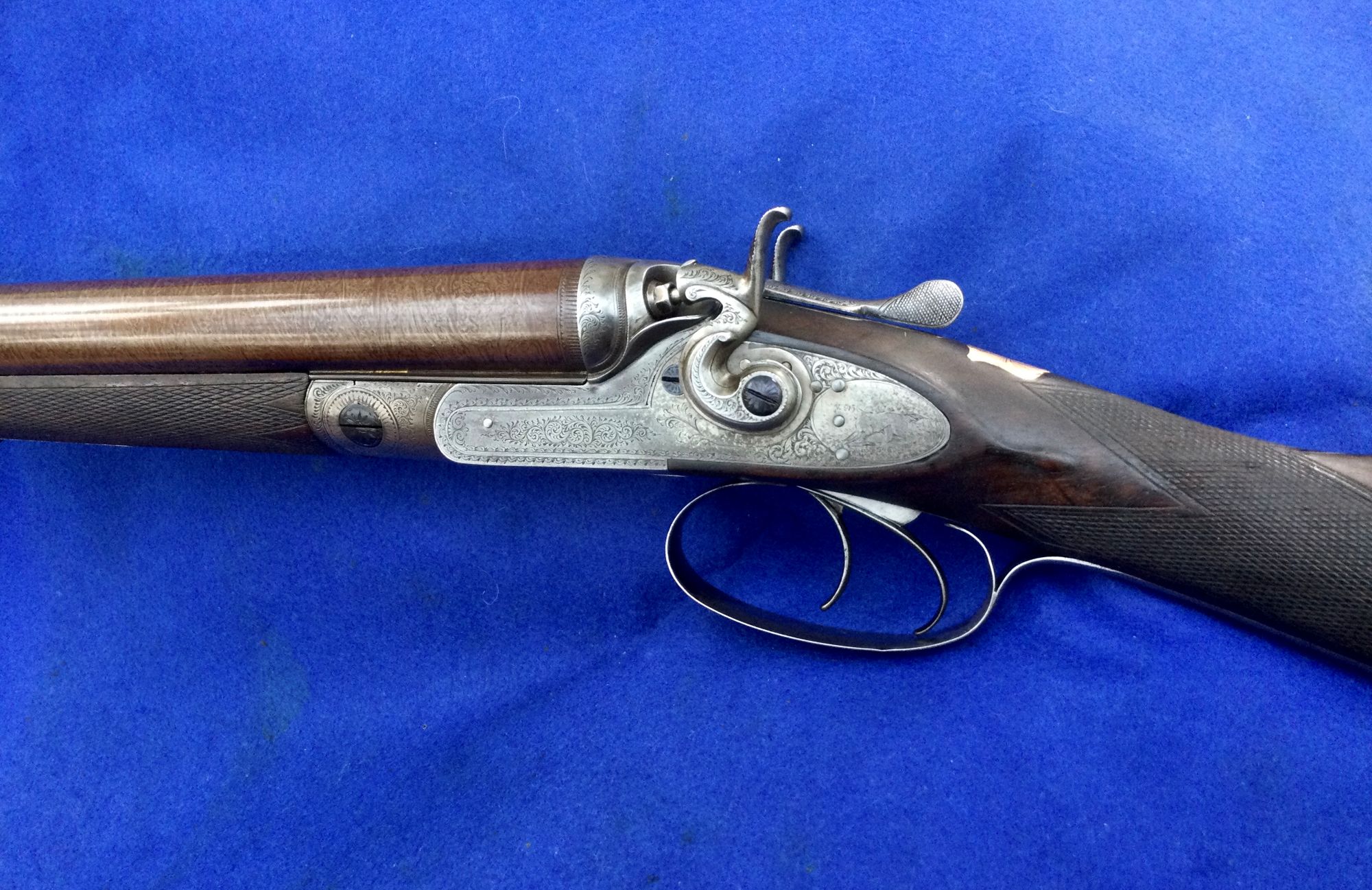
The W. R. Pape gun featured in this article, is an example of a conversion from muzzle loader to Centre fire. The conversion is relatively obvious on close inspection, as there are several pointers to the gun being a conversion, although not so obvious with a fleeting glance.
One of the key points that support the identification of this gun being subjected to a Transitional Conversion, is the gun has design patents that would not have be available when the gun was initially made. This is made more interesting, with the need for deeper research, as the applications do not carry the expected patent stamps or marks, these could have could give us the maker who conducted the conversion ! The serial number on the gun dates the gun through the “Bagnall and Kirkwood” held records to 1859 / 60. This is interesting, as at this point in time W.R. Pape had only been in business for two years, and the gun is highly likely to have been built as a Muzzle loader.

Iron Twist Damascus barrels, Birmingham Proof marks for 1855 to 1868, and New forend loop
The gun has Birmingham Proof Marks for 1855 to 1868 matching the period of when the gun was made. The gun being made and proofed as a 14 bore, nicely the gun remains a 14 bore today. This allows the gun to be kept without a shotgun certificate, as the gun can be kept under Section 58 of the firearms act, and meets the “Obsolete Calibre” criteria in the UK.

Forend opening catch, Number 5938 of 1877 made by Charles Bland Homer
The barrels are laminated steel with an interesting inscription, that reads - “W. R. Pape - Newcastle on Tyne - Laminated Steel - Not effected by Gunpowder - 1859” - The barrel flats, hook and extending wedge bolt are not original, and have been brazed in place using the shoe lump method, there is an addition of a replacement forend loop on the bottom rib, the loop accepts a registered design - number 5938 of 1877, this was granted to Charles Bland Homer of Lench Street, Birmingham. Homer, is recorded as a “ Gun Finisher” - The C. B. Homer name can be seen on the underside of the forend catch. The standard of work is well done, however not to the quality of finish expected if the gun had been converted by W. R. Pape himself.

Engraved steel butt plate - the steel butt plate being a design carried over from the Muzzle-loader era.
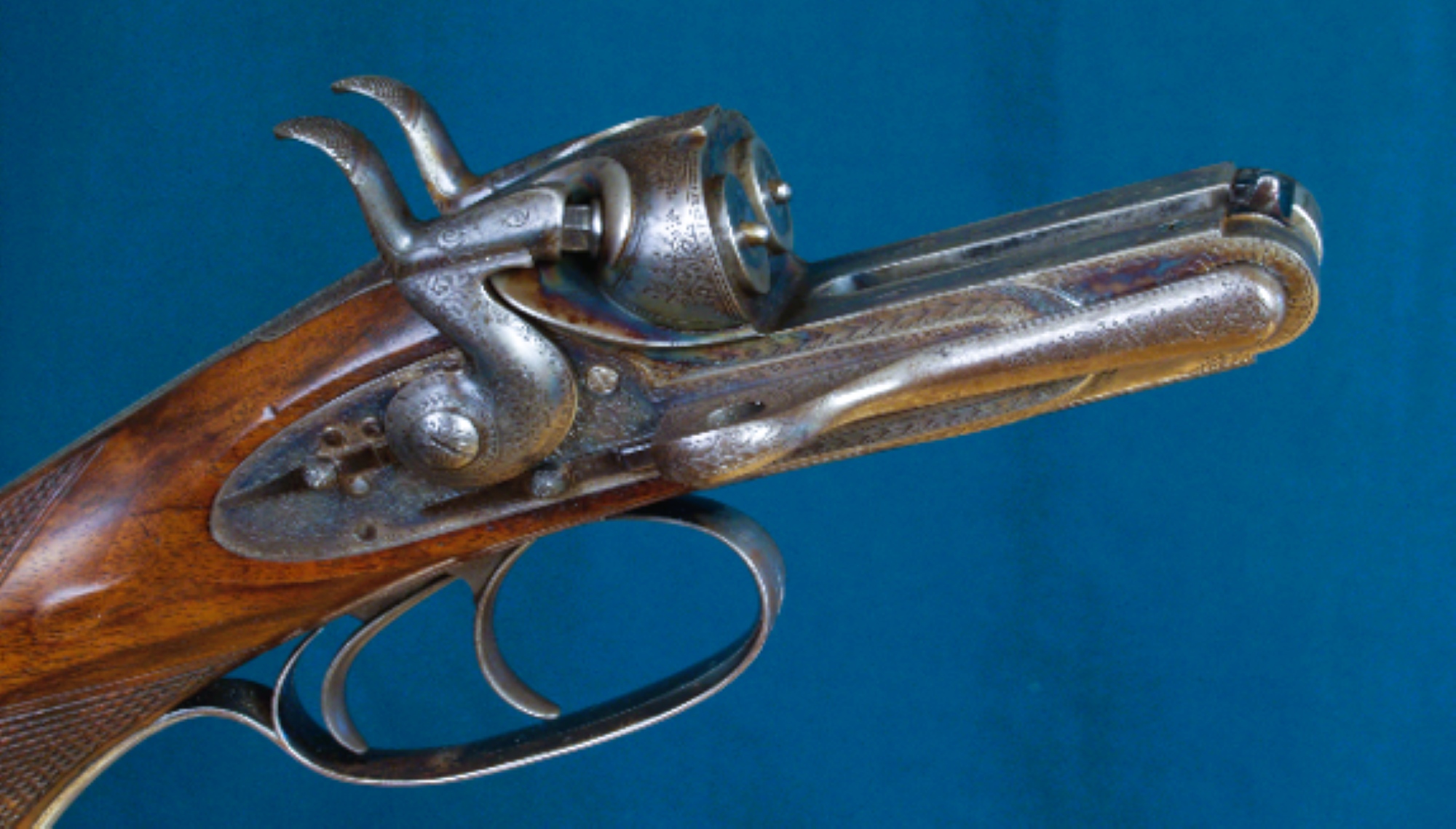
The action and barrels are locked through a single bite snap action. The lock up is through what appears to be a “Tipping & Lawden” Wedge bolt, Vertical Grip Variant. The gun carries no patent numbers linked to the locking system, however the images show clearly the relationship between the barrels and action body. The barrels have an extending wedge, this wedge engages through the breech face on to an angled vertical bolt that catches and secures the top of the barrel wedge via a cam operated by a small V spring. This Vertical Grip variant is likely to date around the early 1870’s

“Tipping & Lawden” Wedge bolt, Vertical Grip Variant - Circa. 1870's
The trigger plate has been cut and modified, the images show two small pins, and a braised join where the plain part of the trigger plate and the engraved section meet. The trigger plate when in place allows us to see the engraving line immediately in front of the trigger guard, and that it does not match. The forend iron work on to the knuckle is a good fit, however on close inspection, the side engraving of the forend ironwork is not of the same quality as the action body, being slightly deeper, less worn, and engraved with a looser hand.

Trigger plate extended with brazed joint to fit the new action body
The conversion work on close inspection, looks to be done by one or more operators - The new or replacement applications include - New barrel flats, hook, wedge bolt and forend loop, and chambering. We also have - New forend iron, forend wood, forend catch. The final part being the action body - wedge bolt locking system, top lever, and new hammers. The applications and component parts used to conduct the conversion would not have been invented when this W. R. Pape Sporting gun was built, confirming the Transitional Conversion from Muzzle loader to Breech Loader in the late 1870’s

The gun retains its good lines for a gun starting life in 1859/60