The Breech Loading Armoury Company (Limited) of London
The Breech Loading Armoury Company (Limited) of London
Dual-Fire Ignition System - Stephen and Joseph Law action
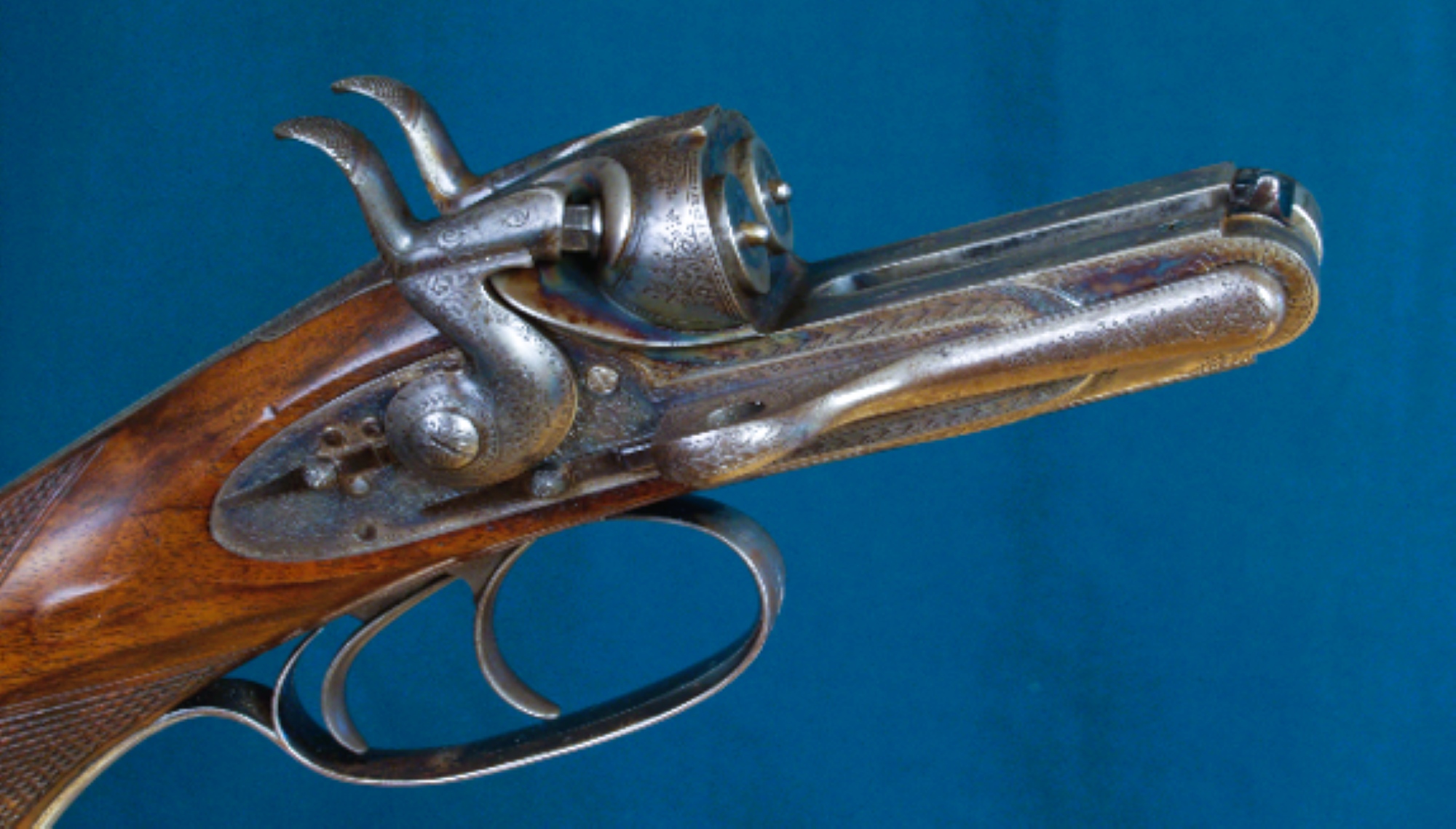
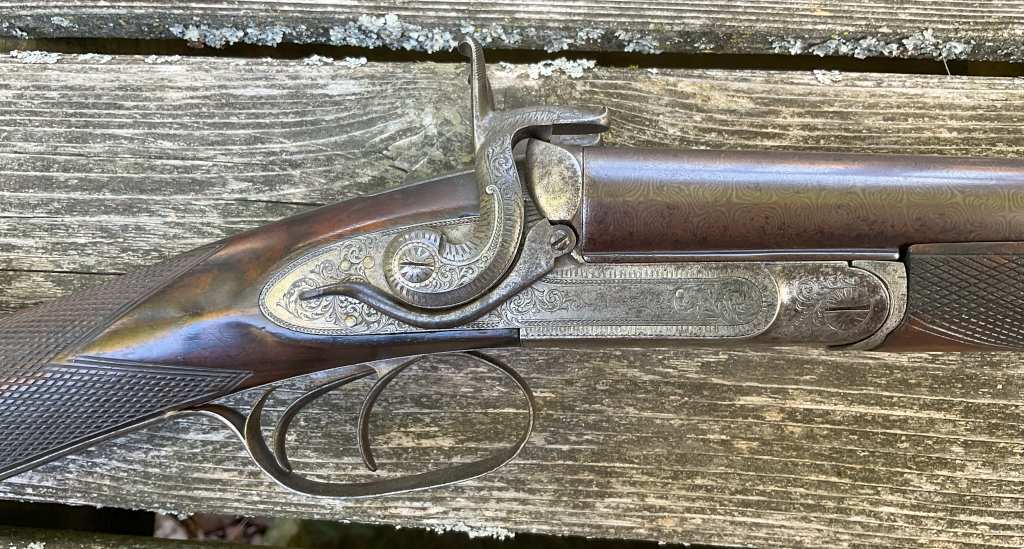
For a short period of time in the mid-1860s, sportsmen were uncertain which of the new cartridge systems would predominate, and the readysupply of pin-fire and central-fire cartridges could not be guaranteed. This supply problem led to some makers building game guns that could fire either cartridge. These ‘dual-fire’ guns did not last long on the market, as sources of both types of cartridges improved. Here is one such gun, a 12-bore with a side lever, single-bite snap action using Stephen and Joseph Law’s provisional patent, and sold by The Breech Loading Armoury Company (Limited) of London. It was made sometime in 1865 or 1866, during the short period of time this firm existed.

The hammer strikes the striker directly under the hammer, moving it downwards, an angled tip transfers the moving energy forward to the second striker, which in turn moves forward hitting the cap of the central-fire cartridge.
In April of 1865, the Birmingham gunmakers Bertram Calisher and William Terry sold the patents to their capping breech-loader carbine of 1856, along with the Birmingham and London premises where the carbines were built, to the Breech Loading Armoury Company. The new company intended to market these and other guns, taking advantage of the growing interest in breech-loading arms, and offered shares to attract investors. Statements within the prospectus circulated by the company were ultimately found to have been incorrect and fraudulent, and the court ordered the winding down of the company in July 1866.
On the gun, the top rib is marked “The Breech Loading Armoury Company Limited 4 Pall Mall London.” The 29 5/8” damascus barrels have London proof marks, and the barrels are fitted with a patent extractor. The bar locks are unsigned. The unusual single-bite snap-action, worked by a side lever, uses part of Stephen and Joseph Law’s provisional patent number 2063 of 1865. The original patent belonging to these Wolverhampton gunmakers was for an ingenious design that would release the barrel locking bolt by pulling to half-cock one of the hammers. The patent included a pivoting locking bolt whose rounded end engaged a hook-like barrel lump, with a vertical V-spring applying tension against the bolt. The locking system used on this gun is from this patent (though it does not have the hammer-bolt release mechanism), and the action flats are stamped with the inscription “Law Bros Patent.” The slender side lever, when pressed downwards, rotates and disengages the locking bolt. This is slightly different from the patent specification, but it may be that the Law brothers’ hammer-bolt release design was too complex to build or too fragile for heavy use, and was never really implemented. In practice, the action works well, although the downward throw required to release the barrels is quite long.

Coupled with the fragile build of the lever, one can only speculate as to how many of these levers might have been bent or broken off in use.
The two-piece central-fire strikers appear to be based on Thomas George Sylven’s 1866 patent, though they are unmarked. Two holes are drilled into the breech face for each barrel, one vertical and one horizontal, meeting inside the breech face. One striker fits in the vertical hole, while the other striker slides in the horizontal hole. The upper striker is retained by a locking screw at the rear of the action, while the horizontal striker is kept in place by a plug fitted flush against the breech face. Upon being struck by the hammer, the first striker moves downwards and its angled tip transfers its energy to the second striker, which moves forward and explodes the cap of the central-fire cartridge. Should a pin-fire cartridge be inserted instead, the hammer nose would strike the pin and explode the charge before the hammer would reach the central-fire striker.

Unlike the pin-fire cartridge, which required no separate extraction mechanism, central-fire cartridges did, and this gun included a simple extractor to perform that function. The built-in nature of the extractor confirms the gun was built as a dual-fire, and not converted at a later date.

The gun is decorated with foliate scroll engraving, and the partially flat-sided hammers have stylised dolphinfish-headed noses with raised flanges. There is a prominent radius cut at the root (the junction of the action bar and the breech face). This radius indicates the action incorporated one of the cutting-edge advances in gunmaking of the day, aimed to reduce the stresses on the action upon firing and prevent cracking.

The gun weighs 6 lb 12 oz.