William Pritchard

By David Neale 6 min read 720 views
William Pritchard

William Pritchard

Overlooked Single Barrel 

Early Single Barrel breech loaders are becoming scarce, however, they are regular overlooked as not being of interest, practical, or of any value. This is very much the same in today’s market. After a brief glance at this smart old single barrel, I decided to have a closer look. This gun unexpectedly gave up several points of interest.

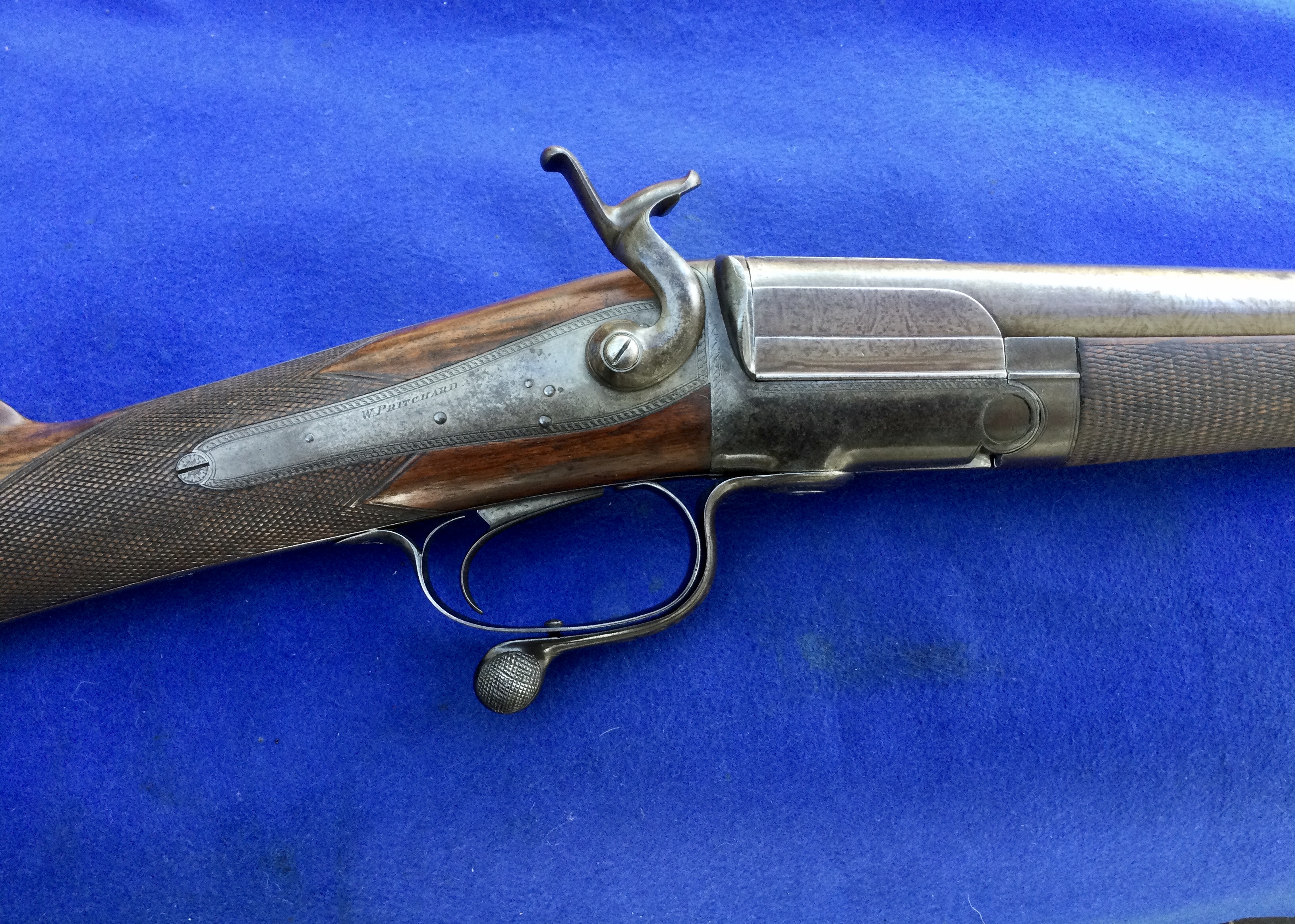
William Pritchard - Single barrel, with a single bite under-lever, complete with rising stud.

 This William Pritchard gun has created a little head scratching from serious researcher’s, as “In 1853 the firm was re-named William Pritchard & Son and they moved to 97 New Street.... In 1859 the firm moved to 108 1/2 New Street, but they were not recorded in the street directories at this address after 1860.” and records show Joseph Needham is recorded at the 108 1/2 New Street address in 1861.

We can confirm from the address markings on the barrel, the gun would have been made 1859 or 1860, but at that point, the address should read “& Son”. The single-bite underlever and rising peg ties in well as being from around 1858 to 1860. However, no matter how much information there is on any maker, collectors, historians and researchers seem to find guns that don’t quite match existing information!

Barrel signed - W. Pritchard, 108 New St. Birmingham.

The gun being made circa. 1860 makes the gun an early and rare example of a Breech Loading Shotgun using the Pin-fire system. The gun was made using an early form of Under-lever locking system ( single bite ). The gun also has a rising peg which operates as the under-lever is used to open the gun, the peg rises to support the opening through lifting the barrels off the action flats. The single bite with the assisted-opening stud is very much the type of action that was around in 1858-1860. This action type likely to have been copied from Joseph Lang / Edwin Hodges, who did not patent either the locking system or the rising stud – possibly due to both being copied from the Parisian inventor / gunmaker Beatus Beringer.

The rising stud - supports the opening of the gun, through lifting the barrels from the action flats.

Old fashioned repair to the hook, this brings the barrels back on the action face.

This particular William Pritchard gun gives an indication to an interesting date line, that being, the Birmingham gun trade were making Lang copies quite early. While this is a Hodges copy, it is unlikely to be one made by him. Hodges would have made deep cuts in the action bar (Side by Side / Doubles), to lighten the action body weight. This gun does not have such lightening recesses ( Single Barrel Acton body ). So, were lightening cuts made to Single Barrel Actions, or is it likely someone else was making action bodies for the trade. One of the earliest single-bite action makers identified as supplying the Birmingham trade, was the Brazier family, but there must have been others. Unfortunately many components made close to patents remained unsigned.

 There is evidence the gun was valued, as the gun not only remains well kept through being cared for, but has also been maintained to good shooting condition, being re-jointed using an early form of the process to bring the barrels back on face. This has been done by way of a precision dovetailed steel insert to the barrel hook. The gun then being prepared for re-proof. The gun has been re-proofed from its original black powder (Birmingham 1855 to 1868) as a 15 bore, to Nitro proof as a 12 bore, the barrel remains in unmarked condition and with strong proof and barrel wall measurements. The cross swords and letters, give the Birmingham Proof House re-proof date code of 1987, this being 127 years after the guns’ initial proofing, making the gun safe to use 165 years from when original made.

The barrel has been prepared, submitted and passed modern day Nitro Proof

 The final area of interest came when checking proof and barrel wall thickness measurements. The gun being made pre 1875 would normally ensure the gun had no choke, however as a matter of course the whole of the barrel was subjected to a detailed series of measurements, and to our surprise we find “Jug Choking” - A form of choke boring sometimes performed on an older gun with less constriction than now desired. This being achieved by reaming the bore to a larger internal diameter a few inches back from the muzzle so that the existing diameter at the muzzle becomes, de facto, a constriction.

The formulation of “Jug Choking” achieved through recess boring behind the muzzle.


A Single Barrel shotgun no longer overlooked.


Bibliography 

David Neale - Southgate Collection

IGC - Historical background

Nigel Brown

Baker and Crudgington

Stephen Nash

British Guns Editorial Team


Related Articles