The Attraction of the British Game Gun

The Attraction of the British Gun
An explanation of Desirability
An article originally written by a fellow gun historian, and an authority on the “British Pinfire Game Gun” Mr. Stephen Nash. This article has gone a long way in summing up how and why the British Game Gun holds a desirability for so many gun collectors, and why all enjoy the British Game Gun like no other. A recent conversation lead to an offer that could not be refused, an updated version of the article, support and future contribution to the British Gun website.
The Attraction of the British Gun
By Stephen Nash
The British did not invent the gun. That credit goes to the Chinese, who invented gunpowder in the 9th or 10th century in a failed attempt to discover the Elixir of Life and built hand-held tubes to fire it out of. The Spanish invented the rifle stock for such tubes, the Portuguese invented the matchlock, the Italians or Germans invented the wheellock, and the French are credited with the flintlock. The idea of a breech-loading sporting gun came from a Swiss.
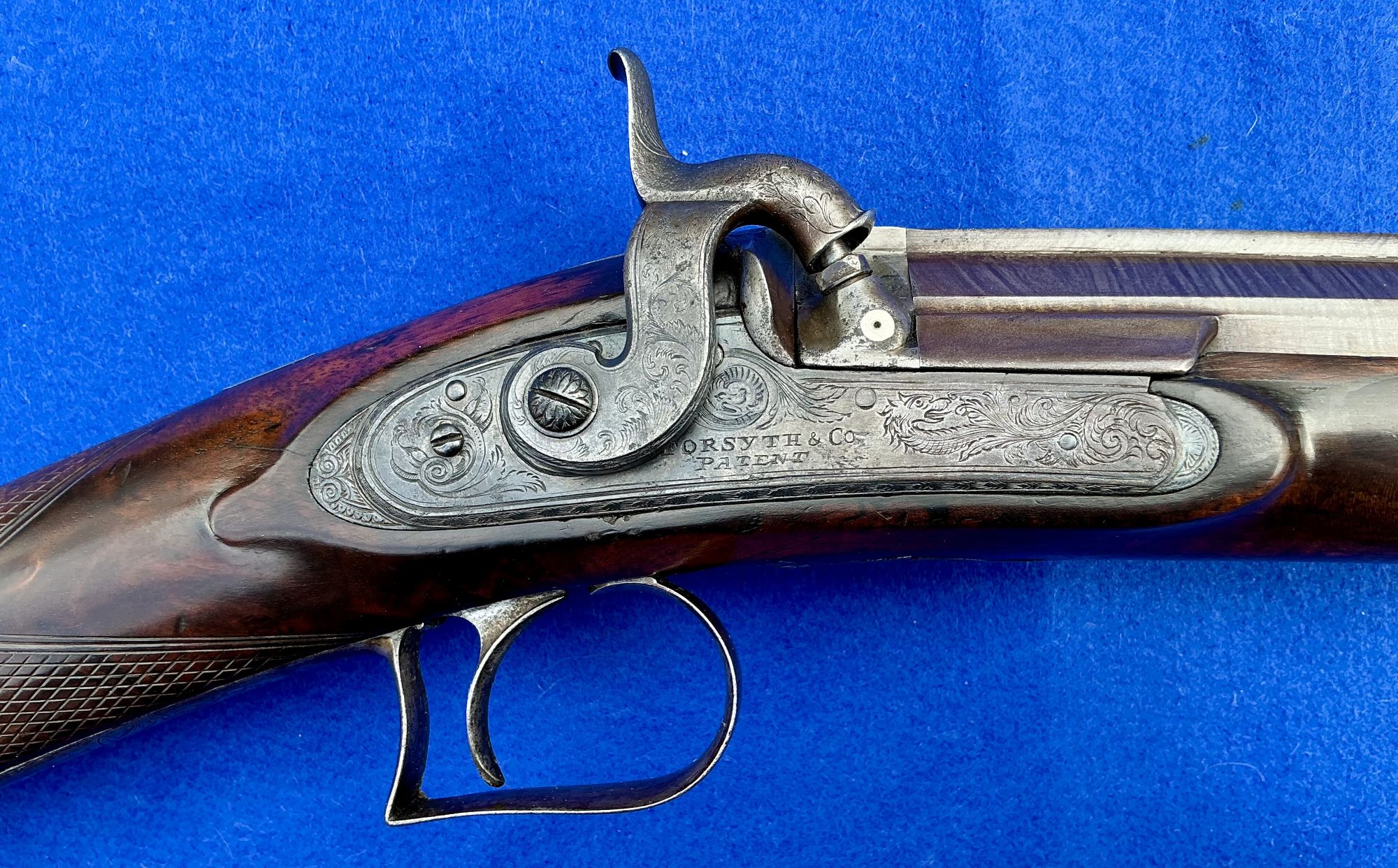
It was a Scot, Alexander Forsyth, who devised a practical chemical ignition lock, arguably a real game-changer. The later percussion cap might have been a British, French or American idea – nobody knows for sure. The French can lay claim to the pin-fire and modern centrefire systems. The Belgians were masters in steel-making technology, and in the world of repeating guns, it would seem that most successful designs came out of John Moses Browning's brain. And yet, though the Spanish, French, Germans, Belgians, Americans and others were (and are) capable of building the finest guns, none of these countries has been able to knock the British off their perch in terms of gun-making desirability.
Britain did not have a monopoly on source materials. Actually, much was second-best. The best gun steels came out of Belgium and Sweden. In fact, just about all the early British sporting guns with Damascus barrels were built with Belgian-sourced tubes. The so-called English walnut isn't even a native species, as Juglans regia originated in Persia before being cultivated and widely dispersed by Alexander the Great and the Romans (the latter brought it to Britain). The beautifully veined and marbled wood sought for sporting guns was most likely sourced from Central Asia and the Balkans. The British eventually caught up with steel production, thanks to Henry Bessemer's process (1856), which removed the impurities that had plagued British steel. Joseph Whitworth used this process, starting in 1857, to produce his fluid steel barrels (though his barrels did not become commonplace until the 1880s).
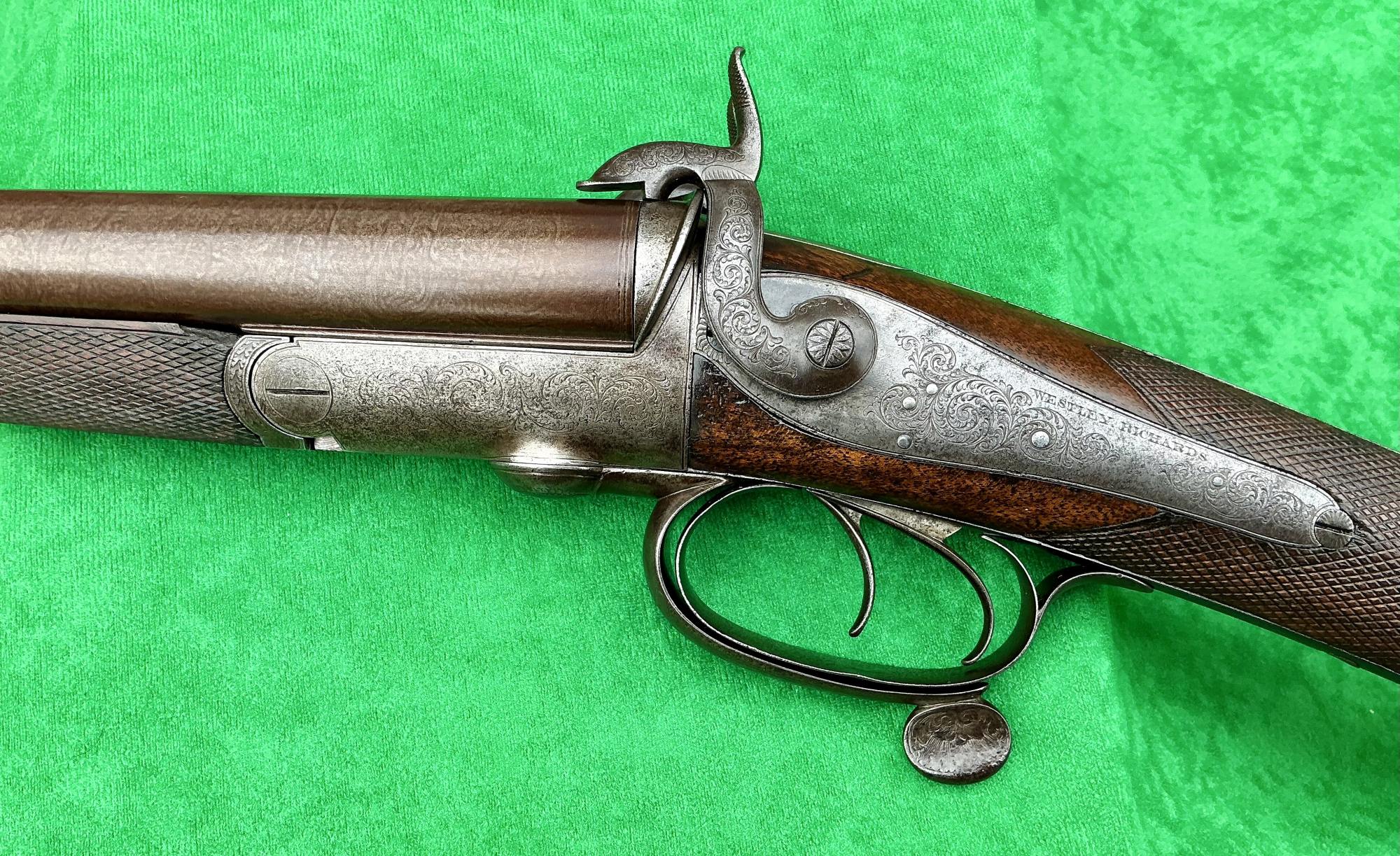
Britain came up with mechanical ideas that drowned out the competition. Theophilus Murcott of London developed the hammerless gun in 1871, available in sidelock and trigger-plate action versions. Then, in 1875, William Anson and John Deeley developed the boxlock action at Westley Richards, and Frederick Beesley conceived the self-opener sidelock in 1879 while working for Purdey's. [We'll leave out the trigger-plate actions of James MacNaughton (1879) and John Dickson (1880) of Scotland, as they essentially copied an earlier German design.] Best-quality Spanish guns are generally copies of British designs (notably Holland & Holland and Purdey sidelocks), and everyone copies the A&D boxlock for its simplicity and dependability. Most French guns are based on similar patterns, while producing a smaller number of their own outside-the-box, often exquisite, mechanical designs.
If the desirability of British guns is only partly due to originality of design and workmanship, there must be something else. It may be a social class affair, as fine British sporting guns were aimed at the wealthy (often land-owning) elite. Who doesn't want to own what was formerly only the domain of the fabulously wealthy? There is also the matter of name recognition. Most can rattle off the names of five British gunmakers of solid repute, and some can name ten without too much difficulty, especially ones still in business or whose span of years was considerable. Beyond this, it might be a struggle, though.
For the period that fascinates me, the 1850s and 1860s, there were over 900 known sporting gun makers in Great Britain and Ireland operating for all or some of those years. Everyone knows the names Purdey, Holland & Holland, and Westley Richards in the context of Best Guns. However, a great many gunmakers could produce guns of equal quality when the commission required it. This is not too surprising when you consider the business model that generally depended on outsourcing the myriad tasks and manufacturing processes, and where the name on the gun is the ultimate retailer, not necessarily its builder. Can a Blanch, Erskine, Pape or Paton equal or surpass a Boss, Woodward or Rigby? Easily, if the client wanted it to, and many did, including royalty. Smaller gunmakers could buy the same materials (barrels, locks, etc.) from the same businesses that supplied the great names, and often hired the same outworkers the big names used, for the more difficult tasks and procedures. And yet, we are still seduced by the storied names, even though many of these are now owned by investment firms, and where profits come from branded clothing and accessories.
The desirability of British guns comes from all of the above in terms of quality materials, workmanship, and humanity's never-ending desire for a good story. Others may claim to have one or two of these, but perhaps not all three, as Britain has perfected. What makes the British guns British? It is a stylistic distinction. German guns are built for strength; an admirable objective, but in the process towards bank-vault attributes, fluidity of lines is often lost. British game guns aim to use the minimum amount of steel possible in the barrels and action – a philosophy taken to the extreme with bar-in-wood guns. The result is lightness and balance that Continental guns are generally shy of achieving, with a few exceptions. Where Spanish guns match British ones, it is usually because they are perfect copies, not because they bring anything new to the table. The finest Belgian guns are a close competitor, but only amongst certain makers, at the highest level – hardly a general comparison. Care in shaping actions, slim stocking and choice of wood, and balancing weight versus strength, seem to advantage the British gun. Perhaps for any given price point, British guns offer a little bit extra in design, construction, decoration, and heritage.