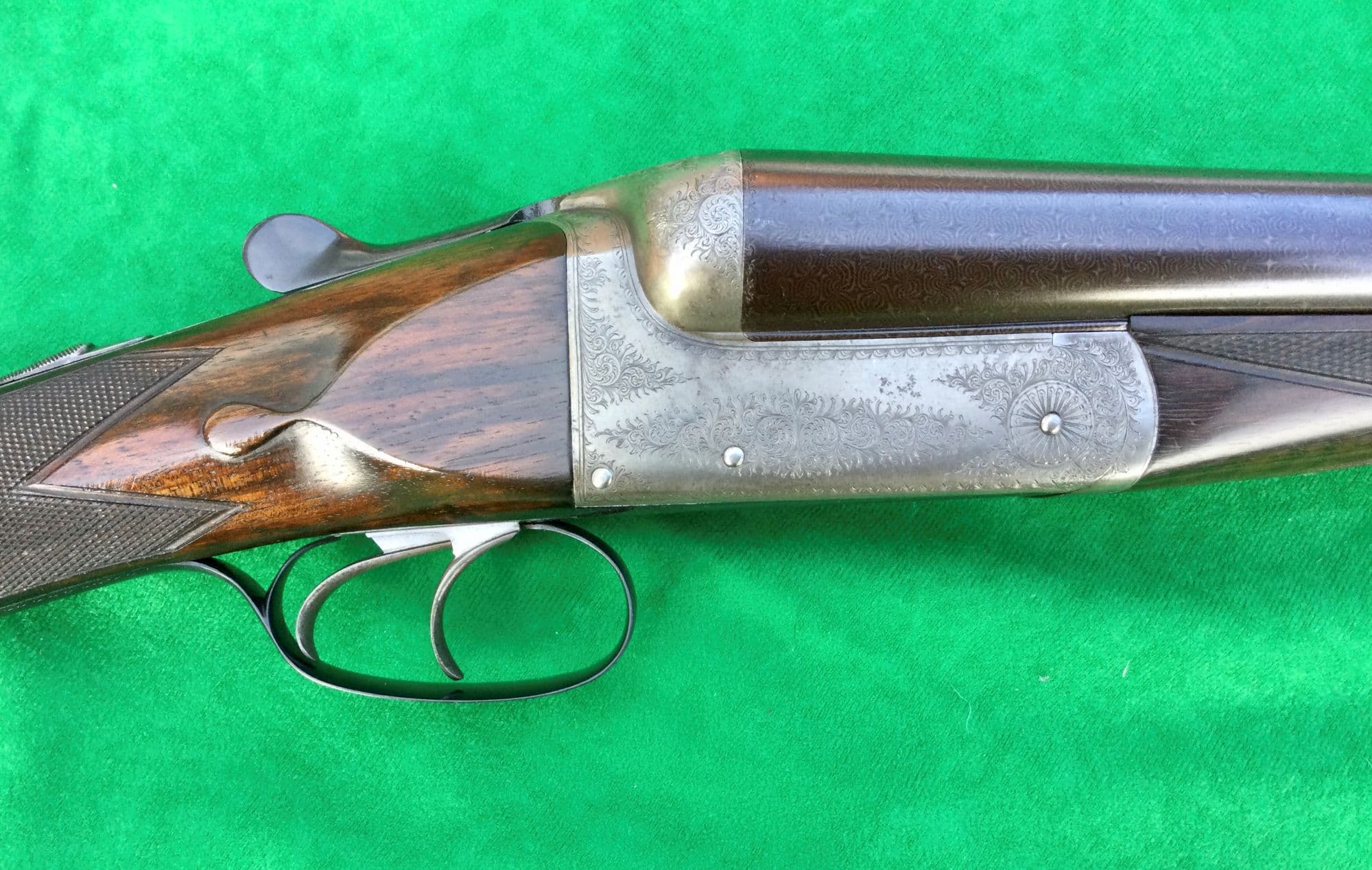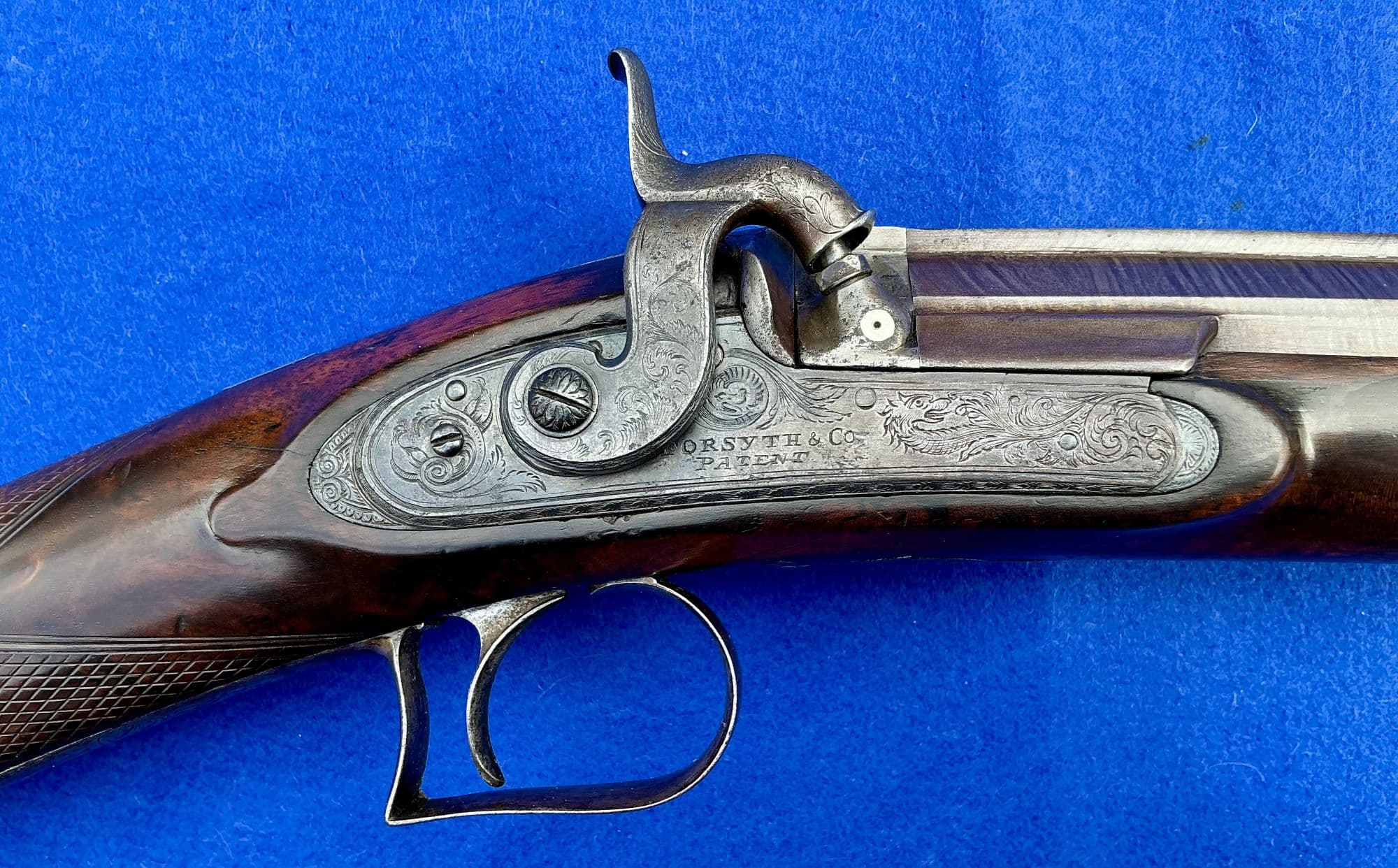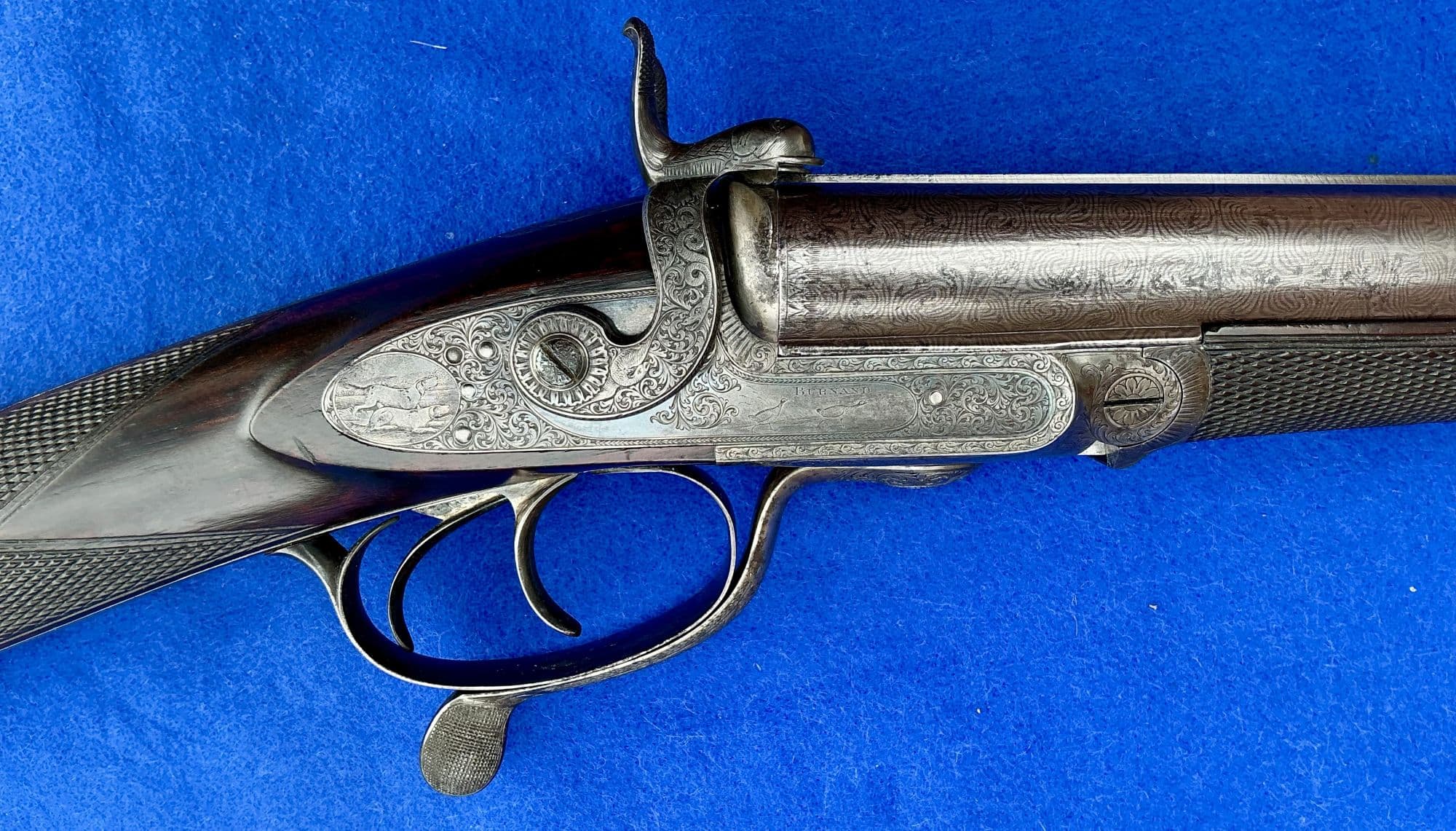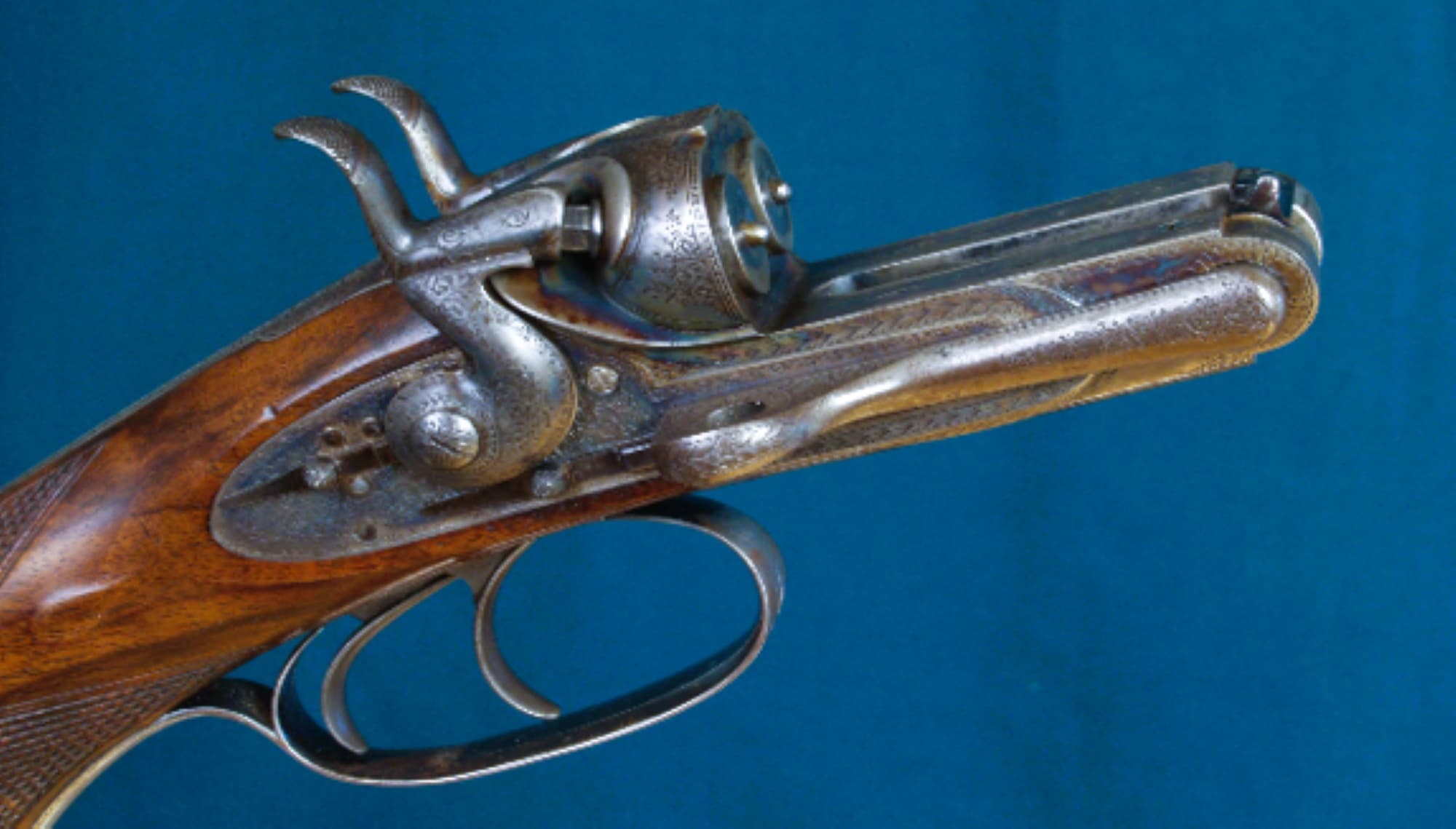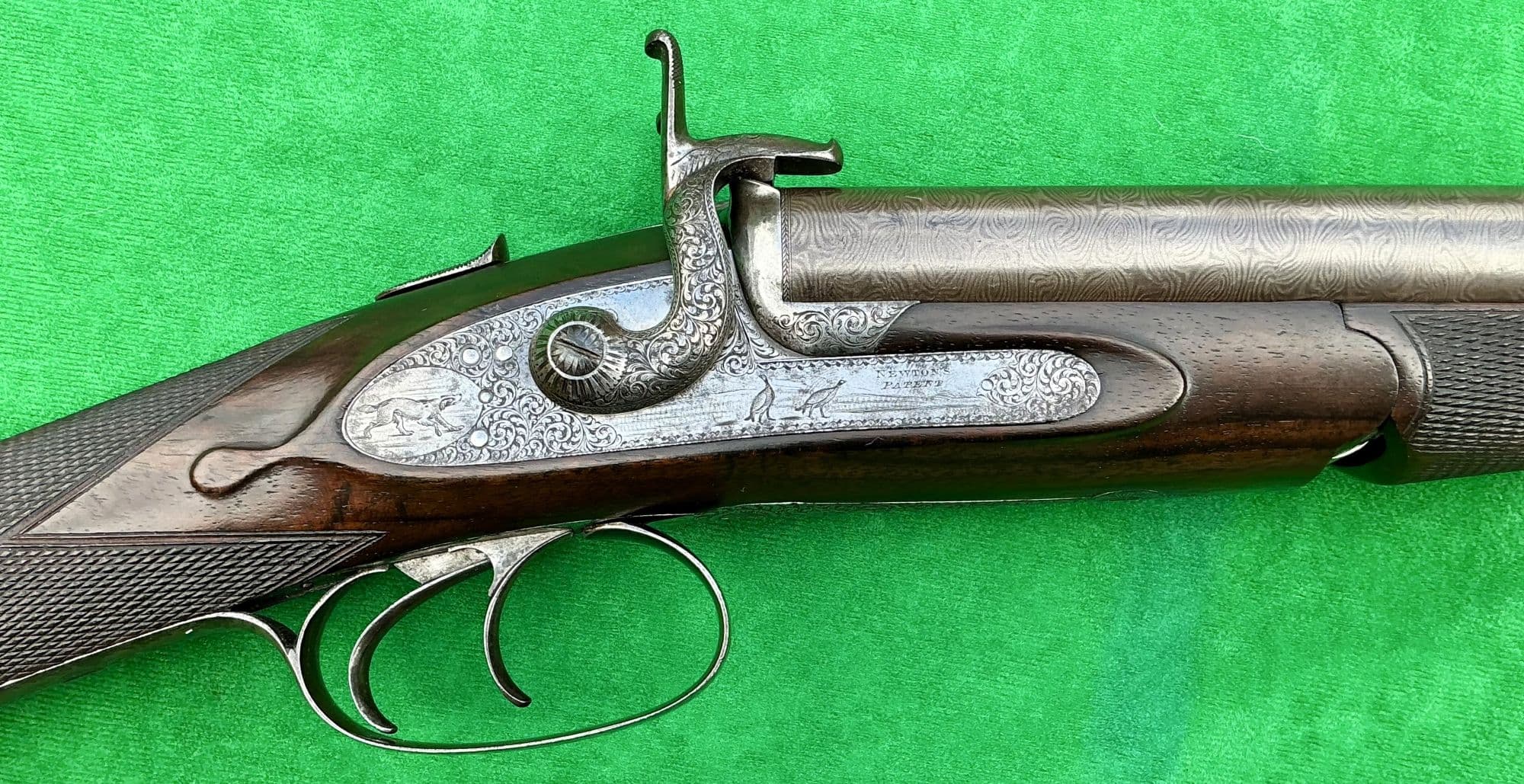
Thomas Newton (1816 to about 1878) was a Manchester gunmaker described by Geoffrey Boothroyd as the Northern Star of the Manchester Gunmakers. This 13 bore bar-in-wood pinfire hammer gun, serial number 191, uses his scarce 1864 patent 297 self-acting push-forward opener. It has 28 inch Damascus barrels with London proof and best quality locks by James Grainger of Wolverhampton.
Thomas Newton – Gun-maker
Manchester – 1816 to 1878
The Gun-maker Thomas Newton has been described by the late Geoffery Boothroyd as the “Northern Star of the Manchester Gunmakers” – Boothroyd’s observations are evidenced through the Thomas Newton Pinfire Sporting game gun in this article.
Thomas Newton was born in Hexham, Northumberland, in 1816. There is little in the way of history to explain where Thomas Newton learnt his outstanding trade skills, or to whom, or where he was apprenticed. However, the standard and high quality of his work tells us; Thomas Newton had been well schooled in the art of gun-making.
The Gun that inspired this article was made by Thomas Newton of Manchester using the scarce Newton patent No. 297 of 1864. This gun, as a result being a scarce example in itself. There appears to very few ‘Sporting Game Guns’ made by Thomas Newton, that remain in use today using the Newton No. 297 patent.
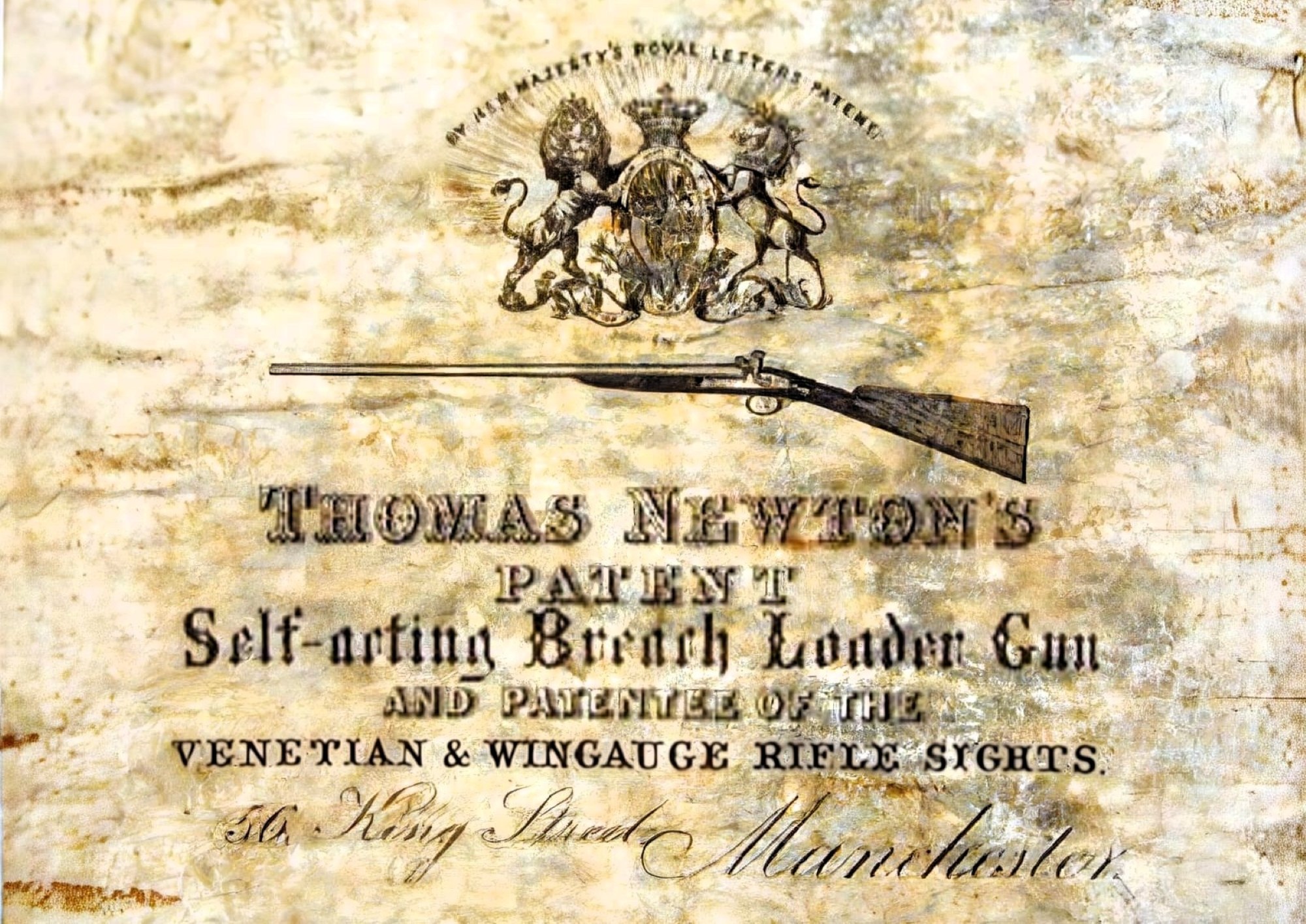
The 1860's trade label above would have been used, during the period the gun in this article was made at 56 Lower King Street Manchester. The business relocated in 1860 from where the business was first established in 1855 at 41 Frederick Street, Salford. Manchester. The 1864 trade label proudly depicts the ‘Self-Acting Gun’ - Newton's Patent No. 297.
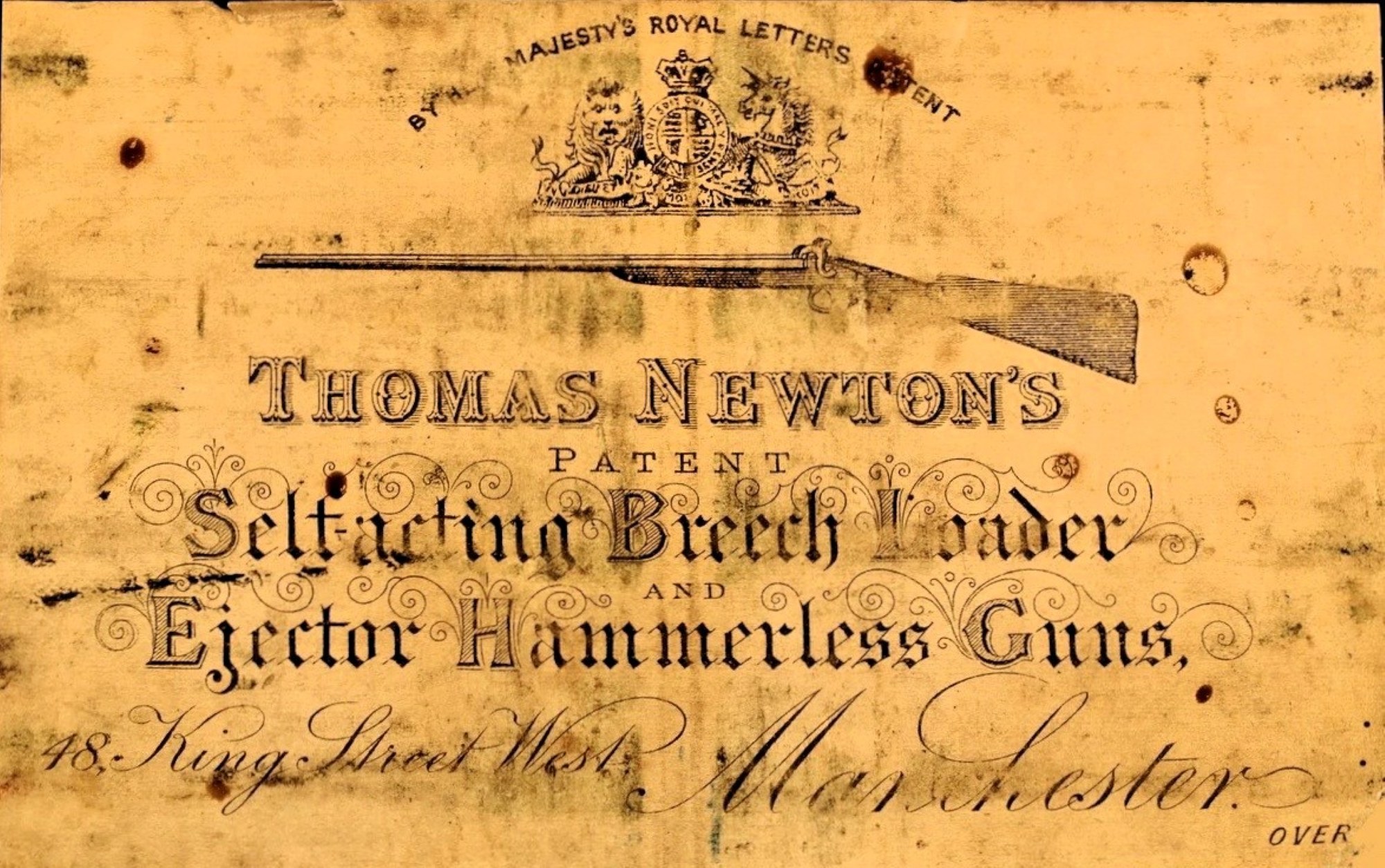
The 1879 Trade Label above, was used after the Thomas Newton business had been sold to William Howat, however, Howat continued to trade under the name Thomas Newton. The trade label informs us, that at this time, the business was selling hammerless Box-lock ejector guns, (some of which were made by Westley Richards). Interestingly, the 1879 trade label, still proudly depicts the ‘Self-Acting Gun’ as the focal point of the business fifteen years after the patents introduction. After William Howat purchased the Thomas Newton business, the business then moved to 48 King Street West, Manchester.
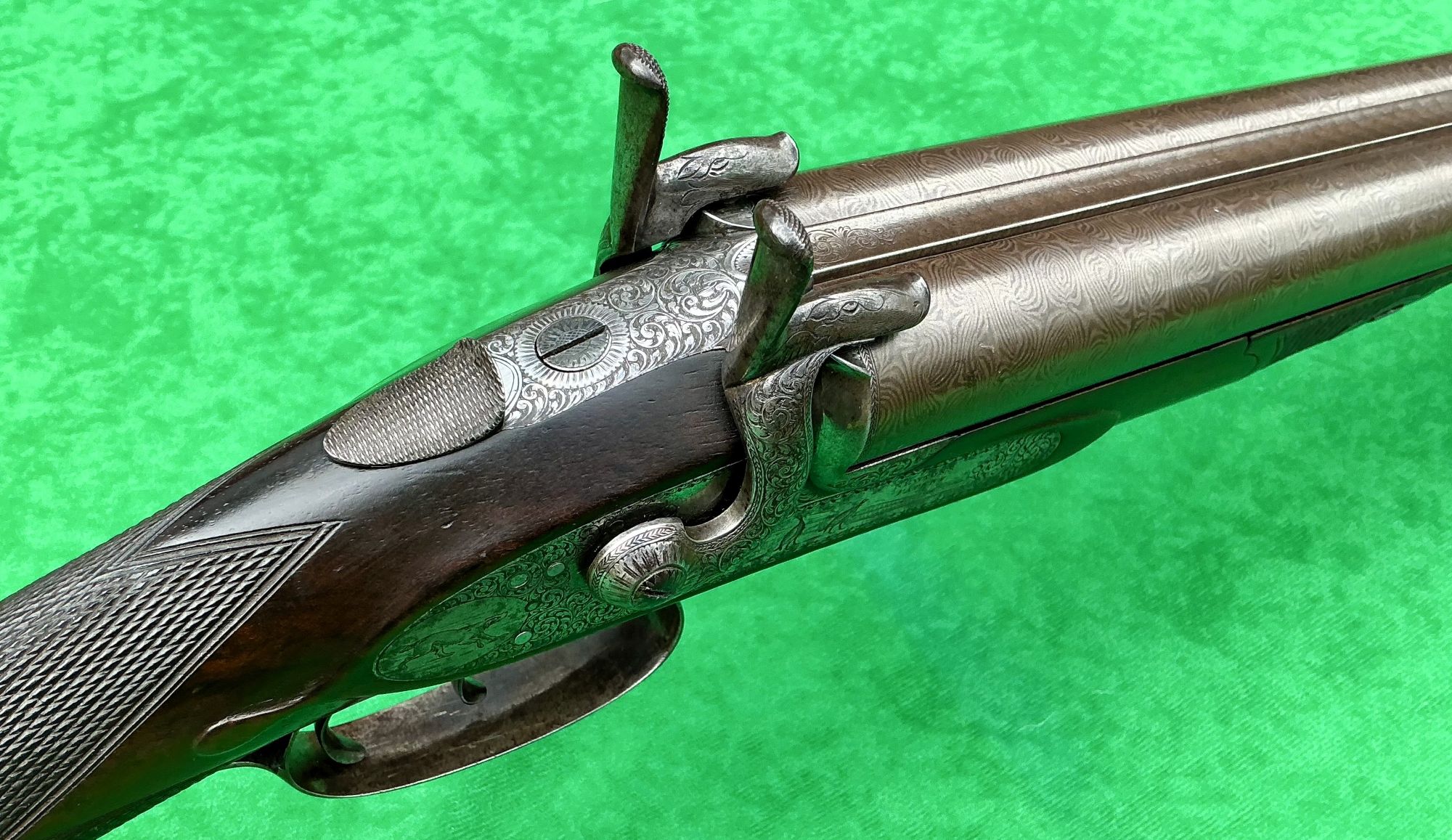
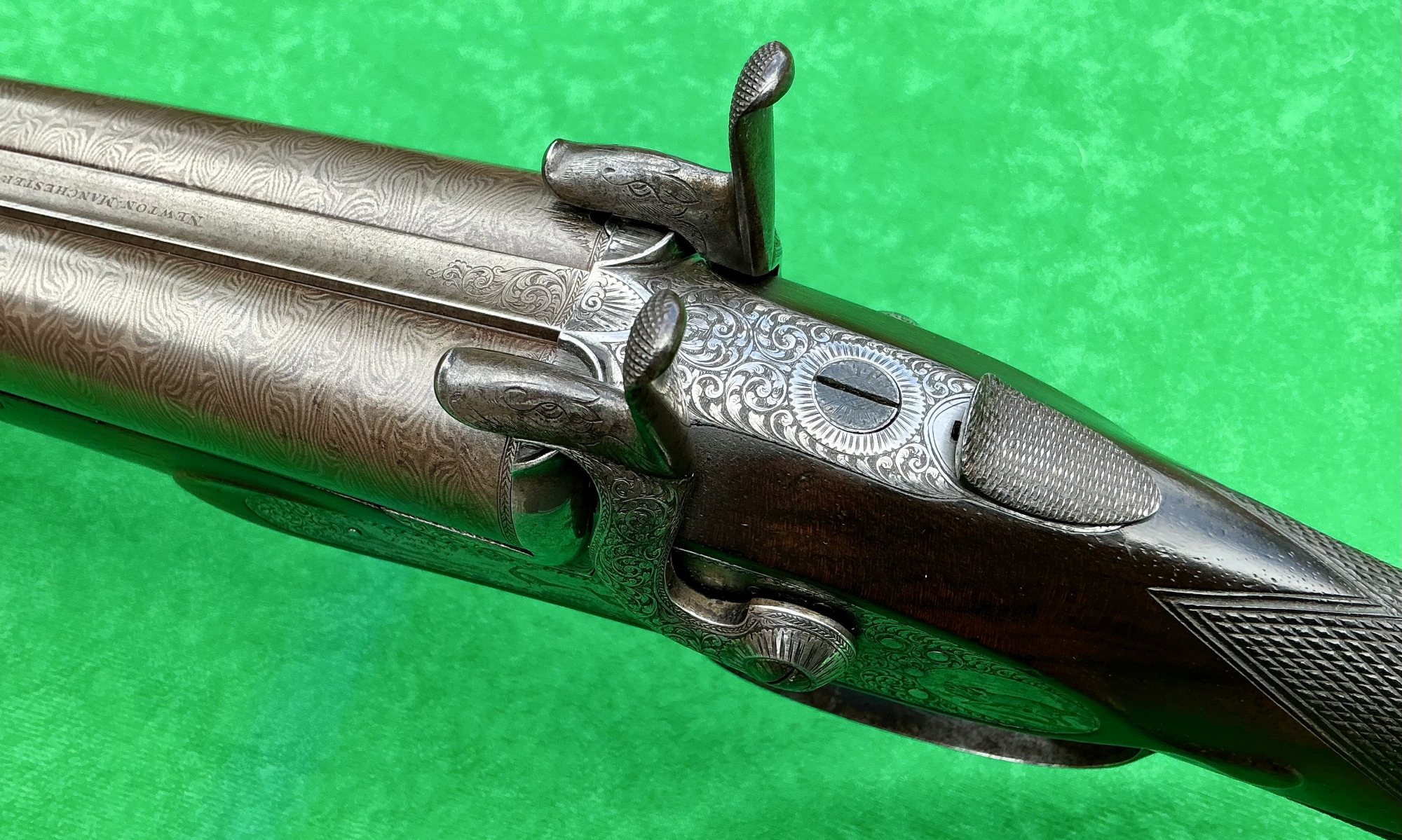
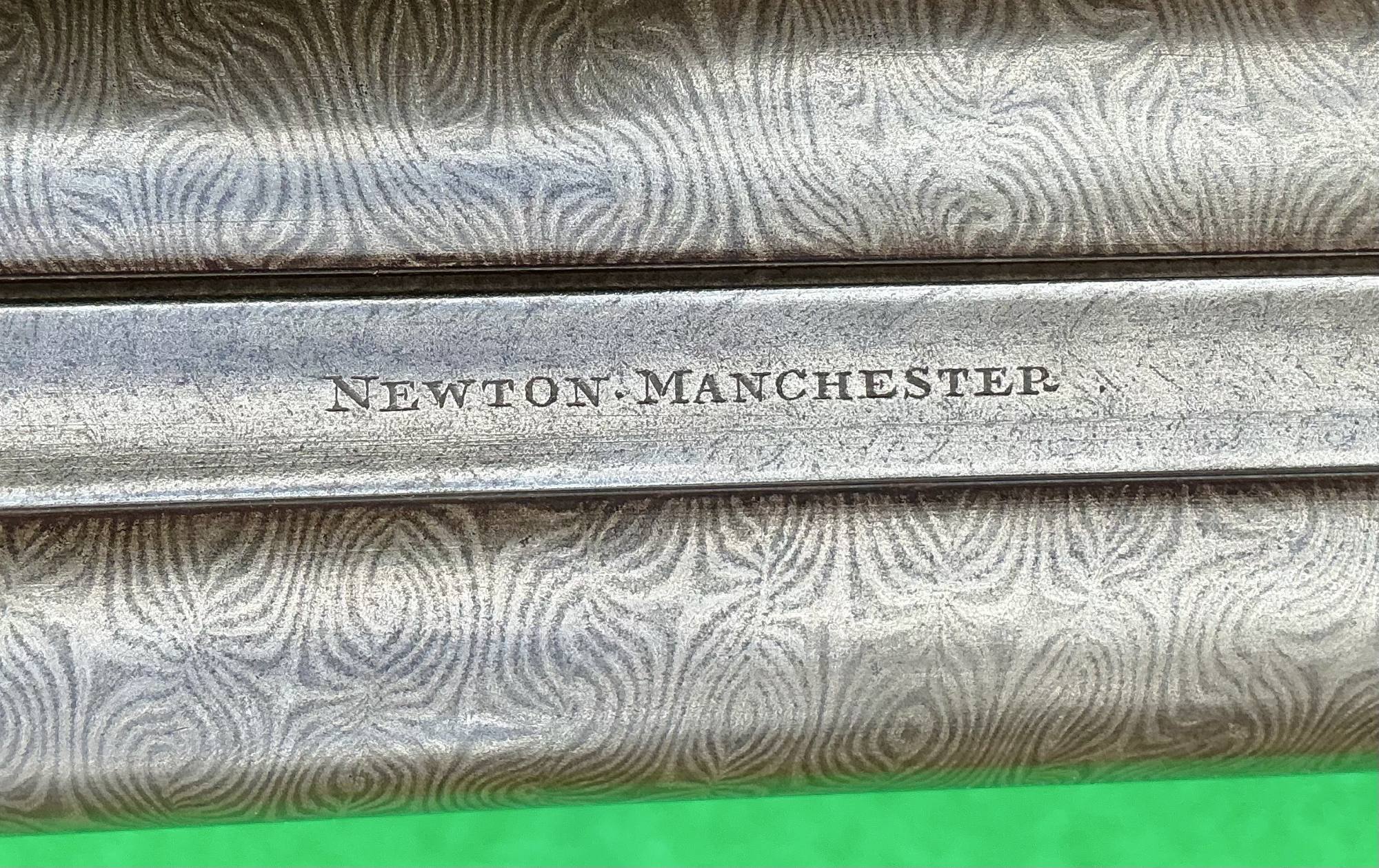
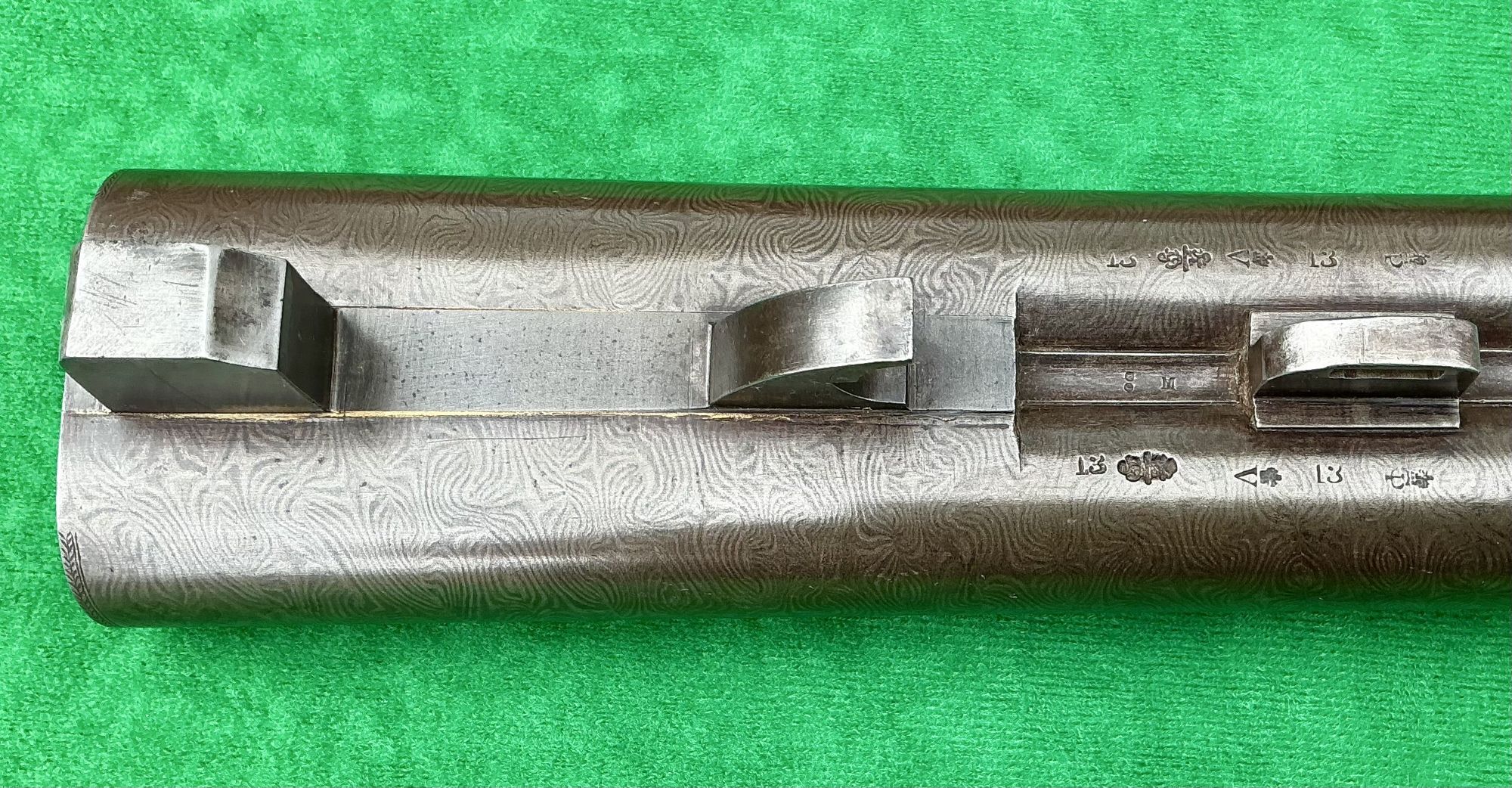
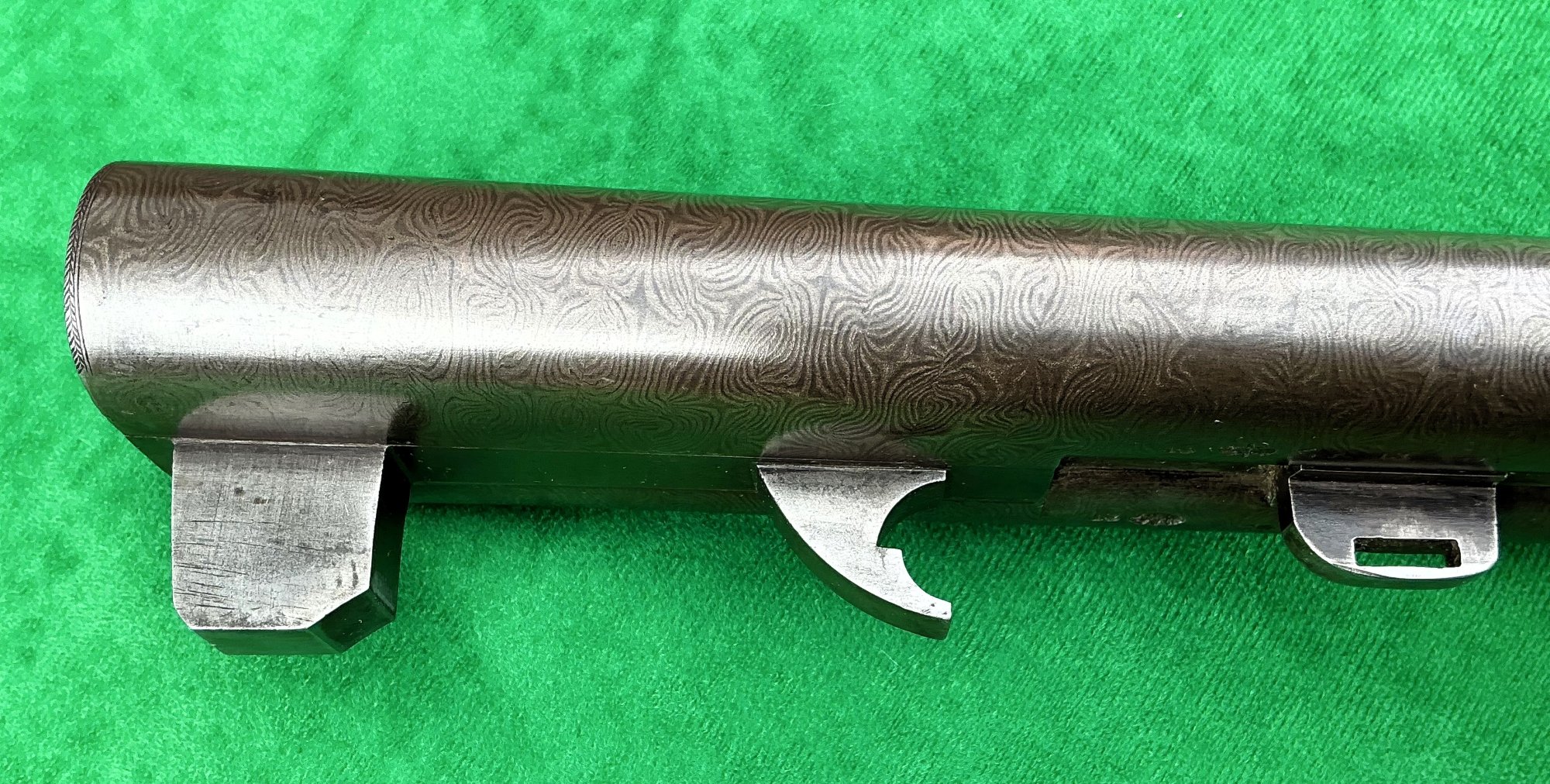
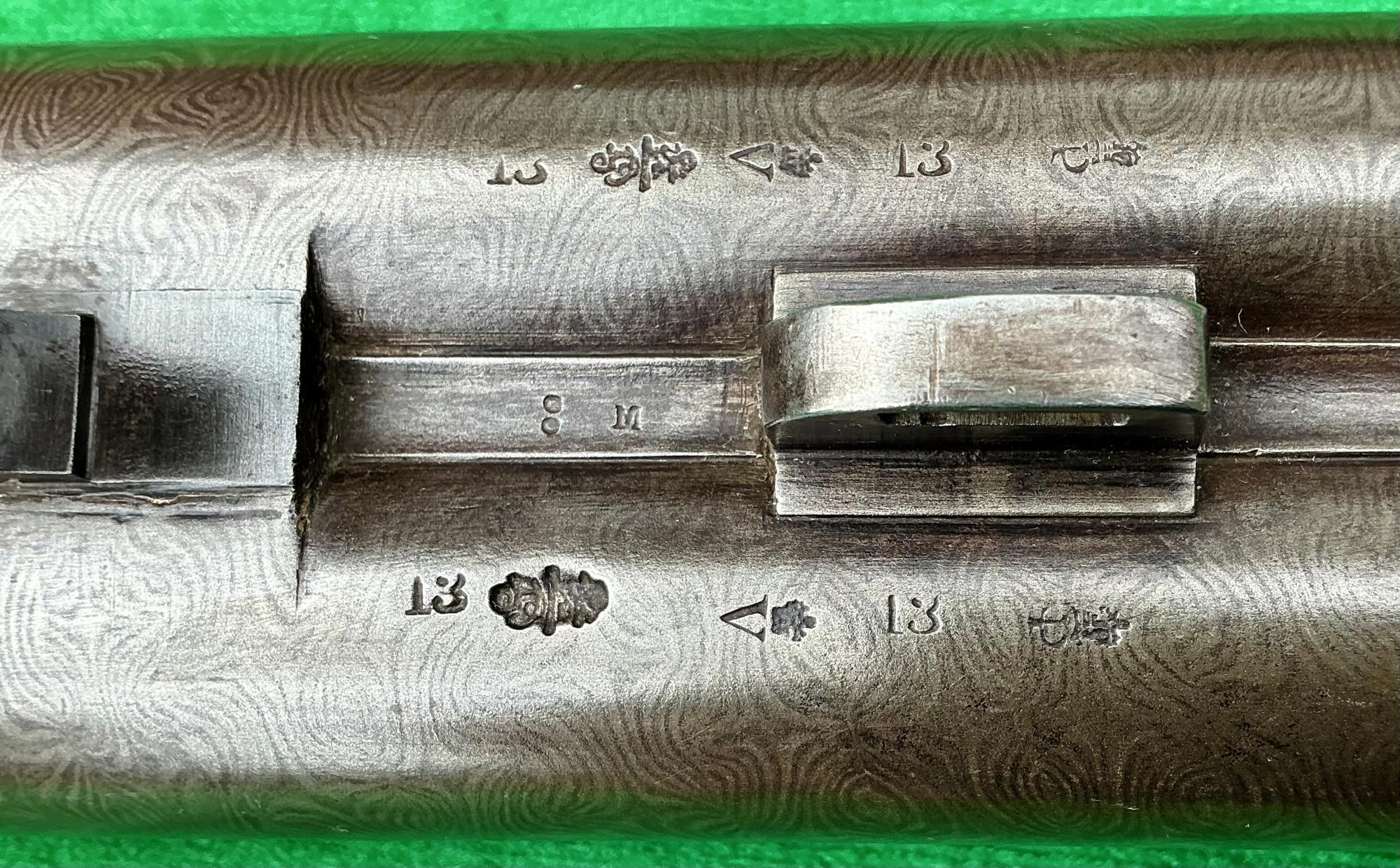
This gun was built by Thomas Newton as a 13 bore, Bar-in-Wood, Pinfire, Hammer gun, with serial number 191. The fine Damascus barrels are 28 inches and signed on the top rib ‘Newton Manchester’. The barrels have a ‘Barrel Makers’ stamp of ‘M’ and two ‘00’ on the bottom rib close to the barrel flats, the strong Damascus patterning and period of manufacture provide strong links to the ‘Monway Iron and Steel Works’ which was run by ‘Marshall & Mills’ until 1865, the business were well known as producers of best quality gun barrels.
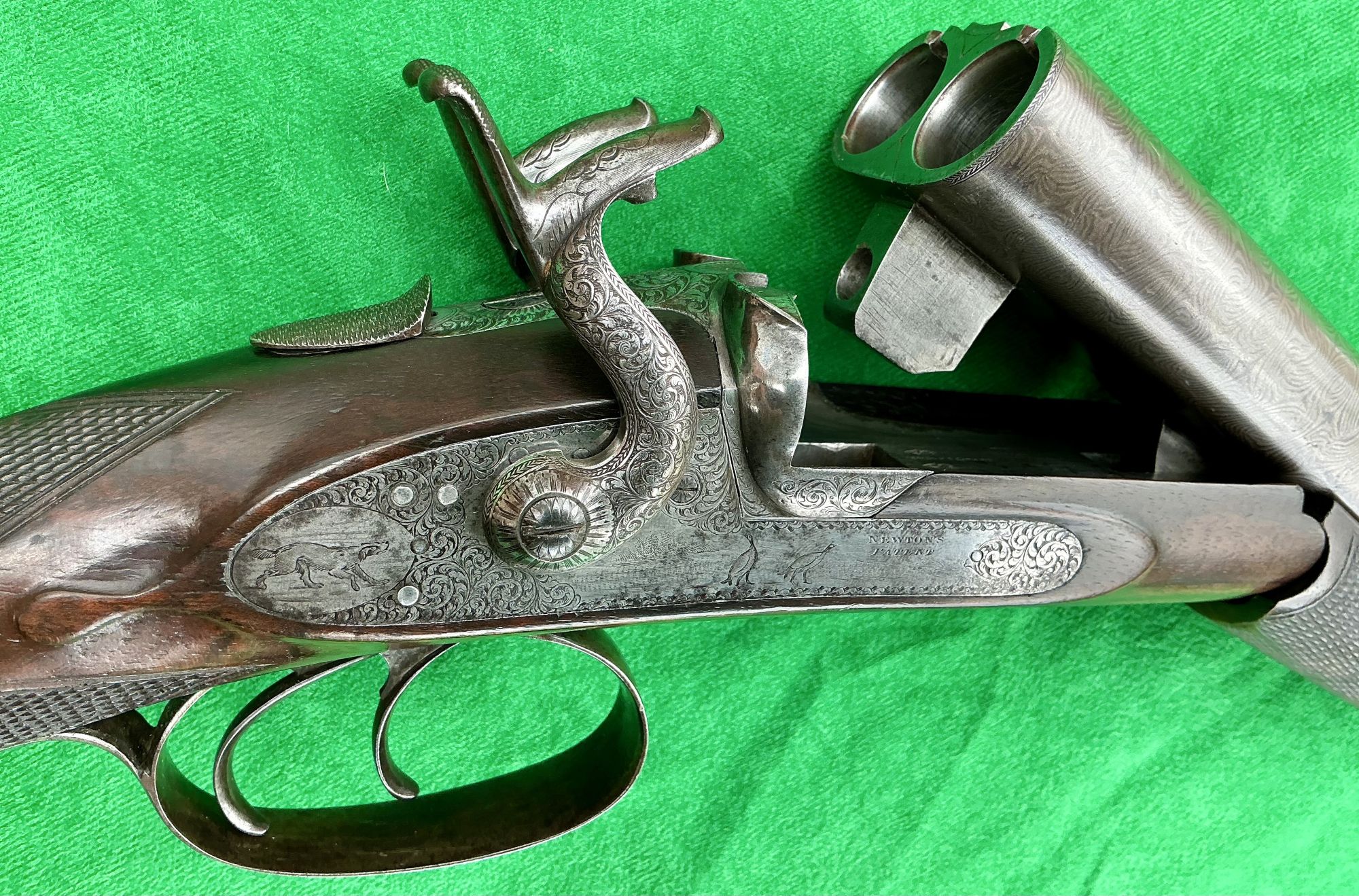
The gun is scroll engraving on the top rib at the breech end, the barrels interestingly, have been proofed at the London Proof house, having London proof marks for 1855 to 1868. There appears to be a common practice by both provincial and Birmingham Gunmakers, taking on and building ‘Best Quality’ guns, in then sending their guns to London, with the thought of creating additional prestige, through giving their guns links to London.
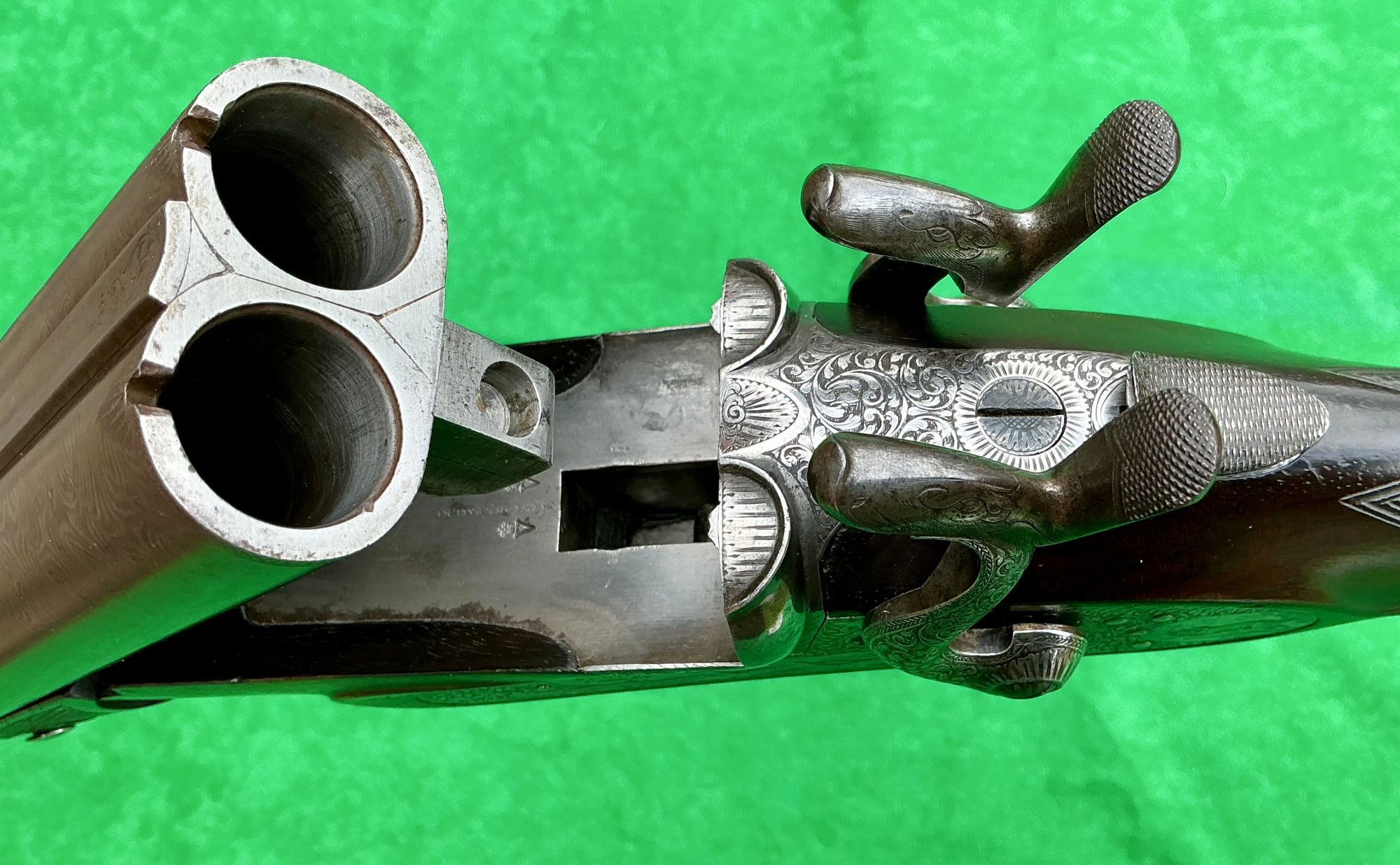
All guns being proofed using the 1855 to 1868 rules of proof, are covered through regulation, that under these rules of proof, the gun becomes out of proof at the next bore size up. This gun proofed as a 13 bore (.710) would put the barrels out of proof at 12 bore (.729). The barrels now measure .722 and .726, the measurements clearly shows the gun remains in proof, with the added bonus of clean and bright bores, and with barrel wall thickness of 20 and 23 thousandth of an inch three inches from the muzzle. The figures from the gunroom are showing a barrel length of 30 inches, an overall gun weight of 7lbs. 6oz. with the barrels weighing 3lbs. 8oz. an overall measurement of the gun at 46 1/4 inches, and a stock length (LOP) of 14 3/8 inches. The gun being cast for the right hand.
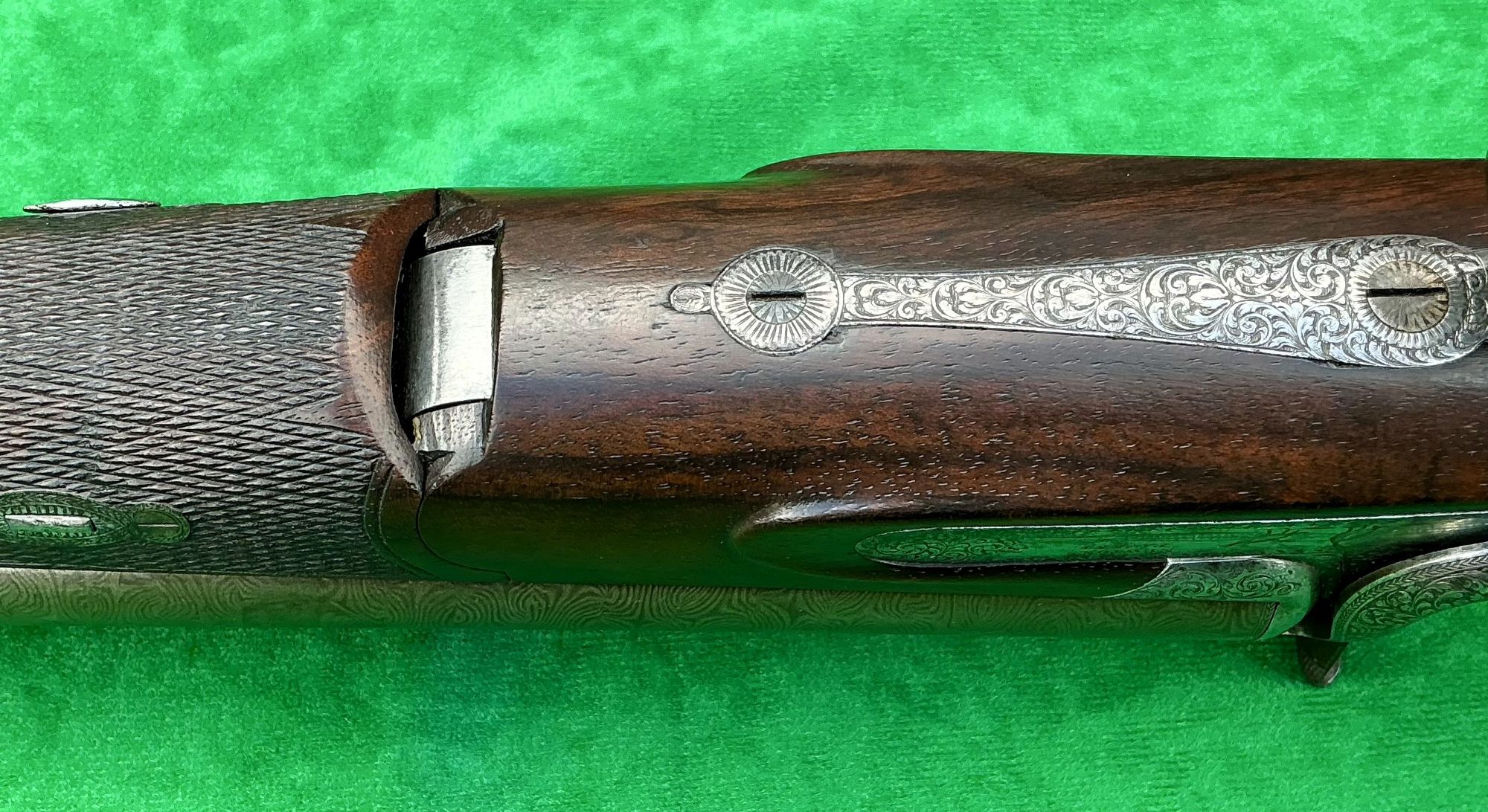
The barrels are decorated with ‘flambé needles’ around each of the pin-fire holes. There is bold scroll engraving to the top-tang. The top tang includes a checkered boat-shaped push-forward thumb-catch, used to open the gun, the catch sits neatly to the rear of tang.
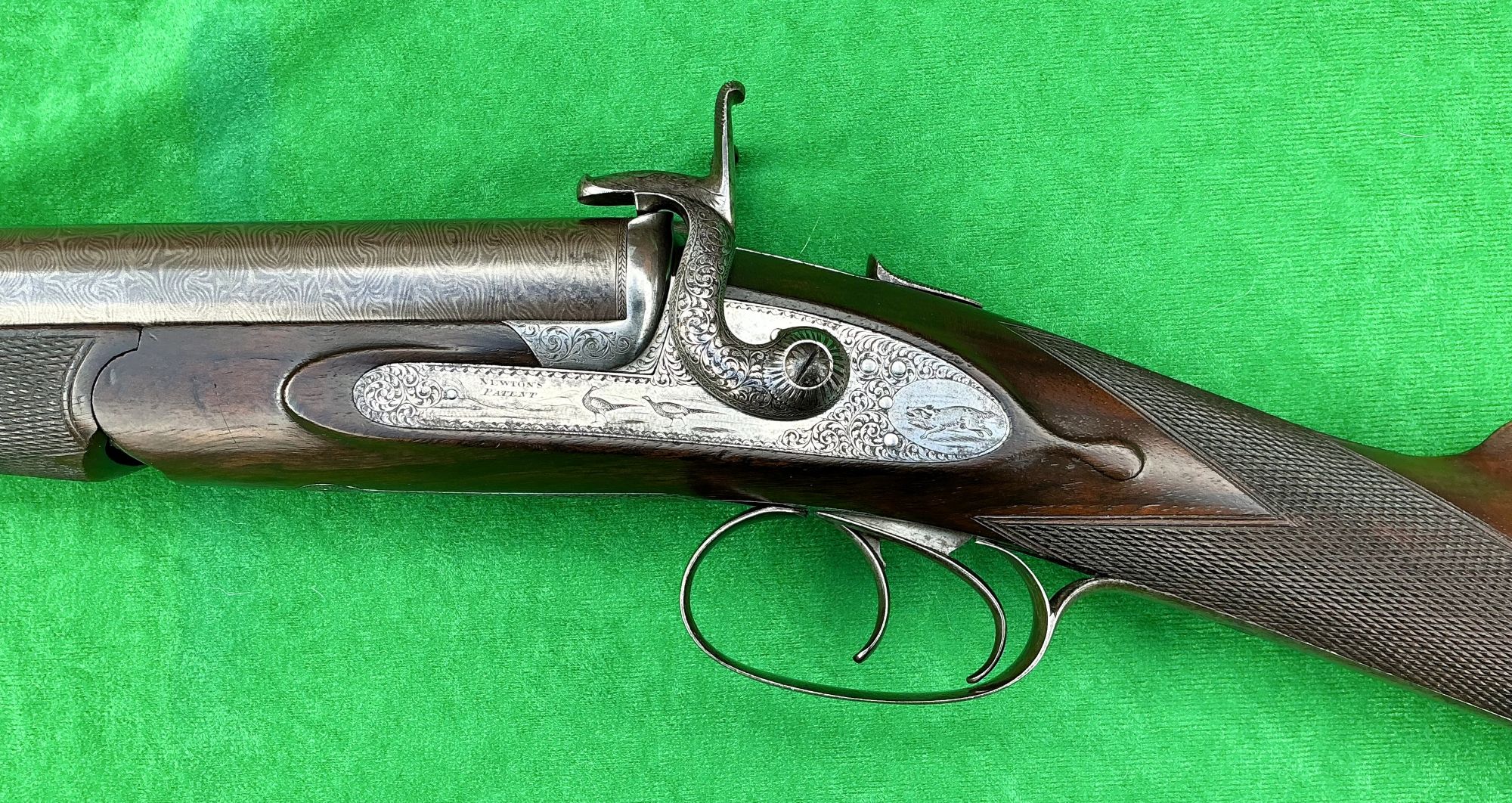
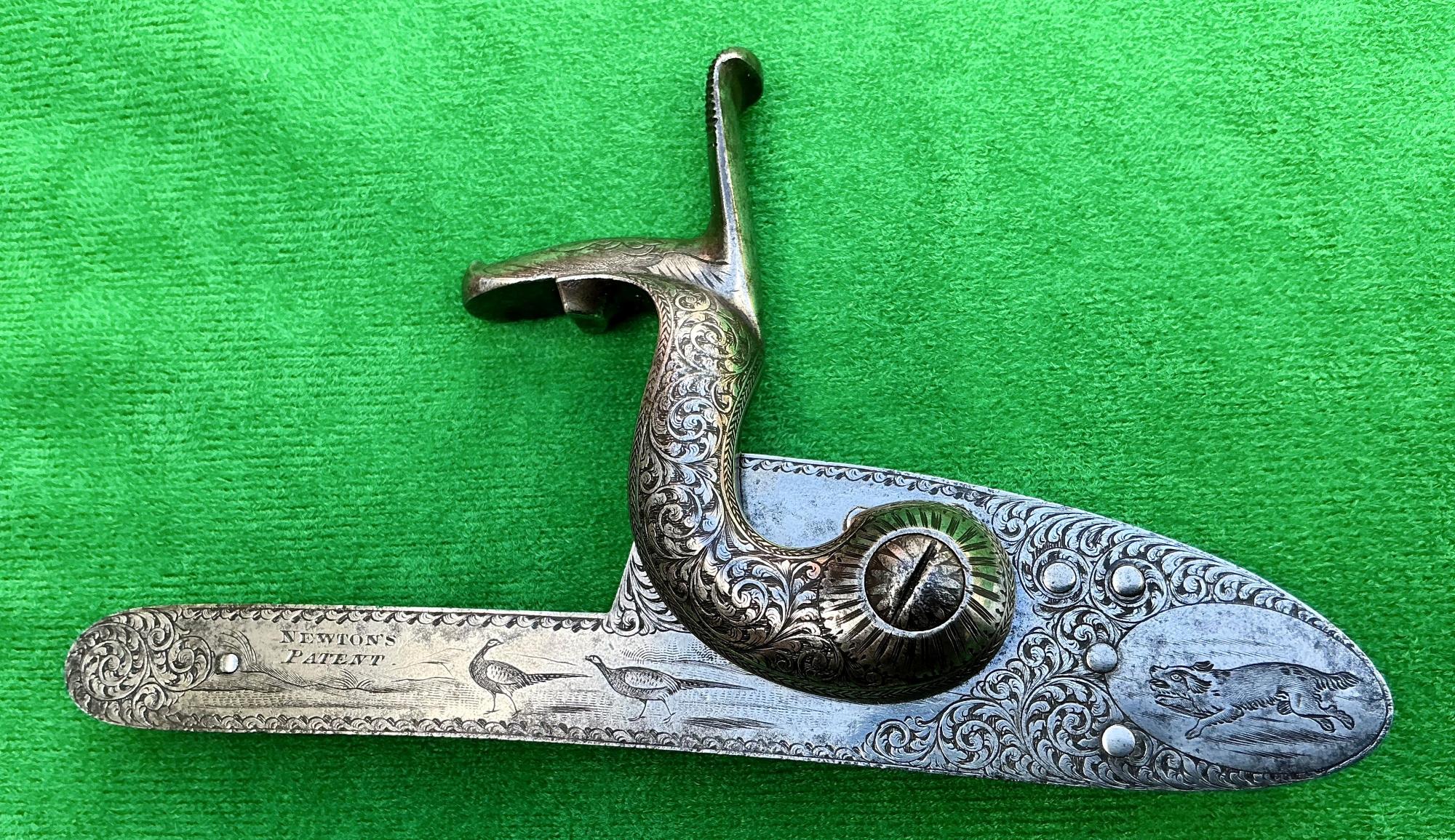
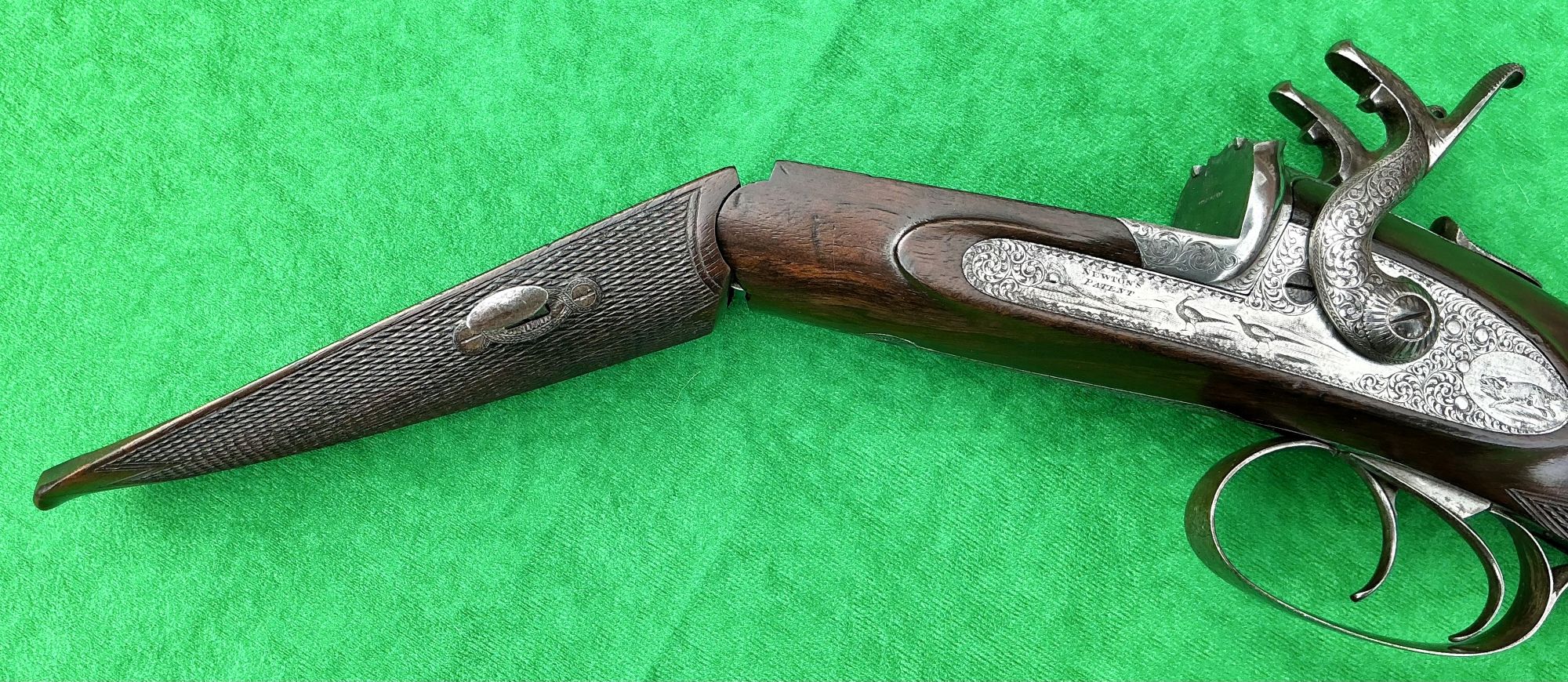
The scroll and game-scene engraving extends to the bar-action locks, the locks are signed 'Newton’s Patent’, with each lock-plate featuring an oval vignette of a hunting dog running.
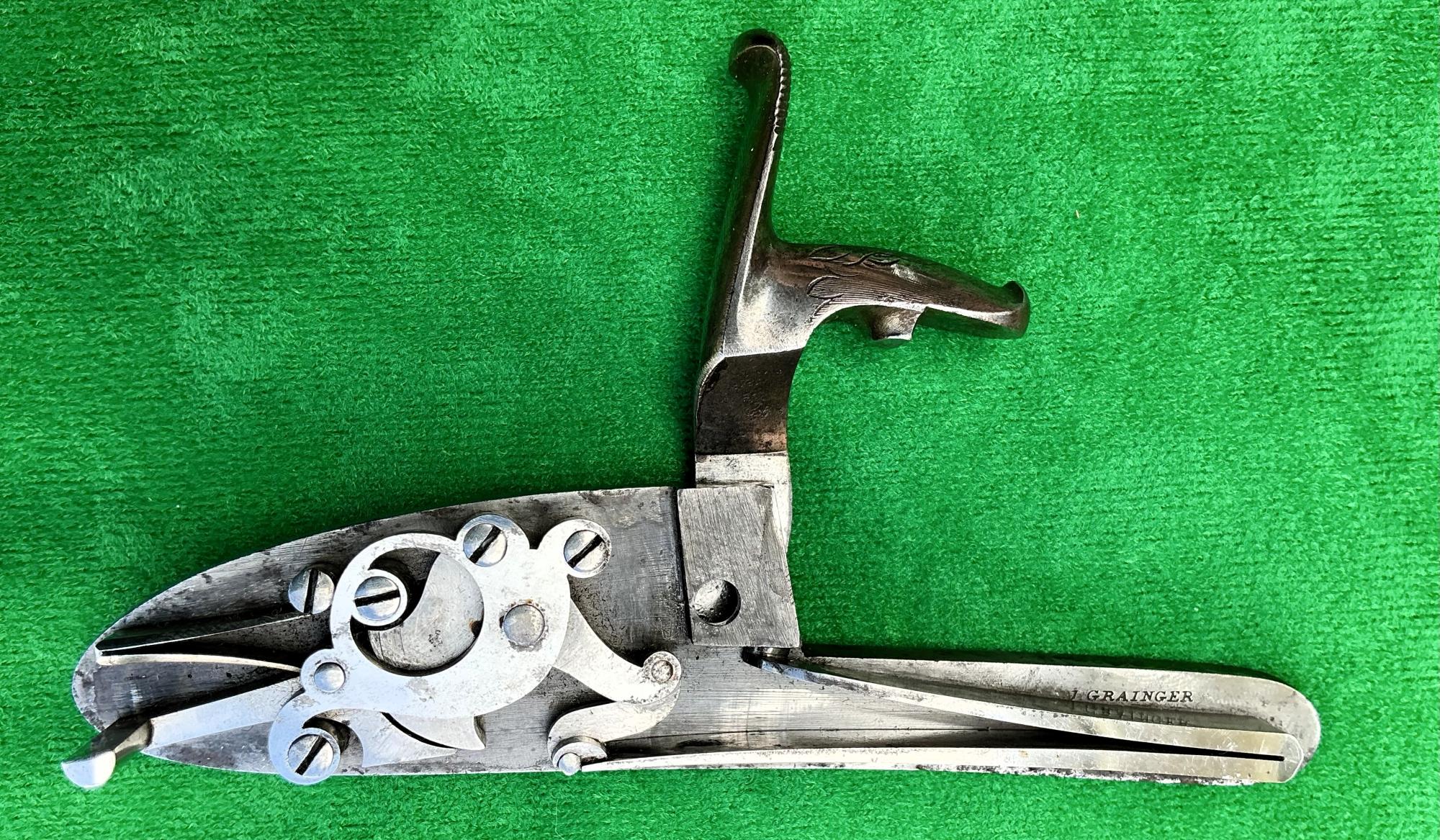
The locks internally tell another story, being ‘Best Quality Locks’ with pierced bridles by James Grainger. There are two records of a James Grainger, believed to have been the same person. The first dates are for 1851 to 1856, with no recorded address other than Wolverhampton, there is a strong possibility James Grainger was working well before 1851, as he was recorded at the Great Exhibition of 1851 – Exhibiting as a ‘Gun Lock Maker’, this in its self tells us, Grainger was not just a ‘Gun-Lock’ maker, but a quality maker of some standing, and belonging to a select group of gun lock-makers supplying the gun trade with ‘Best’ quality locks.
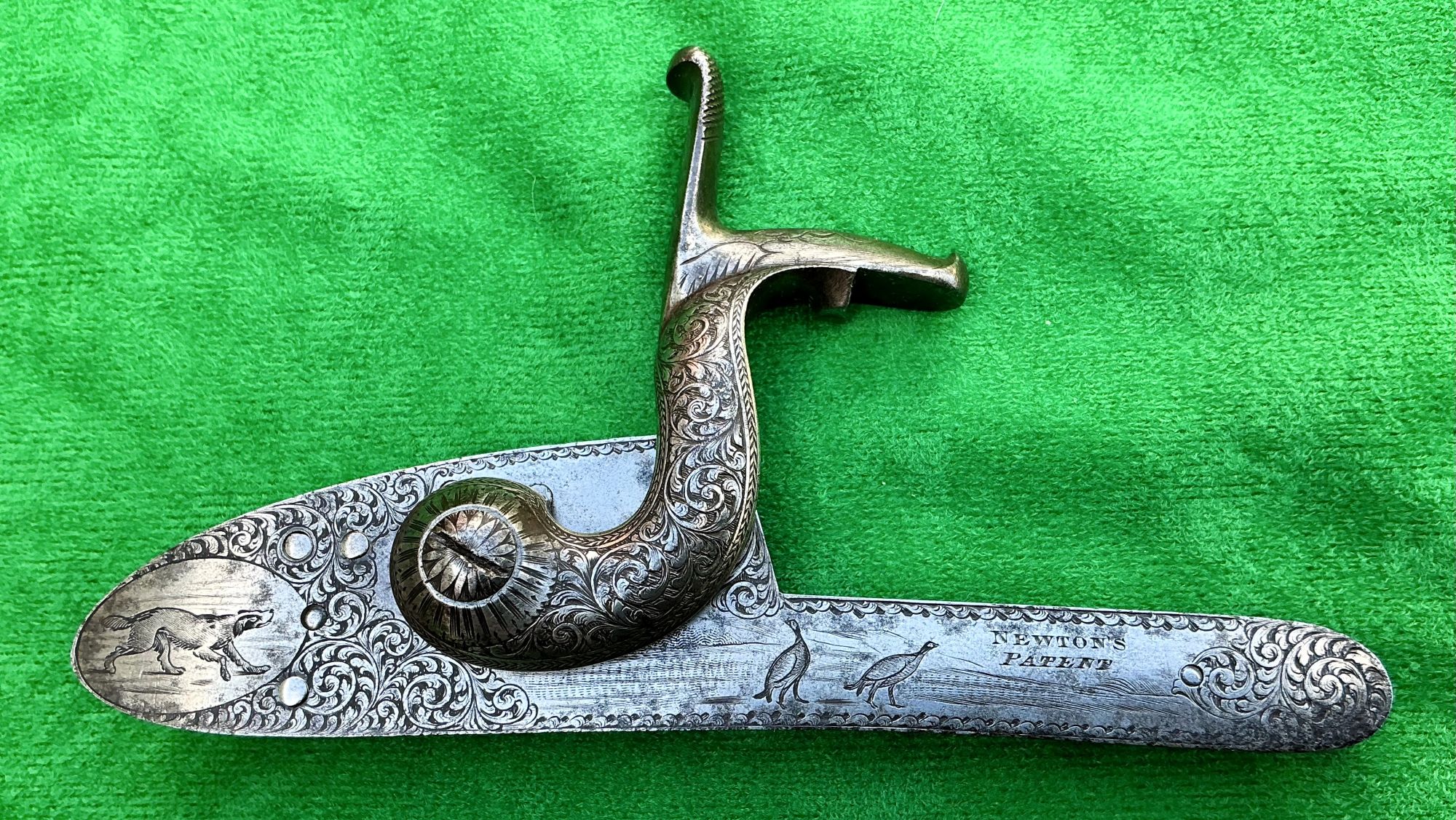
James Grainger being recorded as a Gun-Lock maker, and not a gunmaker. This information places him firmly in the supply chain for Gunmakers. The quality of work and pierced bridles could easily be mistaken as the work of Joseph Brazier, however Grainger’s locks have a marginally heavier gauge about them, although at the same time remain elegant and extremely fine. There is a later record for James Grainger of Wolverhampton, but this time giving an address of 31 Vauxhall, Upper Wolverhampton. Staffordshire, with dates of 1871 to 1874'
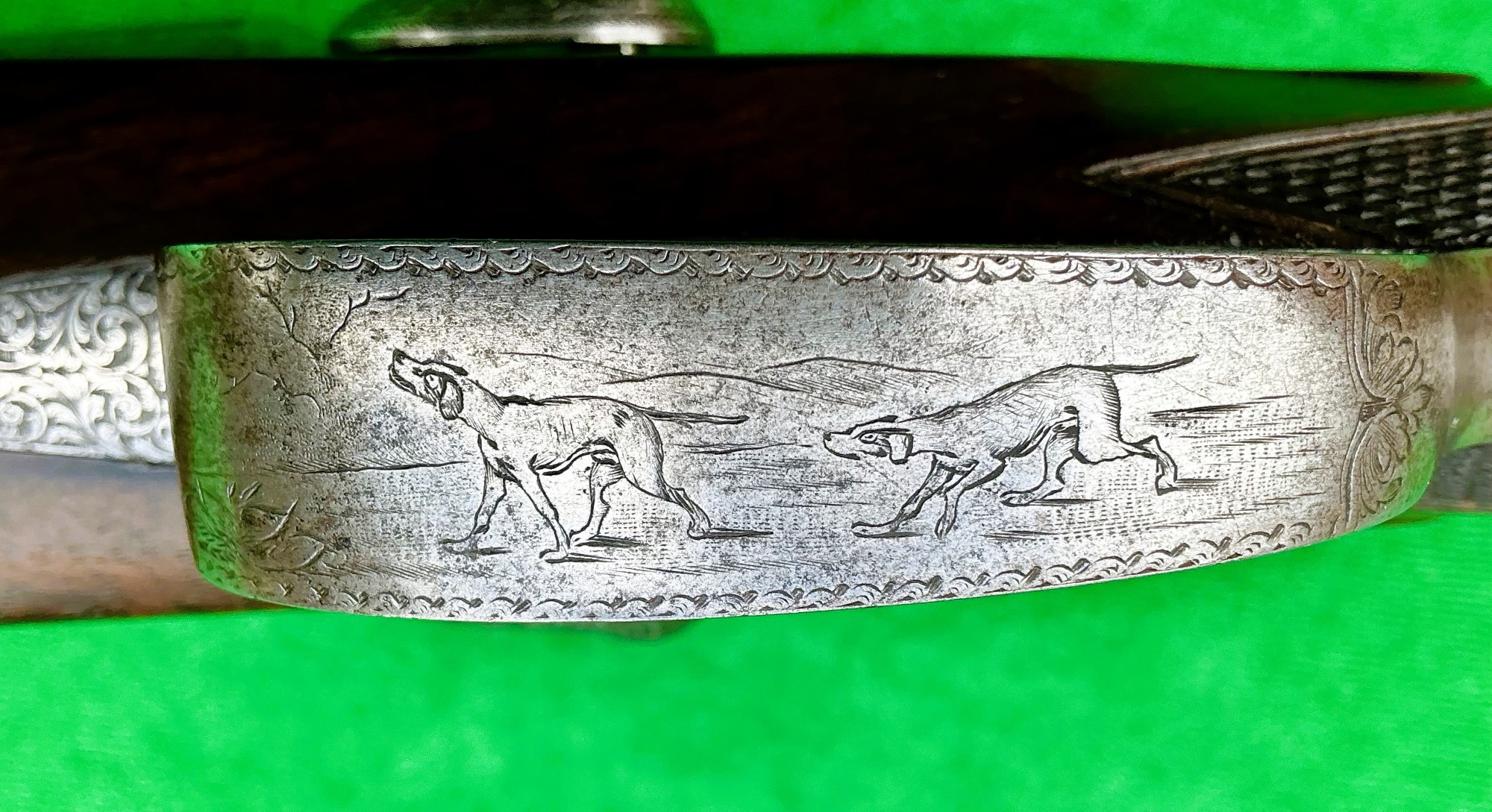
The Hammers are fully scroll engraved and are dolphin headed. The engraving extends to the remainder of the bar-in-wood action body, and the forend fastener escutcheons. The trigger tang either side of the trigger bow is fully engraved. The trigger bow has two ‘English Pointer’ hunting dogs in pursuit of game.
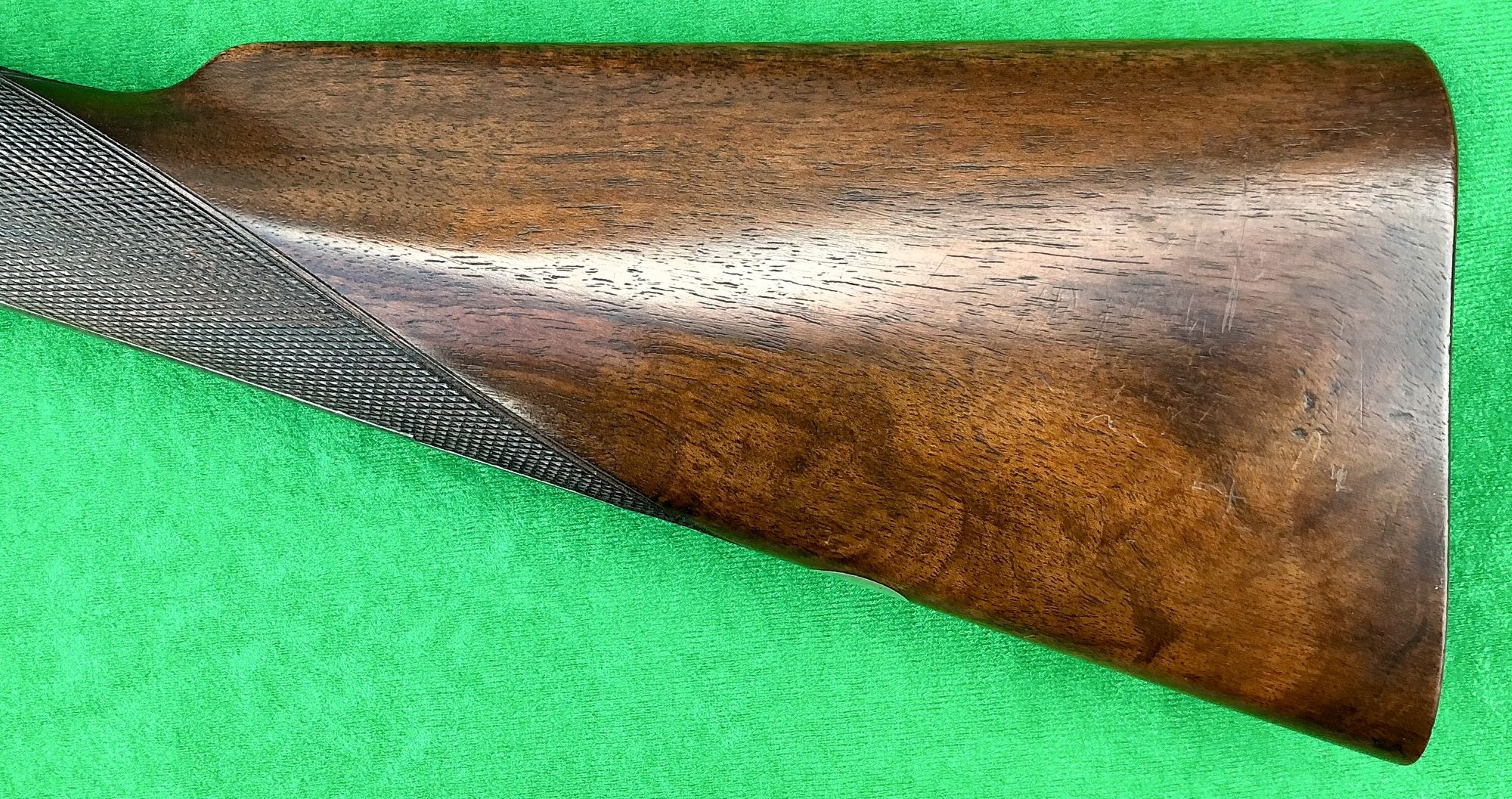
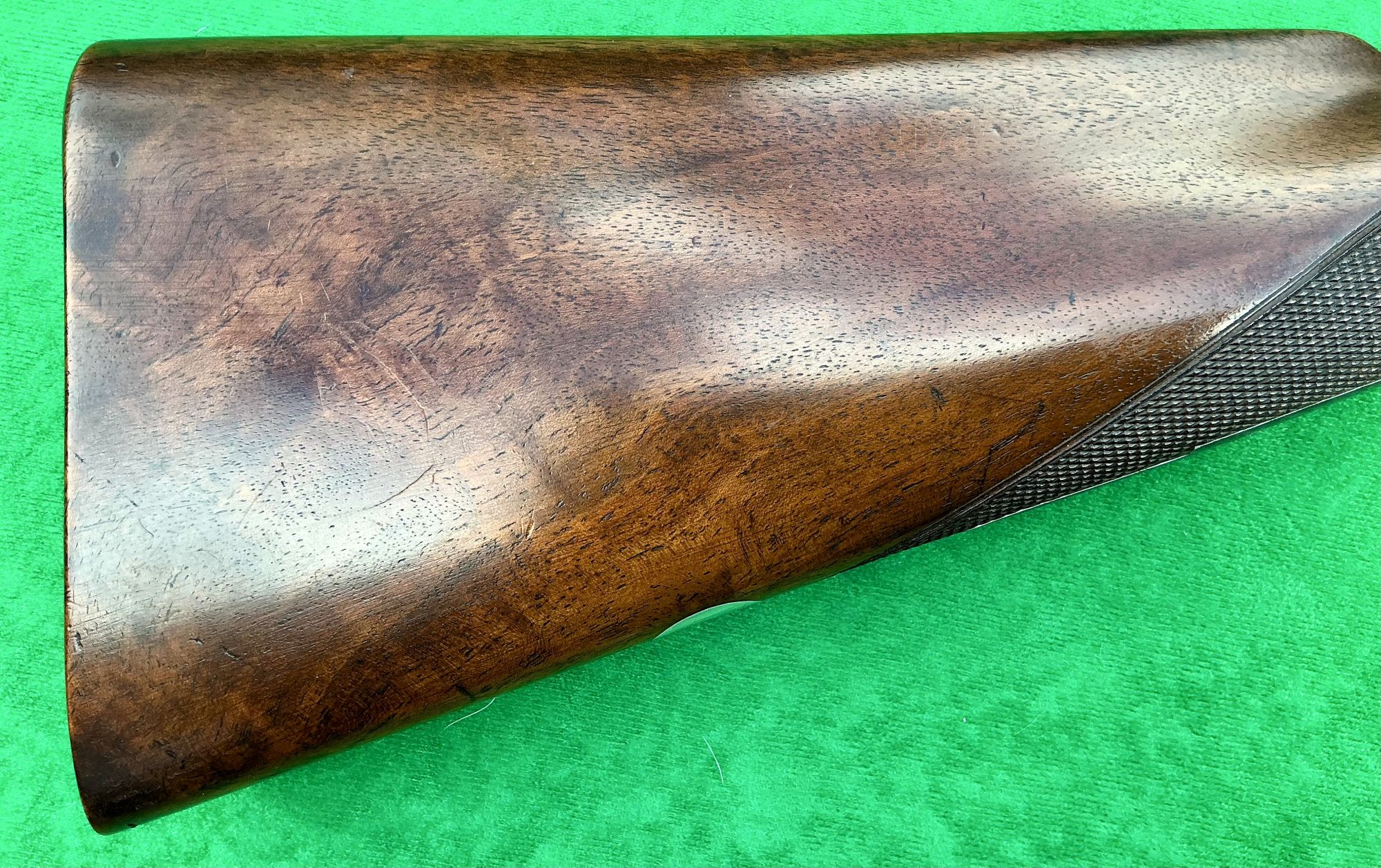
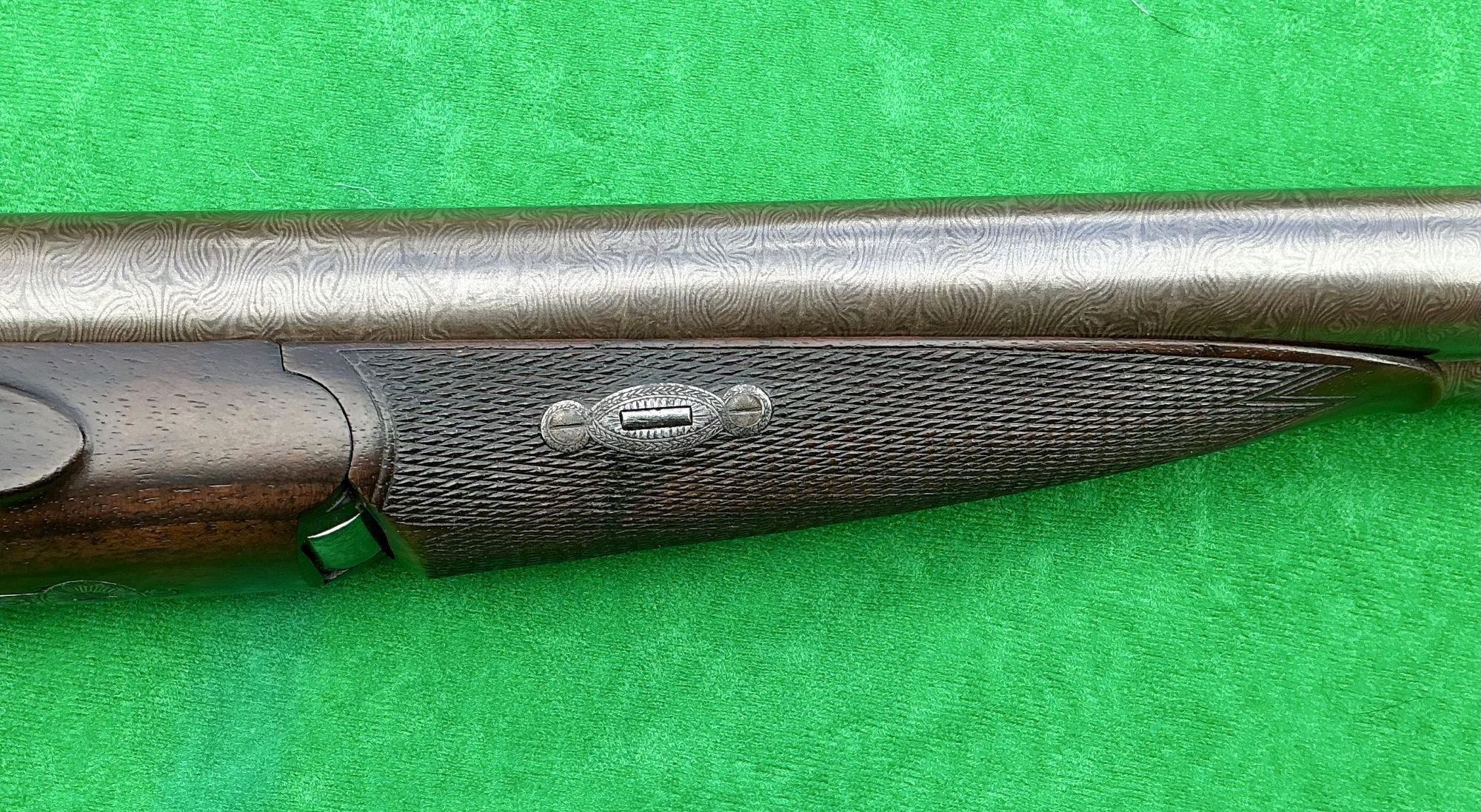
The stock has strong straight grain extending through the hand, the figuring towards the butt is minimal, the butt at some point shortened shaped and checkered. The stock being walnut and checkered at the hand, the stock is completed with drop points, and a (LOP) length of pull measurement of 14 ¼ inches. The forend is permanently attached, with a bar-in-wood joint and matching splinter fore-end also in matching walnut, the forend checkered with a cross-key fastener to attach the barrels once located on the action pin.
The Patent No. 297 by Thomas Newton registered on the 4th February 1864 is included in Crudgington & Baker’s book ‘The British Shotgun’ Volume One, page 117.
There appears to be similarities between the Thomas Newton’s Patent, and that of Thomas Horsley’s Second patent (The Pull-back Lever). The difference being the positioning of a pivot, this was enough to change the movement direction of the sliding bolt within Newton’s Patent. This change has ensured Newton’s Patent works differently, allowing the patent to be secured, and ensuring Thomas Newton’s requirements were achieved.
Thomas Newton moved from Northumberland to Lancashire and established his business at 41 Frederick Street, Salford, in 1855. Within a short space of time, during 1856 Thomas moved his business to 56 Lower King Street, Manchester.
The gun in this article carries the Thomas Newton’s 1864 “self‑acting” drop‑down barrel action, British Patent No. 297 of 1864, the patent described as a tilting breech-loading gun, in which the barrels drop open automatically, in effect “self‑acting” when the top-lever‑slide is operated, by pushing the lever forward.
The core mechanical concept of Thomas Newton’s patent design No. 297 was used during the transitional period, during the Pin-fire era, this is where the patent was first seen. The patent design born out of, and built around three features.
The first being the use of a Single-Bite snap action, which is unusual at this point within the breech-loader development period, due to the fact most makers were rapidly moving toward the use of double-bite systems.
The second being, the use of a sliding bolt / bite, which is engaged via a top-slide lever on the top tang. The lever when pushed forward withdraws and disengages the bite. The barrels through gravity are then free to drop open.
The third being, the drop‑down barrel opening. Pushing the top-lever-slide forward, gravity, and the barrel hinge geometry allows the barrels to fall open under their own weight. At this point in time, this makes the Newton gun “Self-Acting” making guns made with the patent, faster to load than many contemporary Pinfire opening systems.
There were two other patents of note from Thomas Newton - In 1862 Newton patented an adjustable foresight and an adjustable backsight. This was known by interested parties as the Venetian blind and windage adjustment type, patent No. 132 of 1862, we have already covered the 1864 "self-acting" drop-down barrel breech action patent No. 297. The third patent was produced during 1870, this being patent No 703, for a quick detachable barrel attachment, which had a long lever on the fore-end to remove the fore-end and detach the barrels. The patent also covered a trigger guard, of which the rear was hinged and spring loaded to avoid a bruised second finger.
In the 1871 census Thomas was recorded living at 95 Eccles Road, Pendlebury, with his wife, Eliza (b.1831 in Ardwick, Lancashire) Thomas appears to have died in the late 1870’s aged about 60, after his death, the business in 1879 was sold to William Howat (b.1841 in Dumfries-shire) who moved it to 48 King Street West, but it continued the business, and traded as T. Newton.
In 1883 William Howat sold the business to Joseph Percy, who also traded under the name of T. Newton. Joseph Percy was almost certainly employed by Thomas Newton, and then after Thomas Newton’s death, Joseph Percy would have been employed by William Howat.
There are no record’s available after 1906, at which time Joseph Percy would have been 64 years old, however records show the business name of Thomas Newton remained trading until about 1940.
This Thomas Newton ‘Pin-Fire Sporting Game gun’ built in 1864, uses a scarce patent, and at 162 years old this year, the gun remains in proof and ready for a sporting day in the field, with good balance and handling, the gun moves gracefully in the hand at six pounds fourteen ounces.