Late Damascus Barrelled Lancaster
Late Damascus Barrelled Lancaster
Boxlock Non-Ejector - "Made with Care"
This Charles Lancaster shotgun is of a design and configuration, that is straightforward for the gunmaker, ultra reliable, strong, and practical. However quality has a way of showing itself when presented. This gun for all intents and purpose, was built to delivery what it was made for - shooting long distance game including wildfowl. The gun being made before the First World War in 1909, with 32 inch Damascus barrels, as a 10 bore, on a Boxlock action, and being a non-ejector, would in the minds of many enthusiasts and shooters put the gun in the category of an entry level wildfowling gun. However, this gun is "not an entry level gun", and deserves a closer look. This gun was made by Charles Lancaster of 7 Bury Street, St. James’s London, a quality gunmaker and renowned for his work as a gunmaker.

The gun that inspired this article is a well-made, with a better quality of finish than most Boxlock non-ejector Wild-fowling guns. The Gun is based on an Anson and Deeley Hammerless action, patent no. 1756 of 1875, with Double triggers bolted by an automatic top tang safety slide, Anson & Deeley's safety catch no. 907 of 1879. With a Top lever opening, operating a “Purdey Bolts” patent no. 1104 of 1863, by way of a “Scott Spindle” patent no. 2752 of 1865 – The strength of this gun being supported using the three point bolting Webley 'Screw-grip' top extension patent no. 3053 of 1882, in turn giving a Third Bite. The forend is secured via a fastening latch using an Anson's push rod forend fastener patent no. 3791 of 1872.
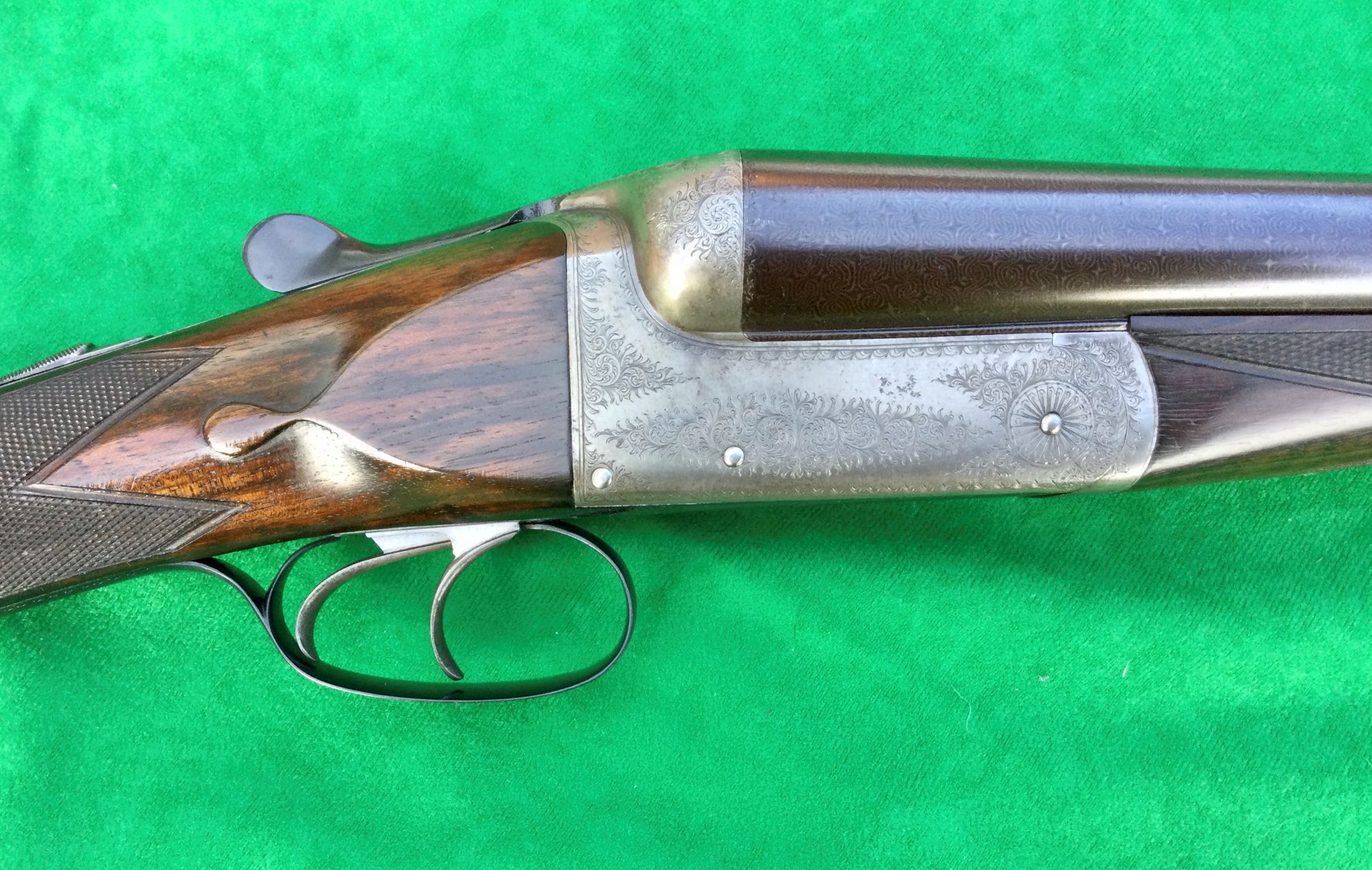
The stock and forend wood on this gun uses a mildly figured dark straight grain walnut for strength through the hand, the stock includes drop points and fine checkering often found on better quality guns. The action is fully engraved, including the forend iron, trigger guard, top lever and forend tip. The forend uses a push-button release, with engraved finial. This gun in conclusion has been completed to a very good level of finish for a Boxlock non-ejector Wild-fowling gun. All of the additional adornments would have cost the original purchaser considerably more when ordering the gun.


Strong straight figured stock giving maximum strength through the hand, completed with finely finished Silvers Pad
The gun being made with Damascus barrels, are likely to have been a request from the purchaser when commissioning the gun, as for many sportsmen Damascus barrels had been surpassed thirty years before. The number of English Gunmakers moving towards using Steel barrels by 1880 had increased dramatically. There were issues with early steel production leaving air pockets in castings. Thankfully Joseph Whitworth brought mechanisation and helped modernised British gun making, with his patent in 1874. The patent being of hydraulic pressure casting of steel, many of us have seen old gun barrels with the words: ‘Made from Sir Joseph Whitworth’s fluid-pressed Steel’. This steel making invention from 1874 was a real game changer for Gun-making as a whole.
Damascus barrels, of various types and quality, had been used since the days of the flintlock, but quality control had always been a problem and craft techniques in a mechanical age were becoming quickly out-dated. British Gunmakers were using Damascus barrels less and less by 1900, leading to the cease of production of Damascus barrels in Britain during 1903. Gunmakers using Damascus barrels after the 1903 date, are likely to have been using the last of their own stock, the purchase of old manufactured stock, or barrels of foreign manufacture. The development of smokeless nitro powders, and the demand for higher pressures for greater velocities, and longer-distance shots accelerated gunmakers towards the manufacture of barrels that were easier to make, lighter and would accommodated and support the modern Sportsman’s needs.

Best Damascus, quality made Boxlock Wildfowling 10 bore - Charles Lancaster - 7 Bury Street St. James London
Countries like America moved away from Damascus barrels starting in the late 1880’s. This is a similar date for European and British gun makers, although, as previously mentioned; the last English Damascus barrels were made in 1903, interestingly during 1906 Liege produced 850 tons of Damascus barrels, including 100 tons for export. The demise of Damascus barrel production was a basic result of modernisation. The production of Damascus barrels in Europe ended soon after August 7, 1914 when Liege fell to the invading German army.

Birmingham Proof Marks 1904 to 1925 - Nitro proofed for 1 5/8 oz - Marked "E" Grade
The request and saleability of Damascus barrelled guns naturally slowed around 1900 in both Europe and Britain. It would be a fair statement, that all British made Damascus barrelled guns after 1903 could be classified as “Late”
In the past 150 years, there have been many patterns and designs including Twist, Laminate, Stubb, Rose, and multiple variations of each, so trying to describe Damascus barrels briefly is difficult. In an attempt to simplify the term Damascus, this is a technique of combining steel and iron for greater strength. It was first used on edged weapons starting around the 3rd century in Damascus, the capital of Syria. These knives and swords were produced in such massive numbers the original unique pattern through manufacture became known by the city’s name.

Best materials, quality finish, established maker - Good quality 10 bore Boxlock non-ejector


At 116 years old this year, this gun remains in excellent condition in all areas of the British gun
During the 1790’s, a Frenchman named Jean-Francois Clouet of Liege, was among the first European gunmakers to experiment with Damascus barrels. Two Englishmen, William Dupein and J. Jones, then expanded on his work, and several years later J. Jones patenting a new process of turning a bevel-edged band of metal into a spiral-twist with interlocking threads. To make these barrels, the iron and steel metal had to be stacked on top of each other, heated and hammered to create one block of mixed metal. The block was then heated and drawn to form a rod. The process was repeated until six such rods were made, and then the rods were prepared for heating and twisting. Three of the rods were twisted with a right-facing thread while three of the rods were twisted in the opposite direction with a left-facing thread. The prepared mix of steel and iron ribbons were then wrapped over and wound around a “Tinned” mandrel, to ensure easier removal from the mandrel once the barrel had been formulated. The threads were connected, heated and hammer-welded, the mandrel was removed, and a barrel was formed. It normally took seven feet of rod to create one foot of barrel.

Fine Checkering to stock & forend - engraved forend tip, with push button release.
Damascus pattern-welded barrels can be very simple, or they can be extremely artistic and contain highly-figured patterns based on how the two different metals were “piled” or layered when the rods were twisted. The most decorative patterns emerge when the outer layers move inward through twisting. The various degrees of depth coming from the number of threads per inch, in turn this determines the pattern, with some being simple chevrons or diamonds, while others being more complex.
Mr. Graham N. Greener, the Director of W.W. Greener Sporting Guns Ltd. offers new shotguns with Damascus barrels. The Damascus barrels used for the new guns, are interestingly manufactured from blanks, and are the last of remaining Damascus Barrel stock from over a century ago. “Mr. Graham Greener stated, “Our company was the last English gun-making company to make Damascus barrels. The production of these ceased in 1903,” he said. “We had a stock of the last manufactured “Damascus Steel” barrels and decided to make shotguns with these barrels again, some of these guns were made with steel, and some with Damascus interchangeable barrels. These have mostly been Best Sidelock, side-by-side sporting shotguns in 12 and 20 bores. All have been made to individual orders including pairs and sets of guns.

One of the W. W. Greener Best Quality Side-lock, using Damascus barrels made in 1903
Old stock Damascus barrels made in 1903, used by a top British gun-maker, and used in the making of works of art in the 21st Century. These guns will be used now and for many years, well into the future – Heritage embraced, and passing today’s most stringent barrel proof testing in the World.