J. P. Clabrough & Bros.
J. P. Clabrough and Bros.
A Transatlantic British Gun Affair
John Plumb Clabrough, often pronounced “Clay-burro,” was an English-trained gunsmith who built a transatlantic business linking San Francisco and Birmingham. John Plumb Clabrough was born in Yorkshire, England, and successfully apprenticed under his Gunsmith father. In 1857, at age 21, he emigrated to the United States with his siblings, traveling by steamer to New York and then westward to Jacksonville, Illinois. By about 1860, J. P. Clabrough had secured work in St. Louis at the renowned Samuel Hawken shop.

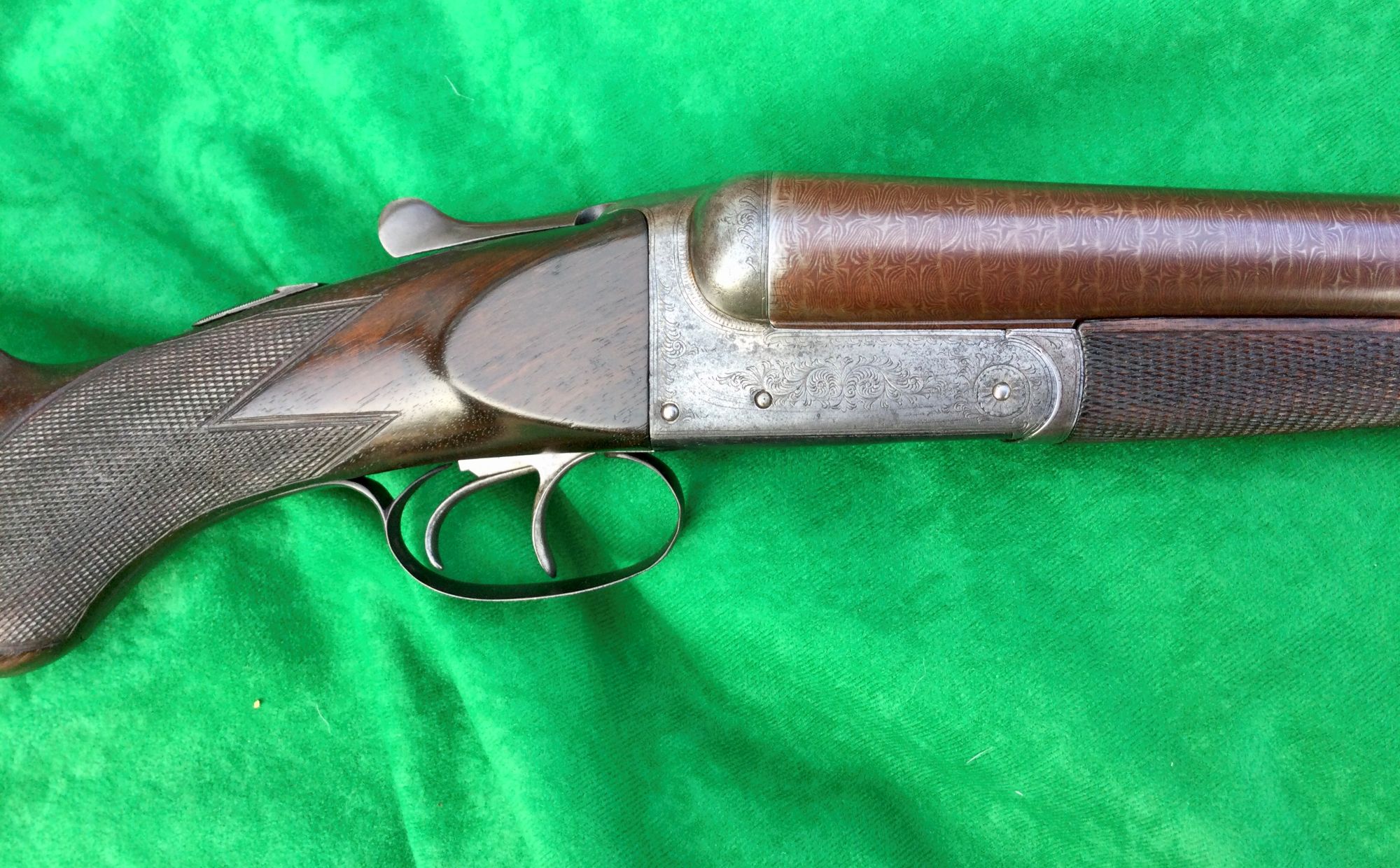
Strong reliable Boxlock - Birmingham made 10 bore - Medium quality, but built to last
The maker J. P. Clabrough, by 1863 was listed in San Francisco’s business directory, and had paid $27 in federal income tax for that year. He worked for shops like "Wilson & Evans" and "Robert Liddle & Co." before opening the J. P. Clabrough shop at 630, Montgomery Street San Francisco in 1867. His earliest surviving guns include two side-by-side 12-gauge percussion shotguns and a .52-caliber percussion rifle, all stamped “J. P. Clabrough, San Francisco”.

Built to last a lifetime - Three point locking - Boxlock - 10 bore - Non-ejector
In 1868, J. P. Clabrough returned to England to arrange manufacture of shotguns in Birmingham to his specifications. He set up a large workshop at 8 Whittall Street in 1871, taking over Ebenezer Hollis’s former premises. He also secured a deal to market W.W. Greener firearms through his San Francisco outlet, this making the link, and bridging the two sides of the Atlantic, and two major Gunmaking centres.
In 1870, brothers George and Joseph joined the Clabrough firm, and it was renamed “J. P. Clabrough & Bros” In early 1872, John P. and Joseph returned to England, leaving George in charge of the San Francisco store. There return to England was for the purpose of manufacturing guns and pistols in Birmingham. This, all being in preparation for the export of firearms to the (now larger) Clabrough store in San Francisco. The business continued to expand, eventually adding sales offices in New York City, Philadelphia and Chicago, and eventually expanding the business to include other countries.


Good grade of wood for a Medium quality Wild-fowling gun - Pistol-grip stock, with a silver stock oval
George Clabrough of the San Francisco store became ill about 1876, unfortunately George died in 1879. The firm now had, both addresses in both San Francisco and Birmingham, the annual firearm production reached about 3,000 firearms by the late 1870’s. Their primary products, being - Side-by-side shotguns (percussion and early hammerless conversions), plus Cape guns (one rifled, and one smoothbore barrel) also a number of both, Single-shot and Double rifles.

Decent quality Damascus 32 inch barrels - Makers name: J. P. Clabrough & Bros. Birmingham
In 1877 John Clabrough met William Golcher who had retired from the gun business in Minnesota, J. P. persuaded Golcher to take a look at the San Francisco store. In 1878 William Golcher took charge of the San Francisco store, William liked the area, and enjoyed the climate very much. This resulted in William purchasing a half interest in the company in 1883. After this date the guns were marked Clabrough and Golcher.
In the late l880’s, the Clabrough business reached the peak of its production at between 10,000 and 12,000 guns a year. All the firearms needed for the J. P. Clabrough business were produced in factories at Birmingham's Whittall Street, and the now legendary St. Mary's Row factory.

Three bite locking, including the Greener style cross bolt - Steel insert on hook (Putting the gun back on face)
The Clabrough & Bros. company at the time were making firearms in large numbers, their "Trade Guns" were made for mail-order catalogues and hardware stores, and carried names like “Samuel Buckley”, “Never Miss”, and “The Invincible”. The firm also made High-grade hammer guns, initially introduced for America’s 1876 Centennial, and were stamped “Centennial”, these guns featured figured walnut, complex checkering, and gold / platinum inlays. In later production premium models bore the name “Diamond Quality”.
Clabrough adopted the Anson & Deeley boxlock in the mid-1870’s and, in 1881, the firm acquired rights to J.T. & J. Rogers’s hammerless, detachable barrel-actuated back-action lock to rival Greener, Bonehill, and Scott.
J. P. Clabrough at 57 years of age had done well in business, and had also invested well in real estate within the San Francisco area. In 1892 he sold the Birmingham gunmaking factory to a man named Douglas V. Johnstone. During 1893 J. P. moved back to San Francisco and emerged himself with his real estate, and the Clabrough, Golcher & Co. store, in which J. P. had retained a half-interest in their business. During the summer of 1895 J. P. was diagnosed with liver cancer; he died October 5 1895. His estate was valued at $200,000, at the time of his passing, this equates to many millions today.
The gun that inspired this article was made during the period when the firm was known as Clabrough & Bros. ? - The gun is a 10 bore with 2 5/8 chambers, and with 32 inch Damascus barrels, the barrels alone weigh 4 lbs. 9 oz. The overall weight of the gun being 8 lbs. 15 oz. The barrels are well in proof, and have barrel wall thickness of 32 thou. in both, and choked at ¾ & ¾. The Length of Pull being 14 ½ inches, with a pistol grip. The top rib name inscription “J. P. Clabrough & Bros.” gives a time period is between 1870 and 1883, we are aware of the introduction date of the Boxlock from 1875, however the proof marks on the gun tell a different story, as they are Birmingham proof marks for 1904 to 1925. This information does not make the seamless link expected, fortunately further research unravels the puzzle, and gives us an answer.

Nitro-Proof Birmingham for 1904 to 1925 - Supporting the date of manufacture circa. 1910
Douglas Johnstone owned a small gun factory in Birmingham, with some financial support from D J’s father, he bought J. P. Clabrough’s side of the business. The sole owner of the business now being Douglas Johnstone, changed the business name to J.P. Clabrough & Johnstone, Douglas Johnstone is known to have sold guns under a number of different names, three of those being; J.P. Clabrough & Bros., Clabrough & Johnstone, and D.V. Johnstone. Advertising has confirmed, these named guns were also marketed in Spain, France, Australia, Russia, Germany and the Persian Gulf. The name engraved on this particular gun being J.P. Clabrough & Bros. with 1904 to 1925 proof marks, confirms the gun as being made in Birmingham within the business of Douglas Johnstone – puzzle solved.
This Gun is based on an Anson and Deeley Hammerless action patent no. 1756 of 1875, with Double triggers bolted by an automatic top tang safety slide, Anson & Deeley's safety catch no. 907 of 1879, with a Top lever opening, operating a “Purdey Bolts” patent no. 1104 of 1863, by way of a “Scott Spindle” patent no. 2752 of 1865 - Three point bolting including via a Barrel extension and round cross bolt giving a Third Bite. The forend fastening latch through a “Deeley & Edge” fastener patent no. 1422 of 1873.


Forend fastening latch - “Deeley & Edge” fastener patent no. 1422 of 1873.
It would be fair to say this is a well-made Birmingham 10 bore Boxlock of the period Cira. 1910. is of medium quality. The materials used being very good, however in comparison with the materials used, this gun lacks the finish of a best quality 10 bore Boxlock, making this gun great value for money for the original purchaser, and testament to the maker, with the gun being ready for a day out, in original condition at 115 years old this year.
Douglas Johnstone continued to market guns under different names, until the pressures of import taxes, and wartime production changes came into effect. The economic depression of the period led to a consolidation of the business with other Birmingham gun makers.