Robert Hughes & Son's
Robert Hughes & Son’s
Birmingham Gunmaker 1855 to 1908
Stories from the Scrap Pile
Another quality British handmade Victorian sporting gun destined for the scrap pile. This Robert Hughes and Son’s hammer gun was found among a group of guns collected for disposal. This gun, unfortunately out of proof, therefore unsaleable to the public, and uneconomical to repair via the Trade through re-barrelling, or sleeving, left little option for this old British Vintage gun - So here we are again, another classic heading towards the fate of “Madame Guillotine” and the scrap pile !

Saved from the "Scrap Pile" through "Proof Exemption"
However, at the time this gun was due to meet “Madame Guillotine” there was an option of “Proof Exemption” This option has been removed, and is now no longer available, in turn the final safety net for these old works of art has gone !
The Proof Houses once offered an inspection of submitted older Vintage guns, and if the gun met the criteria of being historically important, collectable, or antique, with the likelihood that the gun would not survive, or likely of being damaged, or destroyed through the process of proof, or re- proof, then the gun could be considered for Proof Exemption.

A finely balanced, well made Birmingham Game Gun from 1896 - saved from "Madame Guillotine"
In the event the submitted gun met the criteria, then the gun and all its details would be recorded at the Proof House as being Proof Exempt, the gun would be Proof stamped, and a proof exemption certificate issued. This would allow the gun to be kept on the relevant certificate, in this case a current shotgun certificate. The Proof Exemption Certificate information also include a statement “not to be fired”. This Robert Hughes and Son’s at the time of submission met the criteria, and in turn was saved !

The "Proof Exemption Certificate" allowing the gun to be held and transferred to Shotgun Certificate holders.
WARNING:- The arm, to which this certificate should be attached, must not be offered for sale as serviceable. It has not been proved and should not be fired.
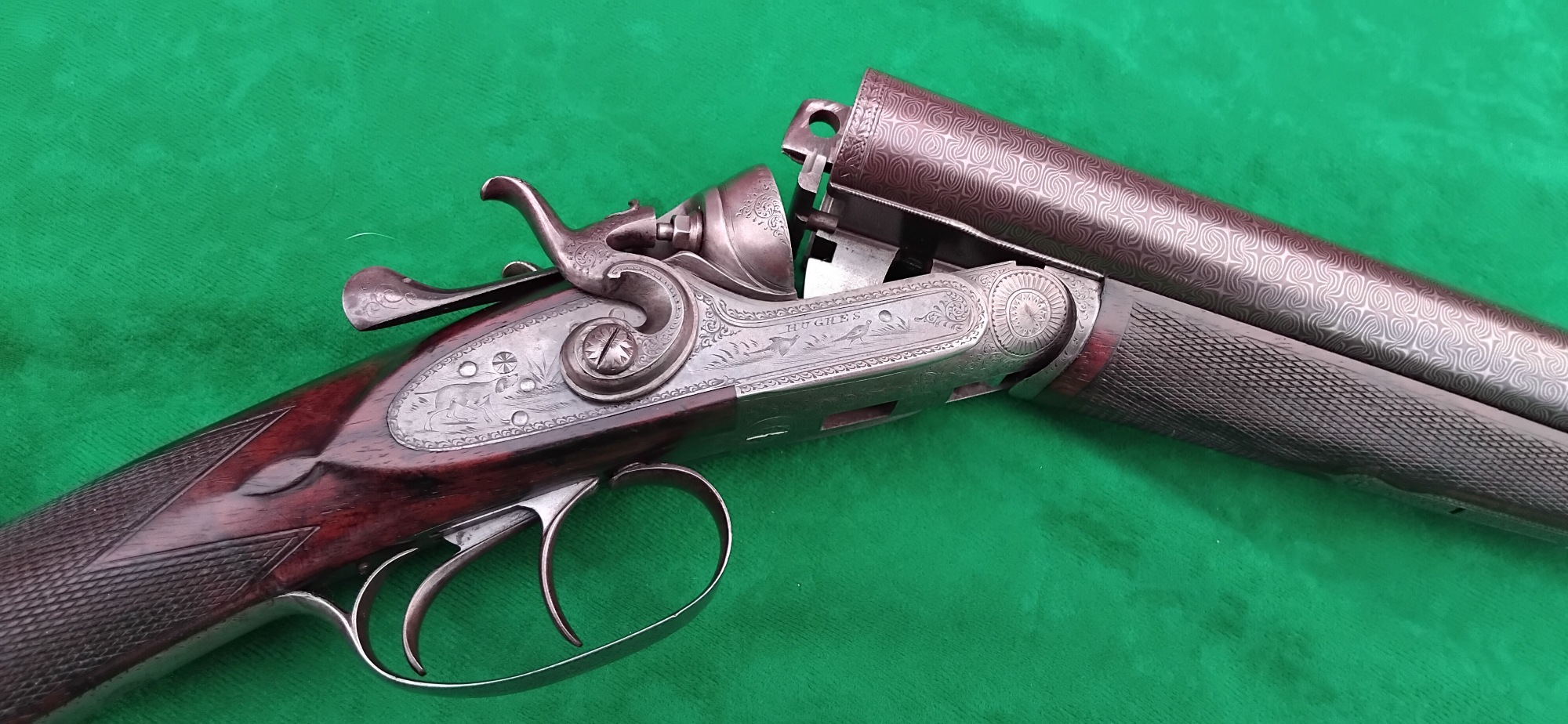
Robert Hughes & Son’s – London Quality, Top Lever opening, 12 Bore Hammer gun, with black powder proof marks for 1887 to 1896 – the gun made and chambered as a 12 bore, although being made and marked as using 13 bore and 14 bore barrel tubes. The Damascus tubes have a vivid and strong pattern. The gun has a number of good quality features, including – Engraved “Heel and Toe” plates to the stock tail, “Tear Drop or Drop Points” behind the lock plates. The locks having quality engraving of dogs driving pheasants, “C” scroll hammers, and quality engraved throughout. Top lever opening, operating a “Purdey Bolts” patent no. 1104 of 1863, by way of a “Scott Spindle” patent no. 2752 of 1865 - Three point bolting including via a Barrel extension and square cross bolt giving a Third Bite. The forend fastening latch operated through a “Deeley & Edge” fastener patent no. 1422 of 1873, and horn tip to the splinter forend. The stock being of strong design, with straight grain through the grip and lightly figured walnut towards the stock tail. The locks are not signed internally by the likes of Brazier, Stanton, or Chilton, however, they are of good quality and likely to have been made in-house by the maker and the company’s extensive workforce.

Quality Locks made in-house by the Robert Hughes & Son's extensive workforce.
The Robert Hughes Gun-making business from around 1880 appointed E B Phelps of 85 Gracechurch Street London, as their London agents (Charles Phelps of Birmingham is likely to have been a relation, or connection). The firm between 1901-1908, now named Robert Hughes & Son’s, had dispensed with their agents in London, and opened the Robert Hughes and Son’s premises / shop at 46 Fenchurch Street London.

Good quality Damascus barrels - Top rib inscription, Robert Hughes & Son's Maker's Birmingham.
Robert Hughes was born in 1827 in Birmingham. No record of him has been found in the 1841 census, however in the 1851 census he was recorded aged 24 years living in 40 Pritchett Street with his sister, Margaret (aged 16 years born in 1835).
Robert Hughes started his business in 1855 as a military pistol maker at 22 Moland Street, but in the 1851 census Robert Hughes described himself as a master gun finisher employing 2 boys. His sister Margaret was described as a gun finisher's fitter. The 1861 census records Robert Hughes at 22 Moland Street as a gun maker. By this time he was married to Emma (nee Whitworth born in 1828 in Birmingham) Robert and Emma had three children, Robert Whitworth (born 1854), William Henry (born 1856) and Emma M (born 1858).

Black Powder Proof marks 1887 to 1896, showing 13 & 14 bore barrel bore sizes, and Vivid Damascus pattern.
The Robert Hughes Gun making factory during 1868 was called the Universal Firearms Works. In 1869 the Robert Hughes firm appointed E Manser of 16 Laurence Pountney Lane, as their London agents, also during 1869 the expansion of the business continued with additional factory facilities being opened at 100 Bath Street. During this time the firm are reported to have commenced making their own barrels, actions and furniture.
In the 1871 census the family was recorded living at Mitchley Road, Harborne, Birmingham. By this time three more sons had been born, James Alfred (born 1863), Albert Victor (born 1865) and Arthur Henry (born 1867). In this census Robert described himself as a master gun maker employing about 50 men and 6 boys. The business was growing, the expansion and records showing this was a large and very successful gun making business. During the time of the 1871 census Robert's son, Robert (II), was described as a gun maker.

The quality of material used for the Forend attachment emerges during the etching process.
The Robert Hughes firm in 1873 moved to 100 Moland Street, at this date additional factory space was obtained in Aston Street. In 1880 Robert Hughes's sons were reportedly made partners in the business, this has not been confirmed and seems doubtful. The name of the firm did not change to Robert Hughes & Sons until about 1896 as confirmed by the gun in this article. In the 1881 census the family were living at The Cedars, 4 Augustus Road, Edgbaston. Three daughters were recorded, Alice W (born 1869), Edith (born 1871) and Amy F (born 1873).

Splinter Forend with Horn tip and strong Damascus pattern throughout the full length of the barrels.
Robert Hughes died on 6 May 1887 leaving an estate valued at £34,247 16s. 9d. The 1891 census records Emma as a widow living at Deanhurst, Oxford Road, Moseley, Kings Norton with Alice, Edith and Amy, and two servants one a domestic and the other a "hospital nurse sick" probably looking after Emma. William Henry, described as a gun maker, was recorded living at Oversley, Bromsgrove with his wife, Edith Ellen (born 1862 in Nottingham). Albert Victor, described as a gun maker, was recorded living at Woodleigh, Middleton Hall Road, Kings Norton, with his wife, Margaret (born 1867 in Burton, Nottinghamshire).

Quality engraving throughout.
In the 1901 census William Henry was recorded living at Oversley, Shepley Road, Bromsgrove with his wife Edith Ellen (born 1862 in Nottingham). They employed a cook and a housemaid. William Henry described himself as a gun manufacturer. Albert Victor was recorded living at Eastnor, Middleton Hall Road, Kings Norton, with Margaret and two sons, Leslie (born 1893) and Gordon (born 1895). The family employed a cook and a housemaid. Albert described himself as a gun manufacturer.


Strong straight grained walnut has ensured strength throughout the Guns' life while in the hands of the user.
In 1907 the firm was sold to, or amalgamated with Joseph Bourne & Sons and moved to 100 Bath Street. Joseph Bourne & Sons were recorded at 100 / 101 Bath street from this date (1907). It seems that Joseph Bourne & Sons produced guns under the Hughes name until 1912 and possibly later.
William Henry Hughes died on 13 April 1911 leaving an estate valued at £23,564 16s. 5d. Albert Victor Hughes was recorded in the 1911 census staying with friends in Bournemouth, obviously he had retired.