J. D. Dougall - Lockfast
J. D. Dougall
Lock-fast Breech-loader
The Gunmaker J. D. Dougall designed one of the strongest early Breech-Loading actions in existence during the 1860 period, making the statement “No Charge Can Hurt The Gun” J. D. Dougall’s Lock-fast patent of May 1860, No. 1182 was his answer to action strength during the breech-loader development period.

J. D. Dougall - Lockfast - Breech face Bosses - Side-lever Cam opening Barrels
James Dalziel Dougall aged 23 years old took ownership of the Glasgow family business in 1841. The business was established during 1760 initially as fishing tackle makers. J. D. Dougall was a keen writer, with publications about shooting, and letters in the sporting press. Dougall was a particularly good publicist, this worked well for promoting the J. D. Dougall Gunmaking business. He had several ideas in the area of mechanical engineering, however the invention that established Dougall as a Gunmaker, securing his reputation was the Lockfast action. The action being patented in May 1860, was at the beginning of the breech loader story, the timing of the Dougall patent was perfect.

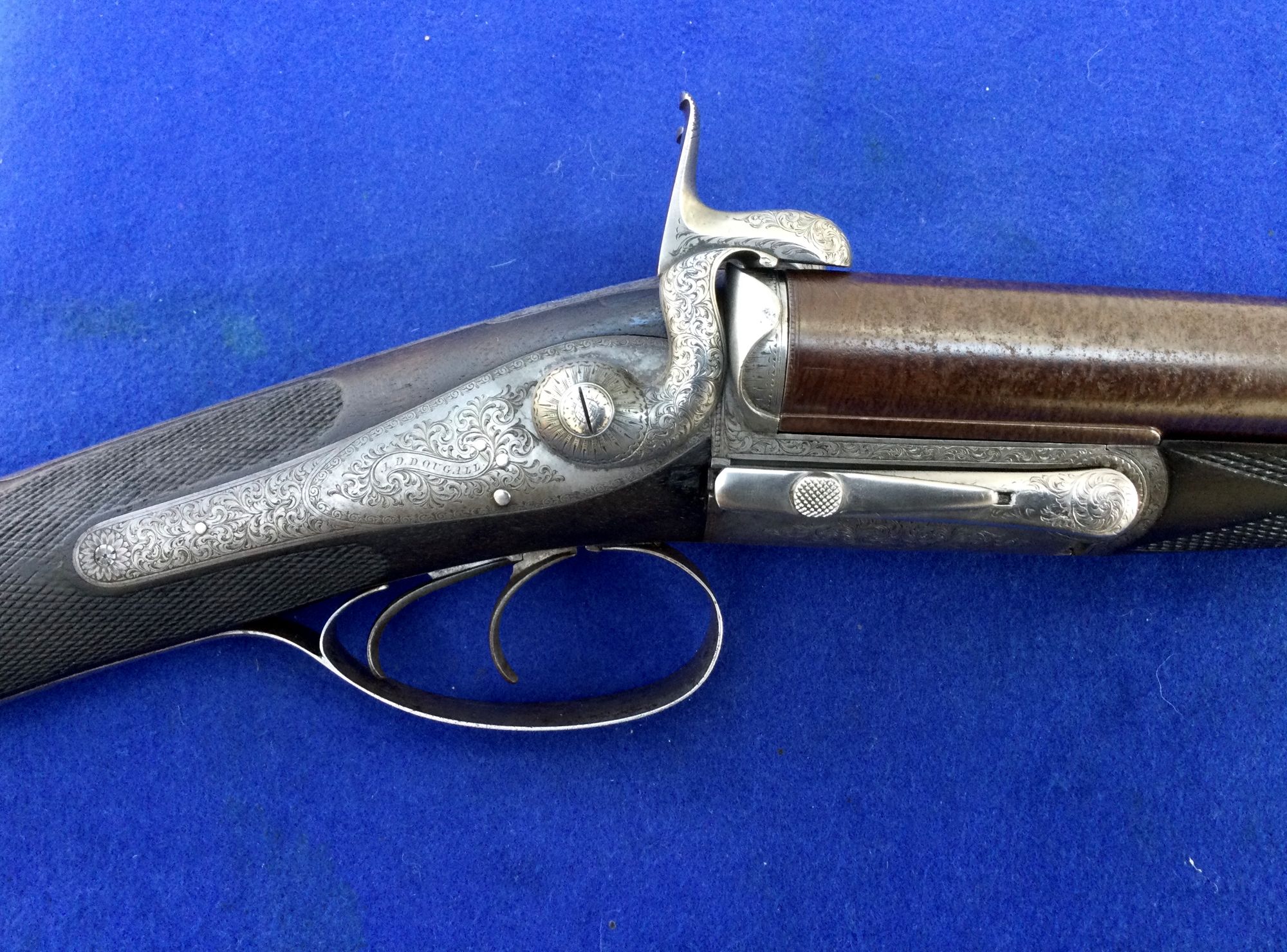
Fully engraved action body, locks, and hammers.
The start of the breech-loader era gave all Gun manufactures involved with its development, the same series of concern, primarily being, how to secure the barrels to their actions, and how to ensure these would hold up under continued use, and the associated pressures when fired. The Lefaucheux Pin-fire actions started the journey towards the development of the British breech loader, with several prominent makers involved, like Joseph Lang, E. M. Reilly, and John Blanch. However, it was noted, the early Lefaucheux gun barrels were secured to the action through a single bite, which operated close to the pivotal hinge point, this design point was identified by many makers as being a natural weak point. This was a development area that British Gunmakers sort to overcome.

Dougall action body underside - showing inscription "Dougall's Patent Lockfast"
The strongest of the early British breech-loader actions, was that of Charles Lancaster. The action known as the “Slide and Tilt” whereby the barrels slide forward, and dropped open at the hinge point by way of a cam linked to a rotary underlever, however, and surprisingly the Lancaster “Slide and Tilt” action was another French invention by L.J. Gastinne, patented in England by the patent agent Auguste Bellford in 1853. The patent was assigned to Charles Lancaster in 1856. The Lancaster action was strong and reliable, in turn the action design was used extensively and exclusively by Charles Lancaster for the next 15 years.
The Henry Jones underlever, patented action of 1859 overcame several lock-up issues, what we are now aware of, is not only was the Jones patent underlever one of the most successful breech closing mechanisms of them all, it was also incredibly strong. The J. D. Dougall 1860 patented “Lockfast Action” invention was implemented at the same time the Henry Jones action was still Patent protected. However during this development period Gunmakers needed to get noticed, to promote and elevate their position. This was achieved through inventing and patenting those designs, that, not only worked, but were also of benefit to the sporting gun user, strengthening their reputations and supporting the development of British Sporting guns.
The J. D. Dougall Lockfast patent was an extraordinary strong design, that supported confidence in breech loader use. The Lockfast patent was well promoted, and its capability through writing in the shooting press demonstrated, Dougall could so this so very well !

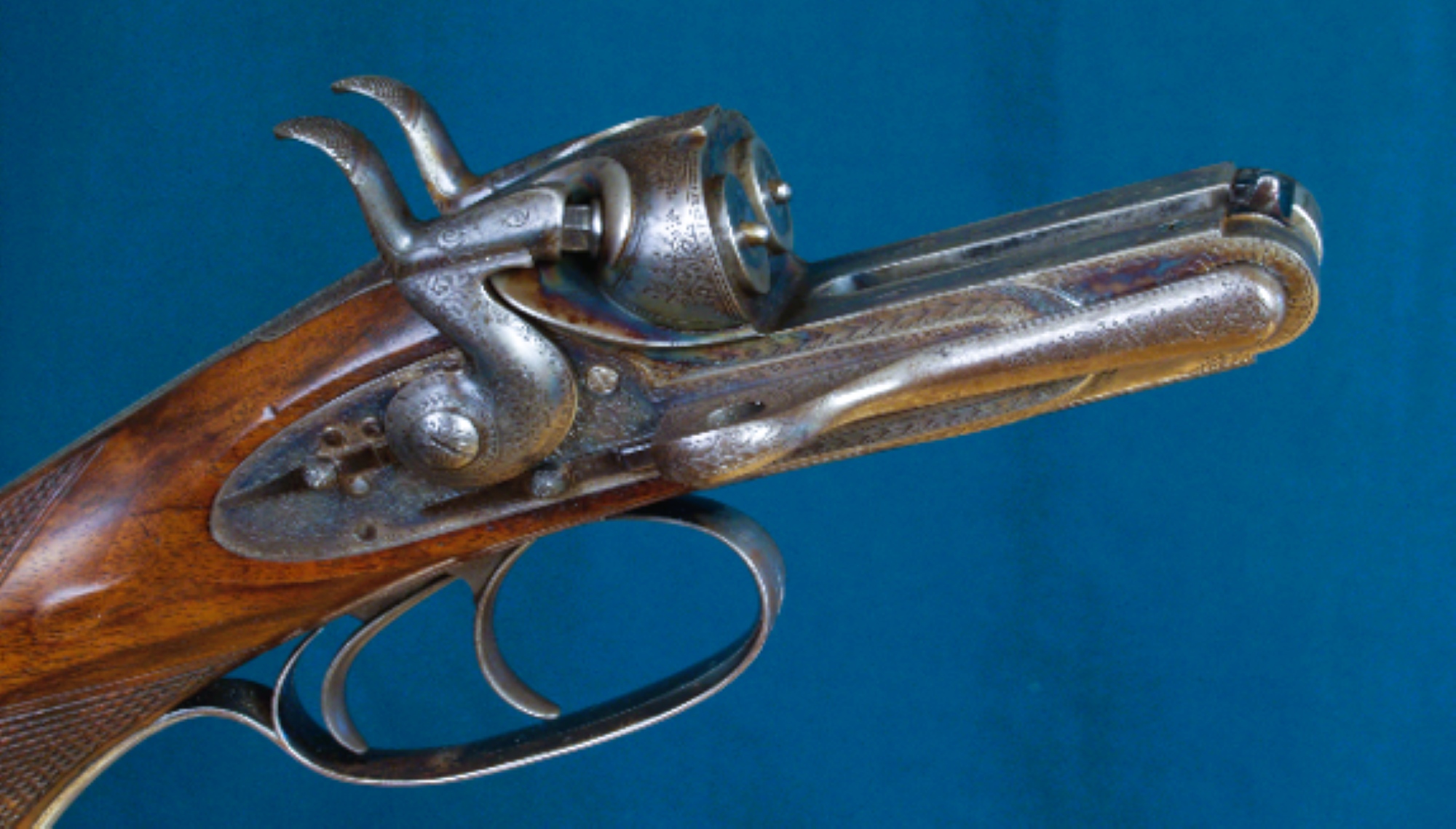
Side Lever starting to open - taking the barrels off the breech-face Bosses.

Side Lever point just prior to barrels fully opening - forend iron clear of the knuckle.
The Lockfast action patent created both forward and backward movement. The forward movement disengaged a bite on the back of the lump beneath the action face, and removed the barrels from the breech face bossed, this is achieved through an elliptical cross pin attached to a rotating side lever. The opening lever protruding at the hinge point on the side of the action body at the point of the knuckle. The side lever is rotated a quarter turn to move the barrels the distance needed for the gun to open over the hinge point, and to be, either loaded or unloaded. The lump has a large hook, this creating additional bearing surface and the ability in reducing ware. The cross pin at the hinge point of the action body, with its elliptical shape acted as a cam. This cam moved the barrels backwards or forwards depending on the rotational direction of the side lever.

Dougall Top strap, Pin Hole breech face location lugs - fully engraved.
The Dougall action evolved over time, particularly the position and direction of the side-lever rotation. This became different in later guns, as were some other details of the barrel bolting. A particular feature of the Lockfast action, is the provision of two circular bosses protruding from the action face, both bosses matching the measurements at the barrel breech ends leading to the chambers, the additional depth of cut at the barrel breech ends accommodates the barrel breech exactly, allowing the bolting and sealing the mechanism between the action and barrels. This all takes place as the barrels move backwards over the bosses, pushing the cartridges into the chambers as the barrels are closed and sealed using the elliptical movement of the sidelever.

Side Lever Open - Barrels moving off the breech face bosses, Forend iron separating from the action knuckle.
The use of the Lockfast patent, on both Dougall guns, and other Gunmakers using the patent under license, have been seen used on Shotguns and Rifles, in both Pinfire and later Center fire guns. The majority of surviving examples are of good quality, with excellent levels of engineering and Gunmaking during their production.
The quality in design and construction of the J. D. Dougall Lockfast patent is evident. This is very much borne out in the fact many of Dougall guns remain usable today. The design in modern times is complicated, over engineered and would be difficult to produce commercially for profit.

Large Hook - additional locking point at base of Hook, linking to forend iron.
During the development of the Breechloader, the design, the patent and the maker J. D. Dougall was exactly what the Victorian British Game shooter needed at that time, Dougall provided a strong, robust and reliable British Game gun, his guns had elegance, style, excellent build quality and reliability. The Dougall Lockfast gun was good enough to be successful on its own merits, however the hard work and ability of Dougall in the areas of press writing and product promotion would have supported his product fully.
Inspiration for this J. D. Dougall Article
The J. D. Dougall Lockfast Pinfire shotgun that inspired this article came into the Collection 20 years ago, after being purchased from Mr. Donald Ladd. This Dougall 12 bore Pin-fire was made between 1863 to 1865. The gun has the J. WILKES name stamped in the base of the action body. Surprisingly the action stamp itself has survived, as well over a century later the stamp was found still in the Wilkes workshop in Soho. The quality of work on this Dougall Lockfast, includes an articulated front trigger, although there is little information about when articulated triggers made a regular appearance on British Game guns, we are presuming 1865 could be relatively early !

Articulated front trigger ! - Trigger finger protection from recoil.

Articulated Trigger - Supporting quicker trigger finger movement.
There are few clues as to what the Wilkes Gunmaking business produced in this period. There are very few guns bearing the Wilkes name surviving from this period, or the period between the transition from muzzle to breech loader. This would suggest that most of the guns made by Wilkes would have been finished bearing the names of others, rather than their own. Through describing himself in 1861, as a breech loading action maker, John Wilkes was clearly positioning himself at the forefront of the new trend.

The Action Makers stamp at the base of the action - J. Wilkes ( Prior to J. Wilkes joining the Dougall firm )
John Wilkes worked for the famous action maker Edwin Charles Hodges. The young John Wilkes rose rapidly in the esteem of both J. D. Dougall and his son, this resulted in John Wilkes soon taking over the management of the Dougall Gunmaking workshop in London. This arrangement lasted until the J. D. Dougall firm closed their London business on the death of James Dougall the younger in 1896.
Whilst John was building a strong reputation within the trade in London, the Birmingham Wilkes business owned and run by John’s uncle was prospering. The London based John Wilkes, although young, must have been seeking to grow beyond the confines of the Dougall arrangement, as in 1894, two years before Dougall’s death, John Wilkes had opened a premises of his own. This was a first floor workshop at 1 Lower James Street, between Piccadilly Circus and Golden Square, in Soho. This being the district where the Wilkes business would remain for the next 109 years. For much of this time Soho was the center of gunmaker outworkers to the London Gun trade, its narrow streets providing affordable workshops for artisan craftsmen within easy reach of the West End. The sudden closure of the Dougall business, allowed Wilkes free to expand his own business interests. His business card at the time describes him as a Gun Stocker and Finisher, late of J.D. Dougall and Sons and able to undertake repairs and alterations.

Action Body - Breech-face bosses, Action base barrel locking lug, Barrel pin-hole locating lugs.
The Field magazine carried the article below in their Saturday 4th May 1861 Issue.
DOUGALL’S LOCK-FAST BREECH-LOADER
Necessity has been wisely said to be the mother of invention, and to the truth of this aphorism the sporting world is indebted for the application of a great mechanical principle to the construction of breech-loading firearms. Mr. Dougall, the possessor of one of the oldest gunmaking establishments in the kingdom, and favorably known to our readers under his signature of “A Glasgow Gunmaker,” finding his cautious countrymen resolved to await the improvement of the “Lefaucheux” gun, confessedly incomplete through the want of any actual locking of the barrels and stock together, set himself to solve the problem, and to do what for twenty years had been pronounced an impossibility, viz., to let the barrels of a “Lefaucheux” gun work upon their hinge-pin, and yet interlock with the false breech. After digesting many plans, and seeing their intrinsic weakness, he finally hit upon the ingenious method of converting the hinge-pin, hitherto a fixture, into an eccentric rod acted upon by a lever, the two representing a locking power which he modestly estimates at 600lb., but perhaps 1000lb. would be nearer to the mark. Not only is a better catch thus obtained, but that catch is at the extreme end of the barrels, the only point where a perfectly solid grasp can be attained. The same pressure acting upon the cartridge, necessarily places it most solidly against the breech, thus diminishing the recoil, and increasing very much the shooting powers of the gun. The value of the invention was seen at once, and large sums were offered for the patent right. These offers Mr Dougall has declined, and has (wisely in our opinion) thrown the invention open to the trade on a moderate royalty, being convinced that this will in no way be adverse to his own private demand, already beyond his powers of supply. We may also mention that at a meeting of the most extensive Liège gunmakers, it was resolved, nem. con., to adopt the invention; and with such rapidity and energy was the matter carried into effect, that before leaving Liège Mr Dougall saw a large number of guns put into workmen’s hands. By another ingenious invention the gun can at once be converted into a muzzle-loader. A moveable brass breech is placed in the barrel. This is not new, but hitherto it had always to be removed to receive a new percussion-cap after every shot. Mr Dougall does away with the percussion-cap altogether, but not knowing whether or not he intends to take a patent for this separate invention, we shall only here state that the plan is most effective, and enables the gun to be used with all the other facilities of a muzzle-loader, while his lockfast action renders this moveable breech much more secure than in the gun as commonly made.

Star Burst Pin Holes, with breech face locating lug recesses.

Barrel Breech end - Hook Lump with Barrel locating bottom locking lug.
A Brief History of J. D. Dougall (Lockfast Period)
In 1864 Dougall opened at 59 St James’s Street London, which he ran along with the business in Glasgow. The area of St James’s Street is a wide gently sloping thoroughfare that runs from Piccadilly at its northern end to join Pall Mall at the southern end opposite St James’s Palace.
During the 1860’s St James Street was the very center of the London gun trade, at the time premises operated by, Boss & Co. at number 73, Moore and Woodward at number 64, and with Rigby and Grant opening shops at number 72 and number 67A respectively before the end of the decade, also with Gye & Moncrieff operating from number 60 in 1876.
The properties in St James Street were numbered sequentially in the late 1870’s, this showed there were six Gunmakers on the West side of St James Street, all within a couple of hundred yards of each other.
In 1872, Dougall was granted a Royal Warrant to supply guns and rifles to Albert Edward, the Prince of Wales, the future King Edward VII. The Sandringham Gunroom have two examples of Dougall’s work, the first being a Pinfire made for the Prince in 1864, and a Center fire made for the Prince during the 1870’s both with the Lockfast action. Dougall, as we are aware is an established promoter, so ensured his Royal patronage was included in engraving on his guns, including the Prince of Wales feathers on some.
At the height of Dougall’s success, the numbers being made were over 130 guns and rifles a year in the 1860’s. The Dougall Company were in a strong position, with a prestigious St James Street London address, and Royal Warrants, everything must have looked very promising. Dougall is a forward thinker, and references outline a discussions between Dougall Senior and Capt. Schulze about the formation of a company to make smokeless powder, these plans were as early as 1864. The involvement with powder development may have been through understanding that everything moves forward and development continues, interestingly it was James Dalziel Dougall Junior (of the same name), that would take an active part in powder manufacturing as it developed.
Dougall Junior joined his father with the running of the London business, taking over day to day management during the early1870’s, another son John ran the Glasgow end of the company. With the two Sons managing both London and Glasgow, this allowed James Dougall Senior to become more involved in writing books, articles and letters to the sporting press.
Production in the 1870’s, was running at just under 100 guns a year. Although the Lockfast was still being made it would have been increasingly hard to sell. The various opening and locking systems on offer were naturally becoming more in demand, with guns now easier to operate, using the various snap action designs. In response, Dougall created a snap version of the Lockfast. The system operated through opening a forward moving lever mounted under the action in front of the guard.
The deaths of both J. D. Dougall’s, Father and Son, in the early 1890’s, accelerated the decision to close the London arm of the business, however for the Dougall Company business in general had already started in become increasingly difficult, as the legacy of the Lockfast diminished, as the product had been superseded.
The Dougall family of Gunmakers. The number of Gunmakers in the family being Six (6). They were: John Dougall; J. D. Dougall Sr.; and J.D. Dougall’s sons; John Dougall, J. D. Dougall Jr., and Norman Dougall. J. D. Sr. being the inventor of the Lockfast.
James Dalziel (J. D.) Dougall Sr. was born in 1819. His gun making business has its roots in his father’s fishing tackle business. J. D. Dougall used the 1760 business establishment date in his advertising, however there are references that state, John Dougall (J. D.’s father) started his business in1808, ( history of J. D’s. Grandfather could possibly be the 1760 starting point, but research has not been able to confirm this ) as a fishing and fowling maker, later to specialize in needles and fishing hooks.
The following listing “Fishing & Fowling, Tackle Makers, John Dougal, 83, Tron-gate” appears in The Commercial Directory of Scotland and Ireland 1820-21 & 22. Then moving to 88 Tron-gate in 1825. In 1830, again relocating to 52 Argyle Arcade and listed as J and J Dougall Fishing-Tackle Manufacturer and Gunmaker.
In 1841, the company name was changed to James D. Dougall, Fishing-Tackle Manufacturer and Gunmaker. J. D. Dougall’s newspaper advertisements for the years of 1845, 1847, 1849, and 1850 tell the story of J.D.’s transition, from focusing on fishing tackle to Gunmaking. During the early part of 1845, in the Glasgow Post Office Directory (GPOD) advertisement, there is only a single line related to shooting, advertising gunpowder, shot and cartridges and gun repair. The rest of the advertisement is associated with fishing. However by March 24, 1845, the Glasgow Herald, Dougall announces that he has “Engaged a first-rate Gunmaker and is prepared to execute all orders in that department…” His follow-up 1847 GPOD advertisement covers about 25% in relation to shooting sports including “Forgings and Gun Materials of all kinds.” By 1849, his advertisements are promoting his own manufactured guns.
In 1846, J. D. Dougall’s Gunmakers’ workshop are at 80 Mitchel Lane, Glasgow, with warehouses at 51 and 52 Argyle Arcade. The firm was growing in 1850, the firm’s Scottish operations have been moved to 23 Gordon Street, in Glasgow where Dougall is employing eight men making fishing tackle and another six men making guns.
On 15 October 1857, Dougall advertises in the Glasgow Herald -
“New Breech-Loading Fowling Pieces and Rifles are now manufactured by J. D. Dougall”. He also advertises the same in The Field stating, “In addition to the manufacture of the very superior Fowling-Pieces which have gained the Advertiser so great celebrity as a gunsmith, he has now respectively to state that he is preparing to take Orders for BREECH-LOADING FOWLING PIECES…” By 1857, he is already well-established as gunmaker of percussion guns and is changing over to the manufacture of breechloaders. The 1857 date pre-dates the Lockfast patent by three years. The type of breech-loading action that Dougall is using at this early date is unknown. However, Dougall was an early proponent of the Pinfire gun, so it is highly likely he is using Single Bite actions made for him by Edwin Hodges, or Brazier.

Forend finial / tip - fully engraved.
The Dougall Lockfast patent of May 1860, is introduced in London during 1862 at the International Exhibition of 1862, J. D. Dougall wins a gold medal at the event. By 1863, Dougall’s business is successful enough to open another commercial outlet, at the prestigious location at 59 James’s Street, London which remains open for 20 years until 1883, after which he traded as J.D. Dougall and Sons at 8 Bennet Street, St. James’s until 1893. The London 1881 census notes that Dougall’s London operation employs 10 men.
The J. D. Dougall Lockfast guns were expensive in comparison to their contemporaries. An overseas press publication during 1870 carried an advertisement for the J. D. Dougall Lockfast guns. The advert gives an insight to the grading of the Lockfast models, and lists four distinct grades of the gun - (1) “Highest”, (2) “First Special”, (3) “Second Special” and the (4) “Minor”. The prices for the 12 bore model in this article, are from £50 to £17. The Dougall company ensured fitted cases were available for all grades, except for the “Minor”. Just bearing in mind, the average wage for a London laborer in 1870 was just under one (£1) pound a week. The highest-grade Dougall Lockfast would be about a year’s salary for the common man.