Baker's Lost Paradox
Sir Samuel W. Baker’s
Holland & Holland - Paradox
By Roger E Lake with David Neale
Is number 11664 a Paradox? Such was the email message from David Baker, my co-author of the book “Paradox The Story of Col. G.V. Fosbery, Holland and Holland and the Paradox” that started this story. By the serial number range, yes it was, but then I looked up the owner and there it was …Sir Samuel W. Baker! This was the Paradox Holy Grail!
While there were many famous owners of the Holland and Holland Paradox, there were none as famous as Sir Samuel White Baker. This important gun, thought to been lost, finally surfaces well over a hundred years later. This is the story of that gun as we know it.

Sir Samuel White Baker
Sir Samuel White Baker, let the name resonate for a minute…... of all the hunters and explorers, there was never anyone who came close to his accomplishments. His was an unbelievable story of hunting, exploration, and adventure. He was a true renaissance man. He is best known to the general public as one of the explorers that answered the riddle of the source of the Nile. While James Henning Speke and James Grant discovered and named Lake Victoria (in what is now Uganda) by traveling into the interior of Africa from the Indian Ocean. Baker, in 1862, on the other hand traveled up the Nile in native boats to Gondokoro from Khartoum. He discovered what Speke and Grant suspected, that the river flowing north from Lake Victoria flowed into a previously unknown lake that Baker named Albert N’yanza, after the late prince consort, Prince Albert. Baker established that the river Nile flowed north from this lake.
But this is only part of his story. He did this in the company of his second wife, which is a story in itself. She was born in Nagyenyed, Hungary, and later abducted by the Turks and was then raised to be part of a harem, only to be bought or stolen by Baker and spirited away. She was his dedicated, constant companion on his expeditions for the rest of his life.
Because of his ability to personally fund the expeditions, there was less drive to get to a destination and as a result the trips were slower and he had more time to write about what he did and saw. An excellent writer and artist, with a perceptive eye, his descriptions and drawing of the environment brought the reader to the scene. His books, I believe were the first of the action travel logs that we take for granted today. They are most readable.

The elegant lines of the First Heavy Load Paradox
Baker was trained as a Civil Engineer and in his 8 years in Ceylon he founded and operated an agricultural settlement. In 1859 after the death of his first wife he took on the assignment of Manager-General of the railroad company building a railroad in Romania connecting the Cernavoda on the Danube with Kustenje on the Black sea.
His biographer, Douglas Murray, described his work: “Baker’s work consisted chiefly in organization and supervision, for there were engineers to carry-out the technical requirements of the undertaking; and the experience gained by him in the management of large bodies of men of various nationalities subsequently stood him in good stead. Moreover, this led to this first practical intimacy with the Oriental mind, the character of which he was able to study, to his eventual profit.”
His engineering background helped him do the meticulous planning necessary for all of his expeditions. In addition he had learned the hands-on, practical approach to solving problems as well as the ability to foresee and cope with the problems that arose on the journey. He had incredible self-confidence and determination. He faced odds in his journey that would appear insurmountable, being that he and his wife traveled alone without any European companions. They were at the mercy of the Arab slave traders and ivory hunters, hostile native tribes and their native hired porters. On top of this were the hazards of tropical diseases and wild animals. This was not for the faint of heart. The Arab slave traders were especially dangerous since they looked upon him as a threat to their livelihood and rightly so as Baker had, as many Victorians, a hatred of slavery. But for now in the expedition it was a live and let live, as he had to rely on the Arabs at times for supplies, bearers and support. However, in 1869 Four years after his return, he was commissioned as Major-General of the Ottoman Empire and sent by Ismail, Khedive of Egypt to return to the area to suppress the slave-trade as Governor General of the Equatorial Nile Basin .

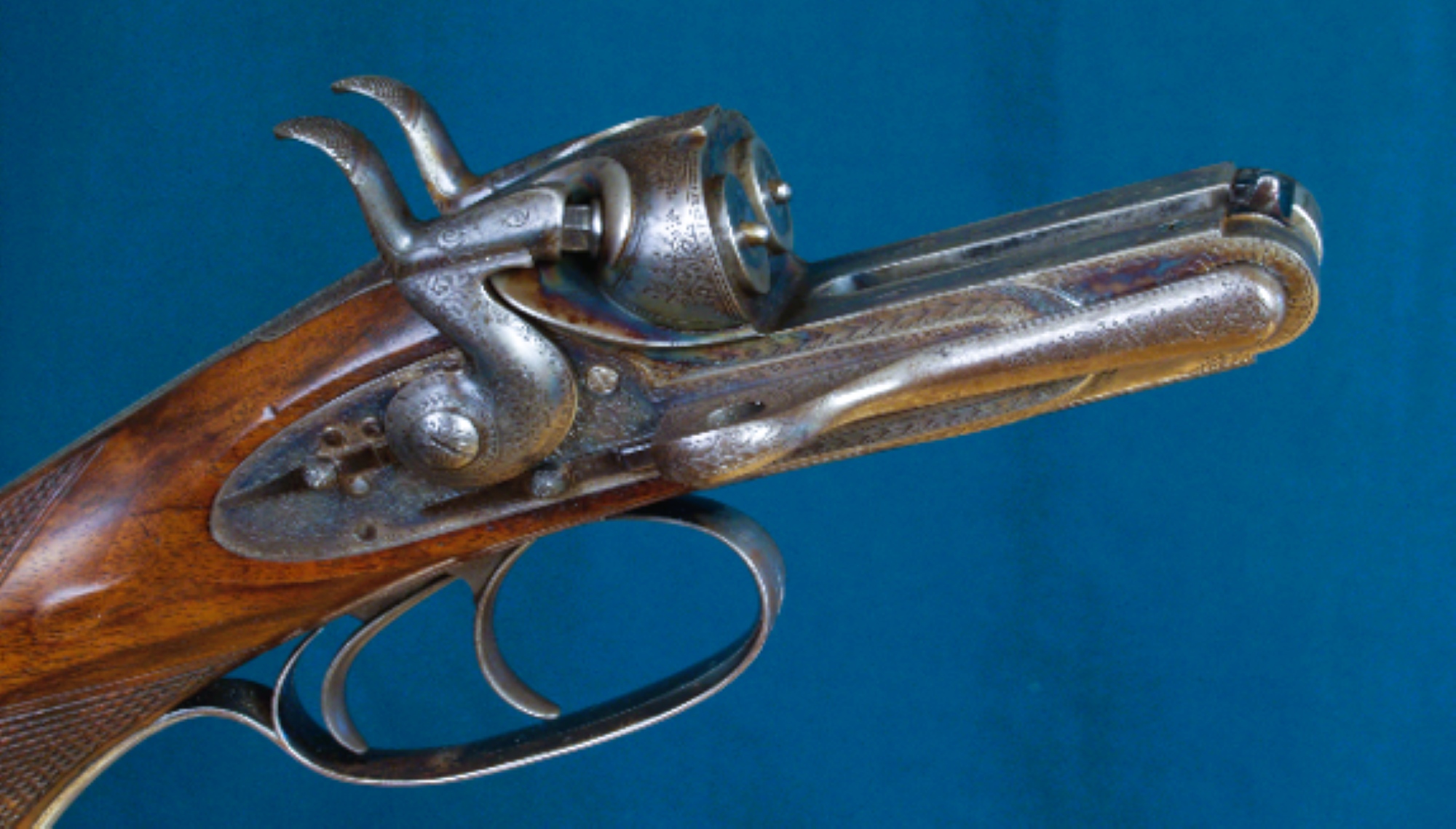
The Jones Lever over Guard - Robust locking for secure lock-up.
His philosophy was best summed up in the following statement: “I could not conceive that anything in this world had power to resist a determined will, so long as health and life remained. I determined to proceed alone, trusting in the guidance of a Devine Providence and the good fortune that sometimes attends a tenacity of purpose.” In preparation for his journey up the Nile, he spent a year exploring the Nile tributaries in Abyssinia as a learning experience for traveling in Africa, part of his goal was to become fluent in Arabic to be able to deal directly with the Arab ivory hunters and slave traders without the need of an interpreter. Their close companion, Johann Schmidt, a German hunter and carpenter on the Abyssinian expedition, died in Gondokoro at the start of the search for the origin of the Nile.
In addition Baker was a man of great physical strength, he once won a bet that he could, with a pack of deerhounds, run down a stag and kill it with a knife. From his writings you can sense his extreme self-confidence and courage. “I cannot agree with some writers in believing that personal strength is unnecessary to a traveler. In these savage countries it adds materially to the success of an expedition proved that it be combined with kindness of manner, justice, and unflinching determination. Nothing impresses savages so forcibly as the power to punish and reward.” Another example of his strength was his ability to shoot his Paradox one handed when holding on to the side of a howdah on the back of a fear-driven stampeding elephant.

Extended top tang - adding strength to the Stock.
In addition to all his other talent, he was what today you would call a “gun guy” and had very strong opinions on the firearms of the day. He based his opinions on the results of his extensive hunting experiences. He was a strong advocate of heavy rifles throwing a heavy bullet with a heavy powder charge. Writing in “Wild Beasts and Their Ways - Reminiscences of Europe, Asia, Africa, and America” in 1890 he discusses his philosophy on sporting rifles.
Baker writes “In 1840, I had already devoted much attention to this subject, and drew up a plan for an experimental rifle to burn a charge of powder so large that it appears preposterous to the professional opinions of the trade…the rifle was made by Gibbs of Bristol. The weight was 21 lbs., length of barrel 36 inches, weight of spherical belted bullet 3 ounces, of conical bullet 4 ounces, charge of powder 16 drams.” … An extraordinary success attended this rifle ….The powder charge was one-third the weight of the projectile, and not only a tremendous crushing power, but an extraordinary penetration was obtained, never equaled by any rifle that I have since possessed.” The ratio of bullet weight and powder foresaw the development of the Express rifle.
In Ceylon, in 1846 after experience hunting elephants and buffalo, Baker decided to order a battery of double barreled- rifles, No. 10 (bore), two-grooved, with 6 drams of fine grain powder and spherical-belted bullets. These were most satisfactory, and they became the starting-point for his future experiments. When the breech-loading express rifles and the Paradox came on the stage, he had the following advice: “For all animals above the size of a fallow deer and below that of buffalo I prefer the .577 solid Express - 648 grains solid bullet, - 6 drams powder… The weight of this rifle should be 11 ½ lbs, or not exceeding 12 lbs. For smaller game, from fallow deer downwards, I prefer the .400 Express with a charge of … 4 drams of powder – solid bullet. The important question of weight is much in favor of the .400, as great power and velocity are obtained by a weapon of only 8 ½ lbs. I should therefore limit my battery to one, .577, one .400 and one Paradox No. 12 (bore), for ordinary game in India, as elephants and other of the larger animals require a special outfit.
The Paradox, invented by Colonel Fosbery and manufactured by Messrs. Holland and Holland of Bond Street, is a most useful weapon, as it combines the shot-gun with a rifle that is wonderfully accurate within a range of 100 yards. It is a smooth-bore slightly choked, but severely rifle for only 1 ½ inch in length from the muzzle. This gives the spin to the projectile sufficient to ensure accuracy at the distance mentioned.

Excellent figured walnut - Traditional English oil finish.
The No. 12 Paradox weighs 8 ¼ lbs. and carries a bullet of 1 ¾ ounce with 4 ½ drams of powder. Although the powder charge is not sufficient to produce a high express velocity, the penetration and shock are most formidable, as the bullet is of hardened metal, and it retains its figure even after striking a tough hide and bones. The advantage of such a gun is obvious, as it enables a charge of buck-shot to be carried in the left barrel, while the right is loaded with a heavy bullet that is an admirable bone-smasher; it also supersedes the necessity of an extra gun (shotgun) for small game, as it shoots No.6 shot with equal pattern to the best cylinder-bored gun.” For Baker, the Paradox arrived late in his hunting career. When it first was introduced he was not keen on it for the type of shooting he did. The reason being that the Paradox in its normal configuration, with a 3-dram black powder load did not meet his requirements for a heavier hitting bullet.
However, in the years before the Paradox was developed in 1886, Baker was hunting in India from the back of elephants. While he normally shot a .577 express double rifle with hardened lead solid bullets, at times he was faced with an enraged tiger at close quarters and had developed a way to handle the situation: “It has already been remarked that a really staunch and tractable elephant is rarely met with. This renders tiger-shooting exceedingly uncertain, as it is impossible to shoot correctly with a rifle when an animal is flinging itself about to an extent that renders it necessary to hold fast by the howdah rail. I generally take an ordinary No.12 (12-bore) as an adjunct. If the grass is very high and dense, the tiger will seldom be farther than 20 yards distant, and a smooth-bore breechloader with a spherical ball will shoot sufficiently well to hit the palm of your hand. This accuracy may be obtained to 30 or 40 yards provided that the bullet is sufficiently large to enter the chamber, but a size too large for the muzzle. It will accordingly squeeze its way through without the slightest windage, and will shoot with great precision with a charge of 4 1/2-drams of powder and a ball of pure soft lead. A No. 12 is exceedingly powerful, and if 7 lbs. in weight, it can be fired with one hand like a pistol. This is an immense advantage, as the shooter can hold tight by the howdah rail with his left hand, while he uses his gun with the right. I always load the right barrel with ball, and the left with the same charge of powder (4 ½ drams), but with either 16 S.S.G. or 1 ½ ounce of A.A. or B.B. shot. … A smooth bore-gun is much easier to use than a rifle from a howdah, as it is unnecessary to squint along the sight, but the shot is taken at once with the rapidity usual in ordinary shooting at flying objects. Care must be taken, when firing only one hand that the wrist should be turned to the left, so that the hammers of the gun are lying over in that direction instead f being erect. In that position the elbow is raised upon the right and the recoil of the gun will not throw it up toward the shooter’s face, which might happen should the gun be held with the hammers uppermost; it is also much easier to hold a gun with one hand in the attitude described. Should a tiger spring upon an elephant, it would be exceedingly difficult to defend the animal unless by shooting with one hand, as the struggles of the elephant would render it impossible to stand.”
It is natural to think that with this experience it was a natural progression to the concept of the 4 ½-dram heavy load Paradox. In July 1887 he placed an order for a back action hammer 12-bore Paradox (No.11664). The normal 12-bore Paradox load at the time was 3 drams of powder and his was built for 4 ½-drams. The result was a heavier gun that weighted 8 1/4 pounds which was ¾ of a pound more than a standard 3-dram Paradox at nominally 7 ½ pounds. It was a Jones-style swing under lever. It had a long top strap, low hammers and Deeley snap fore-end. The gun was "finished and engraved" at a cost of £1 for this extra.

Best Quality locks, with well shaped bridles and serial numbered to the gun.
The dimensions of the gun were: Pull: 14 1/4 inches, Drop: 1 5/8 inches at the comb and 2 3/16 inches at the heel, Cast off: 1/16-1/8 inches. It is interesting to note that the records state the load of 4 1/2 dram with solid ball. This reflected his preference for a solid ball. In his writings he continually states his aversion to hollow point express bullets as they were likely to break up when hitting bone with little effect.
In a letter to "The Field" in the June 16, 1889 issue he states:
“Sir - About 18 months (actually 3 years) ago a gun, named the "Paradox" by the inventor, Col. Fosbery, was introduced by Messrs. Holland and Holland, gunmakers of 98, New Bond Street, as a weapon that combined the accuracy of an express rifle at the range of 100 yards with the power of shooting shot equal to that of an ordinary cylinder-bored gun. It was asserted that this combination was so perfect that the hybrid weapon would serve two purposes, which would render it most serviceable for India and the Colonies, as a rifle, or as a shot gun, or of both when required, as a bullet might be used in one barrel while the other might be loaded with either buckshot or some smaller size.
At first sight this appeared to be a most important arrangement as the gun did not exceed 7 lb. in weight, and it was as handy as any ordinary gun that we use in British sports. The precision at 50 yards and at 100 yards was extraordinary; and the pattern and penetration of shot at 40 yards was highly satisfactory. In spite of these advantages, I did not adopt the gun. The charge of powder was only 3-drams, which would give a very low velocity and inferior penetration; it would therefore be unsuited for dangerous or heavy game. I accordingly deferred the purchase of the Paradox until further development should have increased its power, at the same time that the extreme accuracy should be persevered with a heavy charge of powder. The experiment succeeded by adding only 1 1/4 lb. to the weight of the gun bringing it to 8 1/4 pounds to the weight of the gun, with a charge of 4 1/2 drams of No. 6 powder, and a hardened solid bullet of 1 3/4 oz.
I took this gun to India last November (1888) for a winter's shooting, and was highly satisfied with the result. The accuracy is perfect at short ranges up to 100 yards, and very good at 130 yards. The penetration is good, as may be inferred by the fact of the bullet passing through the shoulder of a full grown bear, and breaking the shoulder of another bear that happened to be some paces upon the other side. It quickly became my favourite weapon. At the same time, I am of the opinion that the same handy gun of 8 1/4 lb. would burn 5 drs. of powder instead of 4 1/2 drs., and would of course increase velocity and penetration. The bullet should decidedly be solid for heavy game ranging in size from tigers to Sambur deer; but although the shoulder shot would be effective at larger game I should never recommend so small a charge as 5 drs of powder for buffaloes, rhinoceros, or elephants.
I consider the Paradox No. 12, with 4 1/2 drs. of powder, to be the most perfect weapon for Indian shooting from a howdah, as the weight is so small as to permit of its being fired with only one hand in case of necessity, should the elephant swing round and render it necessary to grip the howdah rail, with the left hand at the home charge of a tiger. It is also most useful for howdah shooting, as the left hand barrel can be loaded with buckshot S.G., while the right barrel is loaded with ball cartridge. For all other purposes in jungle shooting I prefer the Paradox, although upon the open plains, where long ranges are frequently indulged in, the rifle of .400 or .450 would, of course be superior for small game, and the .577 for larger animals. There can be no doubt that, should special "Paradox" be required, the same principle would ensure good shooting with far heavier charges of powder, by increasing the weight of the gun.
I trust you will excuse me for trespassing upon columns; but when a new invention is offered to the public, the results of practical trials may be of service.
SAM. W. BAKER
The Paradox was part of Baker's hunting battery for 6 years. To avoid the cold of England he wintered in India in 1888 to 1891 and in India and Egypt in 1892/93. Over this period, as we have seen, he became a strong proponent of the Paradox. In "Wild Beasts and Their Ways" published in 1890, he states: "I should limit my battery to one .577, one .400 and one Paradox No. 12 for ordinary game in India..... The Paradox ... is a most useful weapon, as it combines the shot-gun with a rifle that is wonderfully accurate within a range of 100 yards. The No. 12 Paradox (he is speaking of his specially made gun) weighs 8 1/4 lbs. and carries a bullet of 1 3/4 oz. (765 grains) with 4 1/2 drams of powder. Although the powder charge is not sufficient to produce a high express velocity, the penetration and shock are most formidable, as the bullet is of hardened metal and it retains its figure even after striking a tough hide and bones. The advantage of such a gun is obvious, as it enables a charge of buckshot to be carried in the left barrel while the right is loaded with a heavy bullet that is an admirable bone-smasher; it also supersedes the necessity of an extra gun for small game, as it shoots No. 6 shot with equal pattern to the best cylinder bored gun."
He mentions using the Paradox on antelope briefly. In speaking about the four horned antelope he says: "They dash off at full speed, and from the howdah they are difficult to hit with a rifle. A Paradox gun with one barrel loaded with ball, while the other contains a charge of buckshot is an excellent weapon where small deer are objects of the day's sport".
In the book he references shooting sloth bears (Ursus labiatus) in India. In one encounter in India, while searching for a tiger: “We had advanced for about half an hour through the gloomy forest, and were within about ¾ of mile in a direct line of the tents, when I observed a peculiarly dark shadow upon my right, about 35 yards distant, close to a dense mass of feathery bamboos. I stopped the elephant for an instant, and at the same moment the black mass moved away towards the thick cover of the foliage. Guessing the position of the shoulder, I took a quick shot with the Paradox gun; the elephant, most fortunately, not having observed the animal. The effect was most extraordinary; I never heard such a noise; there was a combination of roars and howls, as though a dozen tigers and lions were engaged in a Salvation Army chorus. Away went Hurri Ram (the elephant) rendering it impossible for me to fire, as a large bear came straight at us, charging from the deep gloom of a bamboo clump, and growling, as it ran with the speed of a dog, direct at the elephant.
I thought we must be knocked to pieces; two or three small trees fortunately gave way before the terrified rush of Hurri Ram, but the power of the driving–hook was gone; although the mahout alternately drove the spike deep into his skull and hooked the sharp crook into the tender bas of the ears. The elephant crashed alone, threatening us with destruction, as he swept through bamboos, and appear determined to run for miles.

Sir Samuel White Baker with "Hurri Ram" this was a favoured Elephant used during hunting by Sir Samuel
I had been accustomed to feed this animal daily with all kinds of nice delicacies beloved by elephants, and at such times I always spoke to him in a peculiar phraseology. Although I was in the worst possible humor, and considerably anxious regarding our safety, when rushing through forest at 15 miles an hour, I addressed Hurri Ram in most endearing terms – ‘Poor old fellow, poor old Hurri Ram, where are the sugar-canes? Where are the chupatties, poor old boy?” etc. etc. I believe thoroughly that the well –known tones of my voice restored his confidence far more than the torture of the driving –hook, and after a race of about 150 yards he stopped. “Now turn him round, give him the point sharp, and drive him straight for the bear.” The mahout obeyed the order, and we soon approached the spot, where the roars and howls still continued. My men were up the trees; the shikari had thrown a mighty spear upon the ground, and had gone up the branches like a squirrel, as he did not see the fun of meeting the bear’s charge. Before we had time to examine the actual condition of affairs, the big bear suddenly dashed out again straight at the elephant, and once more in a disgraceful panic he took to flight, without the possibility, on my part, of taking a shot, when the bear thus daringly exposed itself. Again I had to comfort Hurri Ram, and by degrees we stopped his mad career, and once more returned to the scene of his discomfiture. There was a slight depression in an open hollow, where high grass in swampy ground intervened between two sections of the forest. As we advanced, the elephant being severely punished by the driving-hook and scolded by the mahout, the bear suddenly uprose from the high grass, and standing upon its hind legs, it faced up at about 40 yards’ distance, affording a magnificent chance for a deadly shot. Away went Hurri Ram again, whisking round before I had a moment to fire; and after two successive chances of this kind, the bear escaped into the opposite jungle, and we searched for it in vain.
We now returned, and with some difficulty drove Hurri Ram to the scene of the conflict. There was a bear lying dead. The howls and roars had ceased and a few yards to the left of the dead bear was a large black mass: this was another bear, in the last gasp. Both had been knocked over by only one bullet for the Paradox.
Although I had only seen one bear, and that most indistinctly, it appeared that the bullet, being intensely hard, and propelled by 4 ½ drams of powder, had gone completely through the shoulder of the original bear, and then struck an unseen companion, who must have been some yards distant upon lower ground beyond. The bullet had broken the shoulder of this unlucky friend, and was sticking in its lungs, having carried a bundle of coarse black hair from bear No.1 and deposited it upon its course in bear No. 2.
Although these were full-grown bears, there can be little doubt that the bear that had so determinedly attacked the elephant was the mother, infuriated by the roars and howls of her dying offspring. The penetration of the Paradox bullet was highly satisfactory, but I was terribly disgusted with Hurri Ram, whose misconduct had caused the loss of bear No 3, which would most certainly have been included in the list of killed had I had the chance of only one second’s quiet.”
This is the last known reference to his Paradox. After his death in December 1894, his Paradox disappears from view. However from the proof marks, we can tell part of this guns' history.
The first set of proof marks is: a London Black Powder Provisional and Definitive Proof, Chamber Size, Rifled Choke (instituted in1887), and minimum bore size. In this case it is 14 bore instead of 12 since the diameter of the rifled choke is measured as the minimum size.

Proof Marks for Cordite & Nitro
The second set of proof marks are London post-1904: a Nitro Proof, Nitro Proof for shotguns shells (Nitro Proof 1 1/8,] , a Nitro Proof for the maximum service charge for the Paradox cartridge (Cordite 28 – 750 Bullet Max). These proofs would indicate that the gun was passed on to someone who used it or planned to use it with Nitro cartridges after 1904. The Cordite load of 28 grains was equal to the 3-dram Black Powder load not the 4½-dram load.
The third set of proof marks are for when the gun was reproved after being sleeved in Birmingham. Birmingham date code of SB (1967), the bore diameter (.729), Birmingham Nitro Proof, the post 1925 reproof mark and the post 1954 maximum pressure (3 ton per sq inch). Yes, you read that correctly, unfortunately the gun had been sleeved and is now a heavy wildfowling or pigeon gun.
The gun finally surfaced in 2004 when it appeared in Holts March 10th 2004 catalog. It was advertised by Holts as:
HOLLAND & HOLLAND 12-BORE ‘PARADOX’ ROTARY UNDERLEVER HAMMERGUN
Serial no. 11664, 28in. sleeved nitro barrels (by the maker’s in 1967) no longer retaining Paradox rifling, 2 ½ in, chambers, bored approx. imp cyl and full choke, Jones patent rotary underlever, percussion fences, rebounding back-action locks, elongated top–strap, best bouquet and scroll engraving, retaining traces of original colour-hardening, 14 ½ in. well –figured stock including ½ in. ebonite extension, weight 7lb. 11 oz. The maker’s have kindly confirmed the gun/rifle was completed in 1887.
BUT NO MENTION OF THE PROVENANCE !
The present owner, David Neale, purchased the gun along with some others in the sale for a very nominal sum. It seemed that the gun created no interest in the saleroom from the gun trade, collectors or general buyers all giving it a wide berth. It was seen as just another old and heavy hammer gun with a great name, until now.
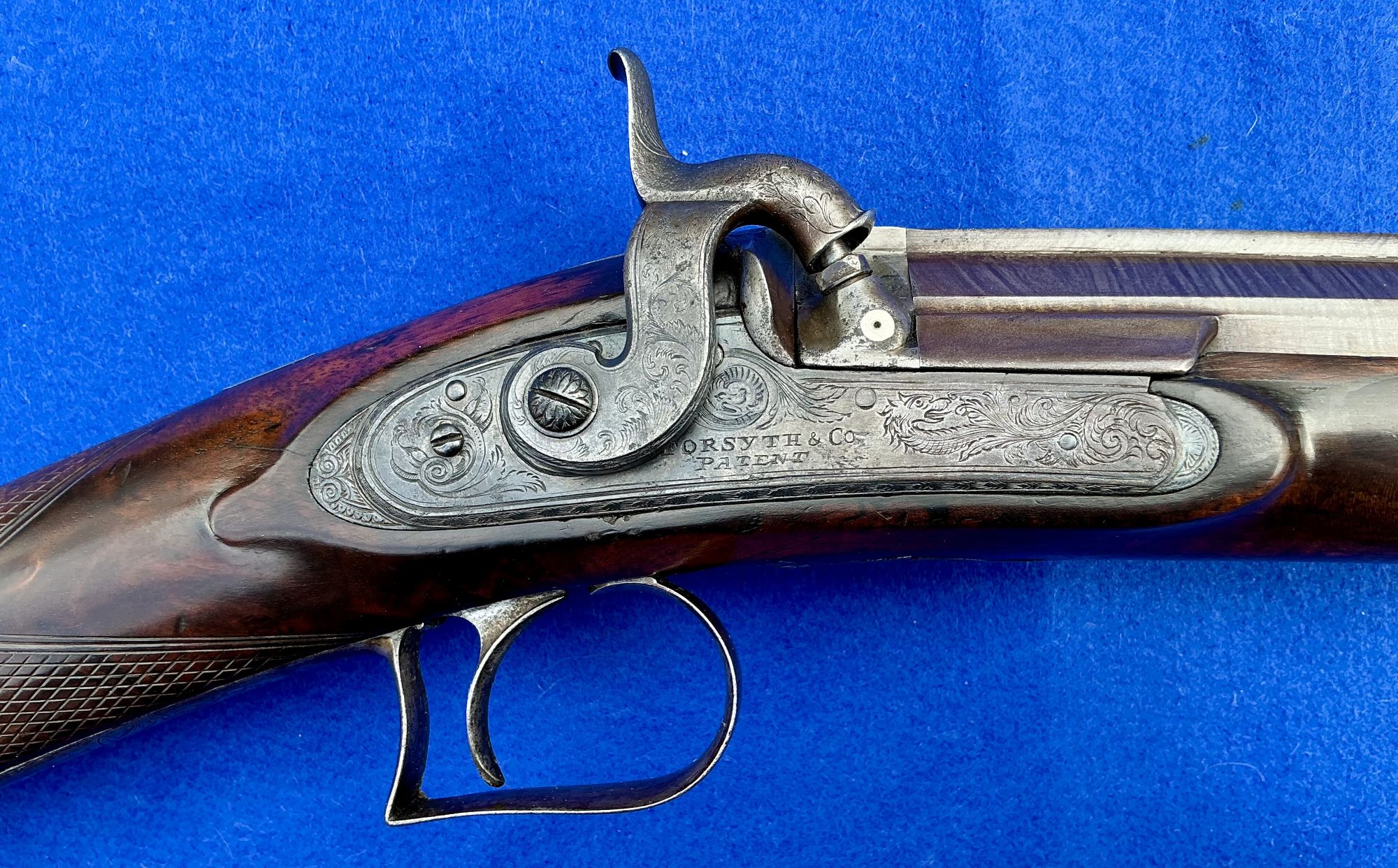
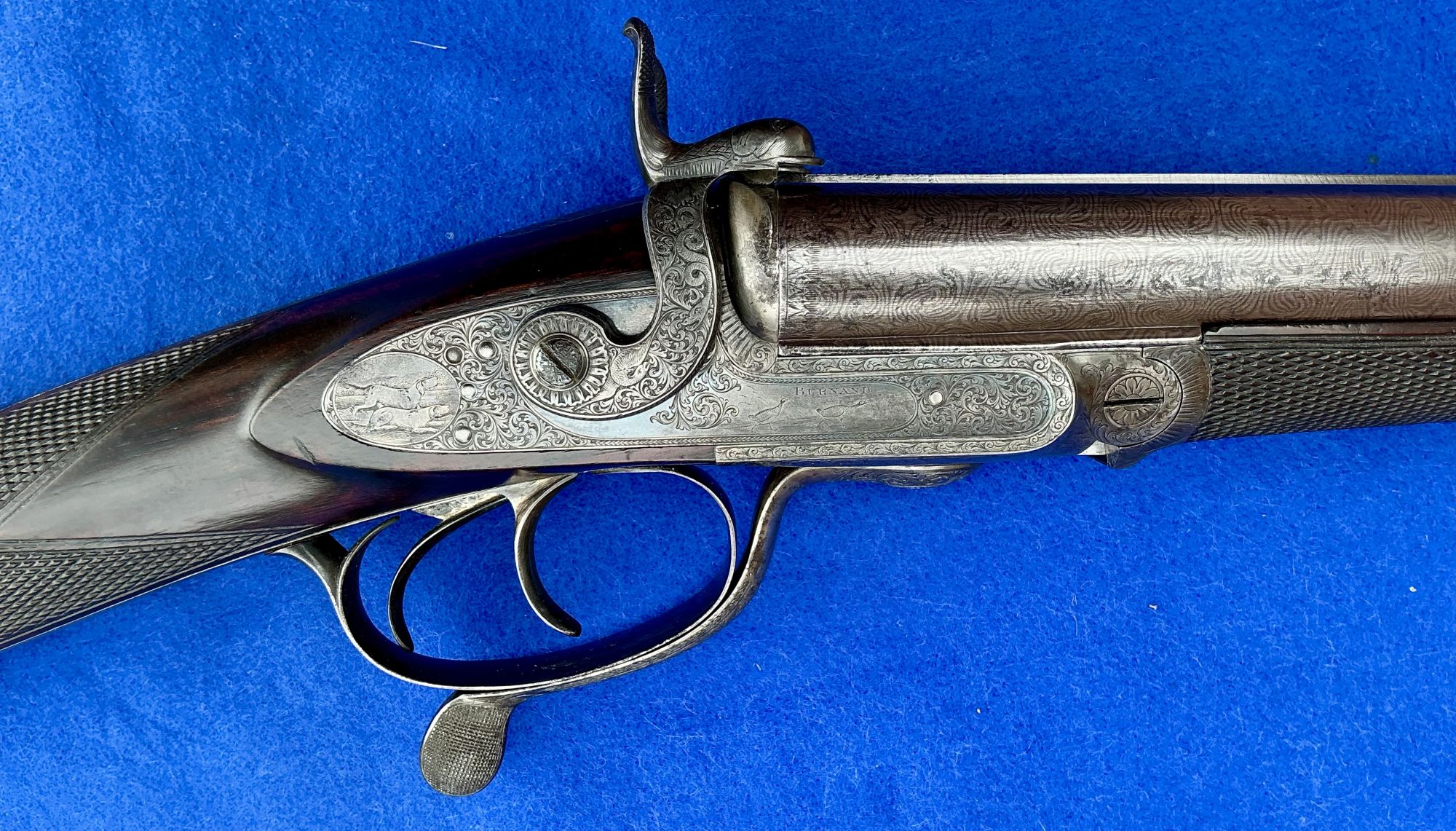
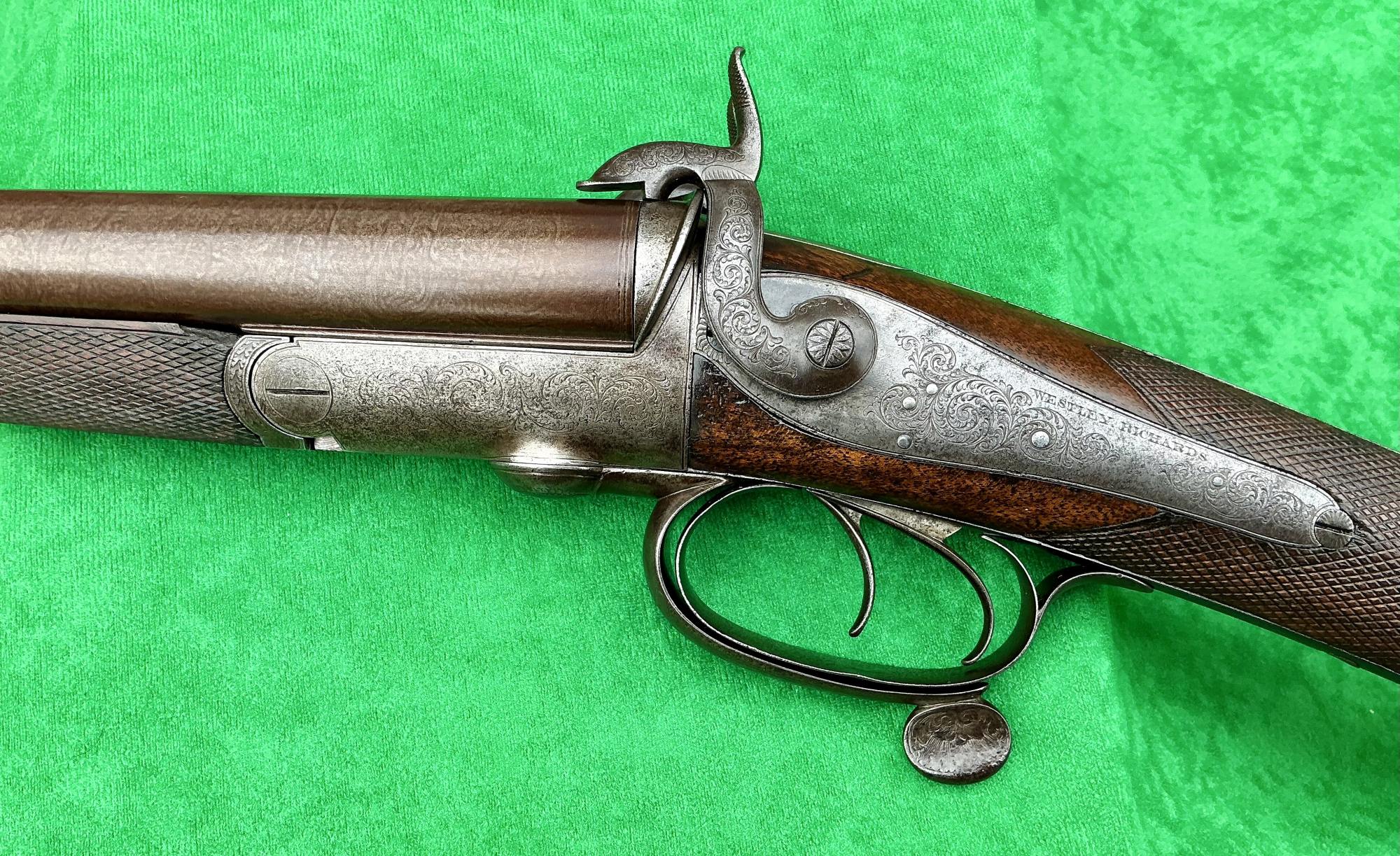
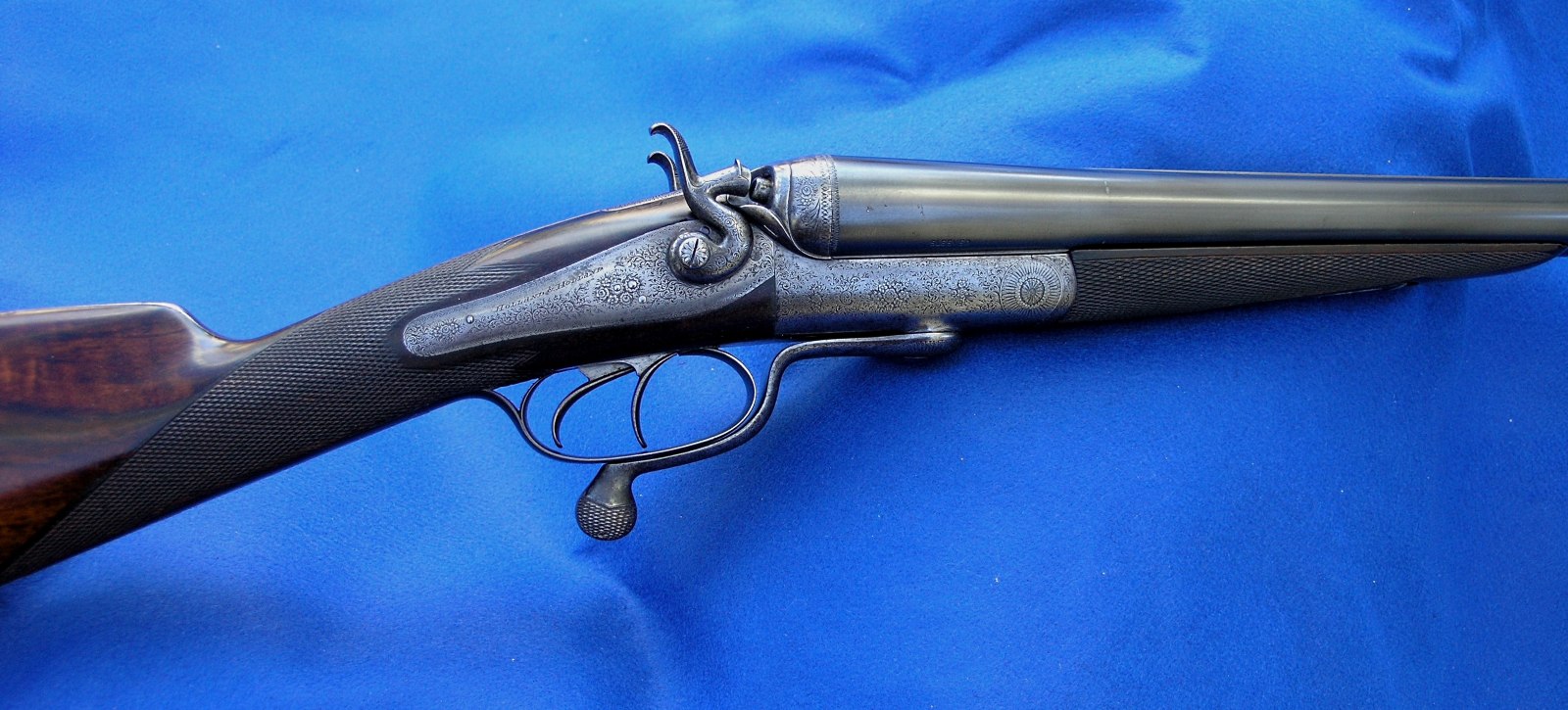
Details on Paradox No. 11664. The gun is built on an overly large Jones’ patent side-swing underlever. Holland and Holland called this design the “Lever over guard” or LOG. It has percussion fences, which were common at the time. It is fitted with back action locks by Joseph Brazier. The fore-end is fitted with a Deeley – Edge release. The back action locks are by Joseph Brazier. The action has a long top strap as fitting the nature of the gun, which provides a strong connection between the stock and action. The gun is fitted with finely checkered, well-figured, walnut straight grip stock. The metal work is engraved as fitting a “best gun” since Baker was charged an additional 1 pound for engraving and finishing. From the photographs it can be seen that it is the fine “Rose and Scroll” pattern. The butt plate tells its own story of age and time gone by. The top of the comb shows the remainder of the widows’ peak from its original metal in-let butt plate, and then we have an extension of compressed horn, the gun’s second butt-plate. Finally the gun has been lengthened in a vulcanite material to 15 inches LOP (length of pull) from the original 14 3/8 inches
The dimensions of the gun are as follows and are compared with two other Paradox:
|
|
No. 11664Baker’s Gun |
No. 11798C-grade hammer |
No. 15002B-grade hammer |
Breech facewidth (inches) |
2.430 |
2.374 |
2.321 |
Action flats(water table)width (inches) |
1.680 |
1.620 |
1.474 |
Barrel thickness at chamber (inches) |
0.25 |
0.196 |
0.180 |
Stock at wrist (circumference) |
4 ¼ inches |
4 1/8 inches |
4 3/8 inches |
Weight |
8 lbs 4 oz. as a Paradox |
7 lbs 8 oz. |
7 lbs 4 oz |
Weight of Barrels |
4 lbs 3½ oz. as a Paradox |
3 lbs 11 oz. |
3 lbs 12 oz. |
Difference from11664 |
|
8 ½ oz. lighter |
7 ½ oz. lighter |
Weight of Stock and Action |
4 lbs ½ oz. |
3 lbs 10 oz. |
3 lbs 4 oz. |
Difference from11664 |
|
6 ½ ounces |
12 ½ ounces |
No. 11664 Other dimensions are:
Stock length - 15 inches
Stock bend – 1 3/8 inches at comb and 2 1/16 at the heel.
Stock cast – Cast off: 1/8 and 3/16 a bit more cast was put into the stock.
Weight of gun – 8 pounds ½ ounce
The sleeved barrels dimensions are:
28 inch barrels
2 ½ inch chambers
Chokes: 0.011 and 0.033 inches (¼ and ¾)
The “Heavy Load” Paradox - The 4 ½ dram Paradox with the publicity from Samuel Baker opened a new market for Holland and Holland, that of the “Heavy Load” Paradox. These guns were more for the pursuit of dangerous game and less used for bird shooting. These guns were an “under the table” product and did not appear in Holland and Holland’s advertising of the time. The reason being since Holland and Holland was heavily advertising the 3-dram Paradox as a “balanced gun” for “Snipe to Tiger”, by advertising a heavier load 12-bore gun it would bring into question the suitability of the 3-dram gun for large game and effect the sales which would not be offset by the sales of the heavier load guns.
In the records Holland & Holland never referred to the heavy load gun by any name, they were either identified by the powder charge or the weight. The information is spotty. As we have seen, the first recorded heavy load 4 1/2-dram Paradox is #11664 made for Sir Samuel Baker. As best as can be determined from the records, twenty-one 12-bore Paradoxes were recorded as having a weight in excess of 8 pounds. The breakdown by action type is:
Five -Hammer – Jones’ Patent side swing under lever
Four - Hammer – Top Lever
Two - Hammer ejector
Six - Royal Hammerless
Three - Number 3
One - Unknown model
Interior Ballistics
From this chart, comparing the various black powder loads for the 12 bore Paradox with a 735-grain bullet, we can see that the pressure for a 4 ½-dram load at one inch is 2.44 times as great as the pressure for a 3-dram load. No wonder the barrels were as thick and as heavy as they were. In addition the muzzle energy of the bullet was 1.6 times greater than the 3-dram load.
Powder(Drams) |
Velocity(Feet per second) |
Pressure @ 1 inch(Tons per sq. inch) |
Pressure @ 2 1/2 inches(Tons per sq. inch) |
3 |
970 |
1.67 |
1.69 |
4 |
1157 |
3.45 |
3.11 |
4 1/2 |
1233 |
4.07 |
3.74 |
5 |
1301 |
4.73 |
4.45 |